

Most of us don’t have hours to devote to working out, so when there’s an exercise that can strengthen multiple muscle groups at the same time, I’m quick to use with my personal training clients.
Quadruped rainbows are one such exercise. This no-equipment move targets the glutes, hamstrings, hips, deep core, and even the shoulder stabilizing muscles, making it a great option when time is limited. The standard version is appropriate for beginners, but there are plenty of ways to up the challenge level if you’re more advanced.
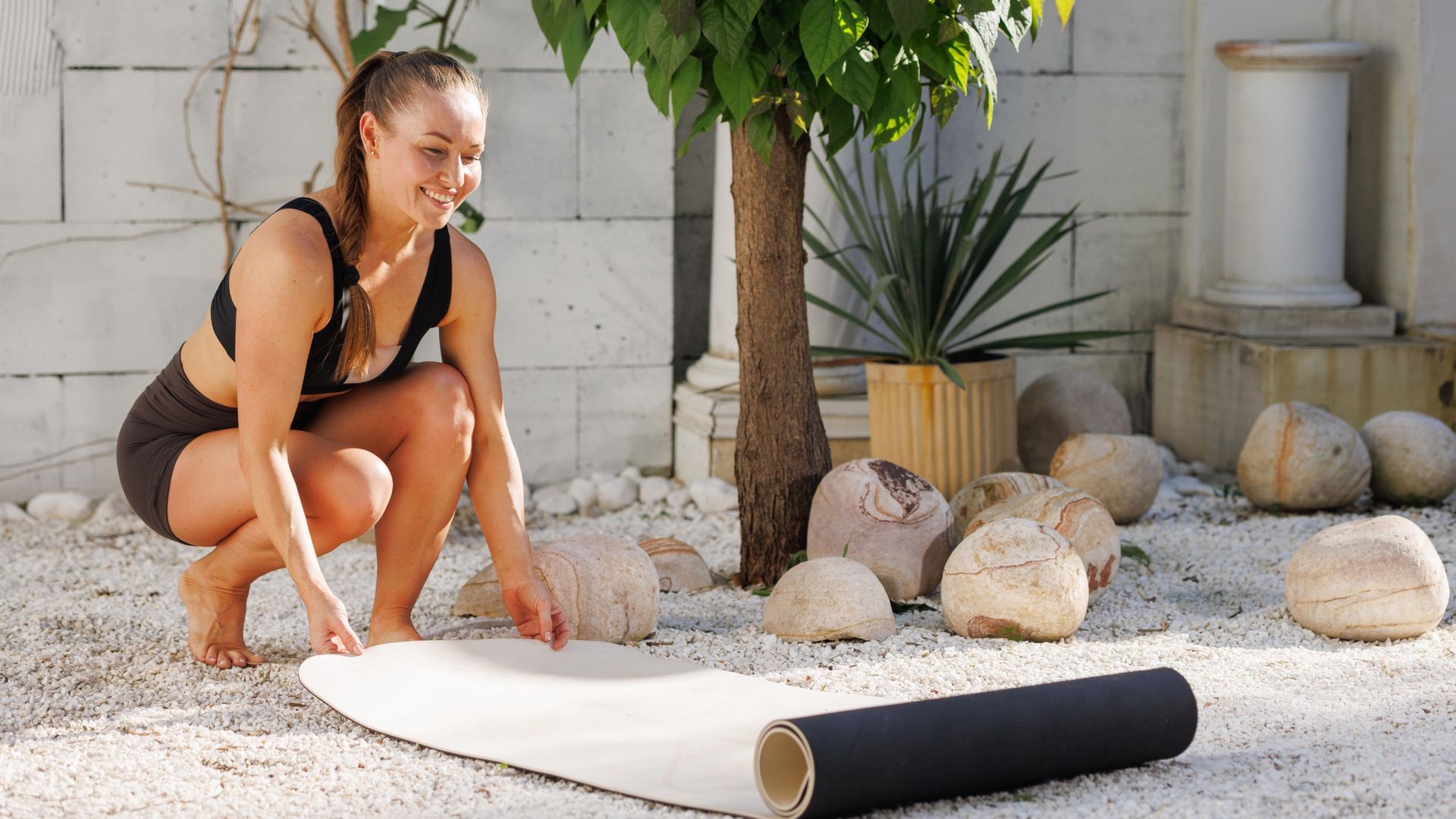
Roll out your yoga mat and give quadruped rainbows a try during your next workout.
How to do quadruped rainbows
Before trying any new exercise, be sure to check in with your doctor first. They may recommend avoiding certain movements based on your health background.
Beginners should consider working with a certified personal trainer to learn how to do quadruped rainbows properly. A trainer can also provide modifications if needed and progression options when you’re ready. Doing any exercise with poor form can lead to pain or injury.
Aside from a yoga mat, those with sore knees may want to use a pillow or a rolled-up towel for additional cushioning.
Start with one set of 10 reps on each side. Gradually increase your reps to 12 on each side and add an additional set. Eventually, you’ll aim for 3 sets of 15 reps on each side.
Do quadruped rainbows 2-3 times a week at first, then work your way up to 3-4 times per week. The exercise can be done on its own, as a part of another workout, or as a warm-up for more intense exercise.
You should feel muscle fatigue but never sharp pain when doing this exercise. Stop the exercise and consult your physician if you feel sharp pain at any point.
Here’s how to do quadruped rainbows:
- Come to all fours on a yoga mat.
- Engage your core muscles.
- Extend your left leg and touch your toe to the mat.
- Lift your left leg in a semi-circular motion and touch your toe to your left side.
- Lift your left leg in a semi-circular motion and touch your toe behind you.
- Continue for 10-15 reps, then repeat on the right side.
Benefits of quadruped rainbows
This exercise works the glutes, hip abductors, hip adductors, hamstrings, deep core muscles like the rectus abdominis and internal obliques, and rotator cuff muscles.
The arc-like movement of the leg promotes optimal hip mobility and range of motion. In the quadruped position, your deep core works to stabilize your entire body as the active leg moves into each position.
Additionally, quadruped rainbows don’t require any equipment and are accessible for a wide range of fitness levels and abilities.
Modifications for quadruped rainbows
If you’ve just started to work out regularly, you may find it difficult to keep proper form during this exercise. The biggest form compensations I see are rotating the hips side to side as you move the leg back and forth, excessive arching in the lower back, and sinking the chest towards the floor.
If you notice any of these compensations, it may indicate some deep core weakness. In addition to including exercises like diaphragmatic breathing, planks, and hollow holds in your routine, you may also want to modify the quadruped rainbow.
Instead of sweeping your leg to the side in a semi-circular motion, try simply lifting the active leg. Aim to bring the knee and ankle in line with the hips. Hold briefly, and then lower the toe back towards the floor.
You can also practice donkey kicks in preparation for the standard quadruped rainbow. Keep the active leg bent at a 90-degree angle, then kick the heel towards the ceiling. Pause briefly, then lower the active leg back to the starting position.
Progressions for quadruped rainbows
As you get stronger and more conditioned, quadruped rainbows may not challenge you like it did at first. The easiest way to increase the challenge is to add reps and sets.
That being said, sometimes doing more than 15 reps of an exercise can get rather monotonous. Wearing ankle weights is another easy way to up the ante, as is performing the exercise on an unstable surface like a balance pad or Bosu ball. Just be sure your form stays solid throughout the exercise.
- I teach people how to be more mobile: 3 low-impact back and shoulder moves that build stability and strength after 40
- According to a personal trainer, this exercise is 100 times more effective than crunches. I tried it and was humbled
- I teach people over 50 to be mobile: 3 low-impact moves that build more stability than a 30-minute walk
