

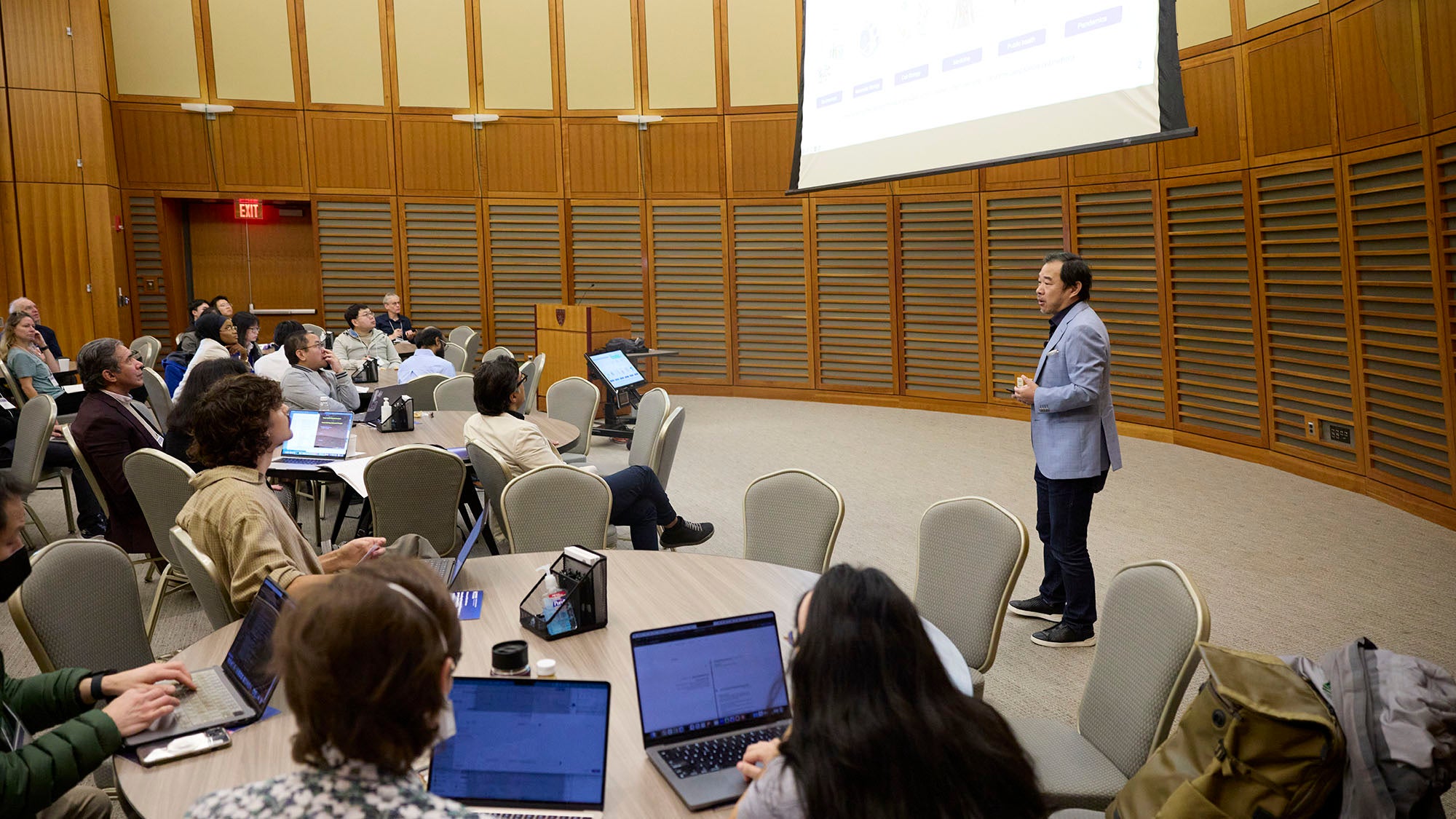
Using genomics, AI to predict, prevent, and treat disease
What is the best way to combine various types of health data—genomic, molecular, clinical, and lifestyle—into a single unified view of a patient so that clinicians, with the help of artificial intelligence, can spot complex patterns, predict disease risks, and tailor treatments?
That was the focus of this year’s Program in Quantitative Genomics conference, hosted Oct. 29-30 by Harvard T.H. Chan School of Public Health. The conference, organized by Xihong Lin, professor of biostatistics and coordinator of the Program in Quantitative Genomics, featured about 15 leading experts from the domains of genomics and clinical research, and drew 130 participants to Harvard Medical School’s Joseph B. Martin Conference Center.
From cellular study to patient treatments
Eric Xing of Mohamed bin Zayed University of Artificial Intelligence and Carnegie Mellon’s School of Computer Science, one of the conference’s keynote speakers, spoke about the promise of using AI to generate a model of a “virtual cell”: a generative AI model of a cell that could move cell biology research from trial-and-error experiments in wet labs to systematic simulation in a digital lab. A virtual cell model is designed to simulate possibilities of how a cell, or a cell population within a particular tissue or organ, might behave under natural or artificial interventions.
Another keynoter, Sylvia Plevritis of Stanford University, discussed a new way to improve lung cancer outcomes—by combining multiscale modeling (detailed computer simulations of how biological systems work) with multimodal AI—which can integrate longitudinal clinical records with imaging, pathology, and molecular data. Together, she said, multiscale modeling and multimodal AI could link population evidence with individual tumor biology to uncover cancer vulnerabilities, and to inform when and how to intervene to improve patient outcomes.
Marinka Zitnik of Harvard Medical School, a third keynote speaker, talked about human-AI co-science—when AI works with scientists as a conversational research collaborator on tasks such as analyzing data, generating hypotheses, and designing tests to evaluate those hypotheses. Zitnik offered examples of AI agents already conducting such work, such as predicting immunotherapy outcomes across cancers and recommending the best treatment for rare diseases. She also described how AI agents can work as “AutoScientists”—working on their own in teams on long-running science experiments, self-organizing around emerging research directions, running experiments in parallel, and reorganizing their efforts when a particular research direction stagnates.
She cautioned that there are important factors to consider to ensure that AI agents’ work is accurate and effective, such as creating agents capable of open-ended discovery, providing them with the right data and biological contexts, and pairing AI with experiments in the lab.
Other speakers at the event touched on subjects such as how to tackle kidney disease using mapped genomic data about kidneys and AI models focused on biological and clinical data; how drug discovery can benefit from a shared digital infrastructure combining genomic, clinical, and pathological data; and how to ensure the trustworthiness and safety of AI systems that have the ability to reason over complex evidence, set plans, and take actions regarding scientific discovery and health applications.
About The Author
Related Topics
Last Updated
Featured in this article
Xihong Lin
Stay connected with Harvard Chan School
