

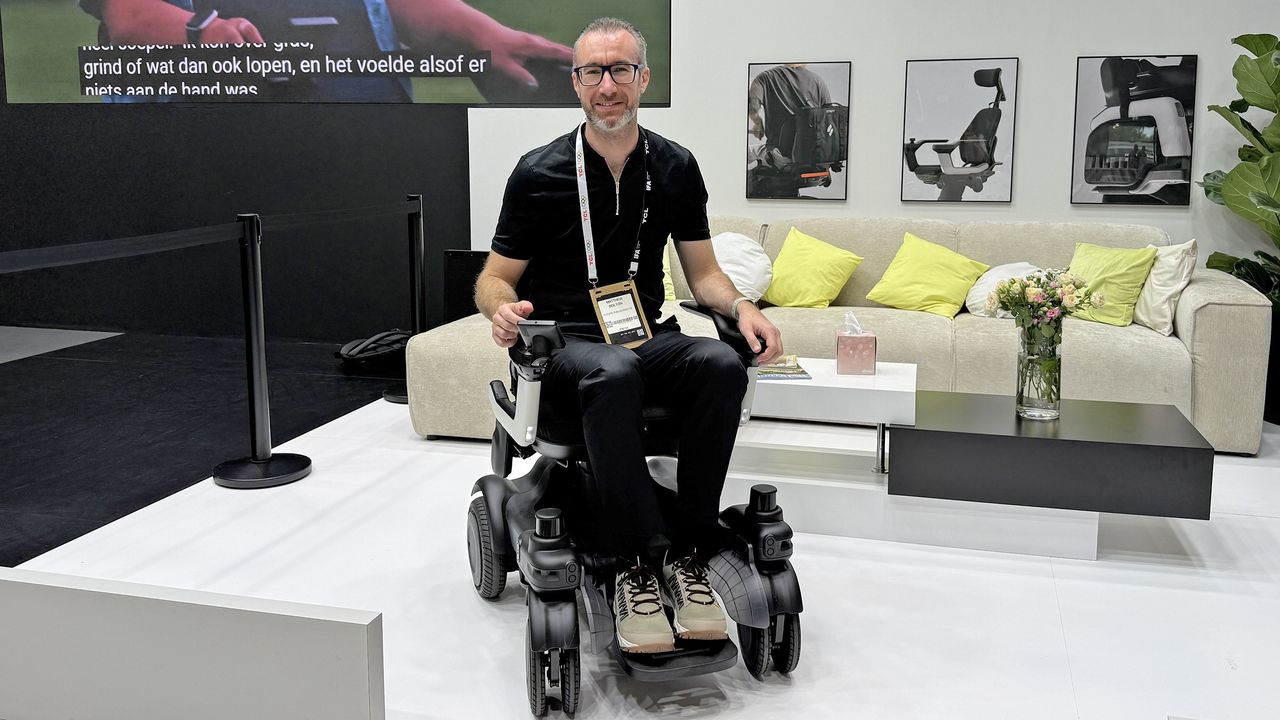
I saw a lot of fun things at IFA 2026, but among the many halls full of tech, one experience has stuck with me the most. It was the Strutt ev1c personal mobility vehicle, which basically mashes up tech from robot vacuumsand self-driving cars to create a wheelchair/mobility scooter that can take you from room-to-room in your home without you touching the controls.
Equipped with cameras and LiDAR to sense the world around it, the ev1c really has two key sets of interesting features that come from these sensors: being able to fully self-drive within a known and mapped environment; and being able to offer automatic measures for safer use when you’re out and under manual control.
Within the home, what it does at first is exactly what robovacs do: it takes a map of the whole area using LiDAR. The system is able to distinguish temporary, moving objects (people and pets) from static objects (walls and tables) — that’s obviously important for mapping, but also means you can see what it ‘sees’ at all times on a little touchscreen on the armrest.
Once the map is created, you can then choose different areas to set as “Waypoints”, basically giving you a menu of places you want it to self-drive you between. So you can use the touchscreen or the connected phone app to select a waypoint, and the chair just starts driving you, no controls necessary from there.
You can also trigger waypoints using voice, so you can tell the app “Take me to my bed” and as long as you have a waypoint called “my bed”, it’ll take you there.
This also means that if you’re someone who doesn’t need the vehicle all the time, though you may sometimes need it suddenly. You can use the app to have the ev1c bring itself to you, even if you’d left it on the other side of the house.
There’s another feature that the team is testing right now for people who only need the vehicle intermittently, which is a “Follow me” mode — so you can start walking, and the ev1c will just trundle along behind you. If you need it, there it is, ready to go.
I tried that out at Strutt’s booth, and while it was buggy at this stage, it did work — and would probably take some getting used to, because having something quietly following right behind you is pretty unnerving.
However, the self-driving side of the tech is ready to go, and when I tried that side out as well, I was truly impressed. The chair can be a little jerky when it’s turning around in a small space, but that’s really the only issue I could take from it, from my admittedly limited demo.
Starting at one end of the fake ‘living space’ in Strutt’s booth, it steered me around a dining table, through a narrow gap towards a doorway, through the doorway, and then up to the couch. It finished with me facing the couch, for convenience, and it didn’t touch a single thing along the way — no brushing a dining chair or clipping wheels against the door. I went across a rug as well as a hard floor, and that made no difference.
I also tried it in its more manual modes, with the ‘Co-Pilot’ feature switched on. This is the ‘smart’ system for when you’re driving it yourself, and the key thing it adds is object avoidance. The simplest benefit is that the system won’t let you crash into anything — Strutt’s team told me to drive towards them at full speed, so I did, and the vehicle just stopped as we got a few inches away. It wasn’t like slamming on the brakes — it just ramped down and left me stationary.
Other handy features for when you’re in manual control include a reversing camera (with a line of your steering trajectory) and a ‘cruise control’ mode so you can just set it to go in a straight line at a set speed, and you can relax your hand.
But there is also a ‘Co-Pilot+’ more advanced assistive mode, and the interesting feature the team showed me here was an alternative to the auto-stop, in which the system will look for space and actually steer around the blockage, rather than just braking when you get too close.
Perhaps more useful in the day-to-day use of the chair, is that this mode will just finesse your driving, so if you’re at risk of clipping the door in your home it’ll automatically adjust the steering to make sure it doesn’t happen — it’s like the steering assist in Mario Kart.
I tried the same demo of driving into someone, but this time the ev1c steered in an arc around them, then returned me to my original position on the path and carried on forward — but my hand had just stayed on pushing the controls forward the whole time, I didn’t contribute any motion to the steering.
As for the vehicle’s general specs, it’s capable of going up to 8mph, with a range of around 20 miles on its battery, depending on the terrain. It can handle grass and gravel, as well as inclines of up to 13° (23%) and two-inch curb heights, all powered by a four-wheel drive system.
The ev1c breaks down into five pieces for packing into car, and Strutt told me that it’s looking into offering a backup battery bag, so you can hot-swap when away from home if you want support for longer distances.
It’s officially priced at $7,499 / £5,995 / AU$9,999, though the actual price you pay might be affected by local schemes to make mobility vehicles more affordable.
It’s a lot of money, though I assumed it was going to be even more expensive than that. I’m not someone who uses a personal mobility vehicle, so all my opinions here need to be taken in that context, but I was really impressed with how the chair works in practice, how it’s been designed and built, and what it can do — it even picked up one of our ‘IFA 2026 Best in Show’ awards.
