


Tap or click here to get this newsletter delivered to your inbox.
Good morning and, as always, thanks for joining me.
Before we dive in today, I want to spend a little time on a project I worked on with my colleagues here at Newsweek: the AI Policy Scorecard. It looks at the public records of all 537 sitting members of Congress across regulation and governance, data centers and energy, jobs and the economy, safety and privacy and national security and China.
The premise behind it is fairly simple: AI has become a major political issue before either party has settled on what supporting or opposing it actually means. In the story I co-wrote about the project, we get into how that produced a map that often cuts across familiar party lines, with lawmakers who can look like boosters on one part of AI policy and skeptics on another.
With the midterms approaching, that makes this an important moment to establish a baseline. Congress will change, but the questions underneath the scorecard—who writes the rules, how AI affects workers and communities, how much influence the industry should have and how the U.S. competes globally—will remain well beyond Election Day in November.
One of those questions, what AI means for work, also runs through this week’s Signal Capture.
More on that below.
Signal Capture
Signals from the frontlines of AI adoption
Twilio Product Chief: AI Could Erode the Path to Engineering Expertise
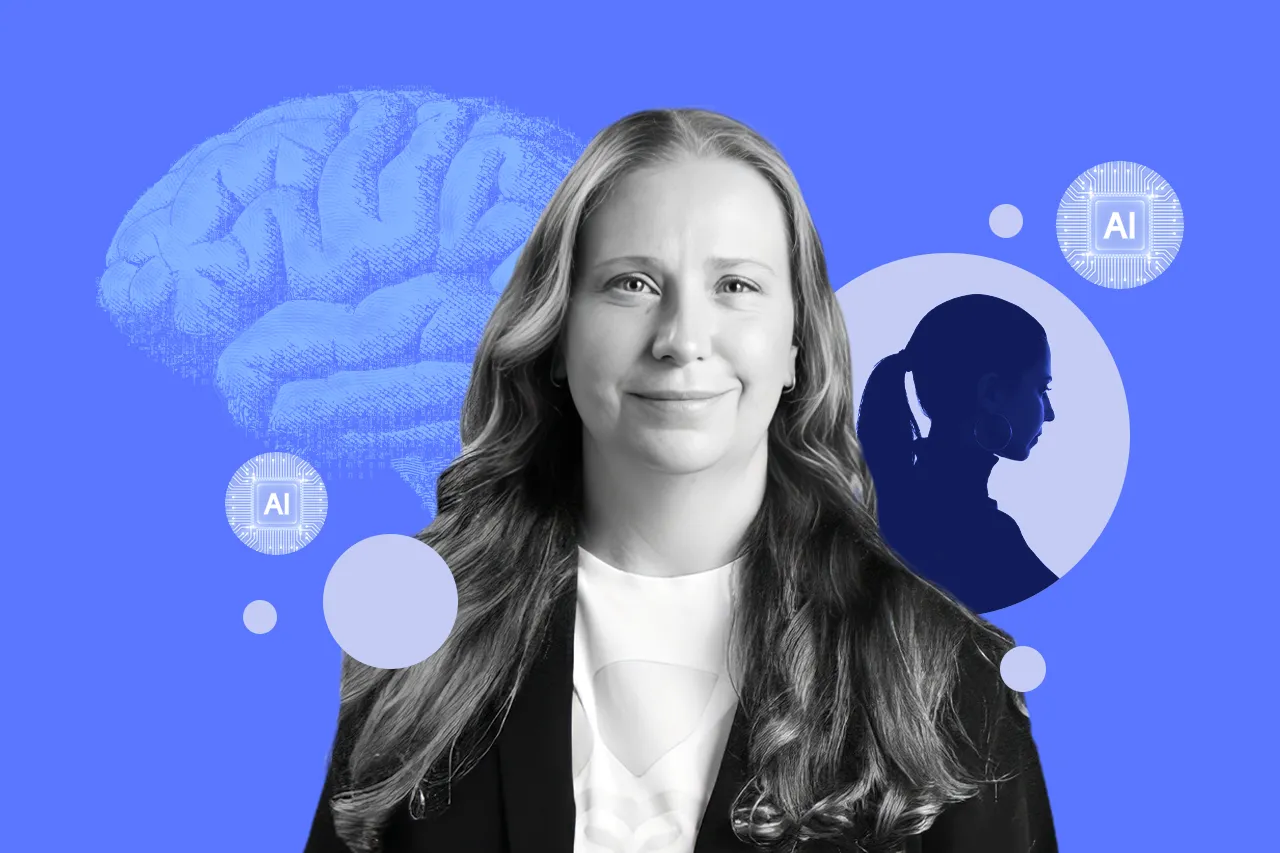
Artificial intelligence can increase how much code engineers ship while reducing some of the trial and error that has traditionally helped them develop technical instincts chief product and technology officer, and head of R&D, at cloud communications company Twilio
“When AI absorbs entry-level execution, we run the risk of sawing off the bottom rungs of the career ladder, triggering an apprenticeship collapse,” Shani told Newsweek.
Historically, building complex software required engineers to think through system architecture, edge cases and how connected components interacted.
“Today, AI allows people to do the doing without necessarily doing the thinking,” she said. “That is a massive shift.”
As AI handles more of the initial coding work, engineers increasingly need to understand how an entire system fits together, from the infrastructure supporting an application to the experience it ultimately delivers to customers.
The training problem is particularly acute early in a career, when repetitive work, failed attempts and debugging have traditionally helped engineers learn how software behaves. Her answer is to put more emphasis on systems engineering and design during onboarding.
“Early-stage engineers need space to run micro-experiments and fail forward under senior guidance, building the structured feedback loops required to develop cognitive muscle rather than simply delegating their thinking to automated code generation,” she said.
Shani pointed to debugging as a particularly important part of how engineers build technical understanding.
“We cannot afford to automate away the tedious debug cycles because debugging is where an engineer builds their mental map of how the system functions under load,” she said.
AI also changes where expertise has to sit inside an engineering organization. Shani contrasted that with previous waves of automation, which tended to concentrate specialized knowledge: compilers reduced the need for most programmers to work directly in assembly language, while cloud computing moved more infrastructure expertise into specialized teams.
“AI breaks this concentration pattern because it abstracts execution without abstracting correctness,” Shani said.
The expertise required to check AI-generated work cannot sit only in a specialist group. Teams using the technology need enough expertise close to the work to determine whether an output will work reliably in production, including when real customers and money are involved.
“Someone who only relies on the tool will implement plausible-looking but subtly flawed code, confidently,” she said.
Shani also questioned the metrics used to judge whether AI is improving engineering performance.
“R&D leaders must stop measuring adoption rates and seat counts—these are vanity metrics,” Shani said. “Instead, we must measure judgment.”
Leaders can look at whether engineers are able to explain why a particular architecture or AI-generated output is correct, along with how often teams have to go back and fix work after it is produced. Higher output means less if teams spend the additional time correcting hidden bugs or rolling back work that should not have reached production.
Shani offered a simple example: if a team ships 30 percent more code but spends twice as much time fixing hidden bugs and rollbacks, the apparent productivity gain may disappear.
The implications extend to hiring. Shani said companies should look beyond experience and execution alone and put more weight on curiosity, creativity, how candidates approach ambiguous problems and whether they probe AI-generated output rather than accepting it because it looks plausible.
“In five years, the bottleneck will not be AI capability—it will be human judgment,” Shani said. “We are simultaneously raising the value of deep technical expertise while dismantling the exact junior-level pipelines that produce it.”
“If we continue to automate away the tedious work without deliberately cultivating the next generation of systems thinkers, we will run out of experts who can tell whether the AI is right,” she added.
Upcoming Webinars
Overcoming Barriers to AI Transformation in Legacy Industries
AI investment is accelerating, and long-established companies are finding ways to bring the technology into organizations shaped by years of customer relationships, complex operations, critical systems and regulatory responsibilities. The challenge is turning promising pilots into lasting business results without disrupting the strengths that have made those companies successful.
In an upcoming Newsweek AI webinar presented by Cognizant, Gabriel Snyder, Newsweek’s executive editor, enterprise, will moderate a discussion titled “Overcoming Barriers to AI Transformation in Legacy Industries.”
The conversation will delve into how established organizations are connecting AI to existing systems and workflows, clarifying ownership and governance and aligning technology investments with people, processes and measurable business outcomes.
Matt Sanchez, chief operating officer at Yahoo, Durga Malladi, executive vice president and general manager of technology planning, edge solutions and data center at Qualcomm and Katy George, corporate vice president of workforce transformation at Microsoft, will join the conversation.
Join the live discussion on October 21.Register for free.
What Enterprise AI Looks Like When It Works
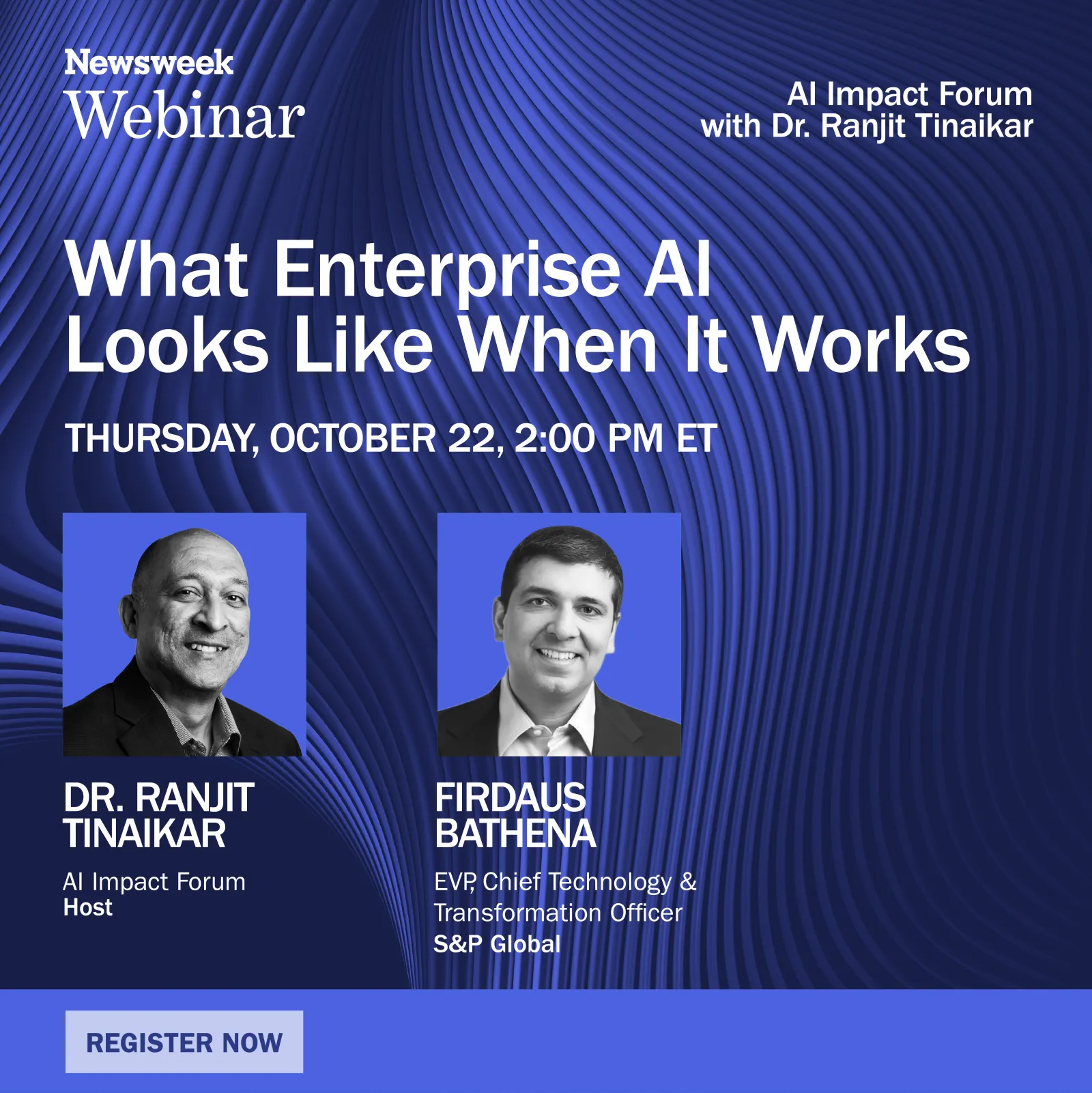
On October 22, Dr. Ranjit Tinaikar, host of Newsweek’s “AI Impact Forum,” will sit down with Firdaus Bhathena, executive vice president and chief technology and transformation officer at S&P Global, to discuss how large companies are turning advances in AI into business results, and why trusted, differentiated data is becoming increasingly important.
Drawing on Bhathena’s experience at S&P Global, FIS Global and CVS Health, the conversation will examine how organizations make data governed and reusable, redesign workflows around new capabilities and balance speed with trust, security and resilience.
They’ll also explore how leaders can keep technology investments focused on customer problems and identify where genuine competitive advantage can emerge.
Join the live discussion Thursday, October 22, at 2 p.m. ET. Register for free.
Prompt Injection
What’s one recent insight you’ve learned about AI?
“One recent AI aha moment for me came from building agents inside InMobi. We recently finished building our 4,000th agent. The funny thing is, the most valuable ones may have been the early ones that failed.
The real insight was how quickly each failure could make the next attempt better if we treated the learning as infrastructure.
One early agent took 10 or 12 rewiring attempts before it became truly useful. Each attempt exposed something missing: the wrong input, a broken workflow, unclear logic or poor evaluation. In a traditional build cycle, that can become a long, painful journey. In an AI-first cycle, those lessons become a cheat sheet for the next agent.
That has changed how I think about AI adoption. The winners will not be the companies waiting for perfect tools. They will be the ones willing to build, learn, codify what works and leapfrog themselves faster each time.”
Have your own lesson to share? Email me at:a.mills@newsweek.com
Run Log
Adding electrical capacity for a data center or factory can take years. Intrinsic Power is trying to make better use of the power already available through a facility’s existing electrical connection.
Broc TenHouten, co-founder and CEO of Intrinsic Power, a company developing power-management technology for commercial facilities and data centers, said electrical systems are typically planned around periods of peak demand. Facilities can leave some capacity unused so they have room for sudden spikes in power use.
Intrinsic Power’s system continuously analyzes electrical conditions at a site and learns how demand and available power change over time. It pairs that analysis with tightly controlled power electronics, allowing the control system to respond faster to changing conditions while staying within established engineering limits.
The company initially developed the approach to help buildings add electric-vehicle charging without costly electrical upgrades. TenHouten said the same constraint applies at a larger scale in data centers, where operators need reserve capacity for sudden changes in power demand.
“One of the ironies of this moment is that AI is driving unprecedented demand for electricity while also giving us the tools to use existing electrical infrastructure far more intelligently,” TenHouten said.
Intrinsic Power says the approach can reduce the need for additional electrical capacity or on-site generation by allowing facilities to operate closer to what their existing systems can safely support.
Viewed more broadly, business leaders facing a capacity constraint should first understand how much room remains in their existing systems before committing capital to expand them.
Have an interesting AI use case to share with me? Email me at: a.mills@newsweek.com
Context Window
■ Google introduced Gemini 4 Argon, a frontier model built for long-running software engineering, enterprise knowledge work and cybersecurity tasks, with initial access limited to trusted cyber defenders as the company strengthens safeguards ahead of a broader release. [Google]
■ California Gov. Gavin Newsom signed new AI laws prohibiting employers from relying solely on automated systems for disciplinary or termination decisions and requiring notice when AI causes a mass layoff, relocation or termination. [California Governor’s Office]
■ An IBM study of 1,500 CFOs and senior finance leaders found that 62 percent say their role has expanded into enterprise technology or AI strategy, while only 6 percent say finance has embedded AI into workflows and decision-making at scale. [IBM]
Transfer Protocol
Tracking executive moves across the AI landscape
Paula DeGangi has been promoted to chief client officer and managing partner of AOx3, while Randi Liodice has joined 120/80 Health Group as chief growth officer and Michael Fay has moved into the chief strategy officer and managing partner role.
Patrick Buell, co-founder of data and AI consultancy Hakkōda, is Eliza’s new chief deployment officer, leading forward-deployed engineers who translate clients’ business priorities into production AI systems.
Asic Demberel, after leading technology initiatives across AWS and Amazon Health Services, has joined Scala.AI as chief technology officer, shaping its technology strategy and advancing the intelligence, agentic capabilities and architecture behind its contact center platform.
Rodolphe Katra, formerly global chief AI officer and vice president at Medtronic, has joined GE HealthCare as global chief AI officer, helping advance its AI strategy across devices, software and healthcare data.
Ravi Simhambhatla, executive vice president and chief digital and innovation officer at Avis Budget Group, has joined AutoNation as chief technology and AI officer, leading its technology, data science and AI agenda.
Know someone on the move in AI? Send job change info to a.mills@newsweek.com
Magic Moment
What’s the most fun or unexpected way you’ve used AI lately?

“I’ve had fun vibe coding recently. I started by making an interactive prototype of our existing product with some targeted modifications. This let me compare my work with something real. What surprised me was seeing where AI performed well and where it broke down.
For example, it did a much better job than I expected translating English content into Spanish, preserving tone and voice far more than earlier models. We know generative content can be excellent, but when I asked to personalize existing content by referencing time since someone’s last mammogram, it created some weird output that missed the mark on supporting behavior change. I hadn’t given any training on why I wanted the content modifications, and so the AI just plopped it in without creating a narrative. Lesson: Without embedded domain expertise, even simple personalization falls apart.
A big duh moment: The interactive replies in my demo were coming instantly, which I know from prior research makes people feel they aren’t personalized. I realized someone has to design and program experiential details like response time. My team’s requirement inputs must go beyond content and layout to the lived experience of interaction.”
Experience some AI magic? Tell us about it ata.mills@newsweek.com
Request Reprint & Licensing
View Editorial & AI Guidelines
