

This post was co-authored with Marc Steren, Odina Salihbaeva, and Aashrit Surapaneni from University Startups, a partnership between University Startups, g/d/n/a, and AWS.
Trinity is a conversational AI solution that helps students with disabilities take ownership of their postsecondary planning. It was developed by University Startups, which was founded in 2020 on a straightforward belief: students with disabilities deserve a clear, personalized path forward. The organization works with middle and high school students across the United States, combining AI-powered transition planning with a career-ready curriculum to help young people turn their strengths into real futures.
In this post, we explore University Startups’ journey to scale Trinity efficiently, as dozens of school districts onboard and complexity increased beyond the initial architecture.
To bring Trinity to production, University Startups partnered with g/d/n/a (gdna.io), a generative AI-forward AWS partner operating at the intersection of AWS native infrastructure and agentic AI. g/d/n/a specializes in helping startups launch fast, scale securely, and build right, spanning agentic SaaS delivery, generative AI advisory, and CloudOps optimization.
Trinity focuses on building Individualized Education Programs (IEP). The IEP is a legally mandated document developed by a student’s parents, teachers, and specialists to support meeting the student’s educational needs. Rather than filling out static IEP forms, students talk with Trinity, explore their interests, strengths, and goals, and walk away with a personalized, Individuals with Disabilities Education Act (IDEA)-aligned transition plan.
Read more on how University Startups built Trinity on Amazon Bedrock. Within its first year, Trinity reached educators and students across more than a dozen U.S. states. International expansion into Saudi Arabia and Kuwait is now underway.
Challenges with scaling Trinity
Transition planning for students with disabilities is a federally regulated process governed by the Individuals with Disabilities Education Act (IDEA). It involves nuanced goal setting across postsecondary education, employment, independent living, and community participation. AI systems supporting this process need to be accurate, contextually aware, legally aligned, and accessible to students with a wide range of abilities. Three core challenges had to be solved before Trinity can operate at scale.
A single model couldn’t carry the full workflow
Early prototypes placed student intake, career exploration, compliance checking, and plan writing all in one prompt. In production, retrieval quality, instructional tone, and regulatory requirements competed in the same context window. This meant a failure in any one domain could corrupt an entire student session, leading to hallucinations or inaccurate information.
Recommending colleges, careers, and training programs to students with disabilities requires filtering simultaneously by geographic location, disability support services, program cost, education level, and career alignment. No off-the-shelf retrieval tool could do this reliably and with low latency.
Compliance and data protection are non-negotiable
Student records in special education must be protected under the Health Insurance Portability and Accountability Act (HIPAA) standards and the Family Educational Rights and Privacy Act (FERPA) for disability-related data protections. As Trinity’s architecture evolved, field-level encryption, strict role-based access, and automated data retention controls had to be built into the foundation from day one.
Solution overview
University Startups defined the product design specifications and Universal Design for Learning (UDL) standards. g/d/n/a delivered the full engineering build on AWS, from infrastructure and AI orchestration to compliance controls and the educator dashboard, resulting in a fully serverless architecture built to scale with the districts University Startups serves.
Architecture overview
The architecture shows a multi-agent solution powered by Amazon Bedrock, with tools and data to provide targeted guidance, with additional accessibility features.
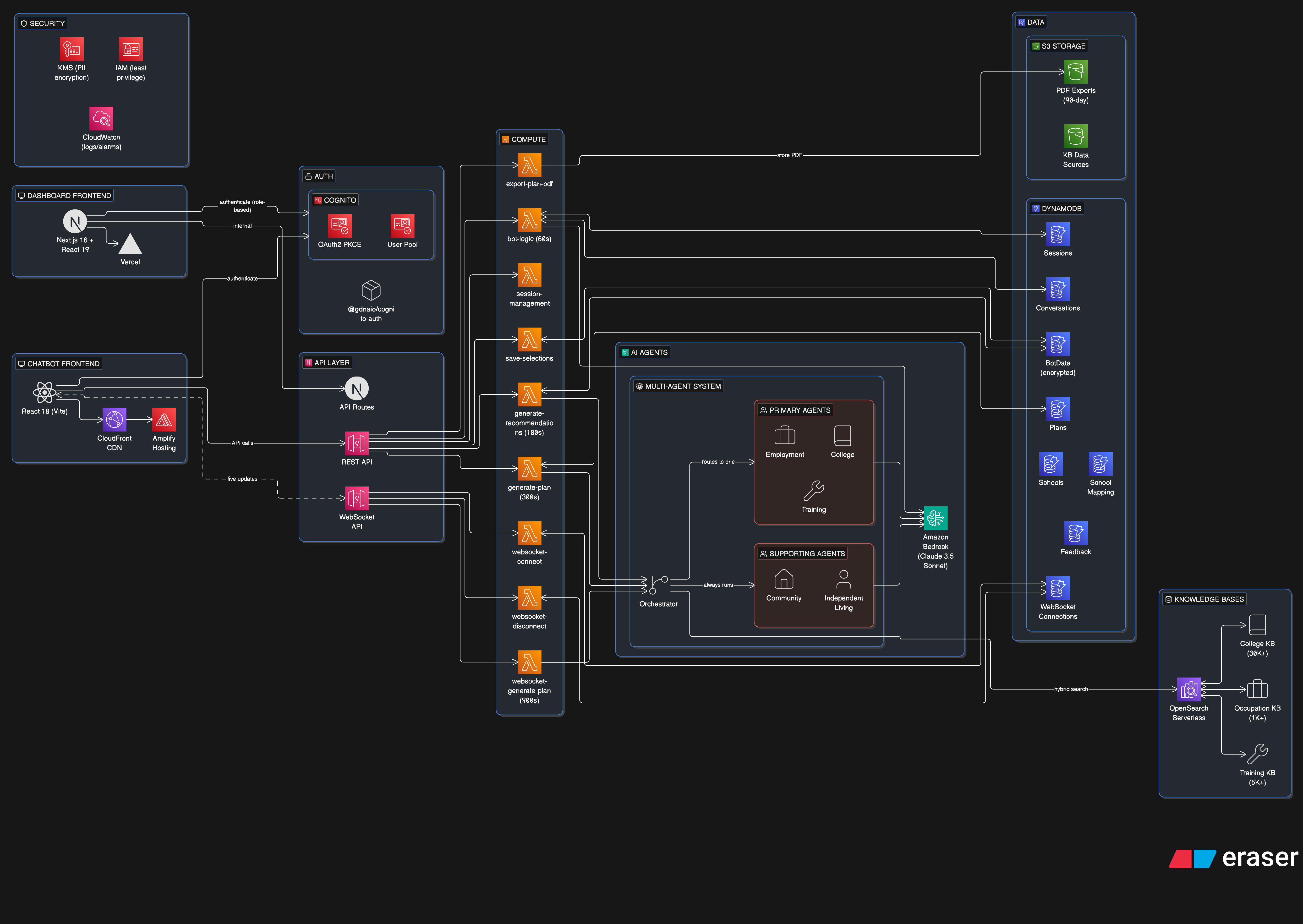
Figure 1: Trinity’s serverless multi-agent architecture on AWS
Students access Trinity through a web client connected to Amazon API Gateway over REST and WebSocket, and compute runs serverlessly on AWS Lambda. Amazon Bedrock with Claude 3.5 Sonnet powers AI interaction, and the conversation state lives in Amazon DynamoDB. Amazon Polly reads responses aloud for students who benefit from audio, and Amazon Transcribe converts spoken student input to text, for full accessibility without changing backend logic. Authentication flows through Amazon Cognito with Canvas LTI 1.3 federation for school single sign-on.
Throughout the architecture, responsible AI measures were in place, including Amazon Bedrock Guardrails for content filtering and reducing hallucinations. For model availability on Amazon Bedrock by AWS Region, refer to Supported models by AWS Region in Amazon Bedrock.
The multi-agent architecture
The key architectural decision was migrating from a single large language model (LLM) to a hierarchical six-agent system. These agents handle specialized tasks by communicating with tools and datasets to provide contextual recommendations.
g/d/n/a designed a system in which specialized agents, each with a clearly defined responsibility, collaborate under a single orchestrator:
- Orchestrator Agent: reads the student conversation, selects the right path, sequences agents, and consolidates the final output.
- College Agent: recommends 4-year universities and community colleges from an over 30,000 record Knowledge Base.
- Employment Agent: matches jobs and career pathways from an over 1,000 occupation Knowledge Base.
- Training Agent: recommends vocational programs and certifications from an over 5,000 record Knowledge Base.
- Community Agent: adds social activities and volunteer opportunities for students, regardless of path.
- Independent Living Agent: adds life skills and daily living goals for students.
This architecture delivered domain focus, better retrieval grounding, and path-aware sequencing. A dedicated consolidation step assembles agent outputs into one internally consistent transition plan, because the agents work from the same shared student profile, backed by DynamoDB session records throughout.
Two-phase pipeline
Trinity’s workflow separates recommendation from plan generation. In Phase 1, after the student completes a four-segment intake conversation, the Orchestrator routes to the appropriate primary agent, which returns five to ten ranked options filtered to the student’s context. In Phase 2, with selections confirmed, all agents contribute their section of the plan. The Orchestrator consolidates the outputs into a structured, IDEA-aligned IEP transition plan that can be exported to a formatted PDF in five to ten seconds. A real-time WebSocket layer keeps the educator’s UI responsive throughout.
Hybrid knowledge retrieval
g/d/n/a built and maintains three purpose-built Amazon Bedrock Knowledge Bases, the fully managed Retrieval Augmented Generation (RAG) capability. Agents issue retrieve-and-generate requests so answers are tied to actual records, not model parametric knowledge alone. Retrieval uses a four-factor hybrid scoring model: semantic similarity (30 percent), keyword matching (25 percent), location preference (20 percent), and program attributes such as disability support availability, cost, and education level (25 percent). Queries are AI-expanded before retrieval, and results below a 25 percent relevance threshold are filtered out entirely.
Compliance by design
g/d/n/a built Trinity’s compliance layer into the foundation from the start. The system helps protect sensitive student information through AWS Key Management Service (AWS KMS) field-level encryption with annually rotating keys. This encryption covers personally identifiable information (PII) including names, disability types, accommodations, and school contact details.
Security extends through AWS Identity and Access Management (IAM) policies that follow least privilege principles. Each Lambda function receives only essential permissions. Role-based access control enforces data boundaries server-side: Super Admins access system-wide metrics across districts, coordinators see district-specific data, school staff view their school’s student information, and students access only their own sessions and plans.
For authentication, g/d/n/a integrated Trinity directly into Canvas using LTI 1.3 rather than creating separate login credentials. While Canvas serves as the identitya-backed OpenID Connect (OIDC) provider, API Gateway, and Cognito, creating a smooth login experience within schools’ existing infrastructure
Impact
Across school districts, Trinity delivered measurable gains in student agency, educator efficiency, and IEP compliance.
Student agency
Through the Trinity experience, students achieve agency over their future goals. Rather than being handed a plan written about them, students arrive at their own goals through guided conversation. That conversation maps relevant supports through a skills matrix and connects them to over 30,000 college options, over 1,000 occupations, and over 5,000 training programs to make those goals concrete and reachable.
“It helped students focus on long-term goals and actionable steps for careers.”
“Trinity helps students visualize career pathways.”
Educator effectiveness
With Trinity, educators can provide a more efficient IEP planning process, with time focused on students’ specific needs. By automating student survey, career discovery, and compliance documentation into a single guided session, Trinity delivers meaningful student involvement and IEP transition compliance in under ten minutes, without distributed resources or manual coordination.
“Compliance, ease of use, and career-ready curriculum — together, not as tradeoffs.”
Validated in the field
Before any school went live, special education teachers and transition coordinators stress-tested Trinity against real IEP scenarios. Their feedback confirmed the core architectural decision: the multi-agent design provided accurate results with low latency for students.
Conclusion
Trinity is the result of three capabilities working together: University Startups’ domain expertise in special education transition planning, g/d/n/a’s engineering of the multi-agent architecture, and the scalability, security, and managed agentic AI services that AWS provides.
The partnership produced a production-grade application, built for real IEP planning, designed for students with a wide range of abilities, and architected to expand into new regulatory environments without rebuilding. Trinity is now expanding deeper into the Transition Planning Management network, launching localization for Saudi Arabia and Kuwait, and extending learning management system (LMS) connectivity so more districts can access Trinity from within the tools they already use.
Every student deserves a clear, personalized path forward. Trinity is how that happens at scale.
To learn more about how you can get started with agents on Amazon Bedrock, refer to Amazon Bedrock AgentCore.
Visit University Startup’s website for more information on programming for special education. Visit g/d/n/a’s website for more information.
