

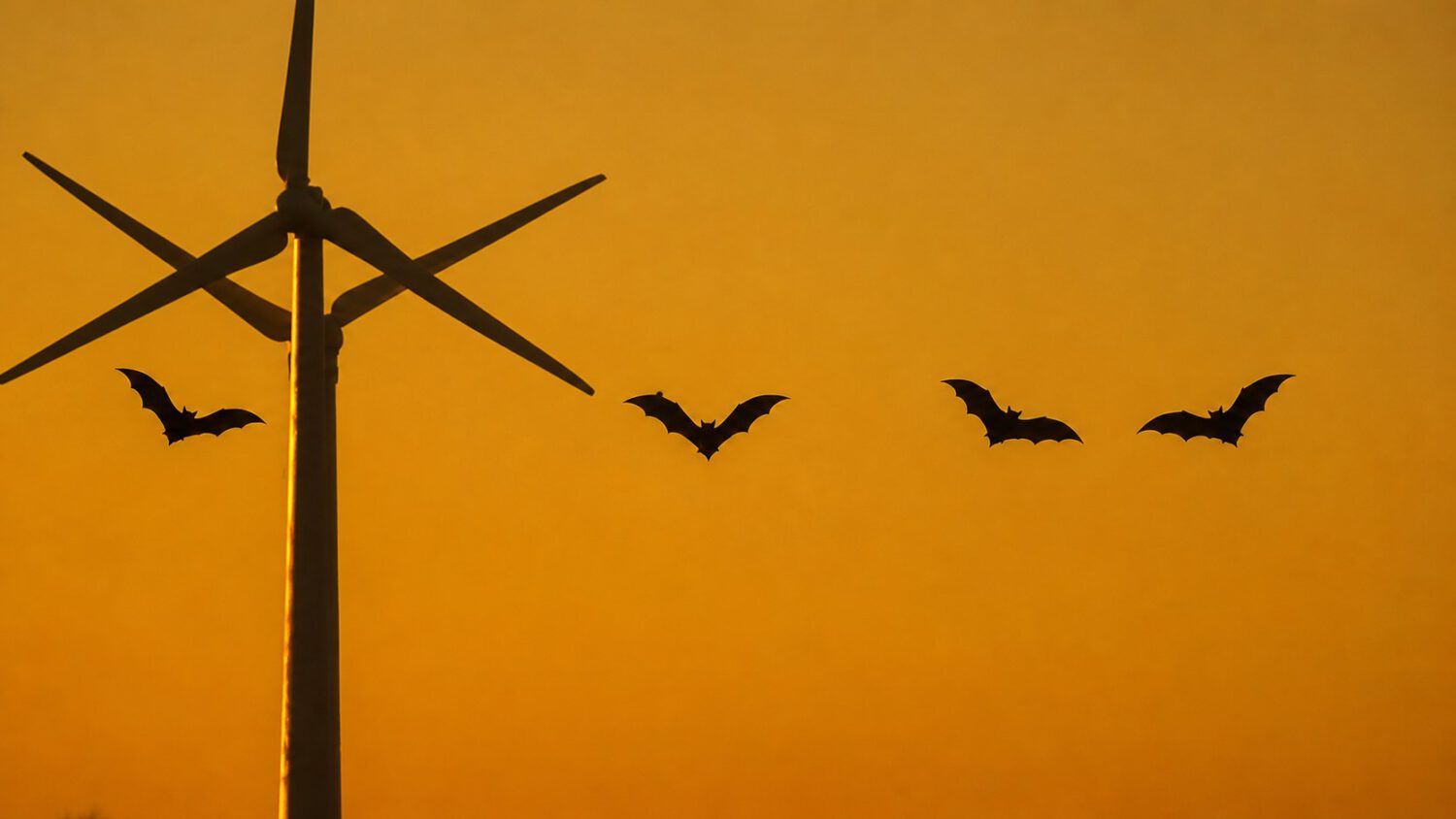
18.7 million bats. That is the estimated toll from U.S. onshore wind facilities between 1981 and 2024, according to the most robust national assessment to date, led by the U.S. Geological Survey. Bats consume staggering quantities of insects, and losing them at this scale carries ecological consequences that ripple well beyond the turbine pad.
A Death Toll Built Species by Species
Annual fatalities exceeded 1.5 million from 2021 onward, and the hardest-hit species are the ones least equipped to absorb losses quietly.
The hardest-hit species tell the story clearly: hoary bats account for an estimated 6.7 million fatalities, eastern red bats 5.8 million, silver-haired bats 3.4 million, and big brown bats 1.5 million. Nearly all are migratory, tree-roosting bats. Their seasonal routes put them in contact with turbines across entire landscapes, not just near a single facility.
USGS researchers analyzed 499 post-construction monitoring reports from 277 wind facilities surveyed between 1996 and 2024. These are modeled estimates, not direct carcass counts: standard surveys routinely miss deaths lost to scavenging, dense vegetation, and inconsistent search protocols.
Where the Blades Do the Most Damage
River corridors, Appalachian ridgelines, and larger rotors consistently show up as the factors concentrating risk.
Facilities near rivers carry elevated fatality rates across multiple species, consistent with bats using waterways as foraging and navigation corridors. Turbines with larger rotor-swept areas and lower ground clearance are associated with higher fatality rates across the data set. Cave-dwelling species face elevated risk near old mine shafts, according to secondary reporting on the study.
Public awareness of this issue dates to 2003, when biologists found several thousand dead bats at a West Virginia wind farm. The new USGS analysis makes clear that the true scale was never fully visible, because the monitoring data needed to see it was too fragmented and inconsistent to reveal it.
The Fix Is There. The Will Is Lagging.
Operational curtailment has cut bat deaths sharply in controlled studies, yet U.S. operators face no broad requirement to use it.
Curtailment works. A European analysis of 141 wind farms found that avoiding turbine operation during peak bat-flight conditions reduced fatalities by more than 80% in that specific study context; current U.S. Fish and Wildlife Service guidance cites an average reduction of roughly 62% under a particular wind-speed approach. The operational knowledge to apply this exists right now at facilities already running across the country.
Yet U.S. operators are generally not required to curtail for bats unless an endangered species triggers a legal obligation (current status should be confirmed against Fish and Wildlife Service guidance before publication). The American Clean Power Association supports voluntary conservation measures, while Bat Conservation International has pushed for broader requirements. Voluntary and mandatory are not the same thing. Asking wind operators to self-regulate bat protection is the energy sector’s version of asking social media platforms to self-regulate data privacy, and your data privacy is doing great, as you know.
Additional viable responses include smarter site selection to avoid migration corridors and river habitats, and increased ground clearance on new and repowered turbines. Standardized monitoring requirements would also close the data gaps the USGS team had to model around.
The Tension Worth Naming
Wind power is necessary, but that does not make a preventable and growing bat toll an acceptable side effect.
Wind power reduces fossil-fuel emissions, and decarbonization is urgent. The USGS study does not establish that turbine deaths have caused population-level declines, partly because reliable bat population data remains scarce; that uncertainty is a reason for better monitoring now, not a reason for inaction.
The near-term question is whether the U.S. moves toward standardized, enforceable bat-protection requirements or keeps relying on voluntary measures while the annual toll holds above 1.5 million. Waiting for better data is itself a policy choice, and the bats are not waiting.
