

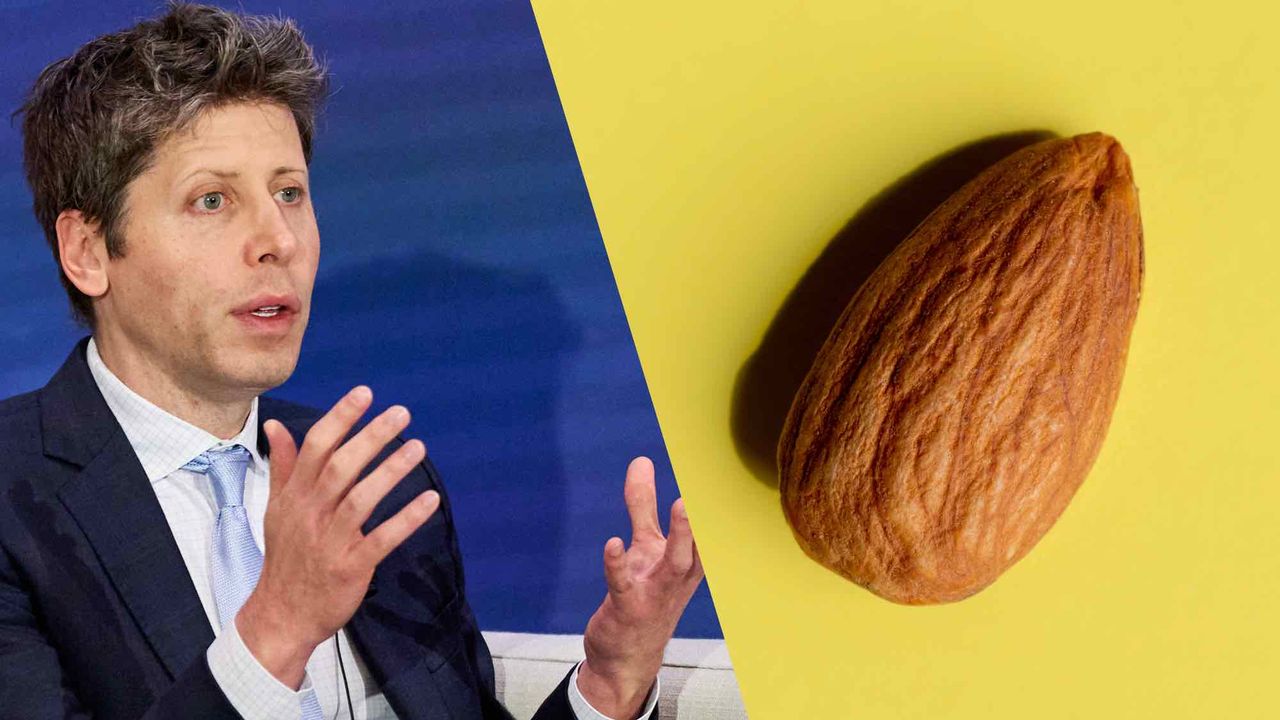
If you spend any time on social media, you have probably encountered the idea of “AI guilt.” The narrative goes something like this: every time you ask ChatGPT to draft a polite email or generate a weeknight dinner recipe, a server farm somewhere drains an ungodly amount of clean drinking water just to keep the chips from melting.
Now, OpenAI CEO Sam Altman wants to put that meme to rest. Speaking on the premiere episode of the Sources podcast with Alex Heath, Altman pushed back hard against the perception that simple AI prompts are environmental catastrophes.
His counter-argument was a comparison to a popular snack food.
38,000 ChatGPT queries = 1 almond? We ran the numbers to find out
According to Altman, data centers that guzzle millions of gallons of water rely on outdated cooling tech. In modern facilities, he claimed, running 38,000 ChatGPT queries consumes as much water as producing a single California almond. He did acknowledge that he was citing the figure from memory and that it might not be exact, though he maintained it was in the right ballpark.
It is an eye-catching soundbite designed to make your daily chatbot habit sound practically weightless. But does the math actually hold up, and should you stop worrying about the environmental cost of your prompts?
The math: How much water is an almond, really?
To evaluate Altman’s claim, you have to start with the almond.
California produces roughly 80% of the world’s almonds, and the most widely cited agricultural estimate puts the water cost of growing a single almond kernel at roughly 1.1 gallons (about 4.16 liters). A separate analysis pegs the full water footprint at roughly 12 liters (3.2 gallons) once you include rainfall and pollution offsets. Almonds are notoriously thirsty crops because the trees need consistent irrigation year-round.
If we take Altman’s ratio at face value using the direct irrigation estimate:
1 almond = ~1.1 gallons (4,164 mL) of water
38,000 ChatGPT queries = 1 almond
1 ChatGPT query = ~0.0000289 gallons (~0.11 mL of water)
To put 0.11 mL into perspective, a standard laboratory water drop or eyedropper drop is about 0.05 mL.
Under Altman’s figures, asking ChatGPT a question uses roughly two drops of water.
If that number sounds absurdly low compared to what you have previously read, you aren’t imagining things. It also does not quite square with Altman’s own prior statements.
In June 2025, he wrote in his blog post “The Gentle Singularity” that a typical ChatGPT query uses about 0.000085 gallons of water, which works out to roughly 0.32 mL.
Using that figure alongside commonly cited per-almond estimates gives you roughly 11,000 queries per almond, not 38,000. His own numbers point in the same direction but disagree on the specifics.
Where did the “AI drains your tap” story come from?
The public backlash against AI water consumption largely stems from a widely cited study led by researchers at the University of California, Riverside and the University of Texas at Arlington.
That paper, titled “Making AI Less Thirsty,” first posted as a preprint in 2023 and later published in Communications of the ACM in 2025, estimated that a brief conversation consisting of 10 to 50 responses from an LLM like GPT-3 consumed roughly 500 milliliters of water, about one standard plastic water bottle. That worked out to roughly 10 to 50 mL per response, potentially hundreds of times higher than Altman’s estimate.
So why the massive discrepancy?
Part of the answer is the hardware and the model. Altman’s figure describes lightweight queries on modern infrastructure running current models. The UC Riverside study analyzed GPT-3 on older systems.
But the bigger factor is what each number actually counts. Altman’s estimate almost certainly reflects onlyon-site cooling water, the water consumed directly at the data center. The UC Riverside figure includes both on-site cooling and the water consumed at power plants to generate the electricity those servers draw, a broader accounting known as scope-1 and scope-2 water use. Independent analyses suggest the electricity-generation layer can account for up to 75% of the total water footprint behind a single AI query. That means the gap is not just about old hardware versus new hardware; it is about where you draw the measurement boundary.
Altman addressed the old-hardware piece directly on the podcast, arguing that earlier estimates were based on facilities using evaporative cooling. In those older setups, massive cooling towers literally evaporate fresh water into the atmosphere to cool the hot air coming off the server racks. Once evaporated, that water is lost from the local watershed.
Modern hyper-scale data centers, Altman argued, have moved aggressively toward closed-loop liquid cooling systems, where water or specialized coolant circulates through sealed pipes like an automobile radiator, losing virtually no liquid to evaporation. In those facilities, Altman argued, water usage looks less like an industrial plant and more like an ordinary commercial office building with standard sinks and restrooms.
The catch: Why the almond comparison is classic Silicon Valley spin
While modern data centers are unquestionably getting more efficient per token, comparing chatbot prompts to agricultural crops ignores several critical realities.
Aggregate scale vs. individual guilt. You might only use two drops of water to check a spreadsheet formula, but OpenAI now serves roughly 900 million weekly active users processing billions of prompts every day. When you multiply tiny fractions of a milliliter across that global scale, alongside continuous model training runs that the UC Riverside researchers estimated can consume hundreds of thousands of gallons upfront; the aggregate total remains massive.
Local water stress matters more than global averages. An almond orchard in the Central Valley relies on established state water allocations and agricultural canals. AI data centers, however, are frequently built in suburban communities and semi-arid regions (such as Phoenix, northern Virginia, and parts of Texas and Georgia) where they tap directly into municipal water systems. Even a modern, efficient facility can cause friction when it competes with residential neighborhoods during peak summer heat waves.
Not all AI queries are created equal. Altman’s “38,000 queries” figure relies on standard, lightweight inference, so thinkbasic GPT-4o text replies. But the industry is shifting rapidly toward reasoning models and autonomous AI agents. When an AI “thinks” before answering, runs Python code in an internal sandbox, searches the live web, and self-corrects through multiple logic loops, it consumes substantially more compute per prompt than a simple conversational chatbot. Independent researchers have noted that these heavier workloads can use many times the energy and by extension the water.
The energy trade-off. When data center operators eliminate evaporative water cooling, they often replace it with energy-intensive chillers, mechanical heat pumps and high-velocity air fans. In short: reducing on-site water consumption often means drawing significantly more electricity from the local power grid, which has its own indirect water and carbon footprint depending on how that power is generated.
Final thoughts
Altman’s claim leans heavily on best-case scenarios for modern closed-loop hardware while glossing over the massive broader infrastructure demands of the AI boom. His 38,000-queries-per-almond number is probably defensible as a rough order of magnitude for a single lightweight query on the newest hardware — but it counts only part of the water story and ignores the trajectory of the industry.
- Humanoid robot fights back after man pushes it in store — is this the beginning of the uprising?
- Meet the mass-produced humanoid robot that wants to steal your face
- Snickers made a digital candy bar that claims to fix ChatGPT — I put it to the test
