

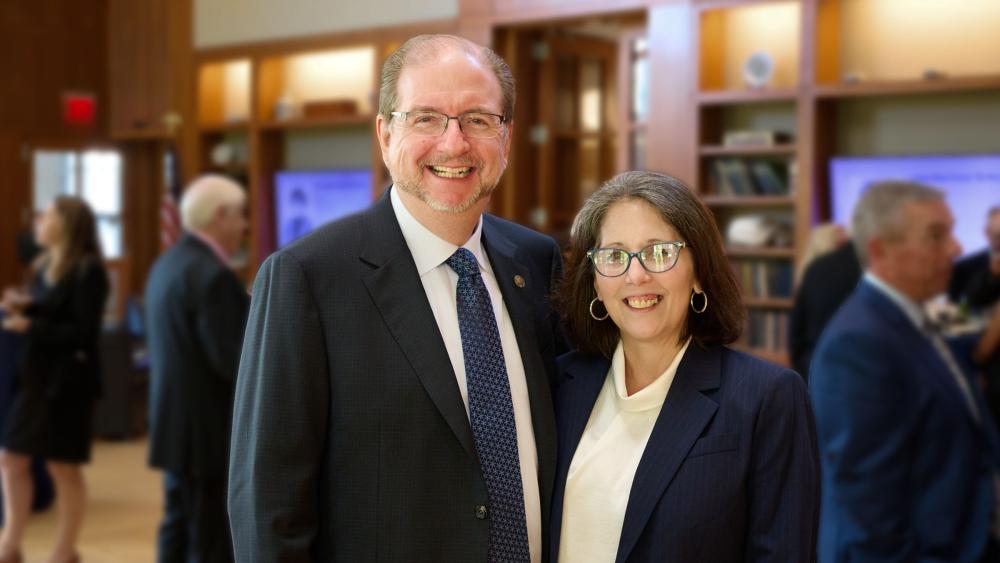
Pa. — Penn State alumnus Joe Atkinson was an artificial intelligence (AI) thought leader well before the generative AI boom of 2023. As the global chief AI officer for the PwC Network of Firms, he said he has seen firsthand how technology has impacted the job market
Atkinson earned a bachelor’s degree in finance from the Smeal College of Business in 1992 and has worked with University leadership on AI and digital curriculum initiatives. He has also served on the dean’s Advisory Board in the College of Information Sciences and Technology (IST) for more than two decades.
In the following Q&A, Atkinson discussed how technology is changing the job market and what that could mean for graduates.
Q: What does a typical day look like for a global chief AI officer, and what kinds of challenges are on your desk right now?
Atkinson: One of the things I love the most about this role is that there really is no typical day. I might start the morning meeting with colleagues from Asia or Europe, spend the afternoon with clients driving their AI transformations and finish the day with our teams managing the portfolio of projects that drive our own global transformation. Moving our firm toward an AI-driven future means staying agile, innovating constantly and maintaining sight of AI’s true benefits.
On any given day, the issues that cross my desk are as focused on leadership and culture as they are on technology. How do we help our people think differently? How do we help them apply AI, not just to do the old work faster, but to discover new ways of working that simply weren’t possible before? We want to redesign work so that our talented professionals can accomplish more with AI in a way that builds trust and fulfills the responsibility we have to our clients. And ultimately, we need to equip our people not just with technology tools, but with the skills they need to succeed in the Age of Intelligence — a moment that’s reshaping the future of work itself.
Q: You lead PwC’s AI strategy across more than 370,000 employees worldwide. How has technology changed what employers are looking for?
Atkinson: When I served as PwC’s first chief digital officer, one of the things I said often was that there used to be technology jobs and other jobs. Now, there are just jobs. Technology fluency and comfort with the rapidly evolving landscape of technology could no longer remain the exclusive domain of technologists. We needed to elevate the technology acumen of our professionals as well as our leadership. Thankfully, I was working with thoughtful and visionary leaders at PwC who embraced that opportunity and leaned in to power our firm’s transformation.
But transformation isn’t a destination. In many ways it has moved from a discipline to a way of life. Organizations that are not continuously evolving and continuously challenging the status quo run the risk of being left behind. That was true when the internet, wireless mobility and the cloud emerged, and it is particularly true now with the pace of AI advancement.
This environment is changing what companies like PwC are looking for in their employees. Technical fluency and competence are now foundational. AI isn’t simply a project or a technology tool; it is weaving its way through every aspect of how organizations operate.
Which, to me, means the differentiators are now the human skills. People who can help others navigate. People who continually learn, explore, and discover. People who understand the importance of governance and of the responsible use of AI. People who lead. People who remember that as tech advances, human skills become more important, not less.
Q: You’ve served on the College of IST’s dean’s Advisory Board for more than two decades and have provided generous financial support and industry expertise. What drew you to become a strong advocate for IST, and what keeps you engaged with it?
Atkinson: I graduated with a finance degree, but my father was a talented engineer and gave me a love of technology from an early age. As a result, my career has always been at the intersection of business and technology. That is what first drew me to IST. The college recognized early that technology is not separate from business. It shapes how organizations operate, compete and grow. That was true 27 years ago when the college was founded, and it couldn’t be more true now.
I have served on the dean’s Advisory Board for more than two decades, and I remain involved because IST reflects the very core of what has defined my career: not just building technology (as important as that is), but unlocking the value it can create, connecting the tech with humanity and recognizing the transformative power it has to improve companies, to improve lives and to improve society.
Supporting students at Penn State is personal. Like many students, I worked while in school, carried student loans and did what I could to knit together scholarships and grants to make it all work. But by any measure, the financial challenges I faced as a student pale in comparison to the challenges our students face today. The foundation Penn State gave me and my wife Laura helped put us in a position to help, and I am deeply grateful for that opportunity.
Staying connected through the Advisory Board has been a gift in itself, a chance to spend time with an incredibly talented and respected group of leaders in their fields. I learn something from them every time we get together. Bringing that expertise into the classroom and connecting students to great opportunities in industry has been an incredible privilege.
Q: What do IST graduates bring to the technology workforce that sets them apart?
Atkinson: IST graduates understand that technology is ultimately about people, systems and outcomes. They can speak the language of technology, but they also understand how information moves through an organization, how people interact with systems and whether a solution will actually work in practice.
That broader perspective is a powerful differentiator for IST students. The hardest business challenges are rarely solved by technology alone. They require people who can identify and frame the right problem, collaborate across diverse teams, communicate clearly and turn an idea into something useful, all while operating with integrity. IST students bring it all.
It’s one of the reasons PwC has so actively recruited IST students and why they perform so well in our organization. IST students bring solution-orientation, teaming skills and a willingness to put in the hard work to move an idea from concept to implementation. These are incredibly valuable skills in a world moving so fast.
Q: Penn State is committed to evolving alongside the rapidly changing AI talent pipeline. What do you see as the most important things the University can do to prepare graduates for what employers need?
Atkinson: First, every graduate needs a foundation in AI. They do not all need to become deep AI engineers — though we certainly need those too — but they should understand the evolving technology landscape, understand how to unlock the power of AI to improve processes and operations and understand how to do it all responsibly.
Second, students need opportunities to apply their AI skills to real problems. The best preparation will combine the classroom with multidisciplinary projects, internships, research and partnerships with industry and community organizations — something IST already does remarkably well. Students should learn how to identify a need, understand how to build and test AI solutions and drive continual innovation through feedback and iteration.
Third, students need to keep building the capabilities that become more valuable as technology advances. For too long we’ve talked about these as “soft skills” when the reality is they are, and have always been, the operating system for organizations and teams. Students need to develop the full portfolio of skills, both human and technical. The graduates who stand out will be the ones who see and understand the full operating system, not just the tech.
Finally, learning cannot end at graduation. IST should help students build the habit of continuous learning and strengthen the lifelong connection among alumni, faculty, employers and students. IST graduates need to be lifelong students.
Q: What else do you think readers should know about Penn State’s/IST’s place in the Age of AI?
Atkinson: Penn State is a remarkable organization built on an incredible mission: to bring access to world-class education to everyone.
Penn Staters have unlocked countless innovations, discoveries and milestones across medicine, technology, the arts, business and more. We enjoy an incredible set of assets, including our breathtaking campus, our unmatched alumni network, our best-in-class faculty and our exceptional research portfolio. This moment of AI creates a generational opportunity for Penn State to lead during a period of such profound change.
Penn State is not standing still. IST’s new degree program in artificial intelligence methods and applications is a great example, bringing together the technical foundations of AI with psychology, ethics, law and policy — exactly the kind of cross-disciplinary program in which IST has so persistently excelled and the kind of program we need to create the pipeline of talent for tomorrow’s entrepreneurs, business executives and leaders in government and society.
IST’s leadership matters because the future will need more than people who know how to build and configure AI. We need people who can decide where and how it should be deployed, and people who can consider the ethics and regulatory implications of its use.
There’s a lot of hype in the AI world, but the reality is that it is the most transformational technology most of us will see in our lifetimes. The Age of Intelligence should be defined by more than what the technology can do; it should be defined by how we use it to improve business, improve organizations, improve society and improve the human condition. Penn State knows how to produce technically savvy, ethically grounded people of integrity, and we need them now more than ever.
Penn State is shaping the future of higher education in the age of artificial intelligence. Our focus is on human-centered, ethical AI innovation that delivers meaningful impacts for Penn State and the broader community. Through visionary planning, strategic partnerships, targeted hiring and strategic investments, we will equip every Penn State student, staff and faculty member with the AI-related knowledge, experience and confidence they need to succeed in the AI-powered future. Learn more atpsu.edu/ai.
