

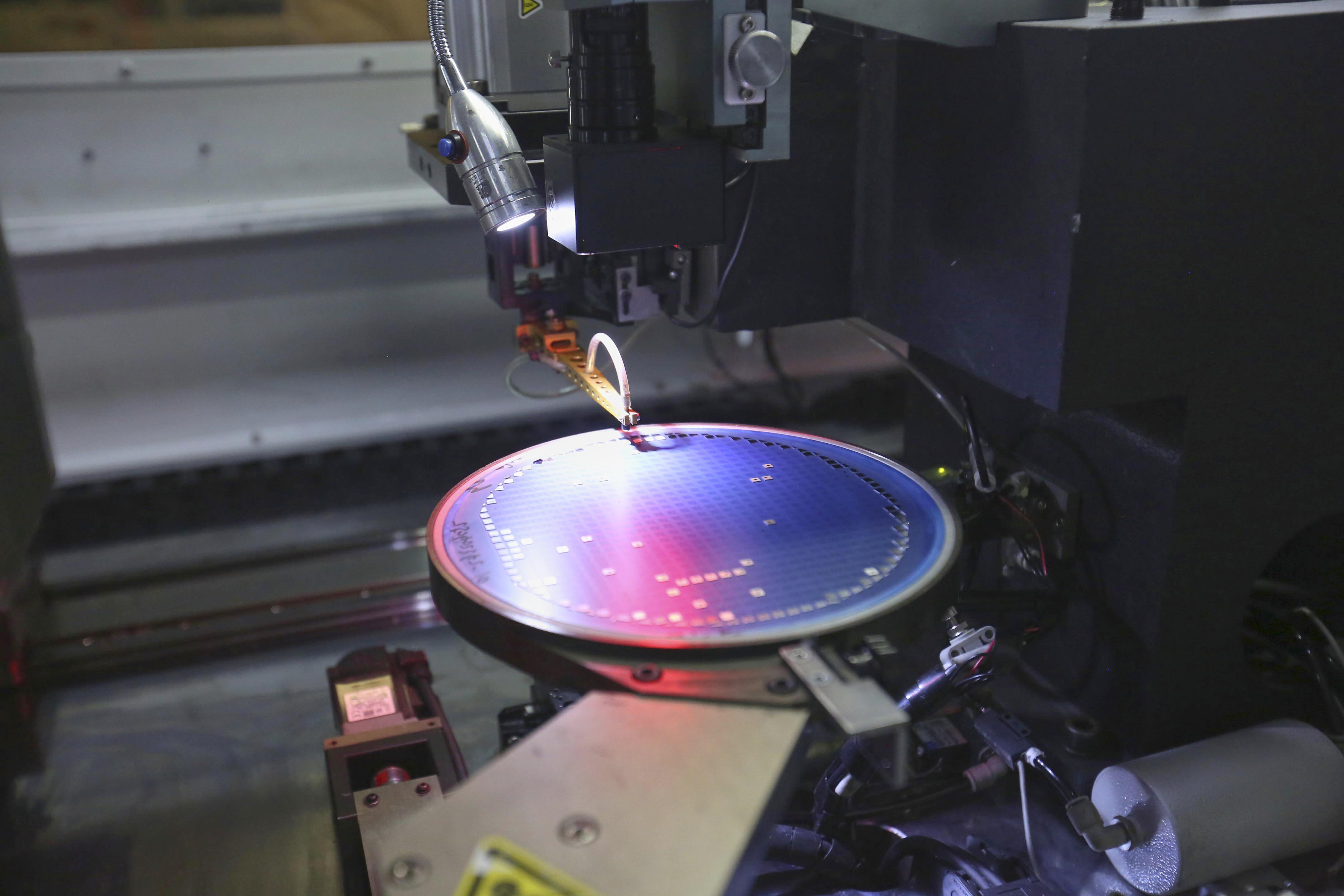
China is the only country other than the United States that controls substantial portions of nearly all the technologies required for artificial intelligence – the so-called AI stack. China has cheap electricity and critical minerals upstream, semiconductors and their software ecosystems in the middle, and models at the end. It is also working on governance, in particular through the World Artificial Intelligence Cooperation Organization (WAICO), to which 29 countries signed up in July 2026, with membership rising to 38 by early September1.
China has a strategy to commercially and geopolitically monetise its AI stack, as the component layers become fit for export. Its open-weight models (AI models for which the main components are made public and which therefore can be built on) are already export-ready. They in effect include the advantage of low energy costs in China: foreign users pay less to run Chinese models on Chinese servers2.
However, China’s chips and the software running them are not yet export-ready. Chinese chips still lag the US’s NVIDIA and, importantly, they are needed to supply China’s own market to reduce excessive dependence on the US3. Once production capacity increases, Chinese chips can be expected to flood overseas markets at competitive prices.
China’s goal is still to achieve parity with the US in AI development, diffusion and governance, rather than seeking outright global dominance4. Achievement of the goal will be done sequentially, following an order that aligns with China’s comparative advantages today while it progressively gains full autonomy over other parts of its AI stack.
In this framework, one of China’s clear strengths is governance, in part reflecting the regulatory vacuum the US has left in international forums. Meanwhile, the European Union has strong AI regulation, but this has yet to diffuse internationally (Collins and Mehta, 2026; Wilkinsonet al, 2026).
How China’s outbound strategy on AI is sequenced is very relevant to Europe, because the first AI-stack layers that China exports will become embedded quickest and will shape future dependencies. Below, we outline several priority questions related to China’s outbound strategy for AI.
Why is China going overseas with AI?
Building a full AI stack equivalent to the US carries very large fixed costs, given the huge network effects embedded in AI (Gambacorta and Shreeti, 2025; OECD, 2026). Even China’s huge market may not be enough to amortise those costs and close the gap. Therefore, beyond technological independence, the main reason for China to develop a global policy on AI is to create the same network effects US companies benefit from when exporting their models and hardware.
Exports extend the network of installed technology, and each third-country developer trained on Chinese tools raises the return on domestic investments. In a related demand-pull effect (‘需求牵引效应’), overseas deployment creates application scenarios and scale that feed back into faster development of Chinese chips, models and the computing ecosystem (Fu, 2026). Beyond exports of AI hardware or digital services with AI models, pushing global AI governance with Chinese characteristics could make China a global standard setter.
What are China’s exportable advantages in AI?
The hard stack: energy, compute and chips
China’s clearest advantage is its rapid deployment of renewables-sourced electricity, which makes its compute comparatively cheap, attracting international users who pay lower prices to use Chinese AI models when run through Chinese cloud services. Chinese data centres consumed about 170 terawatt-hours of electricity in 2025, only 1.6 percent of China’s total power consumption, but computing-related demand grew by close to 40 percent a year over the past three years (H33, 2026), so there is ample room for further growth in compute without straining the grid. Whereas China’s binding constraint is access to advanced chips, the emerging US constraint is energy and the willingness of financers to extend capital without adequate near-term return (García-Herrero and Storella, 2026).
Provincial governments in China have cut electricity bills by up to half for data centres that run domestic chips, but this is mainly to offset the lower energy efficiency, and therefore the higher electricity demand, of Huawei chips5. The low prices of Chinese models abroad owe at least as much to cheap energy as to efficient model architectures and domestic competition (Luong, 2026). Chinese AI industry leaders and provincial governments are championing strategies involving the export of tokens (basic data units, such as a word or part of a word, read by AI models), computing power and tokens/compute power ecosystems (Fu, 2026).
On semiconductors, China is intent on creating alternatives to dominant US firm NVIDIA. Huawei is China’s most credible champion. Huawei’s most advanced AI chip, the Ascend 950PR, remains technologically inferior to NVIDIA’s Rubin GPU6, but demand for Ascend chips in China is strong because restricted access to NVIDIA’s highest performing chips has created a captive market (García-Herrero and Martens, 2026). China could theoretically incentivise the export of such chips, enabling other countries to reduce their dependence on the US7. But Huawei has instead set as its primary objective the goal of serving as much domestic demand as possible. For chips, self-reliance is still more important than dominating overseas markets.
The soft stack: models and software
On the soft stack, China’s most exportable layer is its AI models. The decision by many leading Chinese developers to publish the weights of their models is a sharp competitive tool that both strengthens domestic innovation and expands their international user base. Open-weight models reduce barriers to entry for domestic innovators, while their low cost and international accessibility have helped make Chinese models among the most widely used globally (Meinhardtet al, 2025; Ghoshet al, 2026).
Their openness does not, however, eliminate potential dependencies. Users can retain, modify and deploy versions for which weights have already been released, but continued access to frontier improvements still depends largely on the original developers releasing subsequent generations. If some EU industries become dependent on Chinese open-weight models, China could pressure EU countries by cutting off Europe from updates. In demonstrating a willingness to take such steps, China released draft regulations on 16 October 2026 limiting or prohibiting the export of 23 types of cutting-edge AI technologies, including several related to large-language models, agents and computing clusters8. Although technologies already in the public domain through open sourcing need not be removed, the regulations and the accompanying interim sensitive technology registration system have raised further questions over the long-term openness of Chinese AI9.
Beyond security concerns, open-weight strategies limit the ability of developers to monetise access to their models, and Chinese AI companies have so far struggled to make profits10. Consequently, future releases could become less open, not for security considerations but simply for the sake of profitability.
On software, NVIDIA’s durable advantage rests on its proprietary software platform, called CUDA, which has become thede-factostandard for AI development. China has sought to construct an alternative ecosystem as part of its push for technological self-reliance. Huawei has developed its own software layer, CANN, to run on Ascend processors, and has progressively opened the platform to outside developers11. To lower switching costs from CUDA to CANN, the Chinese government has also supported domestic-chip adoption, including through preferential electricity pricing for some data centres (see above) and pressure or incentives for domestic developers to use Chinese hardware (García-Herrero and Martens, 2026). Chinese AI company DeepSeek illustrates the potential interaction between the model and hardware layers: its models can run across different hardware platforms, while its V4 model – released in April 2026 – was adapted to run on Huawei’s Ascend architecture from the outset12.
CANN nevertheless remains far less widely adopted internationally than CUDA13. But China does not necessarily need Huawei’s software stack to displace CUDA globally for its strategy to matter. If Chinese open-weight models are adopted internationally while successive generations become increasingly optimised for Ascend chips, they can reduce the software and compatibility costs associated with deploying Chinese hardware. This could gradually weaken the relationship between NVIDIA’s hardware leadership and CUDA’s developer dominance. An open-weight model optimised for Chinese hardware today can in the future become a demand signal for Chinese chips.
Governance and WAICO: China’s greatest soft-stack advantage
China has pushed for a role in global AI governance for nearly a decade. Its 2017 New Generation AI Development Plan aimed to make China the driving force in defining AI norms and standards by 2030 (State Council, 2017). The Global AI Governance Initiative followed in 202314, and China’s AI Capacity-Building Action Plan in 202415. In the 2025 Global AI Governance Action Plan, Premier Li Qiang proposed a new global AI cooperation organisation16.
WAICO is the latest manifestation of this ambition. WAICO is partly a response to the US-led Pax Silica, launched in December 2025, but whereas Pax Silica coordinates partner-country supply chains for critical minerals, semiconductors and AI infrastructure, WAICO’s constitution claims its objective is to coordinate members’ development strategies, AI use-case training, technical standards, open models and governance templates (Collins and Mehta, 2026). WAICO’s operating model, however, is largely untested.
One of China’s main goals in global AI governance is to set international standards for acceptable hardware, software and AI models. China’s 2025 Action Plan called for accelerated development of AI standards on security, industrial application and ethics through the International Telecommunication Union, International Organization for Standardization and International Electrotechnical Commission, while the 2026 World AI Conference (not to be confused with WAICO) launched an initiative on interoperability between AI agents18. Unless the US or EU carve out equally important roles in global AI governance, Chinese standards could become thede-factonorm in much of the Global South, even while their AI systems continue to run on US chips.
However, coercion upstream, through rare-earth export controls, undercuts the attraction China seeks to project downstream through open models and inclusive governance. Whenever Beijing tightens mineral controls, it strengthens the case for the countries it is courting to diversify away from Chinese supply chains.
China’s overseas AI strategy has major implications for Europe
China’s sequencing of AI exports opens a window that Europe should not waste. Because the hardware and software layers of the Chinese stack are not yet fully export-ready, the terms on which they will eventually be deployed in third countries are still to be determined. Europe is presently indispensable in AI terms in high-end lithography for chip manufacture and in its regulatory experience.
Rather than pick a camp, Brussels should engage in the global AI governance forums Beijing is building. This would demonstrate EU goodwill towards China and show that, unlike Washington, Brussels sees the importance of creating common ethical, innovative and commercial standards for AI. To offset possible US consternation about such a move, the EU should not endorse any particular templates of AI governance. But its presence and participation in these forums, including WAICO, will set a helpful precedent for the EU to contribute more assertively later on.
As for the adoption or restriction of Chinese open-weight models in Europe, the EU should let market forces determine the extent to which consumers choose Chinese or Western models. Other than in sectors connected to national security, the main factors determining the adoption of different AI models should be price and quality. At the same time, firms should be encouraged not to become dependent on any single model and to plan for situations in which a switch of model might be required. Until the EU has its own cutting-edge models19, it stands to gain little from endorsing certain models over others, or restricting access to some models without legitimate security rationales.
Finally, the EU must look for partnerships to achieve shared compute and governance capacities (García-Herrero and Dutta, 2026). The fundamental questions for Europe are how to react to the sequence of Chinese AI exports, how to form its own alliances and how to develop self-reliance.
Collins, C. and A. Mehta (2026)The State of AI Global Governance and Its Implications for the U.S.-China Summit, Center for Strategic and International Studies, available athttps://www.csis.org/analysis/state-ai-global-governance-and-its-implications-us-china-summit
Fu, D. (2026) ‘The PRC’s Compute Push Goes Global’,China Brief26(19), Jamestown, available athttps://jamestown.org/the-prcs-compute-push-goes-global/
Gambacorta, L. and V. Shreeti (2025) ‘The AI supply chain’,BIS Papers154, Bank for International Settlements, available athttps://www.bis.org/publications/paper-154-ai-supply-chain
García-Herrero, A. and S. Dutta (2026) ‘Programmable sovereignty: coordinated specialisation as a response to the N-2 problem in artificial intelligence’,Working Paper25/2026, Bruegel, available athttps://doi.org/10.64153/XVWN8948
García-Herrero, A. and B. Martens (2026) ‘Stack battles: the US-China artificial-intelligence rivalry is moving beyond chips alone’,Analysis18/2026, Bruegel, available athttps://doi.org/10.64153/CCJW6603
García-Herrero, A. and T. Storella (2026) ‘China’s artificial intelligence goals and strategic choices for Europe’,Analysis24/2026, Bruegel, available athttps://doi.org/10.64153/IQNE5739
Ghosh, A., L.-A. Kaffee, Y. Jernite and I. Solaiman (2026) ‘State of Openvailable athttps://huggingface.co/blog/huggingface/state-of-os-hf-spring-2026
H33 (2026) 中国电力行业报告(2026年中期) [China power sector report, mid-2026], 28 August, available athttps://www.h33.top/report/20260828-eef0
Luong, N. (2026) ‘Two Loops: How China’s Open AI Strategy Reinforces Its Industrial Dominance’,Research Working Group Paper, US-China Economic and Security Review Commission, available athttps://www.uscc.gov/research/two-loops-how-chinas-open-ai-strategy-reinforces-its-industrial-dominance
Meinhardt, C., S. Nong, G. Webster, T. Hashimoto and C.D. Manning (2025) ‘Beyond DeepSeek: China’s Diverse Open-Weight AI Ecosystem and Its Policy Implications’,Issue Brief, Stanford HAI/DigiChina, available athttps://hai.stanford.edu/policy/beyond-deepseek-chinas-diverse-open-weight-ai-ecosystem-and-its-policy-implications
OECD (2026) ‘Artificial Intelligence markets: Recent developments and competition issues’,Policy Brief, Organisation for Economic Co-operation and Development, available athttps://doi.org/10.1787/d531d73f-en
State Council (2017)New Generation Artificial Intelligence Development Plan[新一代人工智能发展规划], State Council of the People’s Republic of China, available athttps://app.www.gov.cn/govdata/gov/201707/20/408540/article.html
Wilkinson, R., A. Krasodomski, I. Wilkinson and F.J. Varela Sandoval (2026) ‘Breaking the deadlock on AI governance: How a crisis could lead to global coordination’,Research Paper, Chatham House, available athttps://www.chathamhouse.org/2026/03/breaking-deadlock-ai-governance
Xu, E. (2026) ‘Groundbreaking SuperPoD Interconnect: Leading a New Paradigm for AI Infrastructure’, Keynote Speech by Eric Xu at Huawei Connect 2025, 18 September, available athttps://www.huawei.com/en/news/2025/9/hc-xu-keynote-speech
Authors
Alicia García-Herrero
Théo Storella
China Economic Security Consultant
Theme
Global economy and trade
Keyword
artificial intelligencetechnologyinnovationEU-China relationsdigital economytrade policy
Country
China
Language
English
Endnotes
- 1
Alicia García-Herrero, ‘Tough choices ahead as the US pushes a global artificial-intelligence divide’, First Glance, 7 September 2026, Bruegel, https://www.bruegel.org/first-glance/tough-choices-ahead-us-pushes-global-artificial-intelligence-divide.
- 2
John Power, ‘China’s secret weapon in AI race with US? Lots of cheap energy’, Al Jazeera, 28 May 2026, https://www.aljazeera.com/economy/2026/5/28/chinas-secret-weapon-in-ai-race-with-us-lots-of-cheap-energy.
- 3
Chinese chip producer Huawei has said it cannot produce enough of its Ascend chips to satisfy demand in China, therefore, it has no plan to decisively expand into international markets. See Global Business Outlook, ‘Can’t produce enough equipment: Huawei says AI chip demand outstrips supply’, 18 September 2026, https://globalbusinessoutlook.com/technology/cant-produce-enough-equipment-huawei-says-ai-chip-demand-outstrips-supply/.
- 4
The strategy has been characterised as “chipping away”. See Kyle Chan, ‘China’s global AI strategy’, High Capacity, 27 July 2026, https://www.highcapacity.org/p/chinas-global-ai-strategy.
- 5
Zijing Wu and Eleanor Olcott, ‘China offers tech giants cheap power to boost domestic AI chips’, Financial Times, 4 November 2025, https://www.ft.com/content/cad2cdd6-7cce-4de3-8710-977de667378c.
- 6
Eduardo Alvarez, Vishal Mehta and Farshad Ghodsian, ‘Inside NVIDIA Rubin GPU Architecture: Powering the Era of Agentic AI’, NVIDIA Technical Blog, 21 July 2026, https://developer.nvidia.com/blog/inside-nvidia-rubin-gpu-architecture-powering-the-era-of-agentic-ai/. See also Xu (2025).
- 7
Malaysia, for example, has indicated such an appetite. Mackenzie Hawkins and Ram Anand, ‘Malaysia Downplays Huawei Deal as US Checks China’s AI Reach’, Bloomberg, 20 May 2025, https://www.bloomberg.com/news/articles/2025-05-20/malaysia-downplays-huawei-deal-as-us-aims-to-curb-china-ai-power.
- 8
See Ministry of Commerce and Ministry of Science and Technology of the People’s Republic of China, ‘Announcement No. 48 of 2026, soliciting public opinions on revising the “Catalogue of Technologies Prohibited and Restricted from Export in China” and implementing temporary registration management for the export of related technologies’, 16 October, https://www.mofcom.gov.cn/zwgk/zcfb/art/2026/art_0a31a3c9ac404f7a9b0e917ce3412997.html.
- 9
Alicia García-Herrero and Bertin Martens, ‘What lessons should Europe take from China’s tightening grip on its advanced AI?’ First Glance, 19 October 2026, Bruegel, https://www.bruegel.org/first-glance/what-lessons-should-europe-take-chinas-tightening-grip-its-advanced-ai.
- 10
Krystal Hu, ‘Funding frenzy, chip wars, and robot dreams: Inside China’s AI boom’, Reuters, 23 September 2026, https://www.reuters.com/technology/artificial-intelligence/funding-frenzy-chip-wars-robot-dreams-inside-chinas-ai-boom-2026-09-23/.
- 11
See Huawei news of 20 September 2025, ‘Ascend: Open for All to Build a Vibrant Ecosystem’, https://www.huawei.com/en/news/2025/9/hc-shengten-opensource.
- 12
Nicholas Gordon, ‘DeepSeek unveils its newest model at rock-bottom prices and with ‘full support’ from Huawei chips’, Fortune, 24 April 2026, https://fortune.com/2026/04/24/deepseek-v4-ai-model-price-performance-china-open-
- 13
Lily Ottinger and Mary Clare McMahon, ‘Can Huawei Take on NVIDIA’s CUDA?’ ChinaTalk, 5 May 2025, https://www.chinatalk.media/p/can-huawei-compete-with-cuda.
- 14
See Ministry of Foreign Affairs of the People’s Republic of China, communiqué of 20 October 2023, ‘Global AI Governance Initiative’, https://www.fmprc.gov.cn/eng./zy/gb/202405/t20240531_11367503.html.
- 15
See Ministry of Foreign Affairs of the People’s Republic of China news of 27 September 2024, ‘AI Capacity-Building Action Plan for Good and for All’, https://www.fmprc.gov.cn/eng/wjbzhd/202409/t20240927_11498465.html.
- 16
See Ministry of Foreign Affairs of the People’s Republic of China news of 26 July 2025, ‘Global AI Governance Action Plan’, https://www.fmprc.gov.cn/eng/xw/zyxw/202507/t20250729_11679232.html, and State Council of the People’s Republic of China news of 26 July 2025, ‘Chinese premier calls for early formation of global AI governance framework’, https://english.www.gov.cn/news/202507/26/content_WS6884bea8c6d0868f4e8f4732.html.
- 17
Michael Martina, ‘US to tell partners they must pick sides in AI race with China’, Reuters, 14 August 2026, https://www.reuters.com/world/china/us-tell-partners-they-must-pick-sides-ai-race-with-china-2026-08-14/.
- 18
Basu Chandola, ‘China’s bid to reshape the global AI order’, Expert Speak, 20 July 2026, Observer Research Foundation, https://www.orfonline.org/expert-speak/china-s-bid-to-reshape-the-global-ai-order.
- 19
This may not happen soon. For example, France’s Mistral has been dropped by German search engine Ecosia over price and performance issues, with Ecosia opting for Chinese models instead. See Anouk Schlung and Larissa Kögl, ‘German search engine ditches Mistral, bets on Chinese open-le/germany-ecosia-search-engine-mistral-china-open-
