

South Carolina Lt. Gov. Pamela Evette appears distressed in a gloomy room as she undergoes a polygraph test that ends with the lie detector catching fire. Although the video clarifies that the “dramatizations” in this political ad are generated with artificial intelligence, some voters still asked her whether what they saw was real, Evette told Noticias Telemundo.
At first, Evette said she thought, “This is ridiculous, right? Like, nobody could possibly believe this?” Later, as she traveled the state during her campaign to become the Republican gubernatorial nominee — a race she lost in June to Attorney General Alan Wilson — she said she encountered voters who were confused about the video’s veracity.
“On the campaign trail, I would have people ask me, like, ‘Oh my gosh, did they really make you take a lie-detector test?’” Evette said. She then had to explain to them that it never happened and it was an AI-generated fake ad.
“So you almost think it’s a joke and you kind of laugh at it, until you realize that there is a group of people out there that can’t tell the difference,” she said, “and then start to question if what they’re saying may be true.”
Evette is not the only one whose image was manipulated in the lead-up to the midterm elections. The Wesleyan Media Project, a group of experts that tracks political propaganda in campaigns, identified at least 220 ads produced or enhanced with artificial intelligence by candidates or political action committees this election cycle. They cost just under $137 million.
It’s a significant leap in the use of this technology compared to 2024, when the investment in AI was less than $50,000 during the presidential election. As of May of this year, the money spent on these AI ads was already $20 million.
“We really saw the growth in AI ads over the summer,” Travis Ridout, a professor at Washington State University and one of the project directors, told Noticias Telemundo. “A lot of them were connected with closely fought primary races.”
The lieutenant governor of South Carolina saw two videos of herself generated with artificial intelligence, or deepfakes, but she also sharedone that falsely depicted her opponent, Alan Wilson, rejecting a call from President Donald Trump. According to Evette, her campaign used artificial intelligence after the ads featuring her circulated. “But we said it, ‘This ad is AI-generated,’” she said.
The videos targeting Evette are said to have been paid for by a PAC; the one released against her opponent was funded by the lieutenant governor’s campaign. A request for comment sent to Wilson was not immediately returned.
In response to a query from Noticias Telemundo on social media, nearly 40 people said they had seen political ads generated with artificial intelligence. Some admitted that they have difficulty distinguishing them.
“And that could be deceptive; voters could be basing their decisions on falsehoods in that case,” Ridout said. “That’s, I think, what’s most concerning from a democratic perspective.”
In the absence of a federal law regulating them, the responsibility falls to local governments, said Ridout, who estimates that about 30 states have some type of rule or requirement regarding AI in political campaigns.
Of the 220 ads analyzed by the Wesleyan Media Project, only 27% revealed they used artificial intelligence tools.
The possibilities ‘are endless’
Candidates with smaller campaign budgets rely on artificial intelligence to compete with their rivals, Ridout suggested.
“I think it’s here to stay. I don’t know that it’s going to go away,” said Evette. Campaigns “are extremely expensive,” she noted, and AI reduces many recording and editing costs.
These tools could also “unlock” more creativity in political advertising, said Ridout, “which wouldn’t be the worst thing in the world.”
He said the possibilities are practically endless and include satire. Among the ads he analyzed, he saw candidates emerging from a swamp, boxing against Trump, or appearing alongside physicist Albert Einstein, who died in 1955.
“I do worry about the lasting impact of those images, even if people know that it might not be true,” Ridout said. He noted those images might stick in their mind when they’re voting, or it may even generate waves of misinformation that trigger violence.
AI can “redefine” modern political campaigns, the Brennan Center for Justice, a nonprofit institute whose experts have analyzed the potential impact of this technology on democracy, saidin an article.
Mekela Panditharatne, legal adviser and director of the center’s Elections and Government Program, said that without disclosure, “generative AI use in political ads has the potential to distort perceptions of candidates, painting candidates in a flattering light or their opponents in a negative light.”
During the Minnesota primaries, a deepfake circulated showing Lt. Gov. Peggy Flanagan, the Democratic nominee for U.S. Senate, smiling amid mountains of money.
A spokesperson from her office said that although it didn’t stop them from winning the primary, there was alarm over the impact of the AI-generated video. “There is already too much distrust in our politics, and voters deserve to know what’s real and what’s not,” the spokesperson said.
Minnesota is one of the states with AI regulations; in 2023, its Legislature passed with bipartisan support a ban on its use to influence elections. The AI ad targeting Flanagan elicited debate over whether it was unlawful or whether it was protectedunder the First Amendment.
Artificial intelligence “should never be used to manipulate voters,” Flanagan’s spokesperson stated.
A matter of transparency
At least two federal bills to regulate AI in politics are pending discussion and approval by lawmakers.
One seeks to ensure that advertisements have conspicuous notices that artificial intelligence tools have been used; the other attempts to prohibit this technology “to generate materiallydeceptive content falsely depicting federal candidates in political ads to influence federal elections.”
Although local regulations exist, some candidates still violate them
“I think those laws have not had as strong a deterrent effect as we would like,” she said, making a point for the need of a universal federal standard.
When designing any law, legislators take into account the First Amendment, which protects, among other rights, freedom of speech, religion and the press.
Laws that are “carefully tailored” could withstand scrutiny under the First Amendment, Panditharatne explained. AI can also be used to create “forms of commentary or art,” such as parodies or satire.
In the ads analyzed by Noticias Telemundo, the form and content indicating it was done with AI varied; there were differences ranging from the text size to the wording.
One, for example, stated, “This ad contains digitally generated content,” while another referred to it as “dramatizations.” In some, the warning appeared at the end, and in others, it was omitted altogether.
The use of AI in political propaganda concerns both Democrats and Republicans Candidates from both parties have been targeted by deepfakes, “and they don’t like that.”
He thinks next year there could be consensus in Congress to impose some national standards.
Republicans use more AI
Republican-backed PACs and GOP candidates appear more willing to invest in these tools than Democrats and independents, according to a review by the Wesleyan Media Project. It found that 81% of the 220 ads identified were funded by Republican candidates or pro-Republican groups. Another 12% were from pro-Democrat sponsors. The remaining ads were sponsored by independent candidates or groups weighing in on issues that were not ostensibly partisan.
Although Ridout said he has no explanation for this marked difference, he believes the key may lie in each party’s voters.
Democratic voters, he said, tend to be “more in favor” of government regulation and perhaps Democrats may be more constrained by their own voters in terms of what they are willing to do, as opposed to Republicans.
If a candidate “goes too far” in an ad against their opponent, they may also face backlash and criticism, he said. However, he noted that PACs, which typically fund their own ads, have less accountability to the public, “and I think they might be more likely to cross some lines,” he added.
In some of the advertisements during this election cycle, AI was used for aesthetic enhancements, such as improving image quality or dramatizing events in the candidate’s life.
But in others, it was used to criticize candidates by falsely portraying them alongside immigrants, trans people or drag queens as these groups have become greater targets.
“That’s worrying,” Ridout said.
There are also political figures or people who appear more frequently in AI ads; Trump’s image is often artificially used to suggest that he supports or endorses a candidate.
New York Democratic Rep. Alexandria Ocasio-Cortez is “a favorite among Republican advertisers,” the study found. AOC appeared in at least five altered videos that were negative portrayals. Noticias Telemundo requested comment from her office but has not yet received a response.
The states that used AI the most in political campaigns were Oklahoma and Texas, the Wesleyan Media Project found.
‘Very dishonest’
In Louisiana, the Republican Senate primaries heated up after the release of AI-generated videos pitting Rep. Julia Letlow against State Treasurer John Fleming.
Fleming said he saw between five and six videos with his AI-generated image and believed that they influenced Letlow’s victory.
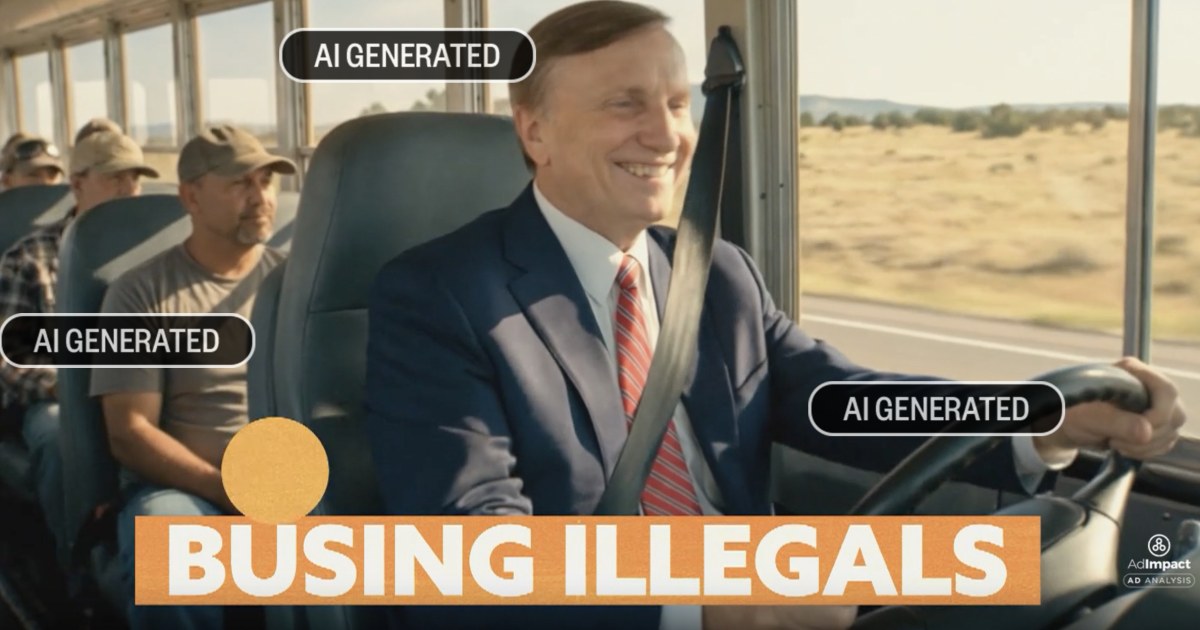
In one ad, reviewed by Noticias Telemundo, Fleming appears driving a bus with a Mexican flag, falsely suggesting that he was transporting immigrants from the southern border to U.S. territory.
Fleming denounced the ads as “highly dishonest” and deceptive, as they showed him endorsing policies that he has never supported. They were also designed “to make you look unattractive physically,” he said.
Although he acknowledged that those aspiring to public office are exposed to criticism and scrutiny — and that lies are also spread without AI — he insisted that political ads must be based on “truths.”
His constituents were “very upset” about the videos, Fleming said, and although he said he tried to convince them that they were fake, “when you are outspent by a ratio of 20 to one, your voice is not heard.”
In an interview with a local station,Letlow distanced herself from the AI ads targeting Fleming, claiming they were from PACs with which she had no connection and indicated that she was “not a fan” of AI in political campaigns.
She also criticized Fleming for sharing on his social media an AI-generated video of herself in which she can be heard talking about her husband, Luke Letlow, who died from Covid complications days before he was to take office as a representative of Louisiana’s 5th Congressional District.
Letlow now occupies that seat after a special election.
Letlow has said that Fleming “crossed the line” with the AI-generated ad. “Releasing this video is shameful and indefensible. The family is off-limits, period,” she said. Her office did not immediately respond to a request for comment.
When asked about the video, Fleming said that “the ad was from someone else, and all I did was post it temporarily, but it was actually very accurate.”
Other Republican figures in the state asked Fleming to remove it. Ultimately, the person who created it was the one who deleted it
Deny, deny, deny
Given the growing popularity of artificial intelligence in the political arena, candidates will have to dedicate increasing amounts of time to debunk AI-generated advertisements circulating against them
This is especially true as the technology advances to the point where it becomes more difficult to distinguish what is real, and people doubt everything they see.
Both Evette in South Carolina and Fleming in Louisiana said it’s necessary to have safeguards to distinguish and clearly mark this content.
“I don’t think that AI is the issue per se,” said Fleming, who mentioned that there were ads generated with this tool that supported his campaign using humor. “I think it’s whether you use AI in a productive and positive and truthful way.”
Doubting some candidates is not “intrinsically bad,” Panditharatne of the Brennan Justice Center said, but the issue is the corrosive effect of distrusting electoral processes or institutions.
Another risk to democracy, Panditharatne pointed out, is that some politicians will dismiss truths in what is known as the liar’s dividend.This means “disregarding or rejecting credible and authentic evidence by attempting to discredit it as false or AI-generated.”
To combat that, digital literacy initiatives are necessary to encourage voters to carefully analyze what they consume without denying the reality of everything they see, Panditharatne said, since “that’s not healthy either.”
An earlier version of this story was first published in Noticias Telemundo.
