

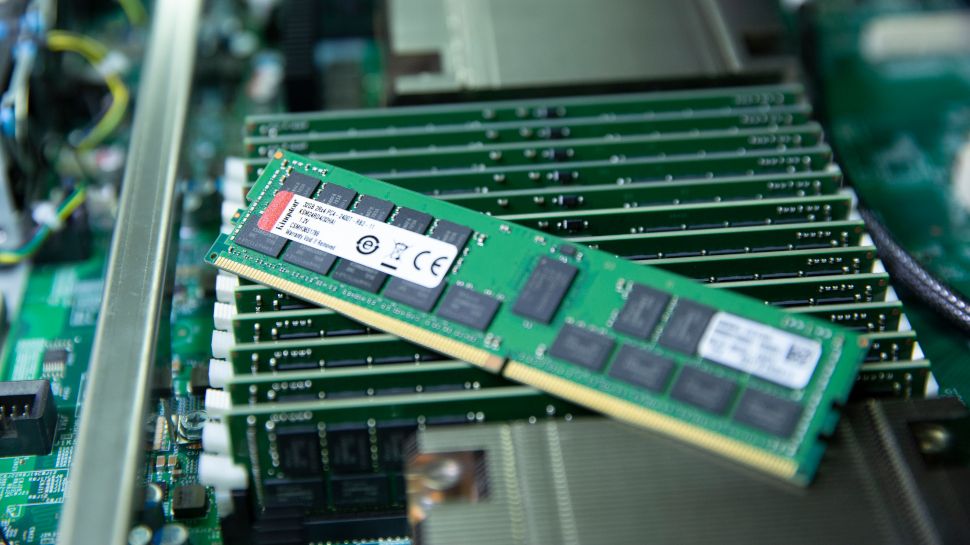
- Counterpoint says global DRAM revenue rose 369% year over year in Q3 2026 to nearly $200 billion on AI data center demand
- The 369% increase in revenue figure comes at a time when shipments are up only about 4%, with a price surge doing most of the work
- Samsung, SK hynix and Micron booked record profits as phone and PC shipments fell about 20%, and suppliers see tight supply into 2028 and beyond
New figures have claimed the worldwide memory business has posted another incredibly strong quarter as demand continues to rise.
Global DRAM revenue jumped 369% year over year in the third quarter of 2026 to just under $200 billion, Counterpoint Research reported, as demand for AI accelerators and data center servers kept supply tight and pushed selling prices to new records.
The increase overwhelmingly comes directly from higher prices rather than the volume of memory chips increasing in the market as it struggles to cater to overwhelming AI demand.
Same chips, much bigger invoices?
A revenue increase due to surging prices is not unusual, but in this market, the gap between the two is unusually narrow: Bit shipments rose only about 4% in the quarter, Counterpoint analyst Jeongku Choi said in comments published byThe Register, indicating that the increase in revenue comes at a time when supply remains relatively price inelastic.
In a nutshell, this means memory makers are charging a significant premium over previous pricing, even as Counterpoint cites higher average selling prices as the main engine of growth, with the blended DRAM price reaching $1.90 per gigabit. Choi puts it more bluntly: “AI has turned memory from a commodity into a valuable scarce resource,” with buyers now scrambling to secure allocation instead of haggling.
The trajectory is steep even by the standards of this cycle. Counterpoint put first-quarter DRAM revenue at $97 billion, up 260% year over year, so the market has roughly doubled again in six months.
Counterpoint research director MS Hwang described the per-unit shift in starker terms in an October 28 2026 note on SK hynix’s results, saying DRAM prices that once sat at 20 to 30 cents per gigabit have climbed to about $2 per gigabit, with HBM4 heading toward $4 per gigabit.
For scale, Counterpoint’s January 2026 price tracker put the previous supercycle’s 2018 peak at about $1 per gigabit for server modules, so today’s blended average sits close to double that high-water mark, even if the two measures are not a perfect like-for-like comparison, as it skips certain aspects such as surging raw material costs.
At the component level, the jump is easier to picture. The contract price of a single 16Gb DDR5 chip climbed from $8.70 in October 2025 to $48 by September 2026, according to figures cited by Fortune, an increase of more than 450%.
What has changed is the pace, not the direction. Counterpoint says increases slowed after the steep run-up of the first half, and TrendForce expects conventional DRAM contract prices to rise a further 10% to 15% quarter over quarter in Q4.
Barclays data shows contract prices up 24% for DDR4 and 20% for DDR5 over the prior three months, and the benchmark DDR4 8Gb PC chip set another record in October at $27.50, up 5.8% on September
Interestingly, NAND is a different story: the 128Gb MLC benchmark held flat at $30.61, ending a 21-month run of back-to-back increases. Some in the channel think the top is near. Transcend chairman Peter Shu expects DRAM and NAND prices to level off, seeing limited room for further increases but little chance of declines.
TrendForce sees the opposite risk, saying in a November 6 report that DRAM price increases should gain further momentum in the first quarter of 2027. It is important to note that almost no one in the supply chain is forecasting a fall.
A switch to consumer-grade components?
The most consequential detail in Counterpoint’s report is easy to miss: HBM’s share of DRAM revenue actually fell in the quarter, even though HBM revenue nearly doubled, because conventional DDR and LPDDR memory grew faster still.
“The rise of agentic AI is driving unprecedented demand for conventional DRAM,” said Brady Wang, associate director at Counterpoint, highlighting a trend in which AI demand is seeping into more consumer-grade components.
That shift matters to anyone shopping for a laptop or phone. Agentic workloads rely more heavily on general-purpose CPU servers with standard DDR5 memory, not just on GPU-attached HBM, which puts PC and smartphone makers in direct competition with hyperscalers for the same fab capacity.
OpenAI CEO Sam Altman made that competition explicit on the Cheeky Pint podcast, calling it “quite terrible” for so much of the world’s limited DRAM to sit in personal computers. Two days after the episode aired, he met around 50 Samsung executives in Yongin, though neither side has reported a memory supply deal. Following a backlash, Altman said his remarks had been taken out of context, posting “I want you to have so much RAM” on X.
The revenue surge meant that Samsung kept the top spot with 38% of DRAM revenue and posted a record third-quarter operating profit of 107.4 trillion won, roughly $80 billion. Yet its own phone business is among the casualties: Samsung’s mobile and network division reported an operating loss of about 600 billion won for the quarter, attributed to rising memory costs. SK hynix reported an operating profit of 83 trillion won, up 632% year over year, according to Counterpoint, with quarterly revenue topping 100 trillion won for the first time. Micron’s fiscal fourth-quarter revenue rose 379% to $54.23 billion on a gross margin of 86.8%.
The other side of that ledger shows up across consumer tech. Global smartphone shipments fell 20% year over year in the third quarter, the weakest third quarter since 2012, and Counterpoint says retail phone prices are up around 20% this year. IDC counted 62.7 million PCs shipped in the quarter, down from 78.5 million a year earlier, while TrendForce estimates the CPU, RAM, and SSD now account for 68% of the bill of materials in a typical $900 notebook.
Counterpoint expects suppliers to set fresh earnings records again next quarter, and the manufacturers are in no hurry to promise relief.
SK hynix titled a section of its results release “Memory supply shortage to persist through 2030,” Micron says supply and demand will be much tighter in 2027 and 2028 than in 2026, with its first new Idaho fab not producing wafers until mid-2027, and concedes it has no “line of sight to when supply and demand will return to balance.” Team Group CEO Gerry Chen went further on his company’s November 2 earnings call, as reported by Fortune, predicting “no downward price trend whatsoever” next year and warning that the shortage will reach a point where “even money can’t buy goods.”
Those forecasts deserve some skepticism. Memory has historically been among the most violently cyclical corners of the chip industry, and the companies making these predictions profit handsomely from them, especially with roughly 90% of global supply in the hands of a few giants. Harvard Business School professor Willy Shih, cited by Fortune, notes that memory booms have always ended once new supply arrives, which he expects to arrive in late 2027 or 2028.
What is genuinely different this time is the contract structure. Micron alone has signed 26 multi-year take-or-pay agreements, which it estimates will cover more than 35% of its revenue through 2030, backed by $32 billion in customer commitments. Hwang argued in his October note that stronger capital discipline could change the memory cycle itself.
If that holds, a cooling in AI demand would not quickly translate into cheaper RAM, because a growing share of future supply is already spoken for. For PC builders and phone buyers waiting for a crash that might never happen, current prices persisting might be the most sobering result of all.
