

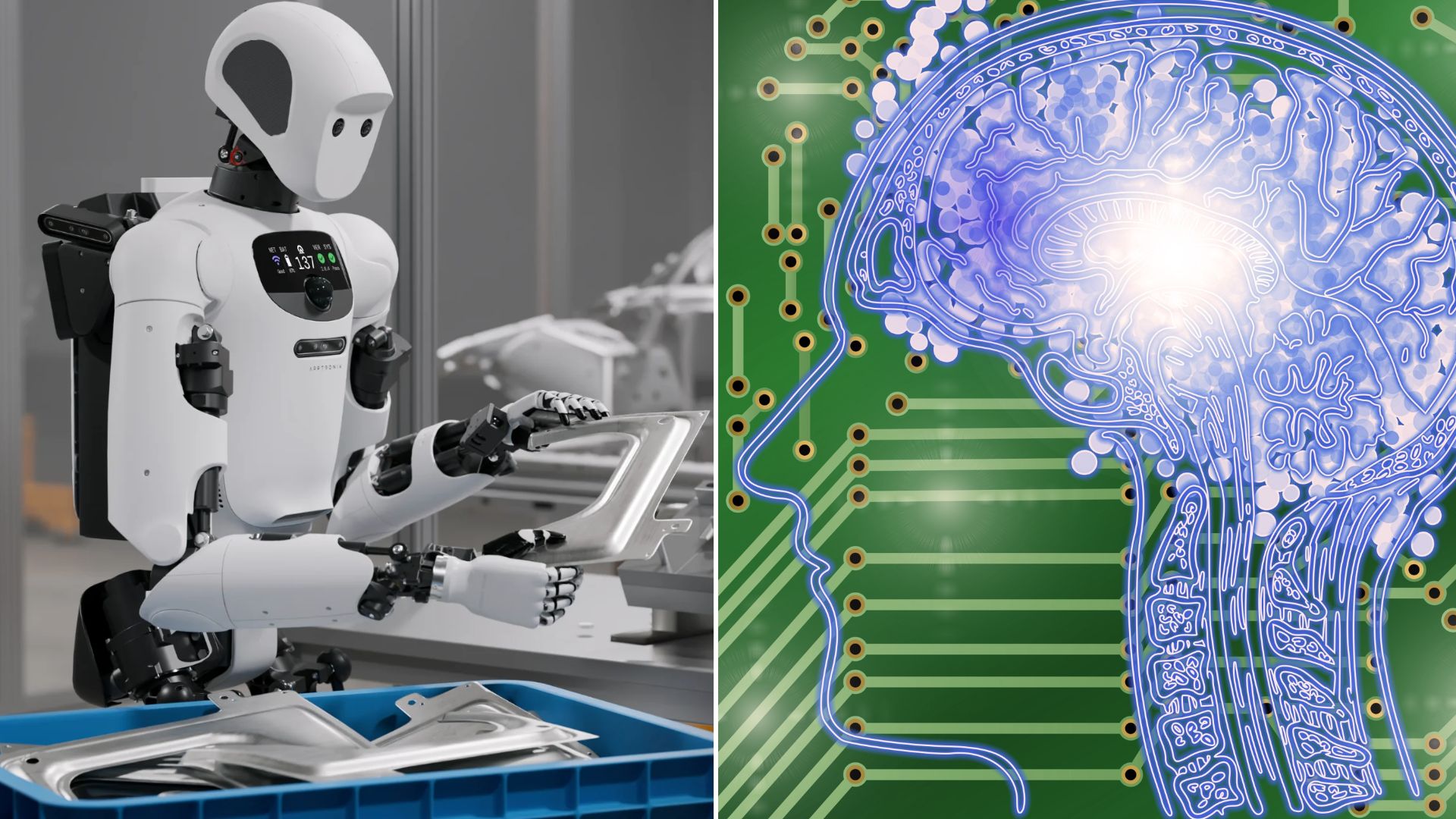
Key Takeaways
-
AI agents are autonomous software systems that use reasoning models and APIs to execute multi-step digital workflows across enterprise applications.
-
Physical AI embeds intelligence into hardware, such as robots and autonomous vehicles, using sensors, world models, and edge compute to navigate real-world physics.
-
While digital AI agents can often roll back software mistakes, physical AI operates under strict millisecond latency and safety constraints because errors carry real-world physical consequences.
Today’s Artificial intelligence has evolved far beyond simple chatbots that merely answer questions or generate text. Two major branches of autonomous AI now dominate engineering and enterprise roadmaps. AI agents and physical AI.
While both are built to pursue goals independently rather than waiting for step-by-step human prompts, they operate in fundamentally different environments. One moves bits across software networks, while the other moves atoms in the real world.
Understanding where AI agents end and physical AI begins is essential for engineers, developers, and businesses deciding how to automate digital workflows versus physical operations.
How AI agents automate digital workflows
AI agents, often referred to as agentic AI, are autonomous software systems designed to plan, reason, and execute multi-step tasks inside digital environments. According to IMEC and enterprise software architectures, standard generative models simply respond to a prompt and leave the human user to act on the output.
An AI agent takes an overarching objective, breaks it into logical subtasks, accesses external software tools or application programming interfaces (APIs), and carries out the workflow end to end. Under the hood, AI agents typically pair large language models (LLMs) or reasoning models with memory modules, orchestration frameworks, and standardized connectors such as the Model Context Protocol (MCP).
More from AI and Robotics
See All
AI and RoboticsWhen AI knows too much: The hidden risks of our digital lives
AI and RoboticsThis shape-shifting robot looks like real transformer; can bend, grab and combine for new role
AI and RoboticsSoft-armed drone uses rolling cam joints to squeeze through tight spaces at 4.5 mph
AI and RoboticsNew OpenAI benchmark tests how well models reason through complex drug discovery tasks
AI and RoboticsTrump warns US tech firms of massive taxes for overseas data centers amid China fears
When tasked with resolving a supply-chain delay or debugging a software repository, an AI agent can query databases, write and test code, update enterprise resource planning (ERP) records, and send notifications without continuous human hand-holding. Its inputs are text, code, structured data, and digital signals; its outputs are API calls, file edits, and software transactions.
How physical AI interacts with the real world
Physical AI extends autonomous intelligence out of the cloud and into embodied machines, including humanoid robots, autonomous vehicles, warehouse mobile manipulators, and industrial drones. Rather than processing static text or database rows, physical AI systems must perceive, predict, and act upon continuous, messy real-world physics such as gravity, friction, inertia, and shifting lighting.
To operate safely alongside humans, physical AI combines multimodal sensor arrays, cameras, LiDAR, radar, force-torque sensors, and accelerometers with specialized models that map sensor data directly to motor commands. In a 2025 arXiv paper introducing the Cosmos World Foundation Models, NVIDIA researchers detailed how video- and physics-aware foundation models help robots internalize real-world dynamics in simulation before deploying to physical hardware.
Unlike digital agents that output text or software commands, physical AI outputs real-time actuator torques, joint trajectories, and navigation paths, often running directly on edge processors to avoid network latency.
Key engineering differences and failure stakes
The clearest distinction between AI agents and physical AI lies in their operating constraints and the cost of errors. An AI agent runs inside deterministic digital infrastructure where actions can often be rolled back, sandboxed, or audited in logs if a model hallucinates or misinterprets an instruction.
Physical AI enjoys no such undo button. If a vision-language-action model misjudges the weight of a fragile component or fails to detect a wet factory floor, the result can be a dropped payload, damaged machinery, or injury to nearby workers.
Consequently, physical AI requires closed-loop control running at millisecond intervals, strict safety guardrails, and extensive simulation-to-reality (sim-to-real) training to handle unpredictable edge cases that never appear in purely digital workflows.
Where the two technologies converge
Despite their differences, AI agents and physical AI are increasingly deployed together as complementary layers of autonomous operations. In new-generation smart factories and automated logistics hubs, software-based AI agents handle high-level orchestration, forecasting inventory shortages, scheduling maintenance windows, and dispatching fleet orders while physical AI systems execute the hands-on picking, transport, and inspection on the floor.
Together, digital agents provide the operational brain across enterprise software, while physical AI provides the eyes, hands, and wheels in the physical world.
50% off your first year of IE+
$20.99first yearRegular price$41.99
Renews at $41.99/year after the first year.Cancel anytime.
Kaif Shaikh is a journalist and writer passionate about turning complex information into clear, impactful stories. His writing covers technology, sustainability, geopolitics, and occasionally fiction. A graduate in Journalism and Mass Communication, his work has appeared in the Times of India and beyond. After a near-fatal experience, Kaif began seeing both stories and silences differently. Outside work, he juggles far too many projects and passions, but always makes time to read, reflect, and hold onto the thread of wonder.
- 1US Navy plans massive 600-ton hypersonic missile upgrade for USS Zumwalt destroyer
- 2This shape-shifting robot looks like real transformer; can bend, grab and combine for new role
- 3US firm to advance rapid carbon-carbon manufacturing for hypersonic applications
- 4US ally bombarded with ballistic missile, jet-powered drones by nuclear enemy
- 5China’s new 7-seat electric minivan can add 249 miles in 15 minutes
