Close Menu
MyAppsPlus

    Subscribe to Updates

    Get the latest creative news from FooBar about art, design and business.

    What's Hot

    “Not even Secretlab’s Titan Evo has these”: I’ve never tested a gaming chair with features like this Boulies model — and it beats key rivals on price, too

    September 12, 2026

    Apple on wide Android foldables beating iPhone Duo; ‘they got the aspect ratio’

    September 12, 2026

    5 Android Phones Better Than iPhone 17 Pro in 2026

    September 12, 2026
    Facebook X (Twitter) Instagram
    Facebook X (Twitter) Instagram
    MyAppsPlusMyAppsPlus
    Saturday, September 12
    • Home
    • Breaking Tech
    • Apps & Software
    • AI & Automation
    • Android
    • iPhone & iOS
    • More
      • Reviews
      • How-To Guides
      • Deals & Discounts
      • Shop
    MyAppsPlus
    Home»AI & Automation»Grant-funded physics research uses AI to explore deep within the Earth
    AI & Automation

    Grant-funded physics research uses AI to explore deep within the Earth

    myappsplusBy myappsplusSeptember 11, 2026003 Mins Read
    Share Facebook Twitter Pinterest Copy Link LinkedIn Tumblr Email Telegram WhatsApp
    Follow Us
    Google News Flipboard
    Grant-funded physics research uses AI to explore deep within the Earth
    Share
    Facebook Twitter LinkedIn Pinterest Email Copy Link

    For over two decades, Clark Physics Professor Arshad Kudrolli has studied the flow of fluids and gases that erode and reshape the Earth underground. His foundational research contributes to identifying new energy and water sources, preventing human-induced earthquakes during fracking, and storing carbon beneath the land, allowing industries to cut greenhouse gas emissions.

    Now, funded by a two-year, $125,000 New Directions grant from American Chemical Society’s Petroleum Research Fund, Kudrolli will introduce AI — specifically, “physics-informed neural networks” — to develop models that will be tested via physical experiments in the lab. Working with a Ph.D. student and an undergraduate student, he seeks to develop a more efficient, accurate process to reconstruct and predict changes in porous rocks and sand beneath the Earth’s surface, pinpointing underground flows of hydrocarbons and water.

    “The materials underneath us are constantly evolving, shaped by flows due to the interaction between water and sediments. Pores open or close, depending on whether there is erosion or deposition,” he explains.

    “With advances in computers and training models, we can explore questions we were not previously able to. For example, if I measure the speed of the flow in certain places, and give the neural network these references, can I reconstruct what the entire basin looks like, even in regions I do not have access to?”

    However, human-brain-inspired neural networks — which scientists train to search for patterns in huge amounts of data — are not always “smart.” If the research team were to feed data on underground structures and fluid flow to a neural network, “it would make wild guesses and completely ignore the physics, which is important in determining these flows,” Kudrolli says.

    To avoid these miscalculations, the researchers will introduce Darcy’s Law — the equation used to describe how fluids flow through porous earth — as constraints on the neural network, forcing it “to respect the underlying physics,” he says.

    “This is a significant departure from purely data-driven machine learning models that don’t consider underlying physical principles,” Kudrolli explains.

    Ultimately, this AI-driven modeling could make underground exploration projects less expensive and invasive, he says. Applying the laws of physics, the neural network could discard nonsensical or improbable scenarios, and surveyors could become more precise in their explorations for water and hydrocarbons.

    “Instead of a surveyor digging everywhere and destroying the field to determine where fluids are located, we can start with computers,” Kudrolli notes. “We can give the neural network a few data points to determine where a surveyor might dig a hole for measuring and figuring out what is hidden beneath the surface.”
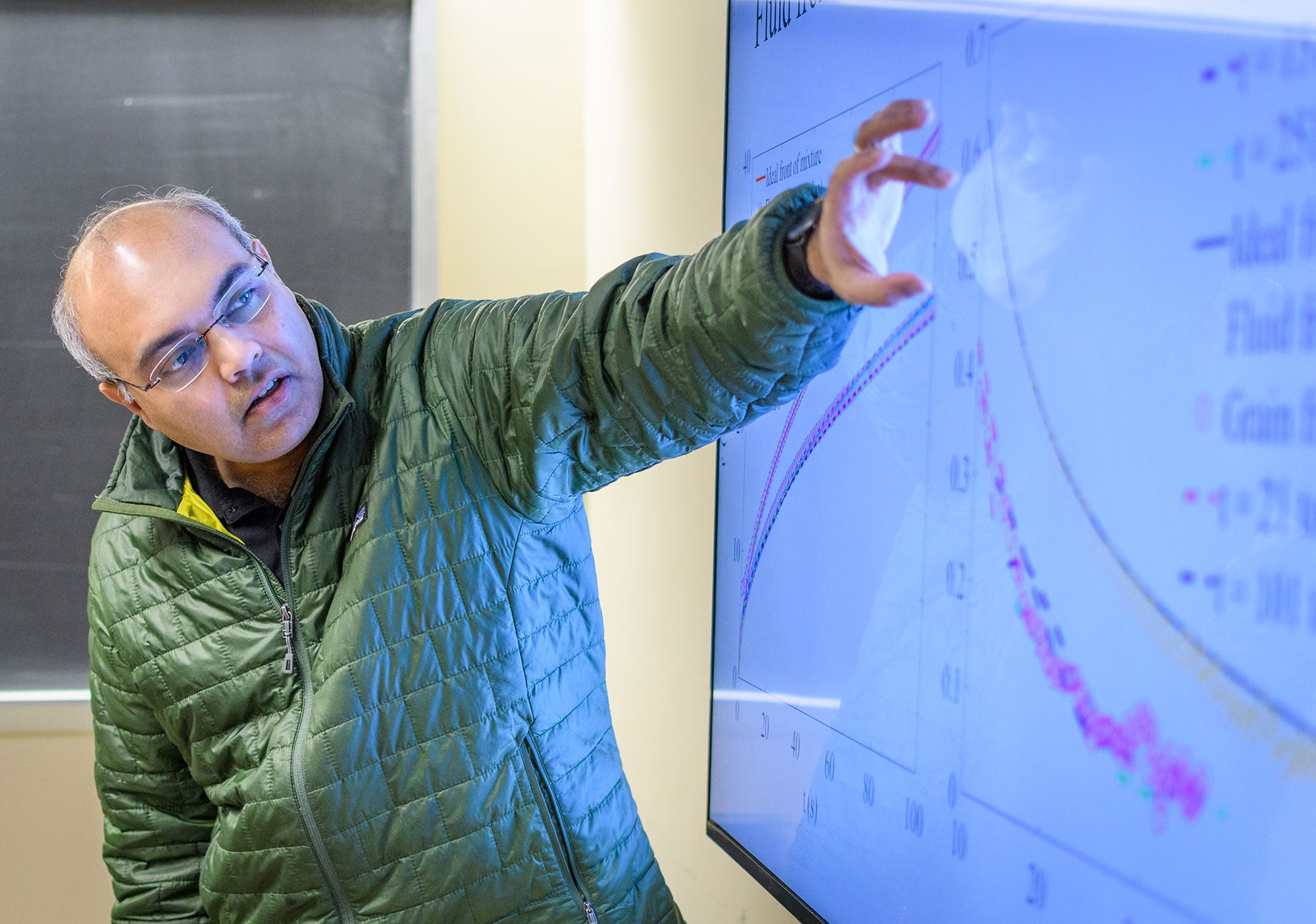
    Arshad Kudrolli teaching in the classroom

    Although their research could contribute to identifying new pockets of hydrocarbons like oil and gas, Kudrolli says he’s even more excited about the potential to uncover additional sources of water underground.

    “As time goes on, water will become more challenging than petroleum. There will be a point where we may not need as much petroleum, but we will certainly need clean water,” he says. Access to clean water now affects three-quarters of the world’s population, according to the United Nations University Institute for Water, Environment and Health.

    Kudrolli’s research team could explore questions crucial to uncovering new water sources, he says, like, “How is the subsurface shaped, which determines how the water flows? Or if you have a pollutant at one location underground, how far does it spread?”

    Answering such questions and making predictions about shifts in the subsurface could ultimately help us adapt as the Earth changes, he points out.

    “We know more about faraway galaxies,” Kudrolli says, “than we do about the Earth just a few miles underneath us.”

    Explore Grantfunded physics research uses
    Follow on Google News Follow on Flipboard
    Share. Facebook Twitter Pinterest LinkedIn Tumblr Email Copy Link
    myappsplus
    • Website

    Related Posts

    Anthropic boss Dario Amodei calls for AI development to slow down

    September 12, 2026

    More AI: Boaz Levy describes the future battlefield

    September 12, 2026

    Deepfakes are wrecking influencers’ credibility, one fake ad at a time

    September 12, 2026
    Add A Comment
    Leave A Reply Cancel Reply

    Top Posts

    The 6 AI-free Linux distros I recommend most

    August 19, 20263 Views

    AI, automation, robot dogs ensure on-site nuclear safety

    September 7, 20262 Views

    This tiny AI box could save me from upgrading my perfectly good laptop

    September 6, 20262 Views
    Latest Reviews

    Apple Wallet driver’s licenses are coming to North Carolina, but there’s a catch

    myappsplusAugust 18, 2026

    3 Japanese AI Stocks Turning Automation Spending Into Real Revenue

    myappsplusAugust 18, 2026

    Apple: DOJ’s latest challenge in antitrust case ‘fails at every level’

    myappsplusAugust 18, 2026
    Stay In Touch
    • Facebook
    • YouTube
    • TikTok
    • WhatsApp
    • Twitter
    • Instagram

    Subscribe to Updates

    Get the latest tech news from FooBar about tech, design and biz.

    Most Popular

    Apple Wallet driver’s licenses are coming to North Carolina, but there’s a catch

    August 18, 20260 Views

    3 Japanese AI Stocks Turning Automation Spending Into Real Revenue

    August 18, 20260 Views

    Apple: DOJ’s latest challenge in antitrust case ‘fails at every level’

    August 18, 20260 Views
    Our Picks

    “Not even Secretlab’s Titan Evo has these”: I’ve never tested a gaming chair with features like this Boulies model — and it beats key rivals on price, too

    September 12, 2026

    Apple on wide Android foldables beating iPhone Duo; ‘they got the aspect ratio’

    September 12, 2026

    5 Android Phones Better Than iPhone 17 Pro in 2026

    September 12, 2026

    Subscribe to Updates

    Subscribe to our newsletter and get the latest tech news, app updates, AI trends, smartphone reviews, and exclusive deals delivered straight to your inbox.

    Facebook X (Twitter) Instagram Pinterest
    • About Us
    • Get In Touch
    • Disclaimer
    • Privacy Policy
    • Terms & Conditions
    © 2026 MyAppsPlus. All Rights Reserved.

    Type above and press Enter to search. Press Esc to cancel.