

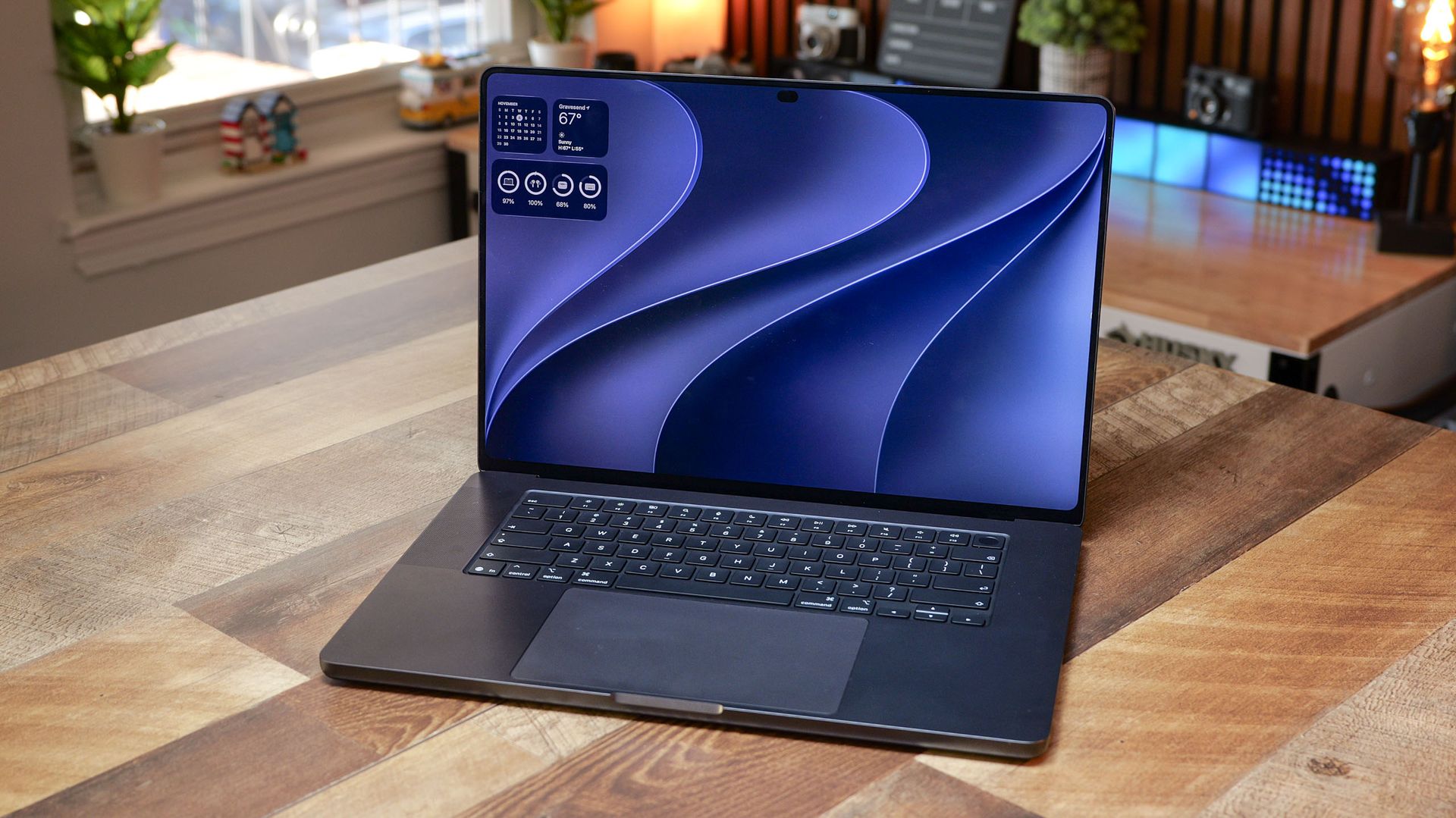
If you read any review for Apple’s new MacBook Pro, you will see a lot of folks drooling over the new PROLED XDR display. And they’re not wrong — flawless color calibration, a new touchscreen interface and up to 2,000 nits of peak brightness.
But if you look past the shiny new Dynamic Island, you’ll see a darker reality. One where what I like to call “OLED washing” is happening.
Apple didn’t build a machine for the next generation of computing (local AI). They built a $2,899 luxury item. If you want to see what a real, weaponized local AI computer looks like in 2026, you need to look away from Cupertino and start looking more closely at the better value-for-money monsters being built with Nvidia’s RTX Spark and AMD’s Strix Halo inside.
The elephant in the room: memory
Yes, we are currently living through RAMageddon, a brutal memory shortage driven by enterprise data centers hoarding silicon. While I do see cracks in this cloud AI bubble, it’s going to be here for a while.
Apple’s response to this was to slap a near-three racks starting price on the 14-inch PROLED MacBook Pro and give you a paltry 24GB of unified memory.
It’s both overkill in some ways — that tandem OLED screen might be worth it if you are a Hollywood color grader editing 8K ProRes video for example.
But in others, for those moving into the era of ditching the data center and running local agentic AI directly on our hardware — 24GB is a tough pill to swallow.
It’s effectively a multi-million dollar mansion with only one bathroom. It looks gorgeous from the street, but the moment you invite guests over (or spin up a local 70B parameter LLM), the plumbing completely collapses.
The portable data centers taking its place
While Apple is obsessing over making their chassis lighter and adding a touchscreen nobody asked for, the Windows ecosystem has been quietly preparing for a value war.
Just a few weeks ago, I balked at the high $5,899 price tag for the 128GB version of the Microsoft Surface Laptop Ultra that I tested. And then, I saw the equivalently-specced 14-inch MacBook PROLED come in at $7,099 ($7,399 for the 16-inch).
And yes, the PROLED does have a much better display, better CPU performance and a longer battery life. But, are those uplifts worth an additional $1,200? I’m not sure.
|
RTX Spark (Surface Laptop Ultra) |
||
|---|---|---|
|
Waterloo Battle Analysis prompt (Meta Llama 3.1 8B) |
61.26 tok/sec |
52.69 tok/sec |
|
Apollo space program history prompt |
67.51 tok/sec |
53.66 tok/sec |
Plus if you are leaning more towards local AI, the tokenomics of an RTX Spark are a little better than M5 Pro too. M5 Max isfaster, but you’ll have to pay much more for that (as you can see).
If the tandem OLED is important, then the MSI Prestige N16 Flip AI+ may have a terrible name, but at $6,799, it’s still $300 less.
More bang for your buck with team red
And I haven’t even gotten to the AMD side of things yet. The Strix Halo chip has grown into quite the AI-capable silicon over its life. And that longevity means you can find some good options with more money for muchless money than taking a bite of the Apple.
TUF Gaming A14 (AMD Ryzen AI Max+ 392, 32GB RAM): was $2199 now $2149
This is definitely one for those with more of a gaming persuasion, but it’s a strong chip for local AI workloads with 8GB more memory than the MacBook Pro for much less.View Deal
Yoga Pro 7a (AMD Ryzen AI Max+ 388, 32GB RAM): $2299
If you don’t want to give up the slick utilitarian aesthetic and the OLED display, the Yoga Pro 7a is the option to go for. Still more memory, and still $600 less.View Deal
ROG Flow Z13 (AMD Ryzen AI Max+ 395, 128GB RAM): $3299
Taking things to the next level is what’s essentially a far superior Surface Pro with a monster amount of memory. For context, to get this amount, you’ll need to spend $3,800 more for the MacBook PROLED equivalent.View Deal
So as you can see, whether you want a better balance of memory, want to keep that OLED display, or want to go all out (that Z13 with 128GB for $3,800 less is looking mighty tempting), you can get much more local AI headroom with these machines too.
Form over function
So let me be clear, because I don’t want this to be me dunking on Apple here. The MacBook PROLED has easily won the display and battery life war this year — that screen is a masterclass. But the “why not” era can easily blind you from picks that offer better bang for your buck.
Apple’s charging you $3,000 for a reference monitor so you can have a prettier interface when you ask Siri to summarize your emails. Meanwhile, the RTX Spark and Strix Halo laptops give you the raw compute and massive memory pools to actually build this local agentic future on your desk.
- I just reviewed the MacBook Pro with PROLED XDR Display — Ask me anything!
- I waited years for the iPad mini 8, so why do I feel like Apple is ripping me off?
- Did the AI bubble just pop? $2 trillion reality check hits Nvidia, Meta & SpaceX as Wall Street panics, signaling a potential end to RAM crisis in 2027
