

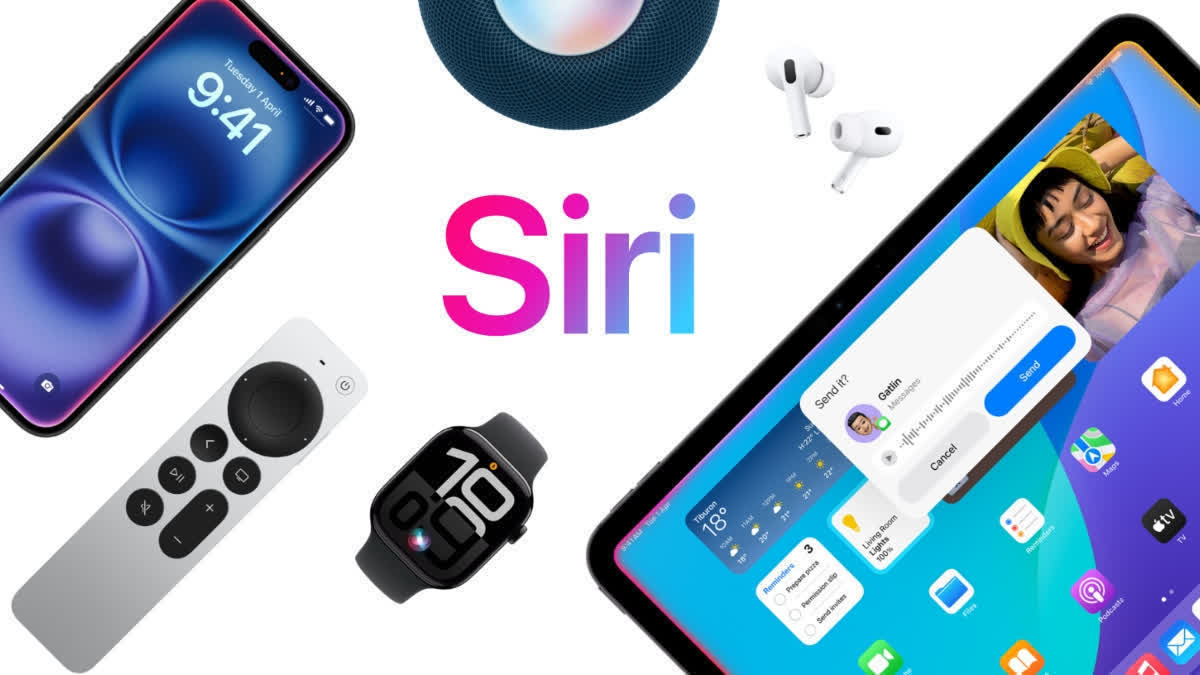
Apple wants Siri AI to take actions on users’ behalf, like rival AI agents, changing how iOS 28 is built, says Bloomberg’s Mark Gurman.
Representational Image (Image Credit: Apple)
Hyderabad: Apple plans to turn Siri AI into an “autonomous agent” that can take actions for users. According to the latest edition of the weekly newsletter Power On by Bloomberg’s Mark Gurman, the company is also said to be changing how it builds iOS 28 and iPadOS 28. He says John Ternus, Apple’s new CEO, wants Siri AI to work more like rival Artificial Intelligence (AI) agents. These include OpenAI’s Dots, Meta’s Muse, and Grok from Elon Musk’s SpaceXAI.
Where does Siri AI stand today?
Apple reintroduced Siri AI at its Worldwide Developers Conference (WWDC) in June this year. It later arrived on compatible devices with the iOS 27 update. The launch came more than two years after Apple first promised a revamped, AI-powered Siri.
Today’s Siri AI can handle basic tasks. It can draft emails and messages, and set reminders and calendar events. It can take some actions inside third-party apps, and a few more inside Apple’s own apps.
Apple recently released the iOS 27.3 beta, which adds “advanced in-app actions” for Siri AI. Even so, the assistant still lacks many features offered by Dots, Muse and Grok.
What are AI agents?
OpenAI, Meta, and other AI labs describe their agents as an “AI companion”. It runs in the background and acts for the user when needed. Users can hand over repeated and dull tasks to it.
Dots and Muse can also watch different platforms for changes and alert users when something changes. They can give summaries of important work updates through connected apps and platforms.
What could change for Siri AI?
Gurman says the abilities of the new Siri AI could arrive “as soon as next year”. They would let iPhone, Mac, and iPad users hand off tasks to the assistant. Apple would be aiming to match the do-it-for-me style of its rivals, rather than just answer simple requests.
The newsletter also says Apple has changed how it builds its next iOS and iPadOS updates. Development is now split into three stages, called M1, M2, and M3. Each stage lasts eight weeks.
The M1 stage used to be split into two four-week sprints. Gurman says Apple has now asked its software engineers to spend six weeks coding, exploring, and building features for iOS 28. They will then spend two weeks bringing the work together.
In simple terms, engineers get more time to build before they have to combine their work.
Why it matters?
The AI assistant race is heating up. Rivals already market their tools as helpers that can work for users in the background. It the newsletter turns out to be true, then Apple wants Siri AI to do the same across iPhone, iPad, and Mac.
Apple has not confirmed these plans. As the details come from a report, they may change before any launch. For now, users can expect more Siri AI features in the iOS 27 updates, with bigger changes possibly arriving next year.
