

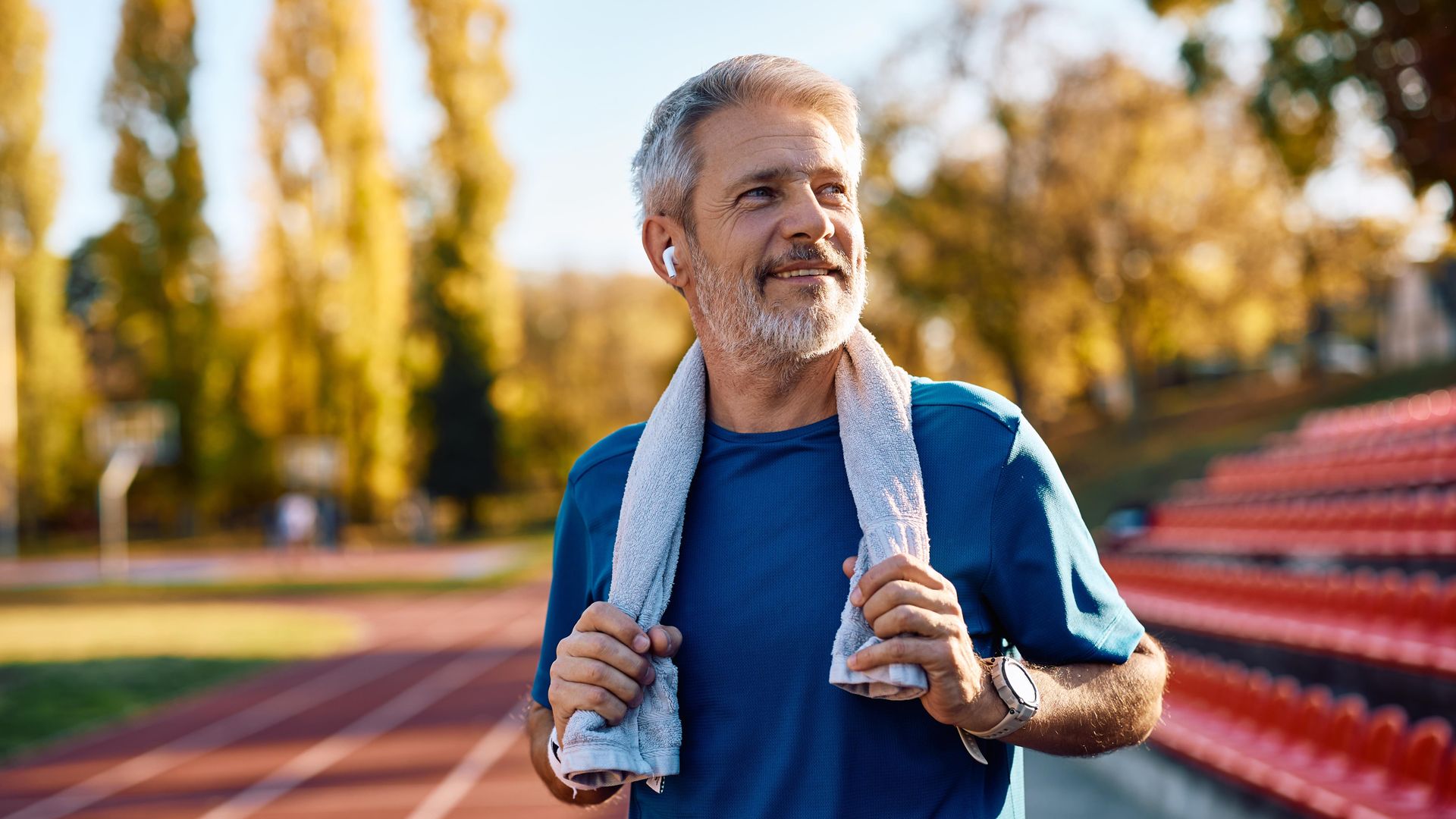
I’ve been training my dad for roughly six years, and one element of his training I’ve been really ramping up lately? Core work. It’s all well and good watching him get stronger, more mobile and better balanced, but a strong core reduces pain, minimizes risk of injury and helps you move well as you age.
There are essential strength exercisesin his routine already, but we often work on his core strength at the end of sessions. We try to stay as low-impact as possible, supporting his back while focusing on building deep core stability. My dad has sciatica, so keeping his spine and glutes strong and active is crucial.
As you get better and stronger, you can adapt the load, reps and sets to suit your needs. If you’re ready to get started, check out the three exercises below.
- Clamshells 3-4 sets of 8 heavy banded reps:Lie on your side with your hips, knees and ankles stacked. I recommend a heavy-duty loop band above your knees. Lift through your torso so that you don’t dump into your shoulder. With control, open your top knee toward the ceiling, pressing against the band. Slowly lower your knee, keeping the inner sides of your feet together.
- Farmer’s carry 3-4 sets of 50 seconds on / 10 seconds off:Hold two heavy weights in your hands, stand tall and walk up and down for 50 seconds. Keep your core engaged and try not to lean to one side or backward. A slight forward lean is fine, as long as you don’t hunch.
- Weighted overhead squat 3-4 sets 8-10 reps: Stand with your feet roughly shoulder-width apart and press a weight or two weights overhead. Keep your weight stacked over your shoulders. Sit your hips back into a squat, lowering as far as you can without your chest falling forward. Press up using your legs and core muscles to drive the movement.
https://www.instagram.com/p/DeTqxBDiPcm/
If you experience limited mobility in your hips, knees, ankles, or spine, go easy and take these exercises slowly. You could progress by adding weight or slowing the exercises down more.
Clamshells strengthen your glutes, which are powerful muscles that help stabilize your pelvis and protect your lower back. Overhead squats require plenty of core stability to help stabilize the weight overhead while you squat. Again, your core works hard to keep your torso upright and stable while carrying a heavy load during the farmer’s carry. If you choose to carry one weight, this trains your core for anti-rotation, making you more robust.
If you experience pain, or you’re unsure if this exercise is for you due to pregnancy, a health condition, illness, or injury, I recommend seeking medical advice first.
I have my dad hold a weight plate with both hands overhead during overhead squats, but we have been doing this exercise for a long time. You can also wrap a band above your knees and push against it with your legs as you squat. Try to sink your weight into your heels and spread weight to your little and big toes; lift your chest and lower your butt as far as you can.
During squats, I commonly notice heels rising (thoracic, hip, or ankle-related), knees caving in (often lower-joint-related), backs rounding, or a lack of squat depth. It’s better to use your bodyweight first until you improve overall strength and mobility.
Try to keep your spine straight and your shoulders pulled back and down during all exercises, with your core switched and locked on. Imagine bracing for an impact and drawing your breath downward as you move.
- FollowTom’s Guide fitnesson Instagram for more workouts, routines, tips, and tricks.
- Forget sit-ups — this exercise targets your deep core and is great for beginners, seniors, or anyone with tight hip flexors
- The 5 best ways to build muscle without lifting heavier weights
- I train clients over 60, and this is one exercise I use to build lower-body mobility, strength and stability
