

As the old saying goes, all politics is local. And when it comes to data centers, municipalities from sea to shining sea seem to agree: They don’t want ‘em.
The artificial intelligence industry’s power-hungry compute-powering facilities suffered more bruising losses than even the incumbent party. There were 41 different ballot measures across 10 different states proposing moratoriums or restrictions of varying degrees on local data center construction Voters sided against the data centers in 40 of those votes (and have voted against data centers in 46 out of 47 total measures overall so far in 2026)
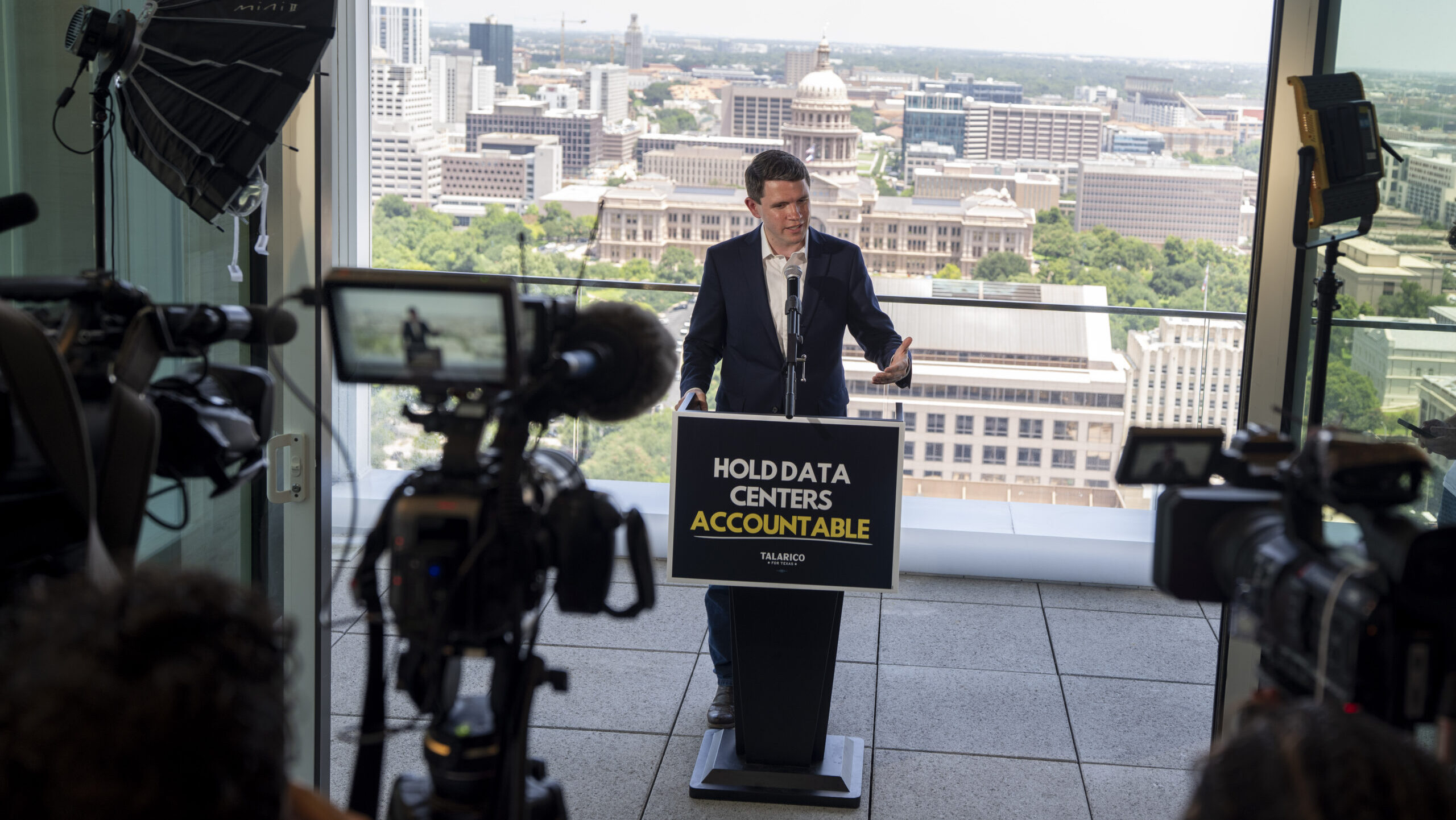
Scores of successful candidates last week ran in part on data center and AI-skeptical campaigns. That includes Texas Governor-elect Gina Hinojosa, now tasked with running a Lone Star State home to one-fifth of planned 253-GW data center pipeline across the country. Meanwhile, 23% of voters said in an NBC News exit poll that data centers played a “crucial” role in their vote, while 33% more said they played a “major” role; 76% said they would oppose the construction of a new data center in their community.
Simply put: Public sentiment is acting as a major circuit breaker for the AI industry’s planned $10 trillion data center build-out and a long pointy pin for any potential bubble. The tech-heavy Nasdaq 100 deflated more than 6% during the broad meltdown on Thursday as the market digested the reality of a stricter regulatory regime. Analysts, meanwhile, began pondering the fate of Anthropic’s forthcoming mega IPO. The company, which flagged political opposition as a possible risk in its S-1 filing, now may face a delay or another valuation haircut for its massive public offering.
So where does the fallout end? Experts say the outcome is likely more gloom than doom, though some industry stakeholders are destined to feel the pain more acutely than others.
Not 60 to Zero
To be clear: The results are more of a brake-check than a complete crashout for the buildout.
Following Tuesday’s elections, existing and proposed state moratoriums only extend to around 40% of planned US data center projects, according to industry-tracking firm Cleanview Energy, and most proposed moratoriums also would not impact projects already in development. Hinojosa’s policy, for instance, would not halt projects that are currently permitted or under construction from moving forward (there are 119 projects now in the construction phase in Texas, according to Cleanview) and only calls for a pause until legislators pass a unified rulebook for future projects.
Developers, in the meantime, will also flee to friendlier territories, be it Florida (which elected a pro-data center governor on Tuesday), foreign countries (as Meta President Dina Powell McCormick suggested at a Wall Street Journal conference this week), outer space (as Elon Musk mused in an X post after the election), Harwood, North Dakota (the one community to vote for data centers in a ballot measure on Tuesday), or elsewhere.
“I think our clients are going to be able to step back and go, ‘All right. This is what the new opportunity map looks like for us. Here’s where we can go,’” Andy Roehr, energy practice managing director at tax and advisory firm Baker Tilly, told The Daily Upside. “I don’t think it’s going to take six months. Capital can’t sit for six months doing nothing. The continuance cost on these things would be brutal. Six months will cost you two years.”
A national moratorium, though floated by Democratic Senator Bernie Sanders this week, appears remote. In sum, Tuesday’s results are likely to slow — and perhaps slightly shrink — the overall buildout. “We estimate 10% of datacenters will not happen now,” noted tech bull and Yorkville Ives Partner and Managing Director Dan Ives forecasted.
Do You Remember When?
On the other hand, local opposition and roadblocks are nothing new, and tech firms and data center developers have for months now been confronted with staunch local demands. The possibility of national reform has also long been on the table, by way of the Ratepayer Protection Act, which passed the House of Representatives in September with widespread bipartisan support and would require data center operators to cover associated infrastructure costs.
Similarly, bottlenecks are already slowing down the process of getting new data centers online, and experts told The Daily Upside that the massive build-out thus far means the good old days of easily finding viable real estate with readily available grid connectivity are already over. That complicates and expands the scope of projects to far beyond just the data center itself, and communities across the country have already grown accustomed to demanding developers ease the burden of simple cost-benefit analyses.
“Communities understand they need to know what their community needs,” Roehr said. “They ask developers, would you be willing to come build a little league field? Would you be willing to rebuild and widen some very old bridges because you’re going to be running concrete trucks and everything else across them, and you’re going to beat the heck out of them? And most developers are, frankly, they’re starting to allow for it in their budget.”
AI firms are starting to change their tones, too. Since the midterms, OpenAI has already published a new policy blueprint that pledges a far friendlier and more transparent tack when approaching communities. It’s a lesson to Sam Altman: Approach with handshakes and gift baskets, not NDAs.
Storm Clouds for Neoclouds
Speed bumps and delays won’t impact firms equally and, as usual in the AI space, it’s the neoclouds sitting on a knife’s edge of financing facing the most risk.
“A moratorium hits whoever is borrowing against capacity that isn’t built yet, and that’s the neoclouds first,” James Mercer, a principal at data center and cloud advisory firm Metro Colo Advisory, told The Daily Upside. “Their GPU loans assume the chips are earning within months. A 12-month delay means paying interest on hardware that sits idle while the customer contracts behind the loan start to slip.”
Neocloud stocks were, predictably, among the hardest hit in this week’s selloff: CoreWeave and Nebius fell 16% each across the week, while IREN fell 10%.
Token of Gratitude: Hyperscalers, predictably, are relatively insulated, given the massively profitable side hustles that Big Tech was built on. But that doesn’t mean a slowdown won’t cause headaches: Mark Zuckerberg has already said that Meta can’t roll out agentic AI platform Muse internationally until the company increases its compute supply (not that Muse was necessarily pulling enough revenue to cover the data center bills anyhow). Leading-edge AI labs Anthropic and OpenAI sit somewhere in the middle of the risk equation. Neither is quite as overleveraged as the neoclouds, though compute constraints could slow down the development of the stronger, future models they need to sell to enterprise clients to continue to spur revenue growth.
Enterprise clients and consumers, by the way, could feel the crunch as well.
“When capacity is tight, AI companies ration first: waitlists, usage caps, slower rollouts to new countries. Price increases come later, and they show up first at the premium end, for the most capable models and for guaranteed enterprise capacity,” Dan Ye, CEO of AI adoption consultancy firm CollegeNode, told The Daily Upside. “Token prices have been falling fast for years. A moratorium probably doesn’t reverse that trend, but it’ll slow it. Consumers won’t see a price spike. They’ll see a price that stops dropping as quickly.”
Count Your Chickens: There is also something of a counterthesis emerging: A slowdown may not matter because the industry was building supply that surpassed demand anyhow. Token spend is quickly moderating among enterprise clients, according to a recent analysis of corporate expense data by Ramp. Advisory firm Gartner’s Chief Forecaster John Lovelock, meanwhile, recently said compute capacity already surpasses demand. The firm predicts 80% of independent neoclouds could cease operations by 2030 due to insufficient returns.
Others say a compute shortage could also force the industry to get creative for its own benefit. “Constraints have a way of changing what engineers consider worth optimizing,” Satyam Dhar, a software engineer at Cisco’s Galileo AI observability platform, told The Daily Upside. “You’ll see more attention paid to model efficiency, smarter inference, better utilization of existing hardware and architectures that can accomplish useful work with fewer resources. … Some of the most important advances in computing have come from exactly that kind of pressure.”
