

Today, I’m trying something different. Instead of another standard “What is Jev?” explainer, I want to answer the questions people are actually asking and clear up some of the hype coming from YouTube, social media, and AI influencers.
I’m looking at Jev as someone who has spent years working with machine learning and natural language processing (NLP) systems, including classifiers, zero-shot classifiers, and language models. And honestly, a lot of what Jev does looks familiar.
That does not make Jev uninteresting. TypeSafe AI appears to have built a new architecture and training approach around a very specific problem. But there is a big difference between improving an existing class of NLP systems and inventing an entirely new kind of AI.
We also still know very little about Jev’s internal architecture, training setup, and model size. So for now, many of the biggest claims depend heavily on TypeSafe AI’s own benchmarks.
What Is TypeSafe AI’s Jev?
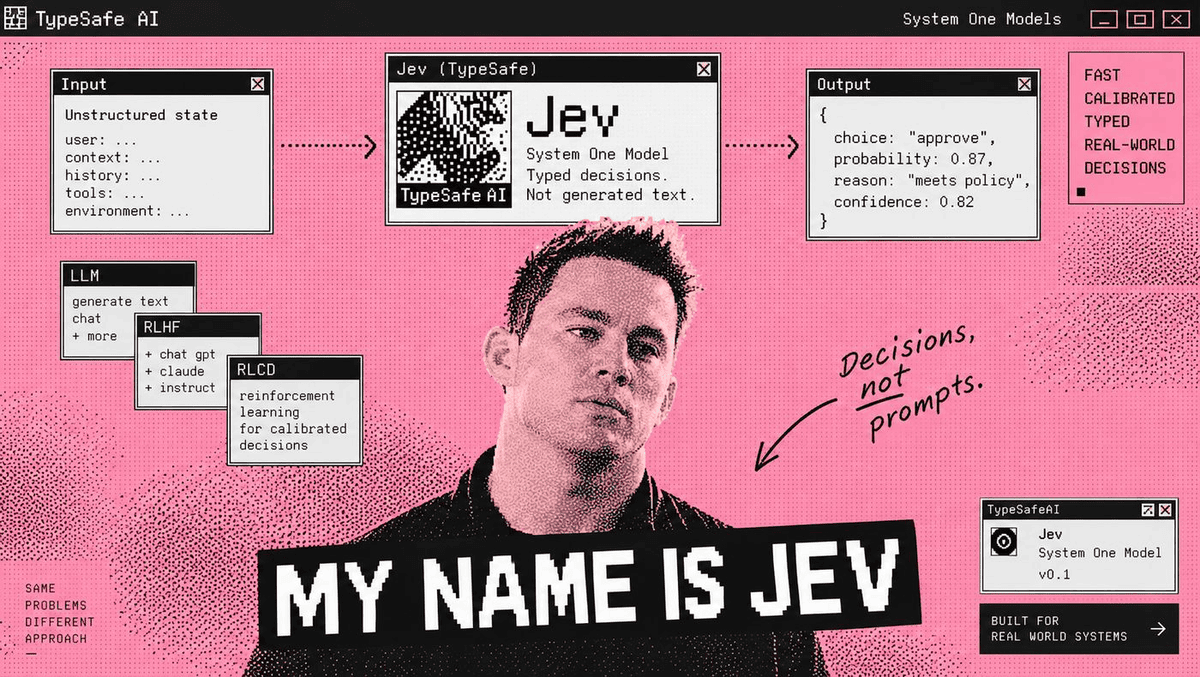
Jev is an AI model built for fast, structured decisions rather than open-ended text generation.
TypeSafe calls it a System One Model, distinguishing it from conventional large language models (LLMs).
Give it a customer message such as:
I upgraded yesterday but now I can't access the features I paid for.Instead of writing a long support response, Jev evaluates the message against a fixed set of choices and returns a probability distribution:
Technical      64%
Sales          23%
Billing        13%
Cancellation    0%
In this case, Jev selects Technical, but the probabilities also show that the request is somewhat ambiguous. That matters because an application can use both the decision and the model’s confidence to decide what happens next, such as routing the ticket automatically or sending lower-confidence cases for review.
Classification, scoring, routing, and intent detection are not new machine learning problems. What TypeSafe AI is doing differently is building a model specifically around these kinds of typed, probabilistic decisions, rather than taking a general-purpose LLM and prompting it to behave like a classifier.
What Is a System One Model?
TypeSafe AI describes Jev as a System One Model, inspired by the idea of System 1 and System 2 thinking.
System 1 is fast and instinctive. It makes quick decisions based on the information available. Jev follows this idea by producing structured decisions and probabilities without generating a long chain of text.
System 2 is slower and more deliberate. This is closer to how reasoning-focused LLMs work when they need to solve a complex problem, plan multiple steps, or work through difficult questions.
For example, if an AI system receives a support ticket:
- System One: “Which team should handle this?” — Technical: 64%
- System Two: “Investigate the problem, determine what caused it, and explain how to fix it.”
The idea is not that one replaces the other. System One is useful for fast decisions, while System Two is useful when deeper reasoning is required.
Is Jev Just a Zero-Shot Classifier?
Jev is very similar in spirit to zero-shot classification.
Zero-shot text classifiers already allow you to provide some text and arbitrary candidate labels without training a dedicated model for those exact categories.
For example, you could give an existing zero-shot model:
Text: "My subscription was charged twice."

Labels:
Billing
Technical
Cancellation
Sales
and get a probability for each label.
NLP engineers have been doing this for years. Modern NLI-based zero-shot classification became popular around 2019–2020, while zero-shot learning itself goes back much further.
But calling Jev just an old zero-shot classifier would also be unfair. TypeSafe AI has designed it around multiple structured decisions, probabilities, parallel inference, and a new calibration-focused training approach.
My view is simple: the problem is old; the architecture and product around it may be new.
Is Jev an LLM?
I would not put Jev in the same category as GPT, Claude, Gemini, or other frontier LLMs.
Those models are general-purpose. They are built for coding, reasoning, tool use, and open-ended text generation. Jev is much narrower. It is mainly built to take text and make structured decisions from it.
You can force modern LLMs to do something similar with structured outputs, function calling, or constrained decoding, but you are still using a large and expensive general-purpose model for a relatively simple classification-style task.
Jev is designed around that narrower job from the start. That is also one of the main reasons it can be much cheaper and faster.
Why Is Jev So Cheap and Fast?
Jev is built for a much narrower task than a general-purpose LLM. Instead of generating text token by token, it is designed to make structured decisions directly and in parallel.
TypeSafe AI attributes Jev’s efficiency to its specialized architecture, parallel sampler, and calibration-focused training.
The broader idea is not new. Models such as Meta’s facebook/bart-large-mnli have long been used for lightweight zero-shot classification.
So the interesting part is not simply that Jev is cheaper than a frontier LLM, but how its architecture is optimized specifically for fast, structured decision-making.
How Accurate Is Jev?
We do not really know yet.
TypeSafe AI reports Jev at around 68% on its own workflow evaluation, but that is not the same as saying Jev gets 68% of real-world decisions correct. The reference answers come from frontier models, not independently verified ground truth.
There are some early independent tests. One small fact-checking test reported 96.3% accuracy, while another test across 275 documents found strong agreement on some classification tasks. But these are still small and limited evaluations.
So for now, I would treat TypeSafe’s result as promising, not as proof of Jev’s general accuracy. We need more independent benchmarks before we really know how well it performs.
Can Jev Really Not Hallucinate?
Technically, yes — but the wording is easy to misunderstand.
If you give Jev the options Billing, Technical, and Sales, it cannot suddenly return Legal. That answer does not exist in the schema.
But it can still choose Billing when the correct answer was Technical.
So Jev can still be wrong.
“Zero hallucinations” is therefore closer to zero out-of-schema outputs, not zero incorrect decisions.
That is an important distinction.
How Does Jev Compare With Frontier LLMs?
On price and speed, Jev should have a clear advantage.
It is a specialized model doing a much narrower job, so it needs less computation and returns much less output. A frontier LLM is built to handle coding, reasoning, long conversations, tool use, and open-ended generation. Jev is mostly making structured decisions.
So if Jev classifies a ticket much faster and for much less money, that is not really surprising.
The more useful comparison is whether Jev can stay close enough in quality on narrow tasks that developers can replace expensive frontier-model calls without hurting the application.
That is where Jev becomes interesting: not because it is faster than a frontier LLM, but because it may be fast and cheap enough while still being accurate enough for the task.
What Is RLCD?
RLCD stands for Reinforcement Learning for Calibrated Decisions, the training method TypeSafe AI says it developed for Jev.
The key word is calibrated. A model can make accurate predictions while still being bad at estimating how certain it is. Calibration means its probabilities should reflect how often those predictions are actually correct.
For example, Jev might return:
Technical:    64%
Sales:        23%
Billing:      13%
Cancellation:  0%
-----------------
Confidence:   53%
The percentages represent how Jev distributes probability across the available choices, while the confidence score provides an additional estimate of certainty around the decision.
With good calibration, decisions made with higher confidence should also be correct more often. This makes uncertainty usable in software: a workflow might automatically act above a confidence threshold and escalate less certain cases for review.
So, unlike RLHF, which trains models toward human-preferred responses, TypeSafe says RLCD optimizes Jev for decisions with probabilities that accurately communicate uncertainty.
What Can Jev Actually Be Used For?
Jev is useful when software needs lots of small decisions, such as routing, classification, scoring, or deciding what an agent should do next.
People are already experimenting with it in real applications:
- Agent routing:blackbarata used Jev to route requests between recipe, scraper, meal-planning, and other agents, reporting decisions in 145–271 ms.
- Model routing:TigerOk4538 compared Jev with a normal LLM using structured output. Jev took around 1 second, compared with 4–14 seconds for the LLM.
- Browser agents:Browser Use built jev-ultrafast, where Jev decides which browser action and element to use. One Google Flights demo completed the task in about 7.1 seconds.
- Ad analysis:Matthew Berman used Jev to analyze 724 ads from 37 brands in about 40 seconds, reportedly costing around $0.09.
So Jev seems most useful as a fast decision layer inside a larger application, rather than as the model generating the final answer.
Is TypeSafe AI’s Jev Actually Revolutionary?
I would not call Jev revolutionary yet.
Classification is not new. Intent detection is not new. Zero-shot classification is not new. Calibrated probabilities are not new. And specialized models being cheaper and faster than huge general-purpose models is definitely not new.
What TypeSafe AI appears to have done is rethink the architecture, training, inference, calibration, and developer experience around these familiar problems.
That could make Jev a very good product.
But that is different from inventing an entirely new form of AI.
Abid Ali Awan (@1abidaliawan) is a certified data scientist professional who loves building machine learning models. Currently, he is focusing on content creation and writing technical blogs on machine learning and data science technologies. Abid holds a Master’s degree in technology management and a bachelor’s degree in telecommunication engineering. His vision is to build an AI product using a graph neural network for students struggling with mental illness.
