

Topping DX1 II: two-minute review
The world is not short of little DAC/headphone amps that want to bring a taste of authentic audio quality to your desktop experience — and here’s another one. The Topping DX1 II is a thorough update of a previous (and very competitive) in the Chinese brand’s stable, and it makes a strong case for itself even before it’s started doing its thing.
The aluminum casework looks and feels good and the on-paper specification is difficult to lay a glove on. It includes — deep breath — a very hi-res ESS DAC, carefully considered digital and analog architecture, USB-C for both power and data, sufficient grunt to drive most headphones without difficulty, a fistful of input and output options (including balanced analog connectivity), and the facility for plenty of end-user input where sound is concerned. The standard of construction and finish is more than adequate. And a little remote control handset takes some of the pressure off an overworked physical control interface.
The difference the DX1 II can make to your audio experience when it sits between, say, your laptop and the headphones that are plugged into it is fairly profound. The Topping is by no means perfect — it doesn’t attack the top of the frequency range quite as willingly as it might, and it doesn’t have the heft to make big dynamic variations as apparent as they might be — but it’s a far more convincing and well-realized listen than your laptop alone has a hope of being. Soundstaging, rhythmic expression, detail levels and all-around musicality all enjoy a big uptick, and the way the DX1 II handles a tonal balance is one of the most uncomplicatedly enjoyable things about it.
The Topping DX1 II hasn’t closed the door on other desktop-friendly headphone amp/DAC units at similar money, but it’s certainly made sure it’s on the inside of the conversation for the best on the market.
Topping DX1 II review: Price & release date
- Announced on May 18, 2026 (with availability from late June/July 2026)
- Priced $119 / £119 (around AU$169)
The Topping DX1 II is on sale now, and in the United States it costs $119. It’s £119 in the United Kingdom, while in Australia it goes for around AU$169.
So, it’s a little pricier than the oh-so-portable iFi Go Link Max and the bigger, hip-flask-esque iFi Uno,say, but an awful lot cheaper than the also-new iFi iDSD GR2.
What exactly are you getting for your money if you go for the Topping? Read on.
Topping DX1 II review: Features
- ESS ES9039Q2M DAC
- Balanced and unbalanced outputs
- UAC 1.0 and UAC 2.0
There’s something quite admirable about the way Topping has specified the DX1 II — I’ve used bigger and more expensive DAC/headphone amps that don’t come close to the level of this little device.
It’s built around a very capable ESS ES90392QM DAC chipset and features dual-DAC architecture with a dedicated digital-to-analog converter for each channel, plus fully independent processing. Digital files of up to 32bit/384kHz and DSD256 are supported.
A 16-core XMOS XU-316 assists with signal processing — just as with the dual-DAC arrangement and the fully balanced analog stage, the idea is to keep noise and distortion to an absolute minimum.
Digital audio information can be delivered using either the digital optical input or the USB-C slot on the rear of the Topping. The USB-C input also provides power to the device. Outputs consist of an unbalanced 3.5mm headphone socket, a couple of balanced 4.4mm alternatives (one for headphones, the other for connecting the DX1 II to a system, a powered speaker or what-have-you) and a line-level analog output on stereo RCAs.
There’s an optical output in case the digital signal needs to be preserved, and a switch to toggle between UAC 1.0 and UAC 2.0 — the first setting allows the Topping to be compatible with, say, the Nintendo Switch and the Sony PlayStation 5.
Topping has made provision for an awful lot of end-user input into the way the DX1 II performs. Connect it to a computer and you can access both the ‘Home Web’ platform (from where stuff like gain can be adjusted and no fewer than eight distinct digital filters are available) and ‘Topping Tune’. This uses a simple drag-n-drop interface to allow the user to easily create and adjust PEQ settings — frequency, gain and bandwidth control across 10 bands (with independent left and right channel adjustment) can be tweaked and settings saved. It’s available across each of the DX1 II’s outputs.
Topping DX1 II review: Sound quality
- Impressively detailed, easy-going sound
- Pleasant tonal balance
- Could easily sound more dynamic
It’s possible to make quite significant changes to the ultimate sound of the DX1 II, of course — those digital filters have a slight effect, but go crazy with the PEQ and you can achieve some pretty obvious alternations. What you can’t do, though, is defeat the things the Topping does well or fully correct its shortcomings.
With a 24bit/48kHz FLAC file of The Recordby Boygenius playing in the Tidal desktop app and incoming via USB-C, it doesn’t take long at all to appreciate the facility the DX1 II has with detail retrieval. It’s alert to even the most minor, most subtle occurrences in the recording, keeps an eye on the low-level dynamics of harmonic over- and undertones, and deals with transients confidently too. It gives these details good weighting, so the emphasis is always on the music and not solely on how deeply into it the Topping can peer.
The tonal balance it strikes is naturalistic and pleasant, and its over-all character is, in the most positive way, easy-going and quite laid-back. It can do ‘urgency’ if it absolutely has to, of course, but its fundamental attitude is one that’s not in any way fatiguing. At no point is the Topping likely to grab you by the lapels — it’s altogether too grown-up and, again in a positive way, polite for that sort of behavior.
Some of this comes about because of its relative lack of dynamic impetus. The headline dynamics of ‘quiet’ and ‘LOUD!’ in a 16bit/44.1kHz file of Life Metalby Sunn O))) are somewhat flattened by the slight shortage of headroom the DX1 II exhibits. The distance between these two positions is not as pronounced as it is when described by a DAC/headphone amp that breathes a little more deeply. Some of it is due to the Topping’s slight-but-definite tendency to roll off the highest frequencies. There’s acceptable extension into the top end, but not quite the attack or even assertiveness that makes treble sounds properly bite and shine.
Elsewhere, though, the DX1 II is on firmer ground. It has a good understanding of rhythm and tempo, and controls its low-frequency activity to the point that there’s a proper sensation of fluency to the way rhythms are expressed. It can open up a soundstage to the point that even quite complex recordings get a little elbow-room, and the stage is also controlled well. And it’s worth noting that, unlike a couple of nominal rivals, the DX1 II doesn’t alter its behavior depending on the volume you’re listening at — even when playing very quietly or really quite loud, its sonic stance remains consistent.
Topping DX1 II review: Design
- 275g
- Aluminum chassis
- 32 x 100 x 100mm (HxWxD)
The DX1 II is usefully compact (just 32 x 100 x 100mm, HxWxD), so won’t hog space on your desktop or equipment rack. Built mostly from machined aluminum, it’s very well-made and finished — its edges are nicely rounded and it’s not remotely sharp at any of its corners.
At 275g, it’s unlikely to be towed around your desktop by heavy-cabled headphones, either. Only the fact that some of the socketry is quite close together on the rear panel (which is inevitable, really) precludes the use of chunkier, more premium cables and constitutes any kind of issue.
Topping DX1 II review: Usability & setup
- LED display
- Remote control handset
- Overworked fascia control dial
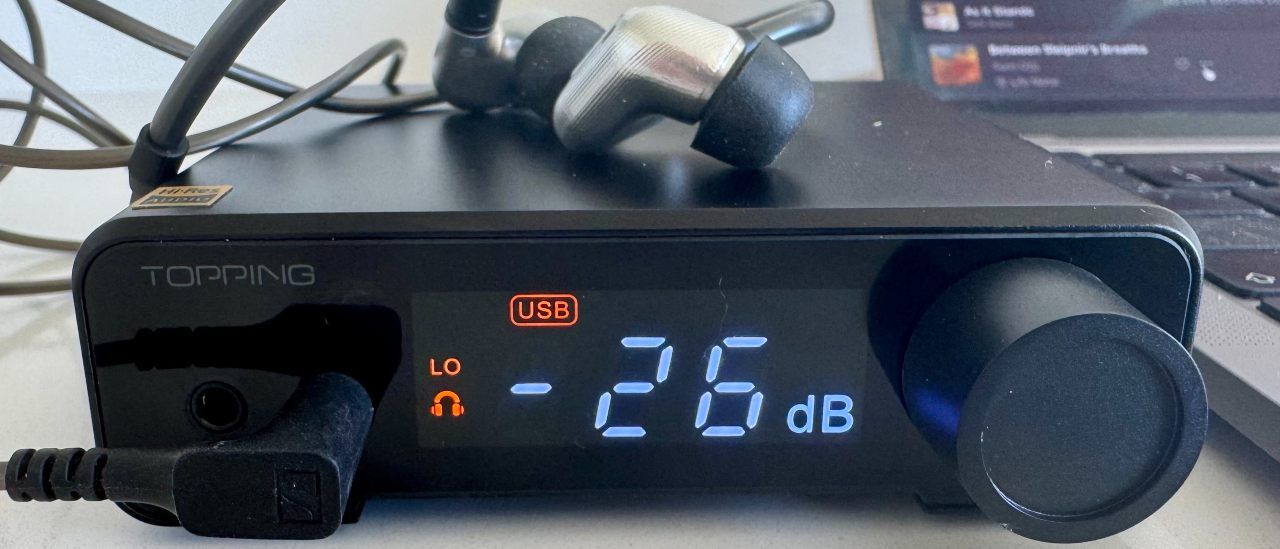
The majority of the fascia is occupied by a relatively large and gratifyingly legible LED display — volume level, selected input and what-have-you is all revealed. There’s also a relatively large turn/press dial that covers a lot of the device’s functions. In all honesty, the dial is not especially intuitive when you want to do anything beyond change input or adjust volume — so it’s just as well Topping provides a little remote control handset that makes getting at your EQs, and all the rest of it, quite a lot more straightforward.
Set-up is the work of a moment, of course. You’ll need to connect the USB-C slot to an’t then yourd to connect the DX1 II to its output device — headphones, probably, or maybe the stereo RCA outputs to an amplifier or powered speaker. And then you’re in business
Topping DX1 II review: Value
- Small but feels premium
- Good standard of build
- Out-and-out sound quality not up there (but you won’t feel short-changed)
It may only be tiny, but Topping has managed to make the DX1 II feel and, to a lesser extent, look like it deserves to cost three figures. The standard of build is well up to snuff, too — and when you take the thoroughgoing nature of its specification into account, too, the sensation of value for money is hard to argue with.
The value proposition isn’t quite so cut-and-dried when it comes to out-and-out sound quality – but even here the DX1 II does more than enough right to prevent you feeling short-changed.
Should I buy the Topping DX1 II?
Buy it if…
You have a desktop audio system that just consists of a laptop and some headphones
Putting the DX1 II between the two will result in a significant uptick in audio quality.View Deal
You want to enhance your gaming experience
With UAC 1.0 selected, the signal from a console incoming and some appropriate headphones attached, gaming becomes a much more immersive experience.View Deal
You have some power-hungry headphones
The Topping’s balanced output is rated at 2 x 1000mW into 32 ohms, which is more than enough to deal even quite tricky headphones.View Deal
Don’t buy it if…
You’re easily frustrated
The fascia controls are not what you’d call ‘intuitive’.View Deal
You enjoy the dynamic aspects of music reproduction
The DX1 II is unwilling or unable to put really convincing distance between dynamic extremes .View Deal
You’re especially attuned to high-frequency sound
You can fiddle with the PEQ and/or the filters all you like — the Topping is inclined to roll off the top end at least a little.View Deal
Topping DX1 II review: Also consider
It’s more affordable than the DX1 II — and it looks and feels it, too — but the iFi Uno is a high-achieving little device that offers a direct, confident and information-rich sound no matter the
How I tested the Topping DX1 II
I used the Topping DX1 II with an Apple MacBook Pro — connecting to the USB-C slot allowed for data transfer and power supply at the same time, and gave access to numerous music streaming services.
I connected a pair of Sennheiser IE900 wired in-ear headphones to the unbalanced 3.5mm output, and also to the balanced 4.4mm output (the Sennheiser have a selection of cables with different terminations).
I also connected a Sony PlayStation 5reamp in my reference system
- Read TechRadar’s reviews guarantee
- First reviewed: October 2026
