

Amana is a solo-built iOS app that draws the sky outside your window and then tries to get you to put the phone down and go look at the real one. Its design document has a one-line north star: take people out toward a sky they want to name. The app is <a href="https://apps.<a href="https://myappsplus.com/apple-rolls-out-first-rcs-for-macos-26-7-1-and-macos-15-8-1/” title=”Apple rolls out first RCs for macOS 26.7.1 and macOS 15.8.1″>apple.com/app/id6790911086?ref=hackernoon.com” rel=”nofollow noopener” target=”_blank”>on the App Store.
In late August I gave the app a theme song. I already wrote about what a month of AI spokespersons and a theme song did for installs — the short answer is not much. This piece is about the song itself: what I actually gave it, what came back, and which parts of the result were decisions rather than luck.
What I gave Suno
This is the entire input, copied from the song’s page data:
Gentle Japanese song about looking up at the sky and giving it a name, 72 bpm; two soft breathy female voices in close sister-like harmony, almost whispered, singing simple Japanese lyrics about dusk, clouds catching fire, and going outside to meet the real sky; shakuhachi breath and a sparse koto motif over warm felt piano and airy pads; hushed verse, a quiet bloom on the chorus, then a bare floating outro; wide intimate mix, restrained and serene, wabi-sabi stillness, generous space between phrases
Eighty-three words, 505 characters. Not one Japanese character.
Most of it is texture. The instruments are shakuhachi, a bamboo flute played with audible breath, and koto, a long plucked zither — the same restrained Japanese world as the app’s visuals. The mix asks for wabi-sabi stillness and generous space between phrases.
The part that turned out to matter most is different: I described what the song was for, not how it should sound.Looking up at the sky and giving it a name. Going outside to meet the real sky. That is the app’s purpose, written as a lyric brief.
What came back
Suno stored the generation in three layers, and seeing them side by side explained a lot.
- My description, as above.
- An expanded arrangement brief it wrote from that description: 109 words that added detail I had not asked for — “delicate unison-to-third movement” for the two voices, “widely spaced voicings” for the piano, “long clean decays.”
- The lyrics: 25 lines in seven labelled sections — two verses, two pre-choruses, two choruses, an outro.
I did not write the lyrics. I want to be exact about that, because the next part is the reason this piece exists.
The lyrics restate the design doc
靴ひもを結ぶ音 / 小さく息を吸う
The sound of tying a shoelace. A small breath in.
That is the moment someone stands up from a screen to go outside — the exact step my app is built around. The chorus:
空に名前をつけよう / ここを出て 会いに行こう / ほんとうの空へ
Let’s give the sky a name. Let’s leave here and go to meet it — toward the real sky.
And the outro ends on まだ呼ばない名前 — a name not yet called.
I had given it three images: dusk, clouds catching fire, going outside to meet the real sky. It built a small story around them that reads like my design document set to music. I think the reason is unglamorous. When the brief states a purpose — going outside to meet the real sky — the model has something to resolve the song toward. A brief made only of adjectives gives it a mood and nothing to arrive at.
The singers are meant to be the app’s two sisters, who are named after the two ends of the day. The elder’s hour is dusk — tasogare, originally tasokare, “who is that?”, the time when a face can no longer be told apart (Digital Daijisen). The younger’s is the half-light before dawn, kawatare (Digital Daijisen).
One generation, two takes
The two files I kept are 4:05 and 3:59. Their embedded creation timestamps are identical to the second. I did not generate twice and pick the better attempt: a single request returns a pair. Every request hands you two songs to compare, so plan your listening time for both.
The limit I only found by sorting durations
Before the vocal song, I had made instrumental background tracks for the app’s videos, some on v4.5 and some on the newer v5.5 preview. Only when I lined up the sixteen clips in my workspace list did the pattern show:
Suno’s own announcement says v4.5 can make songs up to 8 minutes long. The preview model, in my workspace, never went past one minute. Nothing in the create screen told me that. In my runs, every clip long enough for a full video came from v4.5. Listening clip by clip, I would have blamed my prompts; the durations told me to switch models instead.
Where the song does not go
The song is not in the App Store preview, and that is on purpose.
Apple’s guidance is blunt: by default, app previews play with the sound muted. A song whose value is its lyrics, in Japanese, playing to a mostly muted, mostly international audience, is a song nobody hears. The preview uses an instrumental shakuhachi track instead, trimmed with ffmpeg, and does its work with pictures and on-screen text. The vocal song lives where people choose to press play: a full-length video, and short clips of the chorus. (Cutting that chorus clip to the song’s own silence is its own story, which I covered in an earlier piece.)
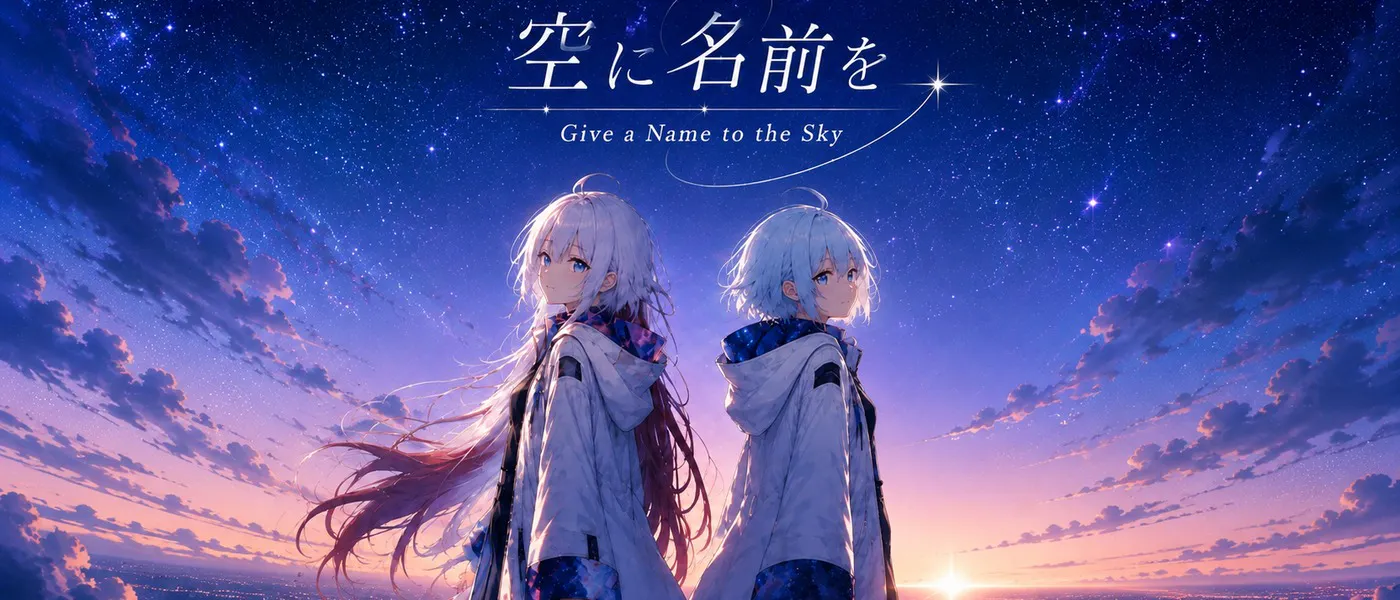
The cover art followed the same rule of fit over polish. Both the candidates and the final cover were AI-generated images. I rejected three because none of them showed the sisters — they were beautiful skies, for a song sung by two people. The one I used has a gradient from starry night to sunset, the two of them side by side, and a few town lights on the horizon: the here in let’s leave here.
The part that was entirely my fault
The full-length video went up on 28 August. Twelve and a half hours later it had one view. That single viewer listened to 4:04 of the 4:05. So the song was not what was failing; nobody was clicking.
When I checked what I had published, much of the problem was my metadata:
- I added 23 tags. YouTube’s own help page says tags play a minimal role in your video’s discovery and are mainly useful for common misspellings.
- I stuffed the title with Japanese, English and the app name, which gave a stranger no reason to click. The current title leads with the feeling — looking up, you want to give the sky a name — and puts the song and app names after it.
- The App Store link in the description was plain text. The channel had not completed phone verification, which unlocks YouTube’s intermediate features. Until I did it, the one link that mattered could not be clicked.
The video has nine views today. I am not going to pretend a better title would have made it a hit. But every one of those mistakes was avoidable, and none of them were the model’s.
What I would keep
- Brief the purpose, not just the texture. Three concrete images and a destination gave the lyrics somewhere to go.
- Budget in pairs. One request, two takes.
- Sort by the numbers before judging a model. A one-minute cap looks like “the prompt isn’t working” if you only listen clip by clip.
- Decide where a piece does not go. A muted autoplay slot is the wrong home for a song whose value is its words.
The song is called Sora ni Namae o Tsukeyou (Let’s Give the Sky a Name). I did not write a word of it, and it still says what the app is for more plainly than I have managed to. You can listen to the full song on YouTube.
