

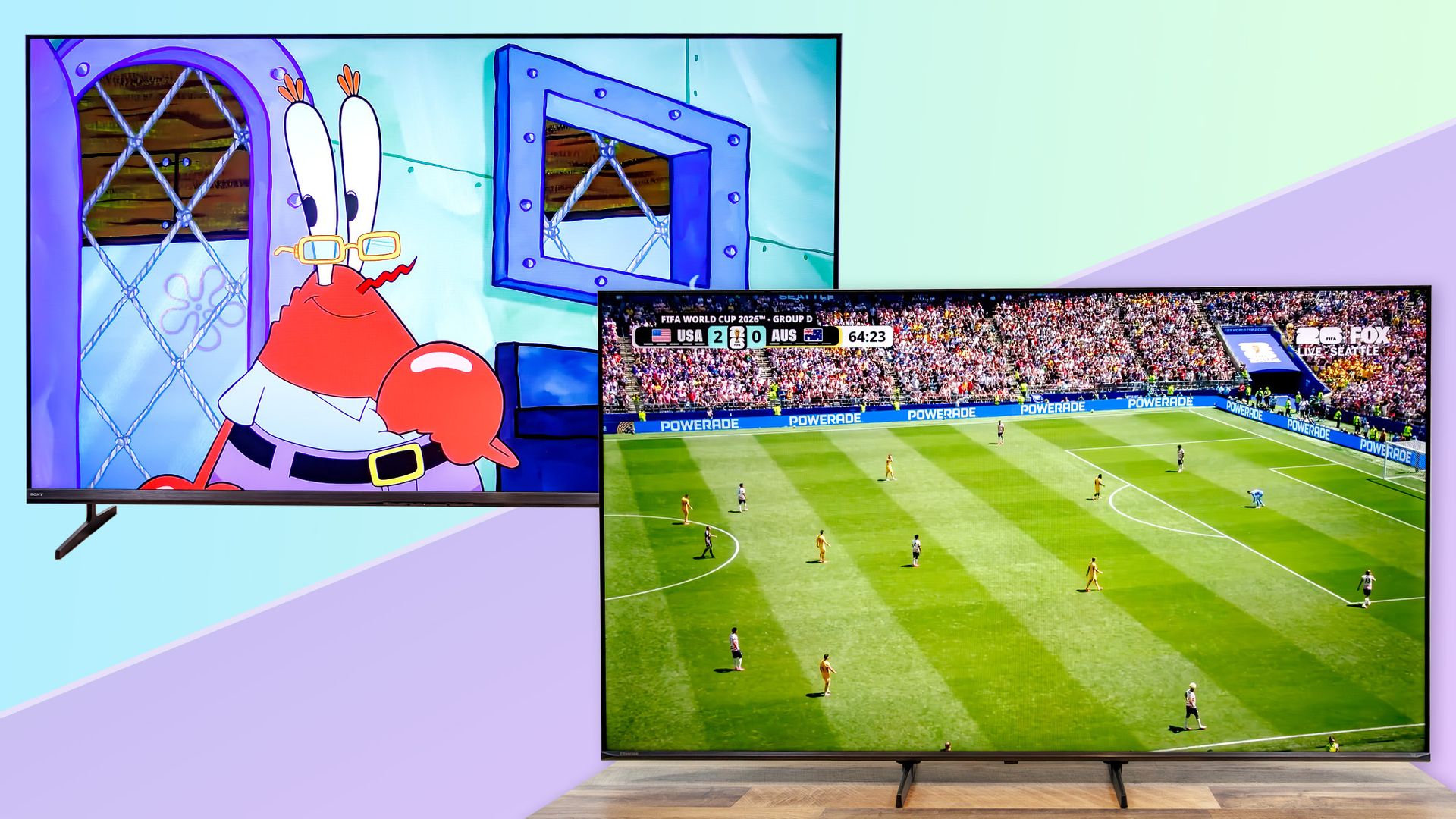
The Sony Bravia 3 II is one of the most affordable Bravia-branded TVs in 2026. It comes with a remarkably thorough collection of features given its place in Sony’s Bravia TV lineup, but its relatively simplistic display hardware and lack of brightness limit its versatility.
As its name suggests, the Hisense U6SF Pro is an entry-level TV with a little extra flair compared to garden-variety, budget-friendly TVs. Its Mini-LED backlighting is the key to its success, and it’s one of the brightest sets in its class. This makes it a dependable choice for a wide swath of shoppers.
In the battle between two affordable, high-performance LED TVs, which one is right for you? Before you make a decision, there are some key differences worth highlighting. We’ve tested both models, and we’re happy to point you in the right direction.
Although it leads the affordable LED TV class in features, the Sony Bravia 3 II isn’t equipped with the display hardware it needs to compete with the brightness and backlight control of a TV like the Hisense U6SF Pro. Sony’s picture processing does a splendid job of making the most of the Bravia 3 II’s direct-LED display, but the U6SF Pro’s Mini-LEDs give it a significant advantage.
The Hisense U6SF Pro is an entry-level Mini-LED TV with added oomph. It’s one of the brightest TVs you’ll find in its price range, which makes it a great fit for all viewing scenarios. It’s not quite as flush with features as the Bravia 3 II, comes in fewer sizes and relies on Fire TV rather than Google TV, but its versatility makes it a better choice for most shoppers.
Sony Bravia 3 II vs Hisense U6SF Pro: Specs compared
|
43″, 50″, 55″, 65″, 75″, 85″, 100″ |
||
|
Dolby Vision, HDR10+, HDR10, HLG |
||
|
ATSC 3.0 support? |
||
Despite its entry-level status, the Bravia 3 II’s spec sheet is one of the best of I’ve seen on a Sony TV in recent years, and it all starts with its full slate of HDMI 2.1-compatible inputs. Until now, it’s been tricky to track down a Sony TV with more than two high-bandwidth ports.
Whichever HDMI port you pick, it’s ready to make the most of your connected device. All four support 4K games at 120Hz — the top 4K spec on current-generation consoles.
The Hisense U6SF Pro, meanwhile, supports 4K content up to 144Hz, so it’s slightly more accommodating for people who plan on linking up a gaming PC. However, only two of its HDMI ports support this functionality, so the Bravia 3 II’s port selection is better equipped for a dedicated gamers.
Another key advantage of the Bravia 3 II is its wider array of size options. It’s available in both 43- and 50-inch screen sizes, which is relatively hard to come by in its class.
The U6SF Pro’s HDR10+ support is nice to have, but the added size options in the Bravia 3 II lineup and its universal HDMI 2.1 support put it over the top.
Sony Bravia 3 II vs Hisense U6SF Pro: Design
Neither of these budget-friendly TVs are dressed as dashingly as higher-end models. However, given their place in each brand’s respective lineup, they could look and feel a lot worse than they do.
The Sony Bravia 3 II (pictured above) leverages a sturdy panel that looks about as utilitarian as a TV gets. That said, I appreciate the minimalist approach, as the Bravia 3 II is able to slot right into any living room without looking aesthetically out of place.
At close to three inches thick, the Bravia 3 II’s panel is a bit of a chonkster.If you’re expecting something slim, you might want to take a look at it in person before plunking down your credit card. In any event, the U6SF Pro isn’t much thinner.
Take a trip around the back of the U6SF Pro (seen above) and you’ll notice that its panel has a bit more business going on — lines, indents, things of that nature. Most notably is its built-in subwoofer, which according to my colleague Dylan Haas, does a pretty decent job of filling out the TV’s soundscape.
Both TV’s screens sit somewhat low to the ground, but the Bravia 3 II offers a bit more soundbar clearance. In addition, I have to shout out the remote control included with the Bravia 3 II, which is much more pleasant to hold and use than the clicker that comes with the U6SF Pro.
But when sizing up both sets, their design chops are pretty much a wash. They’ll look fine in all rooms and don’t feel cheap to the touch.
Sony Bravia 3 II vs Hisense U6SF Pro: Performance
Before we dig deeper into how these TVs look, let’s compare their test results. Both TVs were in their most-accurate picture modes when these tests were taken. (For the Bravia 3, this is Professional mode. For the U6SF Pro, it’s Filmmaker mode.)
The U6SF Pro’s primary advantage over the Bravia 3 II is its display hardware. It taps an array of Mini-LEDs that can be brightened and dimmed across multiple zones, while Sony’s entry-level set is limited to standard, direct-LED backlighting with no local dimming at all.
The result — as is illustrated in the chart above — is that the U6SF Pro features a much brighter presentation. This is especially true for HDR content, where Mini-LEDs really shine.
Additionally, the U6SF Pro’s smaller-sized LEDs and local dimming capabilities allow for tighter contrast control. Black levels are deeper than they are on the Bravia 3 II during certain content, which contributes to a more cinematic picture overall.
Our eyes have evolved to notice contrast above almost everything else.
To its credit, the Bravia 3 II doesn’t sport a bad-looking picture. True to Sony’s reputation, the Bravia 3 II delivers a dialed-in presentation in its most-accurate picture mode. It handles the finer aspects of picture quality (like motion handling and upscaling) better than most entry-level sets.
But while Hisense’s picture processing isn’t as impressive as Sony’s, our eyes have evolved to notice contrast above almost everything else. That the U6SF Pro is about twice as bright as the Bravia 3 II is what makes it the better choice for HDR content, bright-room viewing and with the lights off.
Colors look brighter on the U6SF Pro, too, as a result of this added luminance. When you factor this alongside the Bravia 3 II’s limited contrast, you’re left with a picture that runs the risk of looking flat in certain lighting conditions.
Sony Bravia 3 II vs Hisense U6SF Pro: Smart platform and features
Like all Bravia TVs, the Bravia 3 II is built around the Google TV smart platform. It’s not my first choice when it comes to streaming software, but it’s good enough to serve as a your daily viewing backdrop.
The Google TV interface is, for the most part, laid out in a sensible way, and while plenty of ads grace the home screen, it’s not difficult to prioritize the apps and shows you’re most likely to engage with. Google TV is also connected to a huge library of downloadable apps, so you’ll rarely find yourself wondering why a piece of software isn’t supported.
When it comes to bells and whistles, there’s a lot to enjoy. The Bravia 3 II offers gamers Variable Refresh Rate (VRR) and Auto Low Latency Mode (ALLM), as well as the aforementioned quartet of HDMI 2.1 inputs. IMAX Enhanced mode is along for the ride, too, as well as all of the usual Google TV enhancements (like Chromecast functionality).
Unlike most mainline Hisense TVs in 2026, the U6SF Pro isn’t running Google TV. Instead, it’s built around Amazon’s smart platform, Fire TV.
While Fire TV has seen some improvements in recent years, I still find the overall experience to be rather frustrating. At times it can be slow to boot up apps, and its user interface isn’t as streamlined as that of Roku and Google TV. Unsurprisingly, folks who already use a number of Alexa-enabled devices in their home stand to make the most out of Fire TV.
Similar to the Bravia 3 II, the U6SF Pro also supports VRR, ALLM and IMAX Enhanced mode. It also advertises AMD FreeSync Premium Pro. The U6SF Pro would be a slightly better gaming TV than the Bravia 3 II if it offered as many HDMI 2.1-enabled ports.
Sony Bravia 3 II vs Hisense U6SF Pro: Verdict
The U6SF Pro is a safer pick for a wider variety of viewers than the Bravia 3 II. The reason for that is simple: Its picture is about twice as bright.
Thanks to its impressive picture processing, Google TV and the inclusion of four HDMI 2.1 inputs, an argument could easily be made that the Bravia 3 II is the best direct-LED-based TV on the market. It’s certainly a fantastic gaming TV for the price, at least.
But the U6SF Pro’s Mini-LED backlighting and local dimming are more impactful on a day-to-day basis than the Bravia 3’s extra pair of high-bandwidth inputs, and the same goes for Google TV. The ideal Bravia 3 II-owner is someone who owns several consoles, appreciates the finer aspects of picture quality and does most of their viewing during the day (in a room that isn’t too bright). That’s a pretty narrow slice.
And we haven’t even talked about pricing yet. The 65-inch Hisense U6SF Pro is $699 at Best Buy at the time of publishing — it’s not the cheapest set, but you’re getting a lot for that price.
Meanwhile, the 65-inch Bravia 3 II is currently $899 at Best Buy. Unless you’re absolutely certain that the Bravia 3 II’s performance profile is a good fit for your living room, I recommend taking a closer look at the set with Mini-LED backlighting.
- Sony Bravia 3 II review
- Hisense U6SF Pro review
- Best TV Brands 2026: We just graded them on price, performance and more — here’s how their report cards stack up
