

- Oct 11, 2026
- Original Content
- 52 Views
17 minutes ago
Jev Fever: Predictive AI Is Superhot Again
Originally published in Forbes
The more AI changes, the more it stays the same.
For decades, we data scientists and machine learning professionals were in a long-term, exclusive relationship with predictive AI (aka predictive analytics or enterprise ML).
Then LLMs came along and tempted us almost to the point of divorce – only to now bring us back to our original love: predictive AI.
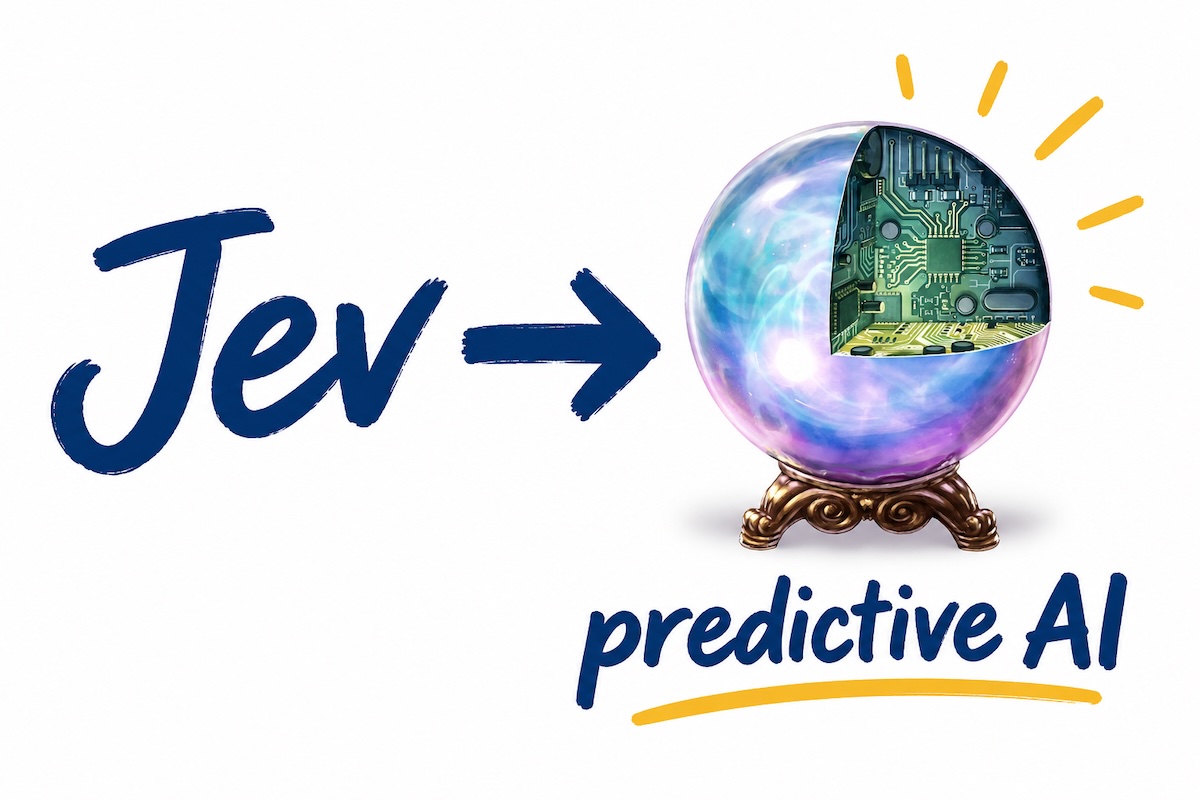
In the last few weeks, a new industry-darling model called Jev has caught on like wildfire, leaving myriad generative AI users questioning whether chatbots and language generation should reign as the most economically-viable form of “intelligent” tech. Jev’s creator announced, <a href="https://www.techbuzz.ai/articles/typesafe-ai-hits-7-5b-valuation-weeks-after-jev-launch” rel=”nofollow noopener” target=”_blank”>only a few weeks after launching, it had raised $870M at a valuation of $7.5B and that 29.4% of the F500 are already using Jev.
In textbook Silicon Valley rebranding fashion, Jev isn’t framed as “predictive AI” – but that’s exactly what it is. The model drives decisions by way of classifying: Will this customer cancel, is this transaction or network activity malicious, will this LLM fail? And beyond binary “yes/no” prediction, it also performs multi-class classification. More specifically, it renders “judgements” by calculating the probability of each class. If you’re experiencing déjà vu, that’s because this has been the mainstay of standard ML models since the 1970s. Been there, done that.
But a rose by any other name would smell as sweet. Prediction is back, baby!
And wow is this movement strong. Jev took over the social-media geek scene, instigating an instantaneous rush of competitors. In only the last two or three weeks, many new judgement models launched, including ones by OpenAI, <a href="https://venturebeat.com/technology/amazon-unveils-a-free-fast-open-source-jev-killer-strands-decider-2b-makes-decisions-in-fractions-of-a-second” rel=”nofollow noopener” target=”_blank”>Amazon, Nvidia, Databricks and Cloudflare – as well as opensourcemodelslike Kev, Nimble, Laya (which actually predated Jev’s splash by a year) and others.
Yet, if all the chatter is any indication, the great numbers of folks who joined the AI world within the recent LLM age tend not to recognize that driving decisions with classification ain’t new at all – instead, it represents a return to the original, predictive AI. It’s the kind of AI use case that dominated commercial ML deployment for decades, up until ChatGPT made a sensation four years ago.
Just like Meryl Streep in It’s Complicated, AI professionals are exuberantly cheating on their lover… with their ex. But unlike Streep, they often don’t realize it.
To be clear, Streep’s ex has had a wondrous makeover. Built on sexy, modern foundation-model tech, Jev and its competitors now do something predictive AI could never do before: zero-shot prediction. You need not train a customized predictive model. And you need not curate a bespoke dataset for such training. Taking those pains may greatly help for some projects, but – at least to get started – you can often tap Jev or one of its competitors to begin predicting straight out of the gate. Removing prediction’s historic barrier-to-entry is remarkable. This promises to energize a predictive Renaissance indeed.
But even if your ex has become more attractive, they are still fundamentally the same old ex. Unless predictive AI adopters change their behavior, this rejuvenated relationship is set to disappoint all over again. The industry still hasn’t learned how to dependably realize value.
Most predictive AI projects fail to deploy. Why? Business decision makers don’t understand their tech team’s prediction machines. They’re not in the loop, deeply collaborating after gaining a semi-technical understanding of exactly what’s predicted, how the predictive probabilities will alter and thereby improve high-stakes, high-volume decisions, and precisely how imperfect prediction serves to generate business value – in terms of straightforward benchmarks like profit and savings.
Even though predictive use cases of AI are hot again – and more technically-accessible than ever – the fundamental challenges don’t change. To date, predictive AI projects rarely take on the following necessities:
- Bridging the notorious tech/biz divide inherent to these kinds of projects. This involves understanding what it means to improve operations with probabilities. It’s the fine art of large-scale uncertainty management. It’s not rocket science, but it’s not yet widely understood by the decision makers who need to inform and greenlight deployment.
- Benchmarking predictive models in terms of business value, rather than only in terms of the standard technical metrics that all data scientists hold dear (precision, recall, AUC, F-score, false-positive rate… and even accuracy is only a technical metric that’s at best a poor proxy for value).
- Labeled evaluation data. Zero-shot prediction means you don’t necessarily need tons of training data to get there, “But here’s the catch: You still need data… to check whether Jev’s answers are right,” as AI engineer Shirin Khosravi Jam points out. Only with a meaningful number of examples labeled with ground truth can a project calculate its pertinent performance benchmarks.
With this new wave, we’ve got a new shot! Predictive AI is much older than genAI – but it’s not old school. Most of its value is still untapped. Before genAI took over, predictive AI never quite reached the level of industry maturity and professionalization needed so that projects could successfully deploy more often than stall. Until now, the energy needed to overhaul the business playbook for running these projects has probably been lacking.
In my book The AI Playbook, I present the gold-standard practice for running predictive AI projects through to successful deployment, a six-step playbook called bizML. (Read this detailed article for a brief overview of bizML, and pre-order the paperback edition of The AI Playbook now and receive free, immediate access to the audiobook.)
Core to bizML is the rare art of moving from the standard technical benchmarks of predictive performance to also establishing — not to mention maximizing and selling — the business value that model deployment will deliver. I’ve published a number of articles covering this fundamental practice, including:
- Jev AI Will Make You Money – But Exactly How Much?
- How To Overcome The Confidence-Killer That Destroys Most Predictive AI Projects
- How To Un-Botch Predictive AI: Business Metrics
- How To Overcome Predictive AI’s Everyday Failure
- Predictive AI Must Be Valuated – But Rarely Is. Here’s How To Do It
Eric Siegel, Ph.D., is a former Columbia University professor who helps companies deploy machine learning. He is the cofounder and CEO of Gooder AI, the founder of the long-running Machine Learning Week conference series, the instructor of the acclaimed online course “Machine Learning Leadership and Practice – End-to-End Mastery,” executive editor of The Machine Learning Times, and a frequent keynote speaker. He wrote the bestselling Predictive Analytics: The Power to Predict Who Will Click, Buy, Lie, or Die, which has been used in courses at hundreds of universities, as well as The AI Playbook: Mastering the Rare Art of Machine Learning Deployment. Eric’s interdisciplinary work bridges the stubborn technology/business gap. At Columbia, he won the Distinguished Faculty award when teaching the graduate computer science courses in ML and AI. Later, he served as a business school professor at UVA Darden. A Forbes contributor, Eric publishes op-eds on analytics and social justice.
Eric has appeared on Bloomberg TV and Radio, BNN (Canada), Cool Science Radio, Israel National Radio, Motley Fool Radio, National Geographic Breakthrough, NPR Marketplace, Radio National (Australia), and TheStreet. A Forbes contributor, Eric and his books have been featured inAmerican Banker, BBC, Big Think, Built In, Businessweek, CBS MoneyWatch, CDO Magazine, Contagious Magazine, The European Business Review, Fast Company, The Financial Times, Fortune, The Globe & Mail, GQ, Harvard Data Science Review, Harvard Business Review, The Huffington Post, The Los Angeles Times, Luckbox Magazine, MIT Sloan Management Review, The New York Review of Books, The New York Times, Newsweek, Quartz, Salon, The San Francisco Chronicle, Scientific American, The Seattle Post-Intelligencer, Trailblazers with Walter Isaacson, The Wall Street Journal, The Washington Post,WSJ MarketWatch. and ZDNET.
