

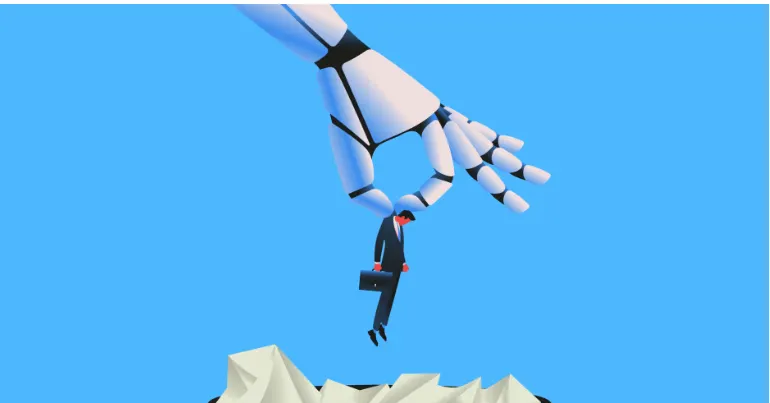
About 11.5 million workers in Vietnam perform jobs with tasks exposed to generative AI, the ILO estimates. Clerical and administrative roles face the greatest impact, though job redesign is considered more likely than widespread layoffs.
Since ChatGPT emerged in late 2022, artificial intelligence tools have become increasingly sophisticated, taking on a growing range of tasks and raising concerns about job security across multiple industries.
VietNamNet examines these developments in a special series, Workers most vulnerable to AI.

A typical day for an administrative employee might begin with dozens of emails, followed by entering data into spreadsheets, compiling documents, preparing reports, taking meeting minutes, scheduling appointments and sending notifications.
These are precisely the kinds of tasks that generative AI can increasingly handle.
It is not necessarily because AI is “smarter” than humans in every respect, but because many office tasks share three characteristics: the information is already digitized, the processes are repetitive, and the outputs can be standardized.
In a 2026 study, the Organisation for Economic Co-operation and Development (OECD) found that current AI capabilities align most closely with routine information-processing, administrative and codifiable tasks.
In Vietnam, the scale of potential disruption is particularly striking.
According to the International Labour Organization (ILO), approximately 11.5 million people, equivalent to one-fifth of the country’s workforce, hold jobs involving tasks that could be affected by generative AI.
Clerical workers face the highest exposure, with nearly two-thirds of people in these occupations falling into categories considered susceptible to task automation.
This group includes administrative assistants, office clerks, data entry personnel and other office support workers.
Importantly, the ILO does not suggest that millions of these workers will immediately lose their jobs.
Instead, its findings indicate that a more likely outcome is the restructuring of existing roles.
Consider an employee who previously spent an entire morning consolidating information from 20 Excel files.
With AI, much of that work could be completed significantly faster. However, a human would still be needed to verify the data, identify anomalies and explain the results.
The workflow could therefore shift from collecting information, entering data, compiling figures and writing reports to a new arrangement in which AI handles much of the collection and compilation, while employees focus on verification, analysis, managing exceptions and making decisions or recommendations.
This creates a paradox: AI may reduce the amount of work required while simultaneously raising the skill requirements for the employees who remain.
A survey of approximately 750 chief financial officers in the United States, cited by The Wall Street Journal, found that financial executives expect AI to affect repetitive, clerical and administrative positions first.
However, their projected reduction in total employment attributable to AI in 2026 was only around 0.4% compared with a scenario in which AI was not adopted.
This suggests that businesses may not need to lay off entire administrative departments.
Instead, they could simply stop hiring additional employees as workloads increase.
An office department with 10 employees might continue operating with the same headcount for some time.
But if its workload increases by 20% the following year and the company still does not recruit more staff, AI will have effectively changed labor productivity without necessarily producing a visible increase in layoffs.
CNN has recommended that workers assess their jobs at the level of individual tasks.
Work that is repetitive, predictable and performed primarily on computers is generally more susceptible to automation.
Yet office administration also highlights an important limitation of AI.
An assistant may use AI to draft an email, but not every email is simply a piece of written communication.
Some messages involve relationships between departments, demanding clients or sensitive situations.
The sender must understand the context and exercise judgment about what should and should not be said.
Similarly, AI can summarize a meeting, but it may not fully recognize who genuinely opposed a decision, which issues remain unresolved or which remarks were merely polite gestures.
AI can also generate reports, but managers still need to determine which figures can be trusted.
This is the dividing line identified by the OECD: AI remains further from matching human capabilities in tasks that require contextual judgment, interpersonal understanding, complex decision-making and accountability.
Another important dimension of AI exposure in Vietnam is gender.
According to the ILO, 24.1% of female workers are exposed to potential impacts from generative AI, significantly higher than the 17.8% recorded among male workers.
One reason is that women are more heavily represented in administrative, office-based and service occupations.
This means the automation of administrative work is not merely a technological issue. It also has implications for employment opportunities and career development.
Employees whose responsibilities are limited to data entry, document processing or information compilation may need to move into roles requiring more advanced skills.
And that could be the most significant transformation facing administrative occupations.
Workers may no longer be paid primarily for their ability to complete a routine process, but increasingly for their capacity to understand that process, verify the machine’s work and handle situations in which technology cannot determine what to do.
