


Category:Acquisition or Partnership
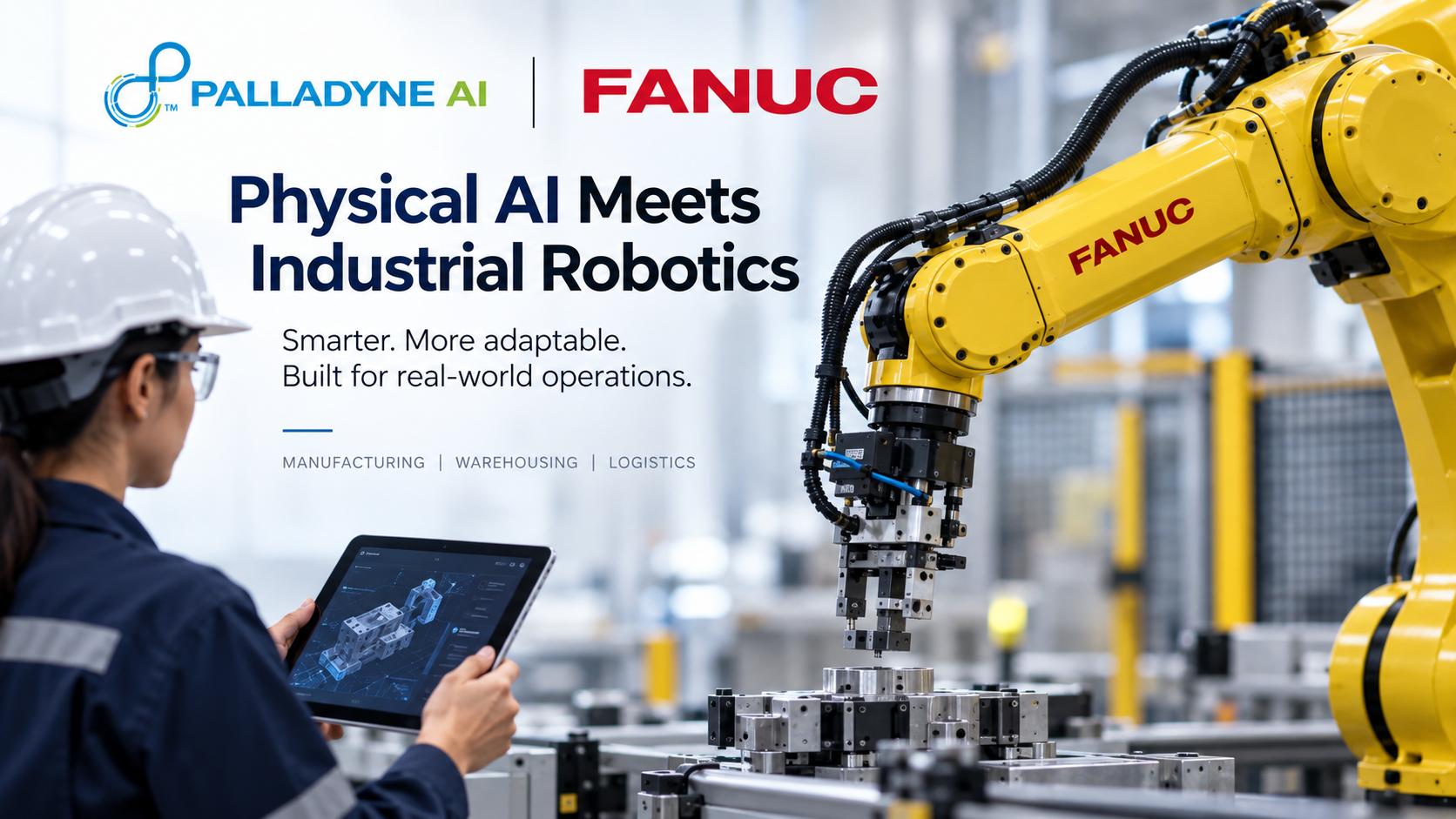
Palladyne AIand FANUC America have announced a strategic collaboration aimed at advancing the next generation of intelligent robotic automation. The partnership combines FANUC’s extensive industrial robot portfolio with Palladyne IQ, the company’s physical AI software platform, to develop more adaptable robotic systems for manufacturing, warehousing, and logistics environments.
This collaboration reflects a growing focus on the challenges of deploying automation in environments characterized by product variability, labor shortages, and frequent operational change. As a result, the competitive battleground is shifting toward software, intelligence, and ease of deployment rather than hardware innovation alone.
Addressing the Automation Gap
Manufacturers continue to face mounting pressure to improve productivity while coping with a shortage of skilled labor. At the same time, production environments are becoming more dynamic, with shorter product lifecycles, greater customization, and increasing demand for operational flexibility.
Traditional industrial robots have excelled in highly structured, repetitive applications. However, expanding automation into less predictable environments often requires extensive programming, integration, and maintenance effort. This complexity frequently limits deployment speed and return on investment.
The Palladyne AI and FANUC collaboration seeks to address this challenge by combining proven robotic hardware with AI-driven software intended to make robots more adaptable and easier to deploy. For manufacturers, the value proposition is straightforward: reduce implementation complexity while enabling automation in a broader range of applications.
Bringing Physical AI to Industrial Robotics
The centerpiece of the collaboration is Palladyne IQ, a physical AI platform designed to help robots understand, adapt to, and operate within changing environments.
Several areas of joint development stand out:
-
Optimization of Palladyne IQ on FANUC robotic platforms.
-
AI-driven motion planning and adaptive robot behavior.
-
Teleoperation and human-assisted learning capabilities.
-
Simulation and AI model training to accelerate deployment.
-
Joint validation of manufacturing, warehousing, and logistics applications.
-
Development of standardized deployment workflows for integrators and end users.
Taken together, these initiatives suggest a focus on reducing one of robotics’ biggest barriers to scale: the amount of engineering effort required to deploy and maintain automation.
Across the robotics industry, there is growing recognition that fully autonomous operation is often less practical than systems that combine AI decision-making with human guidance. These hybrid approaches can accelerate deployment while still expanding the level of automation.
FANUC Enters the Physical AI Arena
One of the world’s largest industrial robot suppliers, FANUC brings a substantial installed base, extensive industry expertise, and a broad partner ecosystem. Many emerging physical AI vendors have compelling software technologies but limited pathways to large-scale industrial adoption. By working with an established automation leader, Palladyne AI gains access to real-world applications and customer environments where intelligent robotics can demonstrate practical value.
Conversely, FANUC gains access to emerging AI capabilities that can help extend robotic automation beyond traditional high-volume, structured tasks. Hardware remains essential, but differentiation is increasingly coming from the intelligence layer to support the broader development of physical AI applications.
As manufacturers continue searching for ways to address labor shortages, improve productivity, and increase operational flexibility, partnerships that combine industrial-scale robotics with intelligent software platforms are likely to become increasingly common. The success of these initiatives will ultimately be measured by their ability to simplify deployment and deliver practical business outcomes, not just technological innovation.
Engage with ARC
-
What I saw at Automate 2026, Part 1: The US Manufacturing Renaissance
-
What I saw at Automate 2026, Part 2: The Future is Humanoid?
-
Humanoids for Industry Blog Part 1: Why Humanoids? Why Now?
-
Humanoids for Industry Blog Part 2: Navigating the Ecosystem
-
Humanoids for Industry Blog Part 3: A New Market on the Horizon
For discussions on physical intelligence and the new wave of industrial robotics, or to offer feedback on this article, contact Patrick Arnold at [email protected].
Set up a meeting with me and the analysts at ARC Advisory Group to find out more about our Executive Insights Service for industrial organizations, MarketMap efforts, and more.
