

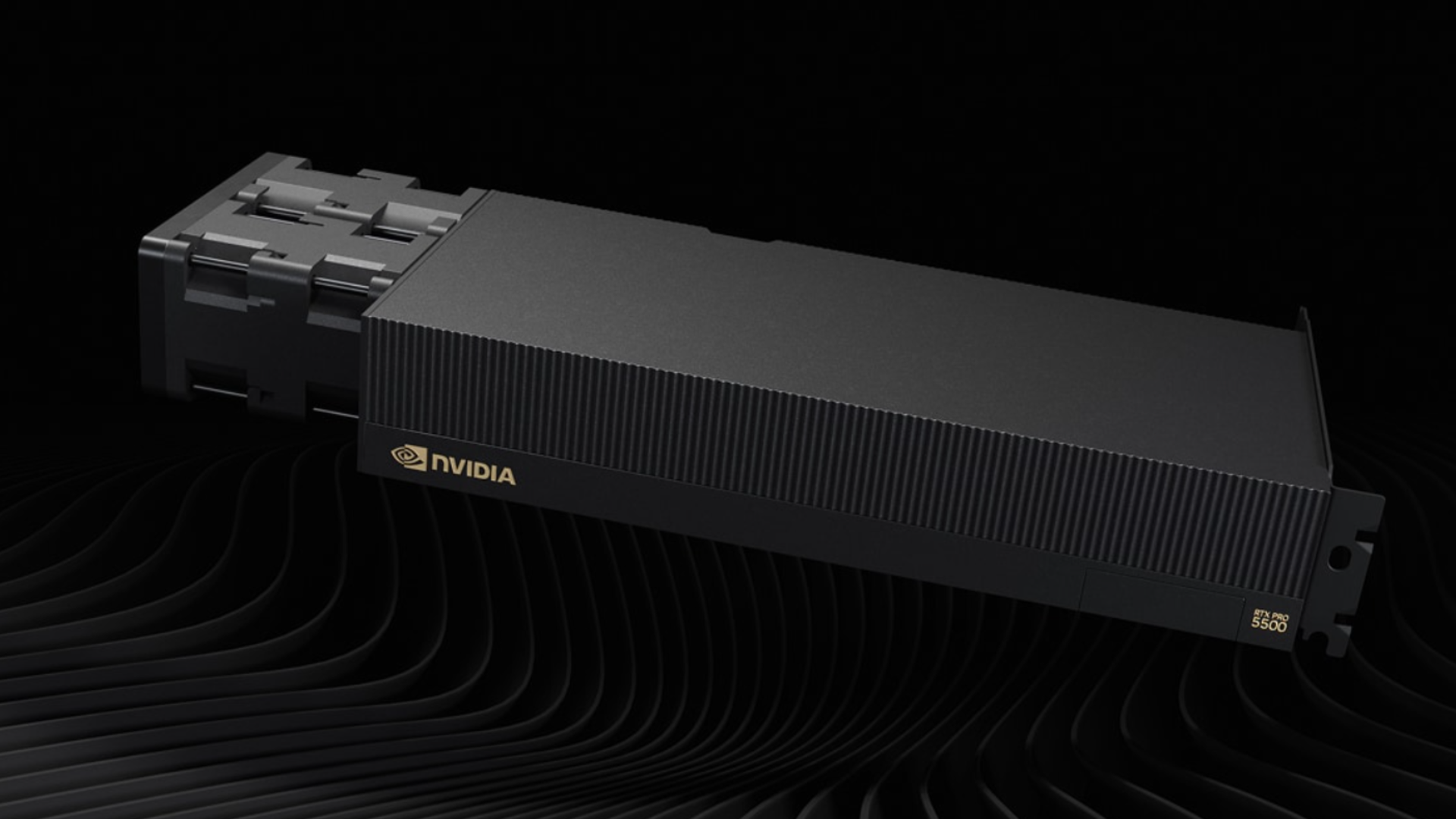
- Nvidia fits 28 GDDR7 memory chips onto one workstation graphics card
- The RTX PRO 5500 carries 84 GB of onboard GDDR7 memory
- Fourteen memory chips sit above the PCB and fourteen below
Nvidia has rolled out a new professional graphics card that carries an unusually generous pool of onboard memory for its class.
Nvidia says the RTX Pro 5500 workstation edition is built on Blackwell architecture and ships with a full 84 GB of GDDR7 memory.
That memory is attached to a GB202 processor carrying 21,760 CUDA cores, the same count found on the GeForce RTX 5090.
How Nvidia packed in so much memory
This particular graphics variant is certified strictly for professional workstation duties rather than for everyday consumer gaming applications and setups.
Reaching such an enormous memory capacity required an unconventional physical layout spread across the entire circuit board of this graphics card.
Nvidia mounted 14 GDDR7 modules on the front of the board next to the processor and another 14 modules on the rear.
That double-sided arrangement, often described as a sandwich configuration, squeezes a full set of 28 memory chips onto one compact card.
Each chip operates at roughly 27 Gbps per pin, which counts as a routine GDDR7 speed rather than the fastest option currently sold.
The resulting 416-bit interface yields about 1,398 GB/s of aggregate bandwidth, a weirdly narrow width given the enormous capacity involved.
This is unusual because GPU memory controllers usually operate in even pairs, producing familiar widths such as 256-bit, 384-bit, or 512-bit.
A 416-bit path implies 13 separate 32-bit memory channels, an oddly uneven number rarely seen in current graphics processor designs.
Buyers can also split the card through multi-instance partitioning, choosing either one full 84 GB block or two separate 42 GB segments instead.
Nvidia rates the board at a hefty 600 W power draw and builds it strictly for rack-mounted workstation deployment rather than desktop towers.
It ships in both air-cooled and liquid-cooled variants, and the air-cooled version relies on high-speed server fans bolted directly onto a sizable heatsink.
Where it sits against Nvidia’s other workstation cards
Within the wider RTX Pro family, this graphics card lands just below the flagship RTX Pro 6000 in raw specification terms.
That top-tier card carries a much higher 24,064 CUDA cores alongside a full 96 GB of dedicated video memory as well.
It comfortably outpaces the RTX Pro 5000, a card limited to only 14,080 CUDA cores and a maximum of 72 GB.
Given those figures, the chip sits much closer in raw specification to the top-tier card than to its nearest numbered sibling below it.
Nvidia seems to be prioritizing sheer memory volume for large datasets over the kind of bandwidth efficiency typically prized in compute-heavy rendering workloads.
Whether that particular trade-off proves worthwhile in practice will likely depend heavily on the specific professional applications each buyer intends to run.
At the moment, there is no official price or launch date, but a steep asking price seems all but guaranteed once details emerge.
The most realistic customers for this card will likely be enterprise buyers rather than everyday consumers given its likely price and power demands.
