

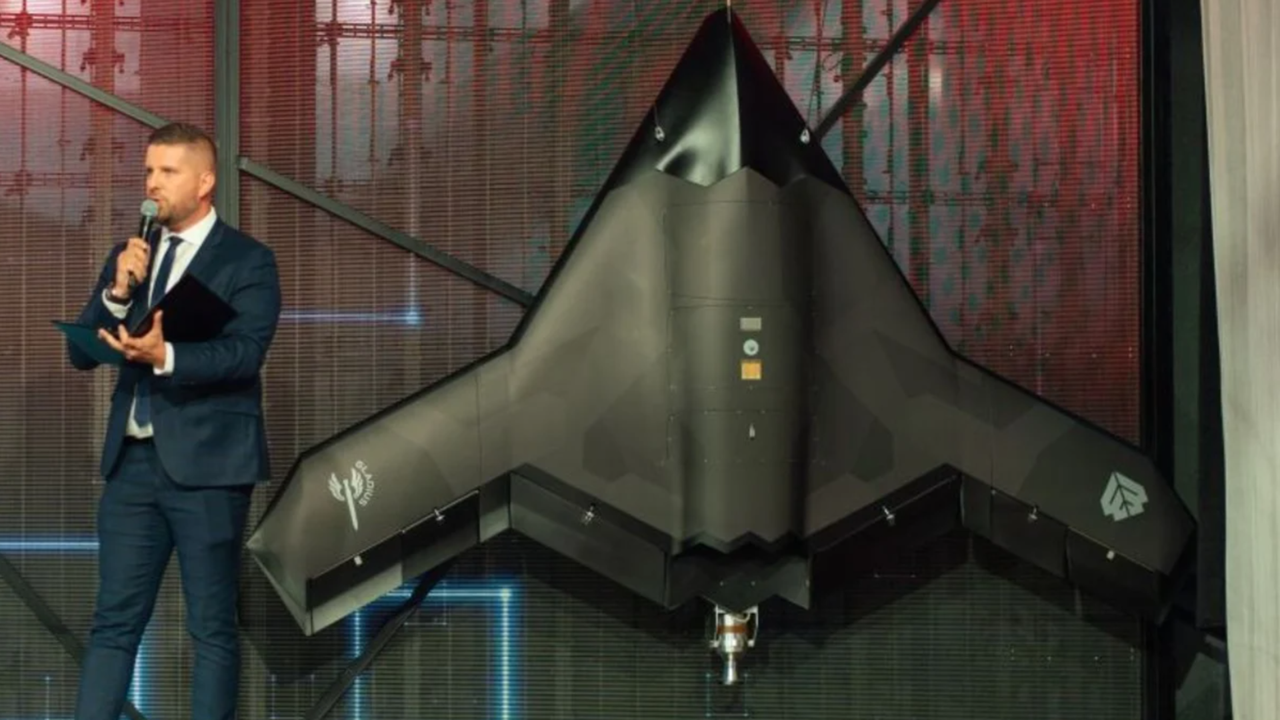
- Poland’s new loitering munition borrows stealth aviation’s shape for practical battlefield reasons
- A turbojet gives Gladius 2 a different propulsion approach from earlier Warmate variants
- The 30kg warhead places Gladius 2 between several established Warmate configurations
Polish defense manufacturer WB Group has revealed a new loitering munition whose flattened, wing-shaped body echoes the American B-2 Spirit bomber.
Gladius 2, also called Warmate 30, uses that shape mainly to cut down on radar and heat signatures rather than for looks.
Flying wing designs scatter radar waves more efficiently than boxy airframes, which is exactly why stealth bombers adopted the same silhouette decades ago.
A shape borrowed from stealth aviation, not aesthetics
The munition runs on a turbojet engine, giving it a faster run toward its objective than earlier electrically powered Warmate versions.
It carries an interchangeable 30 kg (66 lb) warhead and can launch from a shipping container or a dedicated vehicle.
WB Group designed the weapon to operate within its wider Gladius reconnaissance strike system rather than as a standalone munition alone.
That system pairs the FT-5 Łoś reconnaissance drone with separate strike effectors, all coordinated through a software platform called Topaz.
This arrangement lets one operator locate an objective using the reconnaissance aircraft, then destroy it with a separate strike weapon.
According to the company, it started developing this newer variant back in <a href="https://myappsplus.com/quordle-hints-and-answers-for-wednesday-september-16-game-1696/” title=”Quordle hints and answers for Wednesday, September 16 (game #1696)”>September 2022, drawing lessons from the ongoing conflict in Ukraine.
Poland is already investing heavily in the drone family
The new weapon arrives as Poland continues spending heavily on domestically produced unmanned systems and loitering munitions.
In May 2026, Poland’s Armaments Agency signed agreements covering more than 400 Warmate systems and nearly 200 FlyEye reconnaissance drones.
The same contracts included 12 Gladius fire modules, with financing partly supplied through the European Union’s SAFE defence lending programme.
WB Group has not confirmed whether Gladius 2 or Warmate 30 forms part of those existing procurement agreements.
That distinction matters because the newly shown aircraft could remain a future offering rather than an immediately contracted Polish military system.
WB Group has previously described several Warmate variants using payload categories, including models associated with 5kg, 20kg, and 50kg warheads.
Warmate 30 therefore fits between those larger and smaller configurations while carrying a 30kg payload of its own.
The earlier Warmate 3 reportedly carries a smaller warhead while reaching distances of up to 70km, or 43 miles.
The original Gladius system has also been offered with earlier electrically powered Warmate variants capable of exceeding 100km, or 62 miles.
However, those figures should not be treated as specifications for Gladius 2 until WB Group releases its own performance data.
Whether Gladius 2 performs as well as its shape suggests will remain unclear until WB Group releases actual test figures.
This bomber simply copies a proven stealth silhouette, which makes practical sense for a country expanding its arsenal under real wartime pressure.
