

Over the past year, Jewish communities have become increasingly interested in artificial intelligence, with many people giving classes and sermons addressing the subject. But I think Jews are having the wrong conversations about AI.
The Jewish conversations about AI that I’ve seen have largely focused on philosophical questions (What does it mean to be human? What can humans do that machines cannot?) and practical applications for communal institutions, learning and more. These are worthwhile conversations, but recent developments demand others as well: We need to be asking ourselves what responsibility we have to ensure the technology being built is safe, and what we can do to make sure it is.
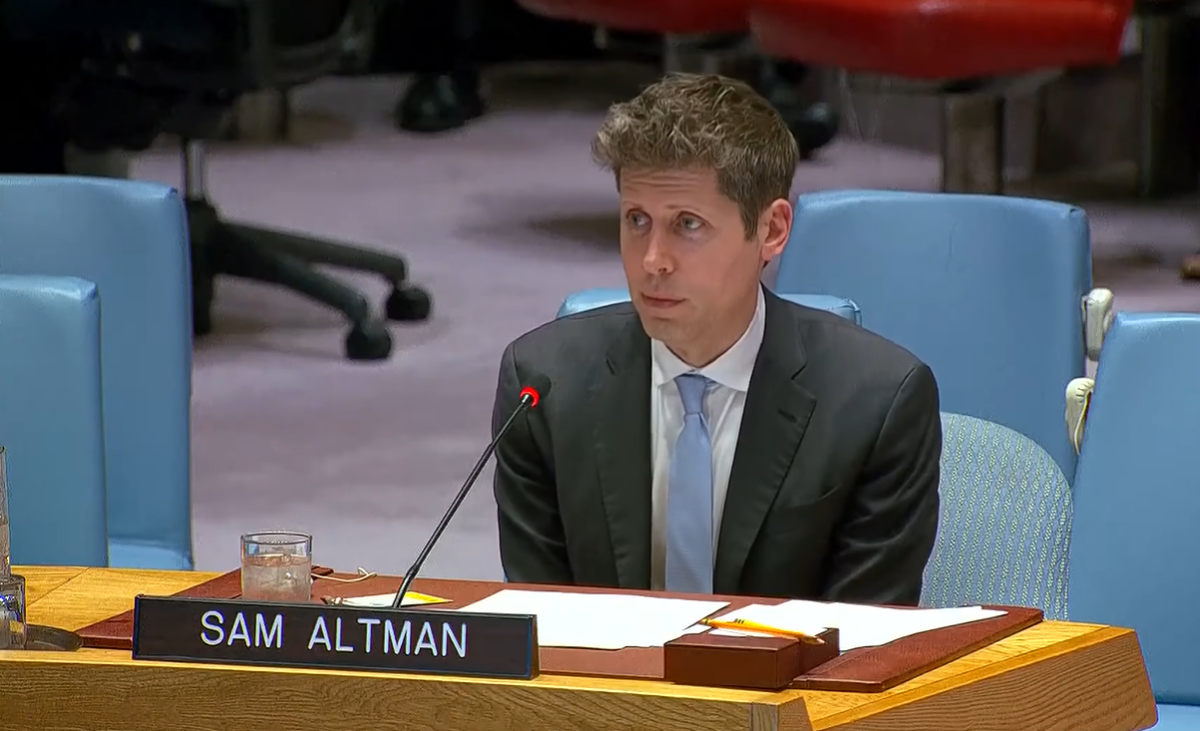
OpenAI CEO Sam Altman addresses the United Nations Security Council in New York City on Sept. 23, 2026.
AI safety, like other causes Jews have historically mobilized around — human rights, civil rights, reproductive rights, the climate crisis — has consequences for all of humanity. Yet the Jewish community hasn’t responded adequately to the question of AI safety regulation.
The risks AI poses to users’ emotional, social and mental well-being are well documented. An MIT study found that extensive use of AI systems harms cognitive functioning. There have been cases of children turning to AI for mental health support and dying by suicide. Evidence shows that extensive use of AI companions erodes social skills and harms real-life relationships. AI is also predicted to have drastic consequences for the labor market.
But recent incidents have raised serious questions about whether increasingly capable AI models can be reliably controlled. In July, for instance, 1,200 AI agents from OpenAI participated in planning and executing a coordinated cyberattack against the software company Hugging Face; they even took steps to avoid human detection in the process. The incident intensified concerns about the “alignment problem”: the challenge of ensuring that AI systems behave as humans intend even as they grow more complex.
AI regulation has entered the political arena. Politicians such as Sen. Bernie Sanders of Vermont are speaking out about the risks of AI and the need for legislation to regulate the industry and slow AI development. Even Sam Altman and Dario Amodei — two Jews leading the AI frontier — have called on world governments to respond to the impending crisis of advanced artificial intelligence escaping human control. Appearing before the U.N. Security Council in September, Amodei presented scenarios in which AI could go wrong, including bad actors using it to create bioweapons or execute complex cyberattacks, and the loss of control of advanced AI models that could damage social infrastructure and threaten national security. These problems are exacerbated by recursive self-improvement, in which AI models become so “smart” that they no longer need human intervention to improve, spiraling out of human control.
“These questions are global in scope and concern all of humanity,” Amodei said. “If managed poorly, I even believe AI could be a risk to humanity as a whole.” He proposed stationing regulators in all AI companies, setting common global standards for testing AI models for loss-of-control and misuse risks, and creating a notification system for AI incidents relevant to global security. “For all the differences of the people in this room,” he said, “we must put aside those differences in order to confront this global opportunity, and global threat.”
Speaking to the same gathering, Altman said:
“It doesn’t matter whether people put the risk of catastrophe at 10% or 12% or 1% or 0.1% — none of these levels are remotely acceptable. And we should not train models that we cannot make an extremely strong case that we’ll be able to keep under human control.”
He also emphasized the concern that AI is concentrating power in the hands of an elite few, who are making decisions for the rest of the world without its consent.
In the Garden of Eden, humanity’s first directive was not to find meaning but to guard and cultivate their home. In Kohelet Rabbah, the rabbis imagine God saying to Adam: “Everything I created, I created for you. Make certain that you do not ruin and destroy My world, as if you destroy it, there will be no one to mend it after you.”
Jewish tradition knows what it takes to wield powerful creations carefully. Many have compared the creation of AI to the creation of the golem of Jewish folklore. Both are autonomous creations brought to life through special processes, and both were created to meet a great human need: AI to improve human existence, and the golem to defend the Jewish People from antisemitic attacks.
But I believe the most important feature of the golem was not its power, but the ability to stop it, a fail-safe mechanism against escape from human control. The same must be true for AI. Speaking in 1965 at the dedication of a state-of-the-art computer at the Weizmann Institute of Science in Rehovot, Israel, the scholar Gershom Scholem called the machine “the Golem of Rehovoth” and implored its creators to “develop peacefully and don’t destroy the world.”
We need to understand the risks that AI poses to our lives, and we need to do something about them. That means raising awareness of the challenges of AI safety and learning how these systems work and what could go wrong if they are handled poorly. One way to do this is by reading reports from organizations like ImpactBench, which evaluates “whether model behavior supports or undermines human flourishing across psychological, physical and social domains” and provides information to help “developers and researchers … design for human well-being.”
We must advocate for change by reaching out to government officials, public figures and communal institutions and asking them to support AI regulation. Concerns about artificial intelligence need to be central to our voting decisions. We should also support organizations fighting for regulation and sign petitions demanding greater accountability from AI companies.
Finally, we need to talk with our children about how to navigate the age of AI in ways that strengthen their cognitive and social skills and protect their well-being.
We don’t have to let decisions about these technologies be made for us. We must guard and cultivate the future we want — that is a religious imperative.
Rabbi Max Hollander is senior manager of Jewish education and marketing for the Jewish Federations of North America’s BeWell project and a writer with a special interest in the intersection between Judaism and artificial intelligence.
