

A new approach using machine learning can help computer models simulate waves more accurately in less time.
Biological and Environmental Research
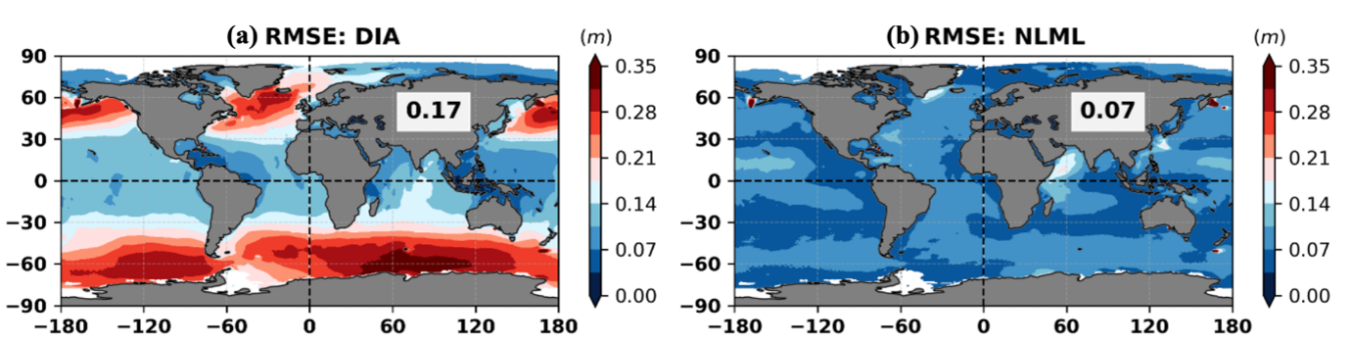
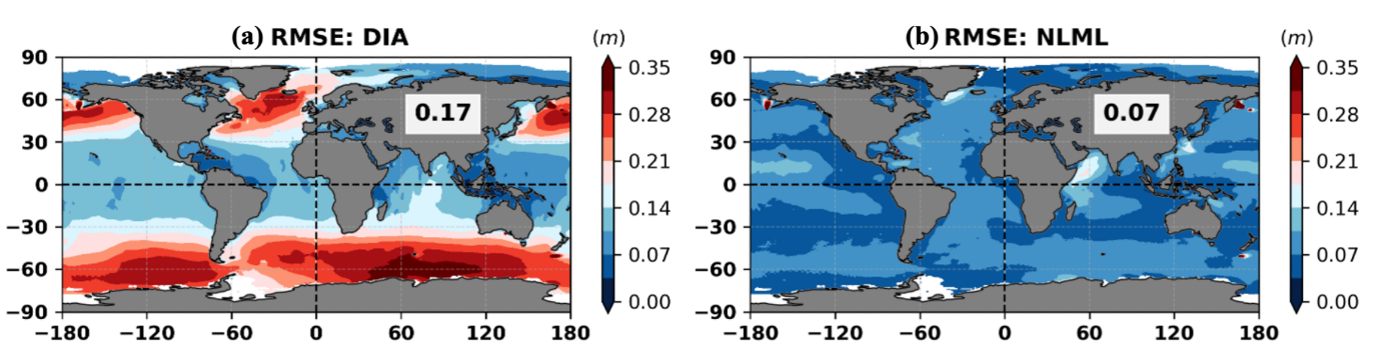
(a) Global Root Mean Square Error (RMSE) pattern of significant wave height in Discrete Interaction Approximation relative to the Exact. (b) Global RMSE pattern of significant wave height in NLML relative to the exact interaction method.
Image courtesy of Publication authors; in JGR : Machine Learning and Computation
The Science
Ocean surface waves strongly influence how the ocean, atmosphere, and ice exchange heat and energy. As a result, these waves affect coastal flooding, sea-ice breakup, and the transfer of heat and gases between the air and sea. Extreme waves pose serious risks to coastal communities, offshore infrastructure, and shipping operations. This makes it critical to forecast waves accurately. A key challenge in modeling waves in computer simulations is representing how the spectrum of waves present at each location in the ocean exchange energy. The exact method is the most accurate approach for calculating this characteristic. But for computers to use this approach, they must solve a very high-dimensional integral. This type of calculation is too computationally expensive for routine forecasting of future events based on past data (operational forecasting). Instead, operational models typically rely on an approximation called the Discrete Interaction Approximation (DIA). However, DIA trades accuracy for speed. It introduces significant errors in wave predictions. In this study, scientists developed a deep neural network emulator that approaches the accuracy of exact interactions. However, it has a computational cost comparable to faster approaches. Deep neural networks are a form of machine learning that mimics how the brain classifies and generalizes information.
The Impacts
Currently, most models use DIA, the fast approximation. This approximation introduces systematic errors in significant wave height (the average height of the largest waves in the region). As a result, it incorrectly models sea ice pack. Inaccuracies in sea ice pack can reduce how well a model can predict potential Arctic access and navigability. To solve this problem, this team developed a deep neutral network emulator called NLML. This emulator narrows a long-standing gap between efficiency and accuracy in wave modeling. It delivers near–exact-physics fidelity at near-operational speed. When the researchers integrated NLML into the Wavewatch III NOAA ocean wave model, it significantly reduced the large errors that DIA introduces. Compared to models using DIA, NLML achieved up to seven times higher accuracy in significant wave height in critical regions. The largest improvements were in high-latitude oceans. The team also observed similar improvements in other mean wave parameters. NLML was up to 136 times faster relative to the exact method while having a runtime only slightly longer (within 4 percent) than DIA’s. This accomplishment makes NLML practical for operational forecasting. It can also be useful in coupled Earth system modeling workflows. NLML is the first machine learning parameterization that remains stable during long-term ocean wave model integration.
Summary
Scientists developed a deep and wide neural network emulator (4 layers and 3072 neurons per layer), NLML to represent the exact nonlinear wave–wave interaction source term in an ocean wave model. It overcomes key limitations of earlier approaches related to computational cost, generalization, and numerical stability. The team trained NLML using data from a global WAVEWATCH III simulation with the exact nonlinear interaction formulation using a customized loss function. The emulator was coupled online into WAVEWATCH III through a Fortran-to-PyTorch interface (FTorch). It remains stable in year-long, wave-only global simulations forced by reanalysis wind fields. NLML reproduced wave spectra that are like the exact interaction method (WRT) more accurately than the approximate method. It also reduced global integrated spectral errors by about 5 percent, and lowered mean significant wave height root mean square error (RMSE) from roughly 0.17 to 0.07, with bias reductions across the globe. By leveraging advanced GPU computing with half precision (FP16) capabilities, we achieved substantial speedups. It was up to 136 times faster than the exact method and only a minimal 1.04 times slowdown relative to the approximate method. This model marks the first use of half-precision GPU inference in an ocean wave modeling system. With ongoing advancements in hardware acceleration, mixed precision computing, and machine learning optimization techniques, researchers will further refine the efficiency of NLML. It is a promising approach for future high resolution and real time wave modeling applications.
Contact
Luke Van Roekel
Lost Alamos National Laboratory
Ivanroekel@lanl.gov
Publication
Ikuyajolu, O. J.; Van Roekel, L.; Brus, S. R.; & Thomas, E. E. “NLML: A deep neural network emulator for the exact nonlinear interactions in a wind wave model.” Journal of Geophysical Research: Machine Learning and Computation, 3, e2025JH000699 (2026). [https://doi.org/10.1029/2025JH000699]
Funding
This research was supported as part of the Energy Exascale Earth System Model (E3SM) project, funded by the U.S. Department of Energy, Office of Science, Office of Biological and Environmental Research. This work was supported by the U.S. Department of Energy through the Los Alamos National Laboratory. This research used resources from the National Energy Research Scientific Computing Center, a U.S. Department of Energy Office of Science User Facility.
