

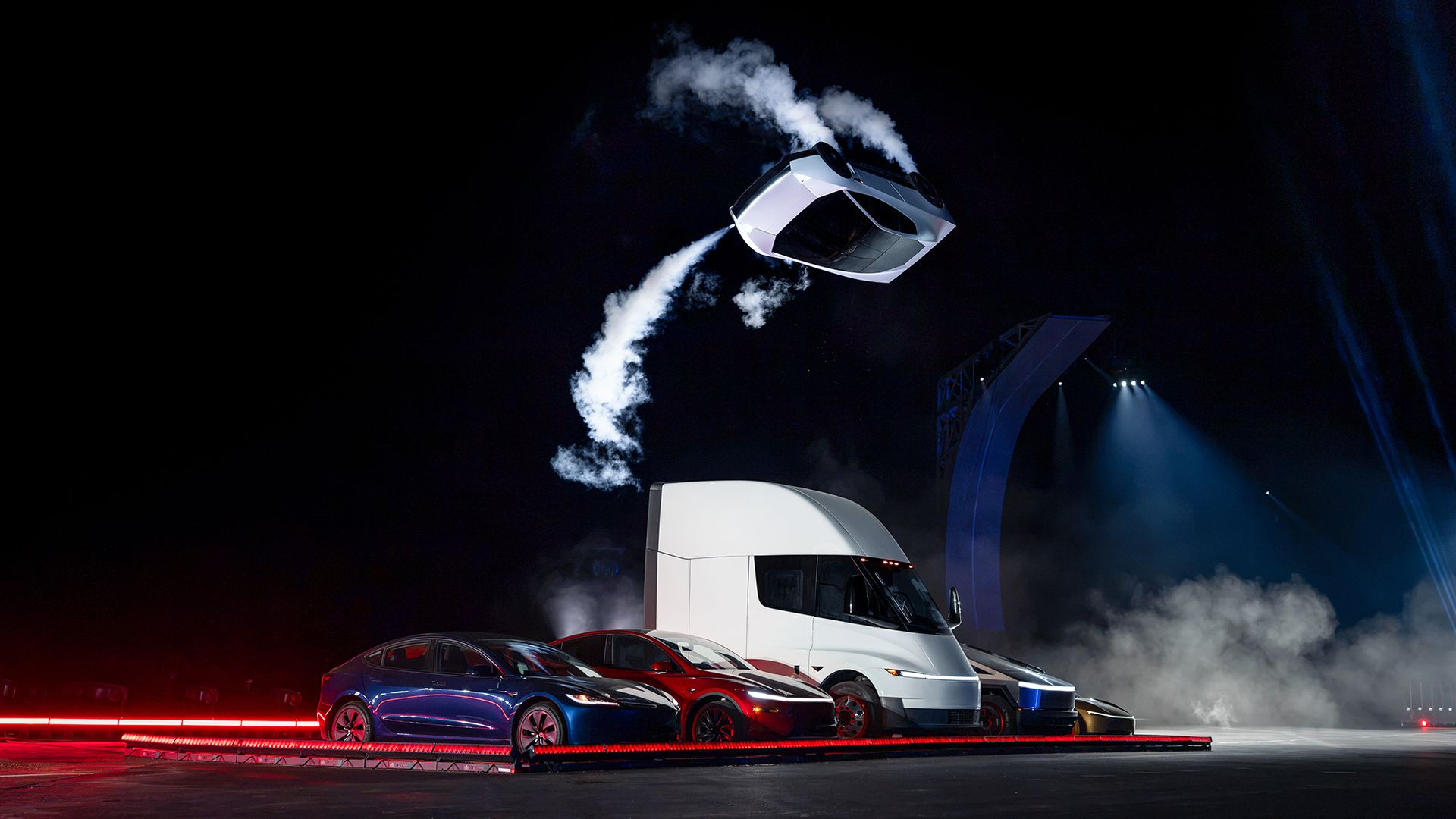
We had to wait a long time for the unveiling of the new Tesla Roadster, but for those who wanted to see something absolutely bonkers, it was worth the wait. A top speed of more than 230mph, 0-60mph in under 0.59 seconds, and a suction system that lets the car hang upside down, if you’re driving along the ceiling for some reason.
Then there are the rocket thrusters, borrowed from SpaceX, with up to 10 fitted on the top-end Rocket version of the car, which will be available buy by invite only. These compressed air boosters gave us the most dramatic moments of the unveiling, as the Roadster went upside down and then flipped back over, before later jumping over a procession of parked vehicles.
How exactly then has Tesla managed to get a car to fly? Is it going to cut down your commute time? And surely this technology can’t be safe enough to ever be allowed on the roads? Here’s the breakdown of the Roadster’s rocket thrusters and how worried you need to be about getting close to them.
How does the Tesla Roadster fly?
The rocket thrusters on the Roadster are powered by tanks called carbon fiber overwrapped pressure vessels (COPVs). These tanks hold highly compressed air, and when that air gets released, through the thrusters, whatever they’re attached to — in this case, a Tesla Roadster — travels very quickly in the other direction.
These COPVs are attached to cold-gas thrusters, but the air isn’t chilled; it’s just tightly compressed. The ‘cold’ terminology is used to distinguish them from ‘hot’ rockets that burn fuel, and there’s no fuel burning here. SpaceX has been using similar thrusters for years, to help Falcon 9 boosters land safely back on Earth.
As per Tesla, “every usable void” in the Roadster is packed with COPVs to give the thrusters enough air to work with — a maximum of 600 liters, Tesla says, on the Rocket variant. That’s divided into a 200-liter tank at the back for the rear thrusters (which is also there on the Thrust variant), and a 400-liter tank that replaces the passenger seat on the Rocket model.
We don’t know how much flight time that will provide, but it seems unlikely to last much longer than the ‘jump’, adjustments and landing that we saw in Musk’s demo. So it’s unlikely you’ll be soaring over city traffic (even if it were road legal). But if you should find yourself facing a missing section of an unfinished freeway, a la Speed, it should be ideal.
At the event, Tesla and SpaceX CEO Elon Musk said the car would be able to refill its air tanks on its own, without any air propellant, but what we don’t know is how long that takes. You might have to limit your barrel rolling when you’re behind the wheel.
Electric motors are used to open and close the thrusters, “completing micro adjustments within a fraction of a second”. You can see from the live demos that there’s a lot of in-flight calibration going on to get the Roadster to land with its four wheels flat, and to give it the necessary lift when required.
“It can do rolls, it can do crazy gymnastics,” Musk said at the Roadster showcase after wowing the live crowd with a few stunts. Notably though, there was no driver in the car — it was controlled autonomously — and the audience was situated a long way back.
Are the new Tesla Roadster’s thrusters dangerous?
As impressive as the Roadster’s stunts are, it’s unlikely that rocket thrusters are coming to a legally approved road vehicle anytime soon. Musk himself said the vehicle was “not necessarily a safety optimized car” and when asked whether it was road legal said that it “depends on the street”.
What we do know is the Rocket version of the Roadster (with a single seat and 10 thrusters, the full flying package) is marked as “not approved for public road use” on Tesla’s website. The “track ready” Thrust version, with two seats and fewer thrusters, is labeled as a “limited release”. The Performance version, which you can reserve now for production planned in 2028, is “road ready” and doesn’t have any thrusters.
Here’s the most likely reason for the restrictions: Tesla says that the four rear thrusters alone produce over 80 kilonewtons (kNs) of force — the same as being hit by a 9-ton weight, if you happened to pass behind the Roadster on a track starting line just as it set off.
I’m no road safety expert, but that seems likely to raise red flags for regulators. It’s quite capable of breaking multiple bones and damaging organs in humans. It could also write off the car behind the Roadster, if used at a green light.
There is a secondary issue, which is that the gas escapes at supersonic speeds, so if it picks up any debris from the road as it blasts, that would be accelerated to bullet-like velocities.
You obviously wouldn’t fare much better if a Tesla Roadster landed on top of you — for multiple reasons — even if its thrusters ensured a relatively comfortable landing for the driver. The driver’s safety remains a bit of a question mark too, though, because something closer to a rollercoaster harness would be needed in place of a driver’s seat to keep a real person secure inside.
In short: there’s a lot of potential danger, and multiple safety risks involved here, meaning its very improbable you’ll ever see one driving down the street. For the foreseeable future, the flying version of the Roadster is just a stunt car. Perhaps we’ll learn more at the next demo, planned for Idaho Snake River Canyon of Evel Knievel fame.
