

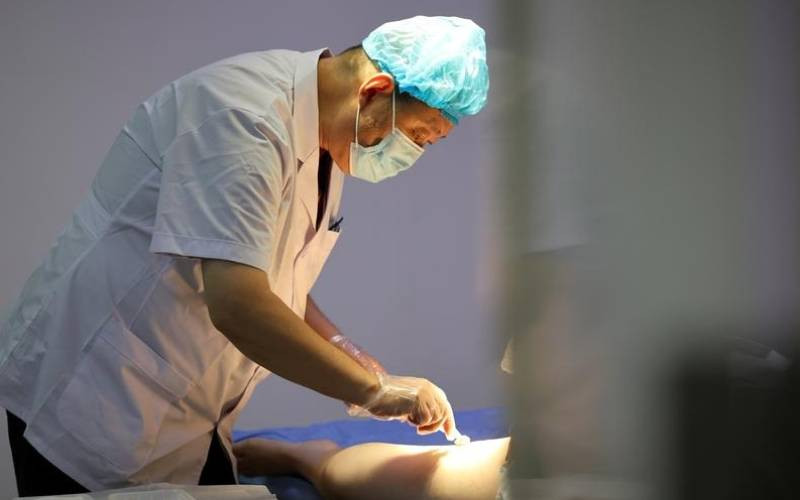
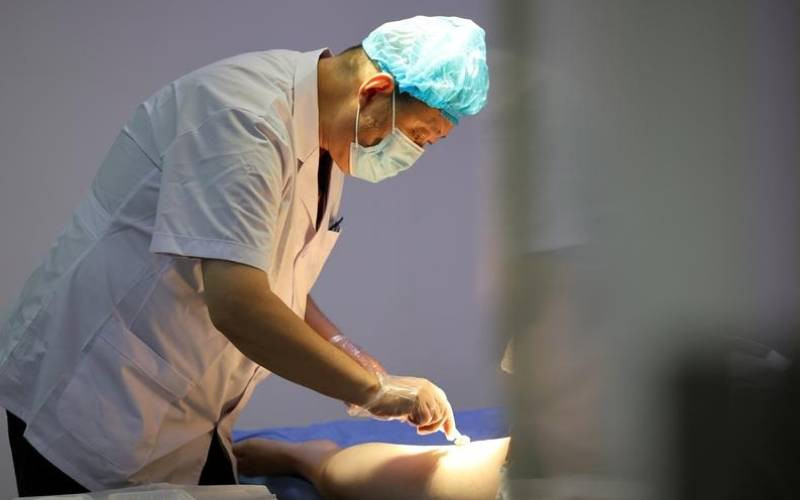
Doctor Ma Chao treats a patient at Tianjin Xiqing Hospital in north China. The 60-year-old has worked as a doctor since 1989, specialising in animal-induced injuries. August 18, 2026. [Xinhua]
Half a century ago, a “barefoot doctor” in rural China might have carried little more than a bag of basic medicines, a few syringes and a dozen or so needles.
Today, those humble practitioners have given way to a vast and diverse healthcare workforce operating within the world’s largest health system that spans village clinics, county hospitals and advanced medical centres equipped with cutting-edge technologies.
As China marks its ninth Doctors’ Day on Wednesday, the evolution of its healthcare system offers a striking lens through which to view how generations of medical workers have helped build a healthier nation. The journey has taken them from delivering basic care in villages to deploying artificial intelligence (AI), surgical robots and brain-computer interface (BCI) technologies in everyday clinical practice.
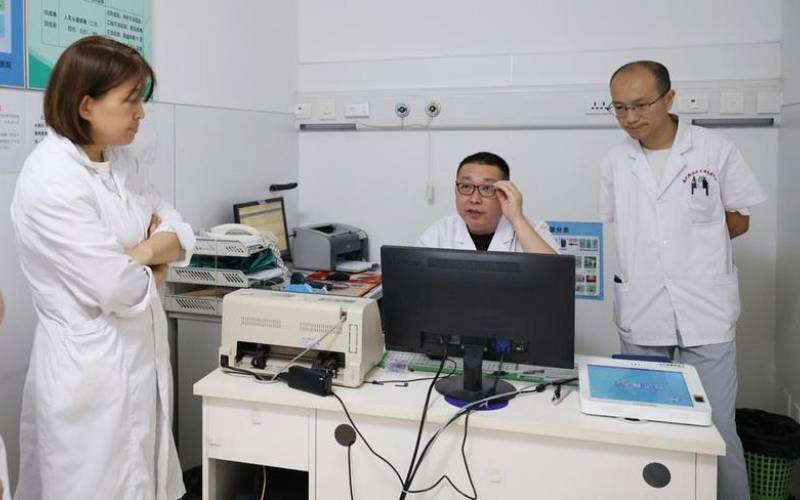
Ma Chao (C) communicates with doctors at Tianjin Xiqing Hospital in north China’s Tianjin Municipality, Aug. 18, 2026. [Xinhua]
Wang Guizhen, regarded as one of China’s earliest “barefoot doctors,” could hardly have imagined such changes when she began tending to villagers on the outskirts of Shanghai decades ago.
“A medicine bag on my shoulder, and mud beneath my feet,” the late doctor once recalled, describing her rounds between villages in the 1960s and 1970s, where she treated rural residents with basic Western medicines and traditional Chinese therapies such as acupuncture and herbal remedies.
In her day, Wang and more than a million fellow practitioners formed the backbone of rural healthcare. With limited training and modest equipment, they delivered essential care to hundreds of millions of villagers across the country.
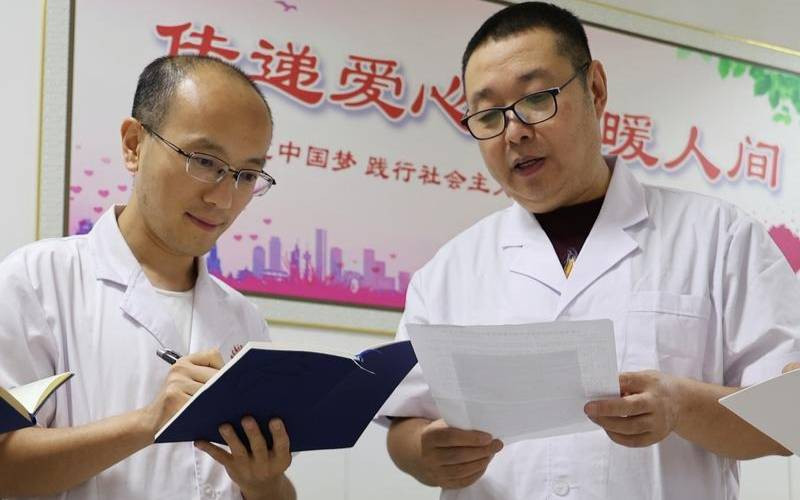
Ma Chao communicates with doctors at Tianjin Xiqing Hospital in north China’s Tianjin Municipality, August 18, 2026. [Xinhua]
Over the following decades, China’s healthcare system grew into the world’s largest. By the end of 2025, the country had more than 1.1 million medical institutions, including about 560,000 village clinics, supported by a workforce of 16 million healthcare professionals. Among them were 5.3 million licensed and assistant physicians.
Primary healthcare institutions across China recorded 5.56 billion visits in 2025. More than 90 per cent of residents can now reach a nearby healthcare facility within 15 minutes, according to official data.
Unlike Wang’s generation, Li Yuqin, a village doctor in Guizhou Province in southwest China, can now rely on an AI-powered medical assistance system when diagnosing patients. The system analyses medical information, generates medical records and flags potential medication risks. “With the help of the AI system, I can make more accurate diagnoses and produce more standardised medical records,” Li said.
The platform, which connects local healthcare data, has been rolled out across healthcare institutions in Qingzhen City, where Li works. It allows residents to access quality medical services close to home.
Meanwhile, in major cities, doctors are increasingly incorporating advanced technologies into routine clinical practice, including high-resolution imaging, robotic surgery and precision radiotherapy.
In July, Huashan Hospital Affiliated to Fudan University in Shanghai issued China’s first prescription for an implantable BCI system designed to restore hand movement, after the device was approved for market. For the patient, the treatment offered renewed hope of regaining hand function.
Hospital President Mao Ying said the hospital had been closely tracking advances in BCI technology while exploring applications involving chips, flexible medical devices and other emerging technologies. The goal, Mao said, was to translate research breakthroughs into clinical benefits.
The expansion of medical services has been accompanied by a broader healthcare protection system. By the end of 2025, China’s basic medical insurance program covered about 1.33 billion people, helping to ease the financial burden of healthcare for the vast majority of the population.
The progress is ultimately reflected in people’s lives. Between 2012 and 2025, China’s average life expectancy rose by 3.85 years to 79.25 years, while infant mortality fell to 3.8 per 1,000 live births and maternal mortality to 13.4 per 100,000 live births. China now aims to raise average life expectancy to 80 years by 2030.
With people living longer, China has increasingly shifted its healthcare policy toward prevention rather than treatment in recent years.
In 2016, the State Council issued a national plan to reorient healthcare services toward health promotion. Another plan was unveiled this year, setting a goal of having around 40 per cent of the population regularly participate in physical exercise by 2030.
For medical practitioners, the shift means taking on greater roles in disease prevention and health promotion, including encouraging regular exercise and healthier lifestyles as part of a broader approach to health management.
More and more doctors are stepping out of the consultation room and onto the internet, turning complex medical knowledge into practical “health guides” through engaging and accessible formats.
On social media platforms, Tan Xianjie, deputy director of the department of obstetrics and gynaecology at Peking Union Medical College Hospital, regularly answers questions about women’s health and other everyday medical concerns.
“Treating a patient helps one person, while health education can help an entire community,” Tan said.
The country’s broader efforts to improve people’s health have pushed health literacy among Chinese residents to 33.69 per cent in 2025, while the rate of premature deaths from major chronic diseases fell to below 14 per cent.
To ensure a steady supply of skilled medical professionals, China has built an education and training system spanning undergraduate education, standardised residency training and continuing medical education. Since the residency training program was launched in 2013, China has trained more than one million resident physicians as of 2024.
China has also been working to improve doctors’ pay and working conditions by reforming public hospital remuneration systems, expanding income sources for general practitioners, and providing greater incentives for those working in underserved areas. Other measures have focused on career development, occupational protection and social recognition.
In July this year, Uhas Sulayman, a doctor who spent decades providing door-to-door medical care to herders in northwest China’s Xinjiang, received the July 1 Medal, the highest honour of the Communist Party of China. The award also serves as a tribute to grassroots medical workers who have stood firm on the front lines of public health.
These changes over the decades have been profound, yet the basic purpose of the profession has remained much the same. That continuity is evident in the work of doctors who still travel to remote areas where access to specialist care remains limited.
For Yin Chengqian, a cardiologist at Beijing Anzhen Hospital, that has meant making regular trips to southwest China’s Xizang Autonomous Region over the past decade to provide free medical consultations.
At high altitudes, Yin continued to examine patients even while receiving oxygen himself. “If I can save one more person, that means a little more hope for the plateau,” he said.
From a medicine bag carried along muddy village roads to AI-assisted diagnosis and implantable BCIs, the tools available to Chinese doctors have changed dramatically over the past half-century.
But for doctors like Yin, the measure of that progress is still ultimately found in the same place it was for the “barefoot doctors” of Wang’s generation: whether a patient can get the care they need, when they need it.
