

- News
- Technology News
- Tech News
- Florida scientists used machine learning to predict when giant Burmese pythons are most likely to be caught; weather and moon phases matter
Trending
John Ternus
John Stankey
Swami Sivasubramanian
Julie Sweet
Florida scientists used machine learning to predict when giant Burmese pythons are most likely to be caught; weather and moon phases matter
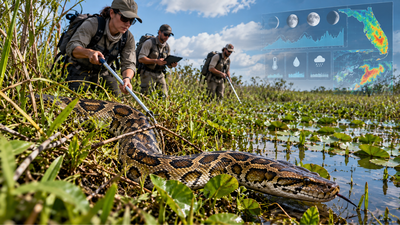
Representative AI image
Florida scientists have used machine learning to identify when python-removal surveys are most likely to capture Burmese pythons with the greatest potential to influence population growth. Researchers from the University of Florida combined demographic information about individual snakes with environmental and survey conditions to develop a Weighted Removal Index, which assigns greater importance to pythons with higher reproductive and survival potential. The study found that survey value was associated with factors including temperature, humidity, season and lunar phase. Large reproductive females emerged as particularly important targets, while warmer, more humid conditions and waning lunar phases were associated with higher-value captures. The findings could help wildlife managers direct limited personnel and resources towards removal periods that are more likely to have a meaningful effect on the invasive population.
Machine learning targets high-impact Burmese pythons
Published in Ecological Applications, the study addresses a problem that conventional python-removal programmes can overlook: the number of snakes captured does not necessarily reflect the ecological value of those removals. A juvenile and a mature reproductive female may count equally as individual captures, but their potential contributions to the future population are very different.To account for that difference, the researchers developed the Weighted Removal Index (WRI). The index incorporates demographic characteristics that influence a snake’s expected contribution to population growth. It gives greater weight to individuals with characteristics associated with higher survival and reproductive potential.The approach allows researchers to evaluate an entire survey according to the demographic value of the snakes captured rather than simply counting animals. This distinction is particularly important for Burmese pythons, whose population dynamics are strongly influenced by the survival and reproduction of mature individuals.The researchers then combined the WRI with environmental and operational information to determine which conditions were associated with surveys yielding greater demographic value.
Large reproductive females can have an outsized impact
The demographic weighting places particular importance on mature, reproductive females. A large female that survives to reproduce can contribute substantially to future population growth, while a smaller juvenile faces a higher risk of dying before reaching reproductive age.This makes the removal of a reproductive female potentially more consequential than the removal of several snakes with lower reproductive potential. The study’s framework therefore shifts attention from the simple question of how many pythons are caught to which individuals are removed from the population.The researchers compared three modelling approaches to determine whether these high-value surveys could be predicted: generalised additive models, boosted regression trees and neural networks. The neural network produced the strongest performance when evaluated against held-out data.It achieved a balanced accuracy of 0.703 in predicting survey success and recorded the lowest prediction error for survey WRI, with a root mean squared error of 5.50. The result indicates that environmental and survey information contained useful signals for anticipating when removal efforts were likely to produce greater demographic value.
Weather and moon phases shape survey conditions
Environmental conditions emerged as important predictors of survey WRI. The researchers found higher values under warmer and more humid conditions, with the pattern also varying according to season.WRI was elevated on warmer days early in the wet season and on cooler days during the dry season. Such patterns are consistent with the biology of Burmese pythons, which are ectothermic and depend on environmental conditions to regulate their body temperature and activity.Lunar conditions also contributed to the model. Surveys conducted during waning lunar phases were associated with higher survey WRI, adding another environmental variable that managers could consider when planning removal operations.The significance of these findings lies in their combined use. Rather than treating weather, season or lunar phase as isolated predictors, the modelling framework considers multiple factors simultaneously to identify periods when surveys are more likely to produce captures with greater demographic importance.One particularly notable result involved the winter months. January and February can produce relatively few captures when success is measured simply by the number of snakes removed. However, their WRI could be comparatively high because the snakes captured during these periods included a greater proportion of mature males and females.
South Florida data provide a real-world test
The research drew on data from the South Florida Water Management District’s Python Elimination Program, giving the researchers access to information collected during operational python-removal efforts.The work builds on earlier UF/IFAS research examining thousands of surveys in South Florida. Previous analysis found that python searches were generally more productive during the wet season and identified particular times and environmental conditions associated with increased detection.The new study adds a demographic dimension to those findings. Instead of using survey success solely as a measure of the number of animals detected, researchers assessed the characteristics of the pythons removed and calculated their potential contribution to future population growth.That distinction could be valuable in South Florida, where Burmese pythons have become an established invasive predator. They are difficult to detect because of their cryptic behaviour and ability to remain concealed in vegetation and other habitats. Their broad diet also allows them to prey on numerous native species, making population control a significant conservation challenge.With removal efforts requiring substantial time and manpower, managers have to make decisions about when and where to deploy those resources. A forecasting system that identifies conditions associated with higher-value captures could provide an additional tool for those decisions.
A new way to measure the success of python removal
The researchers’ approach ultimately challenges the idea that the success of an invasive-species removal programme should be judged primarily by its capture total. Two surveys can produce very different numbers of snakes while having substantially different implications for future population growth.The Weighted Removal Index offers a way to quantify that difference. By combining demographic characteristics with machine-learning predictions, managers could potentially identify periods when their efforts are more likely to remove mature or otherwise demographically important pythons.The framework could be particularly useful in areas where Burmese pythons are beginning to establish or expand their range. Removing reproductive individuals early in an invasion may have greater consequences for population growth than removing the same number of lower-value individuals later.
You use AI every day. Now get your AI Quotient. Take the AIQ test.
End of Article
