

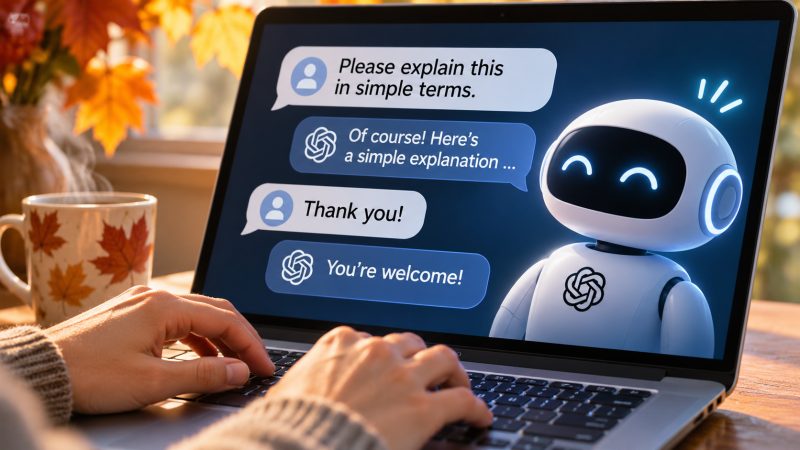
Do you say “please” when asking ChatGPT a question? Do you thank it when it gives you a helpful answer?
If so, you’re not alone. Millions of people have developed the habit of speaking politely to artificial intelligence, even though they’re communicating with software rather than another person.
But does an AI system actually need thanks? And does being polite make any difference in the answers it provides?
Those questions have attracted the attention of technology executives, researchers, and even philosophers. The answers are more complicated than they might seem.
In April 2025, someone asked OpenAI CEO Sam Altman an unusual question on the social media platform X.
How much money was his company spending on electricity simply because people kept saying “please” and “thank you” to ChatGPT?
Altman’s response was brief.
“Tens of millions of dollars well spent—you never know.”
The comment was widely interpreted as a joke, particularly the suggestion that being polite might someday prove useful if artificial intelligence became much more powerful.

But the humor masks a real issue.
Every message sent to an AI system requires computer processing. The software must analyze the words, determine an appropriate response, and generate its answer.
Those calculations use electricity, and the enormous data centers supporting AI services consume considerable amounts of energy.
Even a few unnecessary words require some additional processing. Multiply those words by millions of conversations every day, and the expense begins to add up.
However, Altman’s remark was not accompanied by a detailed accounting of how much electricity polite language actually consumes. There is no verified public figure showing that “please” and “thank you” alone have cost OpenAI tens of millions of dollars.
Still, his response raised an interesting question: Does being polite to a machine offer any practical benefit?
Research Suggests Manners Can Affect AI Answers
Researchers have found evidence that the way people speak to AI can influence the quality of the responses they receive.
A study published in November 2024 by the Association for Computational Linguistics examined how different levels of politeness affected large language model performance.
The researchers, including scientists from Japan’s Waseda University and RIKEN research institute, tested prompts written in English, Chinese, and Japanese.

They used varying levels of politeness, ranging from respectful requests to deliberately rude language.
The results were revealing.
Impolite prompts often produced poorer results, while excessively polite language did not necessarily improve performance.
The researchers also found that the most effective level of politeness differed among the three languages.
In other words, being respectful could help, but surrounding a question with compliments and flattery offered no guaranteed advantage.
The findings suggest that AI systems are sensitive to the style and tone of the language they receive.
That makes sense, given how these systems are trained.
Large language models learn patterns from enormous collections of written material, including books, articles, websites, and conversations.
They recognize relationships between words, phrases, and communication styles.
A carefully worded, cooperative request may lead to a different response than a hostile or demanding one, even when both requests concern the same subject.

That doesn’t mean the computer feels insulted when someone is rude.
It means the wording of the question helps influence the wording and sometimes the quality of the answer.
The study also has limits. It does not establish that politeness improves every response from every AI model. Results can vary by language, task, and system.
Microsoft Says Courtesy Helps Set the Tone
Microsoft has offered similar advice to people using its Copilot AI assistant.
Kurtis Beavers, a director on Microsoft’s Copilot design team, explained in a company publication that polite language can encourage more respectful and collaborative responses.
The idea is not that the computer appreciates good manners.
Instead, AI systems respond to patterns in human communication.
A professional request is more likely to produce a professional response. A conversational request may encourage a conversational answer.
But politeness alone isn’t enough.

Someone asking AI for help with a business letter, for example, will generally get better results by clearly explaining the audience, purpose, and desired tone than by simply adding several polite phrases.
Consider two requests.
“Please write a friendly, professional letter thanking our volunteers for helping with Saturday’s community event. Keep it under 200 words.”
The second request provides much more useful information. The word “please” helps establish the tone, but the detailed instructions do most of the work.
Good manners and clear communication can work together.
But Can Artificial Intelligence Actually Feel Appreciated?
This question moves beyond computer programming into philosophy.
Modern AI systems can produce language that sounds remarkably human. They can apologize, express appreciation, respond sympathetically, and discuss complicated subjects.

But producing those words does not establish that a system experiences the emotions associated with them.
Researchers still debate whether artificial intelligence could ever develop consciousness, subjective experience, or something resembling human awareness.
Even some companies developing the technology acknowledge that the question remains unsettled.
Anthropic, the company behind the Claude AI models, addressed the issue in its published constitution for the system.
The company states that it remains deeply uncertain whether Claude has moral standing or whether future AI systems might deserve moral consideration.
Anthropic has also established research efforts examining questions related to AI welfare and possible experiences.
The company is not claiming that Claude is conscious. Instead, it acknowledges that scientists and philosophers lack an agreed-upon way to resolve such questions definitively.
That uncertainty is important.
When ChatGPT responds with “You’re welcome,” it is producing a conversational response appropriate to the exchange. That response alone is not evidence that the system experienced gratitude or appreciation.
Likewise, an AI system producing an apology does not establish that it feels regret.
These systems can imitate many features of human conversation without demonstrating the inner experiences people associate with those words.
For everyday users, there is no established reason to believe an AI assistant needs a thank you in the way another person might.
Maybe the Thank You Isn’t Really for the Computer
There is another way to look at the question, and it has little to do with technology.
People develop habits through repetition.
We teach children to say please and thank you, not because every request requires a ceremony, but because courtesy helps establish how we treat others.
Those habits become part of ordinary conversation.
Someone who routinely says thank you to a cashier, a neighbor, or a coworker may naturally say the same thing to an AI assistant.
The computer may not need the courtesy, but the person using it may value maintaining the habit.
There is also a difference between being polite and pretending a machine is human.
A person can thank ChatGPT for a helpful explanation without believing the software has feelings. Just as someone might casually thank a navigation system for finding a faster route, familiar language can make an interaction feel natural.
That doesn’t require treating technology as a person.
And there is little reason to abandon ordinary manners simply because the recipient happens to be software.
November, with Thanksgiving approaching, offers a fitting time to think about gratitude and the small ways people express it.
We spend much of our lives communicating through screens. Messages, emails, automated services, and AI assistants increasingly shape how we ask questions and receive information.
Being courteous doesn’t mean every interaction needs elaborate praise or unnecessary conversation.
Sometimes it means asking clearly, responding thoughtfully, and acknowledging help when it arrives.
Artificial intelligence may not need to hear “thank you.”
But there is still something to be said for being the kind of person who says it.



Guaranteed Income Just Got a Raise: Why Retirees Are Taking Another Look at Annuities

