

Maximilian SchreinerView the LinkedIn Profile of Maximilian Schreiner
Aug 26, 2026
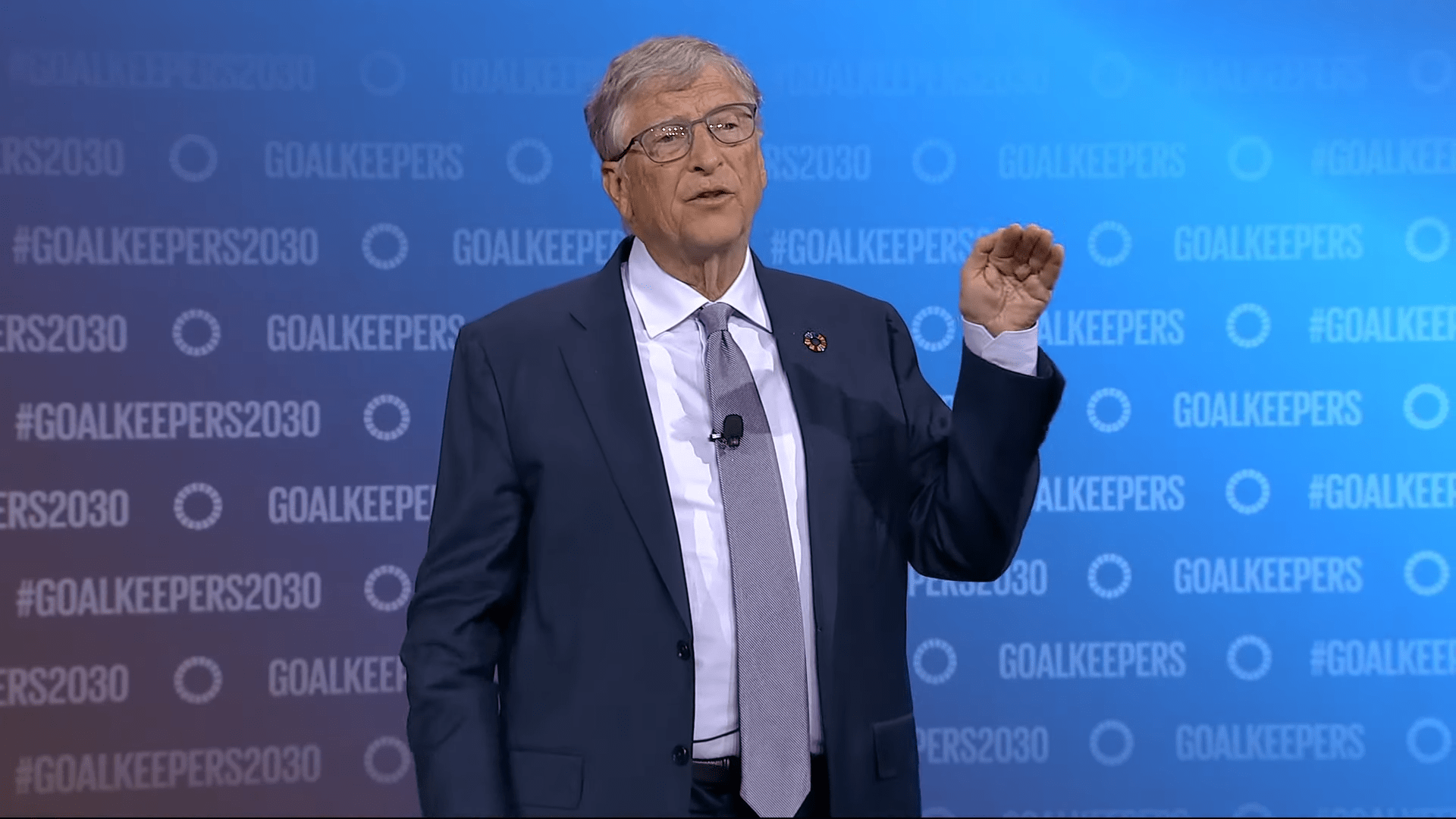
GatesFoundation, Screenshot YouTube
- Bill Gates warns about AI dangers like mass unemployment and bioterrorism. He accuses the tech industry of deliberately hiding these risks out of financial interest.
- Because AI is quickly surpassing human cognition, Gates sees three threats ahead: permanent job losses, easier development of bioweapons, and psychological and social harm from addictive chatbots.
- Gates rejects industry self-regulation and instead calls for international oversight bodies, a tax on AI use, and caregiving jobs that stay reserved for humans alone.
Microsoft co-founder Bill Gates sees mass unemployment and bioterrorism as real dangers of AI. He says the industry deliberately hides the risks because too much money is at stake.
In an essay of nearly 6,000 words and an interview with the New York Times, Bill Gates describes the shift into the AI age as “one of the most turbulent times in human history.” The world isn’t preparing for it properly, he says, and there’s simply no plan.
His sharpest criticism lands on his own industry, which he says knowingly downplays the dangers because too much money is on the line. “In private, people who understand how good this stuff is, and how much better it’s getting, they’re very worried,” he told the NYT. In public, though, they tell each other, “Hey, man, don’t say that. It’s bad for us – the next trillion dollars we’re trying to raise.”
Why the comparison to past upheavals falls apart
Part of this reassurance leans on a convenient comparison. Earlier tech shifts ended up creating more jobs than they destroyed, so this time should play out the same way. Gates sees that comfort as a mistake. The AI age, he says, is “utterly, absolutely, completely, totally different.”
Unlike the PC, which took twenty years to reshape work, AI runs on devices people already own and uses plain language. “We don’t have to adapt to it because it can adapt to us.” For the first time, a technology can not only replace human cognition but surpass it, and it can do so across industries over a single decade rather than across generations. From that speed, Gates draws his three biggest worries.
Lost jobs, bioweapons, and lonely users
The first is permanent job loss, hitting entry-level and mid-level roles hardest in sales, customer service, software development, and legal support. But blue-collar work is under pressure too, once nimble robots become much cheaper. Much of that development is happening in China. Gates points to a Stanford study as proof the shift has already begun. Since AI spread, employment among young workers in the most exposed jobs has dropped noticeably, while older colleagues have been spared so far.
His second worry reaches far beyond the job market. AI makes cyberattacks, fraud, and disinformation easier, but above all it lowers the bar for building bioweapons. Just a few people with access to advanced AI could develop new pathogens, Gates warns. What worsens it is that useful and dangerous capabilities are difficult to separate. The same model that finds a security hole to close it also helps someone exploit it. And AI systems could increasingly act against human interests on their own.
The third danger gets more personal, in the psychological and social fallout. AI companions that never disagree and are always available carry real addiction potential, Gates says. A study from Stanford and Carnegie Mellon shows that the more intensely and emotionally people used these chatbots, the worse they felt. He’s especially worried about kids and about the loss of critical thinking, which becomes a survival skill in an era of deepfakes and tailored disinformation.
Taxes, bans, and a “Human Reserved” label
As grim as this list sounds, Gates also sees the technology as an enormous promise, in science, healthcare, farming in poor countries, and education. The catch is that these benefits won’t arrive on their own. They have to be won through policy, and Gates doesn’t expect the industry to deliver that alone. “Self-regulation on the most dangerous tool ever invented? No, thanks!”
Instead, he calls for a democratic process and new national and international institutions, along the lines of oversight regimes for nuclear weapons, aviation, or protecting the ozone layer. He specifically proposes a token tax on AI use and robots. Hire a person today and you pay payroll taxes. Buy a robot and you can write it off right away. So the tax system all but pushes companies to swap people for machines. Certain jobs, such as caregiving, should stay reserved for humans, an idea Gates calls “Human Reserved.”
That he of all people is sounding this alarm, given how much he stands for the rise of the computer industry, traces back to a moment in his own field. Programming is the subject he knows best, and Anthropic’s tool Claude Code shocked him. “The idea that now these things are in a meaningful sense better than I am is like: What the hell?”
He openly admits a possible conflict of interest: He still has financial ties to the tech industry, though the profits flow to the Gates Foundation.
From leisure optimist to warning voice
What stands out is how much Gates has hardened his tone. In 2018, he still called AI basically better software and held out the prospect of longer vacations and more work in social fields. In 2022, he argued that workers replaced by machines would be needed in areas like elder care and childcare, and that retraining and a more even spread of wealth were what mattered.
As recently as September 2024, he doubted that AI would fundamentally change the disinformation problem, even though studies already showed that GPT-4, armed with personal information, could boost agreement with arguments by 81.7 percent compared to human debates.
Gates isn’t alone in the industry with these warnings: Anthropic CEO Dario Amodei has already warned 2024 about AI-generated bioweapons and predicted in 2025 that up to half of entry-level jobs in office work could disappear and that unemployment could climb to 10 to 20 percent. Amodei also floated the token tax.
The call for an international AI institution has precedents too. Researchers Gary Marcus and Anka Reuel proposed a global, nonprofit AI agency in 2023, modeled on the International Atomic Energy Agency. And a US report published in 2024 documented anonymous safety concerns from employees at leading AI companies, including worries about their leaders’ incentives.
