

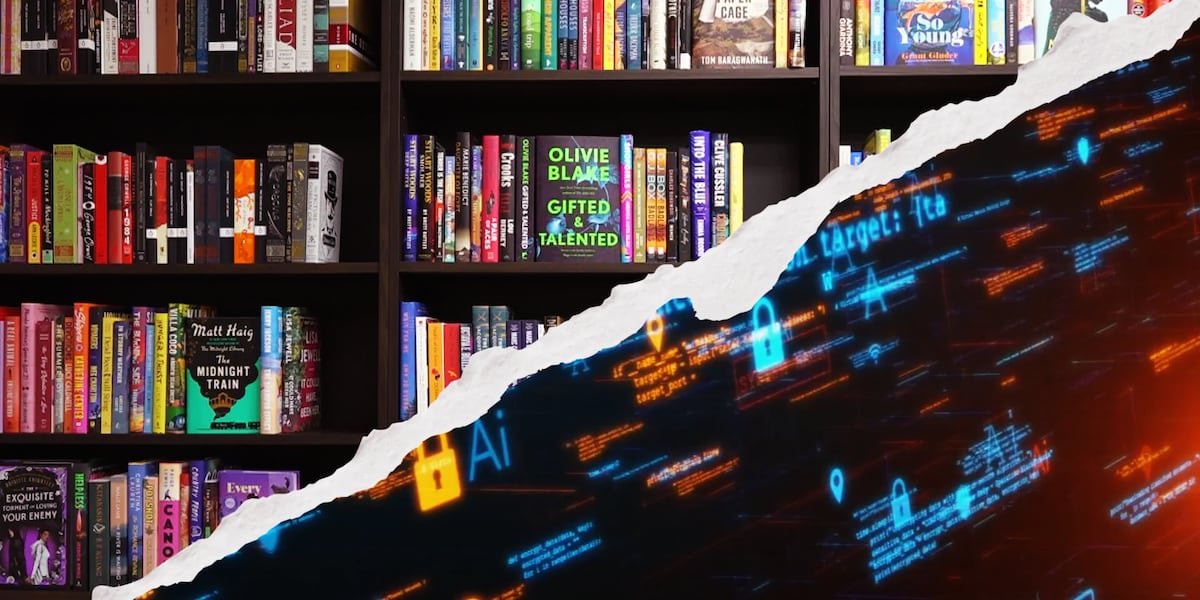
<a href="https://myappsplus.com/sovereign-artificial-intelligence-agents-pose-potential-national-security-risks/" title="Sovereign artificial intelligence agents pose potential national security risks”>Artificial intelligence is changing how authors write, edit and publish books, but its growing use has some readers questioning the quality of what they’re buying and whether authors should disclose when they use it
A2025 BookBub surveyof 1,229 authors found that 45% used generative AI in their work, while 48% did not use it and had no plans to. Of those who used AI, 74% said they did not disclose it to readers.
Janet Gallaspy, a volunteer librarian at the New Augusta Public Library, worries AI could make original storytelling harder to find.
“The characters don’t have much depth. They’re surface-level characters, and they all talk the same,” Gallaspy said.
An avid science fiction reader, Gallaspy said she’s noticedpatterns in booksthat make her suspect AI was used, including choppy sentences, repeated words and characters who sound alike.
She also pointed to inconsistencies, such as characters abandoning plans without explanation or events happening out of order.

Gallaspy said the patterns have led her to stop reading books she once would have finished, but she acknowledged that poor writing alone doesn’t prove AI was involved.
“I would like to know in advance whether an author used AI just to edit a book or actually used AI to write it,” Gallaspy said.
Gallaspy sees a difference between using AI to improve a manuscript and relying on it to write an entire story. She believes authors should remain responsible for their work and make the finaldecisions about what gets published.
“A writer can write something, and then AI can offer suggestions and help edit it,” Gallaspy said.
She also worries about how AI could affect studentslearning to write, saying young people need opportunities to develop their own skills rather than letting technology do the work.
“Kids need to learn how to write on their own because writing makes your brain work,” Gallaspy said.
Authors turn to AI for speed, efficiency
Mississippi author Cody Smith has experienced both traditional writing and AI-assisted publishing.
Smith said he’s published about 40 books since 2017, primarily nonfiction, and has handled everything from writing manuscripts and designing covers to editing and hiring professionals.
Before AI writing tools became widely available, Smith started with a mind map on a large sheet of paper. He used it to organize ideas into chapters and supporting points before creating an outline.
He then wrote his manuscript by hand, dictated it into a Google Doc and sent it to an editor.

Today, Smith uses AI to brainstorm, organize ideas and edit manuscripts. He said the technology helps authors work faster and handle tasks that once required hiring multiple professionals.
“The number one thing is speed,” Smith said.
His first book took nearly eight months to finish. Now, he said, AI can help speed up some of the most time-consuming parts of the process.
“ChatGPT does a really good job actually organizing information which can be one of the slowest processes,” Smith said. “A lot of times we can actually have a lot of information that we want to put in a book and we have no idea where it goes.”
But Smith said AI also makes it easier to publish books without carefully checking their quality or accuracy.
He believes authors and publishers should be responsible for fact-checking their work, regardless of how much AI they use.
Smith said he discloses AI use at the beginning of his books, explaining whether he used it to edit, develop ideas or clarify his writing.
He wants readers to know how AI contributed before deciding whether to buy a book.
“The transparency thing is going to be key from here on moving forward to let them know to what extent that you used AI within your books, whether it’s editing or not,” Smith said.
Experts urge readers to look beyond writing style
Kollin Napier, chief artificial intelligence officer for theMississippi Artificial Intelligence Network, or MAIN, said readers shouldn’t assume a book was

“A writing style alone cannot reasonably establish authorship,” Napier said.
He said repetition, contradictions and questionable sources may raise concerns about a book’s quality, but they don’t prove AI was used.
Napier encourages readers to check an author’s identity, verify factual claims, examinesupporting sourcesand look for reviews from credible sources.
He also cautioned against relying on AI detection tools, which cannot definitively determine whether a book was written using artificial intelligence.
“We absolutely don’t want AI to take away from the creativity of what we as humans are able to write and think up,” Napier said. “But I don’t think it should deter anybody at the end of the day from not wanting to use AI to get them to that accomplished goal of publication or writing a chapter.”
Napier said AI can help authors expand ideas and overcome writer’s block, but it can also generate false information, repeat outdated claims or cite unreliable sources.
He emphasized the importance of AI literacy, saying people need to understand what the technology can and cannot do before relying on it.
Napier said AI should serve as a tool to support creativity, not replace human judgment.
He also believes readers deserve transparency about how books are produced.
“At the end of the day, we as the human are going to be accountable for the work that’s being put out, not the AI,” Napier said.
This article first appeared on RHCJC and is republished here under a Creative Commons Attribution 4.0 International License.
See a spelling or grammar error in this story? Report it to our teamHERE.
Copyright 2026 WLOX. All rights reserved.
