


ByAdam Spatacco–Nov 24, 2026 at 5:00PM EST
Key Points
- Margin debt reached a record $1.5 trillion back in June.
- Excessive leverage can turn an ordinary correction into a more dramatic drawdown.
- Elevated margin debt doesn’t necessarily signal that a market crash is imminent.
-
10 stocks we like better than S&P 500 Index ›
Over the past four years, euphoria for artificial intelligence (AI) stocks has fueled a historic rally in the stock market. Enthusiasm surrounding AI infrastructure and software has helped propel the S&P 500(^GSPC-0.50%), Nasdaq Composite(^IXIC-1.48%), and Dow Jones Industrial Average(^DJI+0.85%) to record highs.
Although much of Wall Street’s attention is focused on whether AI stocks are overvalued, another vulnerability is lurking in the background. Investors are borrowing unprecedented sums of money to participate in the stock market’s ongoing rally. This introduces another layer of risk into an already frothy market.
Let’s explore why margin debt represents one of Wall Street’s biggest threats and what smart investors can do about it.
Margin debt is at historically high levels
Margin debt is a financial term used to describe money investors borrow from a brokerage firm to buy stocks. This practice is more commonly known as leverage. It allows investors to increase their purchasing power without committing an equivalent amount of their own capital up front.
Although borrowing can be lucrative when stocks are rising, leverage works in both directions. For example, imagine you have $10,000 and borrow another $10,000 from a brokerage firm. With $20,000 invested, a 25% increase in the portfolio’s value generates a $5,000 gain. This represents a 50% return on your original capital. However, if the portfolio declines by 25%, you would lose $5,000, or half of your original investment. A 50% decline effectively wipes out your original capital.
According to data compiled by the Financial Industry Regulatory Authority (FINRA), margin debt reached a record $1.5 trillion in June. To appreciate the magnitude of that figure, let’s take a look at borrowing levels during other periods of unusually high speculation in the stock market.
- March 2000 (dot-com bubble): $300 billion
- July 2007 (prior to the great financial crisis): $416 billion
- October 2021 (pandemic-era rally): $936 billion
- June 2026 (AI-fueled bull market): $1.5 trillion
Although today’s borrowing levels dwarf the historical figures in terms of absolute dollars, it’s important to consider the fact that the stock market has become considerably larger. Nevertheless, the rapid accumulation of debt over the last year or so suggests investors are developing more of an appetite for risk.
How margin debt could accelerate a stock market crash
One of the most dangerous aspects of using leverage is that investors do not necessarily control when their positions are sold. Brokerage firms require investors to maintain a minimum level of liquidity in their margin accounts. If declining stock prices cause an account to fall below that threshold, investors could face a margin call. This would require them to deposit additional collateral or reduce their positions.
Brokerages also have the authority to liquidate positions without obtaining an investor’s permission. When this happens across several accounts at the same time, the forced selling puts additional downward pressure on stock prices. As a result, more margin calls are triggered, and a destructive cycle is created.
With all of that said, current margin debt levels could suggest investors are moderating their risk exposure. At the end of October, margin debt was recorded at $1.4 trillion, or about 3.6% below its peak from June. While this could indicate investors are becoming more cautious, declining balances can also reflect forced liquidations rather than voluntary reductions in risk.
How to invest when margin debt is rising?
It’s important to understand that elevated margin debt doesn’t necessarily mean a stock market crash is imminent. Borrowing often increases alongside rising stock prices. Ultimately, margin debt is better viewed as a potential amplifier of market volatility rather than a reliable predictor of when a crash or drawdown will occur.
Even if excessive leverage contributes to a pullback, smart investors should remember that the stock market always demonstrates resilience. The S&P 500 declined by 49% following the dot-com bubble and nearly 57% during the financial crisis. More recently, the index fell 34% during the COVID-19 crash and 25% during the 2022 bear market. Despite these setbacks — depicted by the grey columns in the chart below — the S&P 500 eventually recovered and reached new record highs.
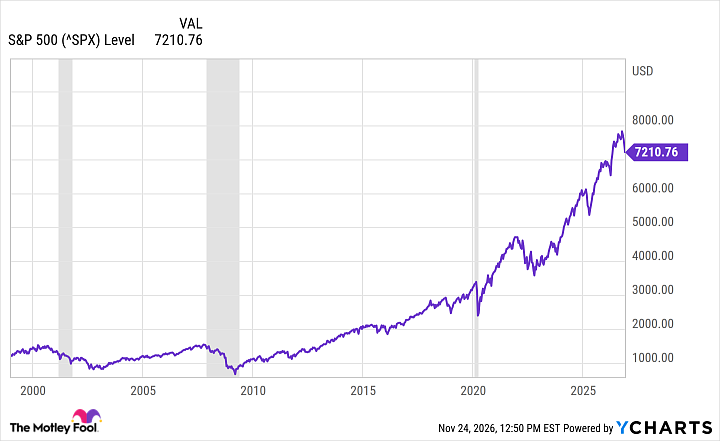
The takeaway here is that investors who buy stocks using their own capital wind up having more financial flexibility to endure prolonged downturns than those whose brokerage firms can force them to sell at unfavorable prices.
Although nobody knows whether today’s borrowing levels will culminate in another stock market bubble bursting event, history suggests that staying diversified and remaining invested through volatility is a more prudent approach to building long-term wealth than attempting to predict the next market crash.
Where to invest $1,000 right now
When our analyst team has a stock tip, it can pay to listen. After all, Stock Advisor’s total average return is 796%* — a market-crushing outperformance compared to 200% for the S&P 500.
They just revealed what they believe are the 10 best stocks for investors to buy right now, available when you join Stock Advisor.
*Stock Advisor returns as of November 24, 2026.
