

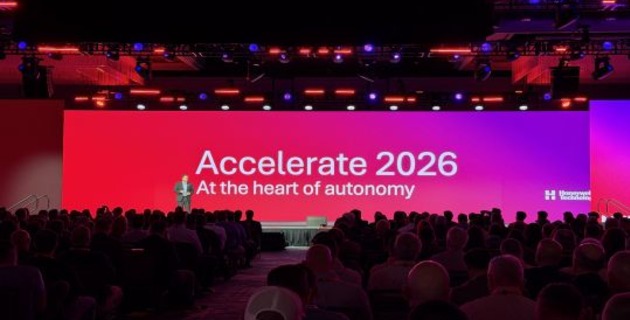
Honeywell Technologies has introduced a set of new AI-powered building automation offerings, including EBI One, fire and life safety, and <a href="https://myappsplus.com/microsofts-windows-security-fix-has-a-loophole-and-hackers-could-use-it-to-gain-full-control/” title=”Microsoft’s Windows security fix has a loophole, and hackers could use it to gain full control”>security innovations at Accelerate 2026.
The Honeywell event had more than 2,000 customers and partners in attendance.
The new technologies are designed to help building owners and operators modernise infrastructure, improve safety and efficiency and accelerate the transition from automation to autonomy with practical, AI-driven features.
Honeywell Technologies Building Automation president & CEO, Juan Picon, said buildings are at an inflection point with owners and operators being asked to manage increasingly complex environments, often with fewer skilled resources.
“Customers today need more than connected systems and volumes of data. Instead, they need technologies that turn information into actionable intelligence, simplify operations and enable better decisions,” Picon said.
“At Accelerate 2026, we’re demonstrating how Honeywell Technologies is combining decades of building automation expertise with AI and advanced technologies to help customers address these challenges and accelerate the transition to autonomous building operations.”
Honeywell Technologies introduced several new technologies and expanded capabilities across building operations, fire and life safety and security at Accelerate 2026 and beyond:
- EBI One brings AI-powered intelligence to building operations.EBI One is a new command and control platform that draws on the AI-powered intelligence of Honeywell Technologies Forge Cognition to continuously assess outcomes and inform operator actions to improve efficiency and safety.
- Honeywell Technologies introducedlow level carbon monoxide (CO) monitoring that provides immediate concentration visibility and trend analysis; System Sensor Distinguishdetector technology that differentiates fire signatures from conditions such as steam, dust and mist to reduce unwanted nuisance alarms; and Incident Command, a software application that brings incident information, unit accountability, operational procedures, and most critically, live data on the evolving conditions within the connected building into a single operational view.
- Expanded AI-powered security capabilities help teams prioritise, manage risk and respond faster.With the upcoming release of LenelS2 Adaptive Intelligence Suite, Honeywell Technologies will bring operators AI-weighted alarm management, alarm contextualisation, natural-language reporting, unified dashboards, anomaly detection and guided workflows, all designed to reduce alarm fatigue and improve situational awareness. The new suite is expected to be unveiled at ISC West in early 2027.
- Next generation Niagara framework creates a foundation for increasingly autonomous buildings. Niagara 5, the new generation of the industry-standard Niagara framework, serves as the engine that enables systems from any building or vendor to connect across HVAC, fire, security, access control, lighting and energy. The trusted, open and contextualised view of all building system assets, combined with Forge Cognition intelligence, reduces engineering and commissioning efforts and helps building owners, system integrators and operators accelerate the transition from connected buildings to increasingly autonomous operations. The new Niagara framework is expected to be unveiled at AHR in early 2027.
