

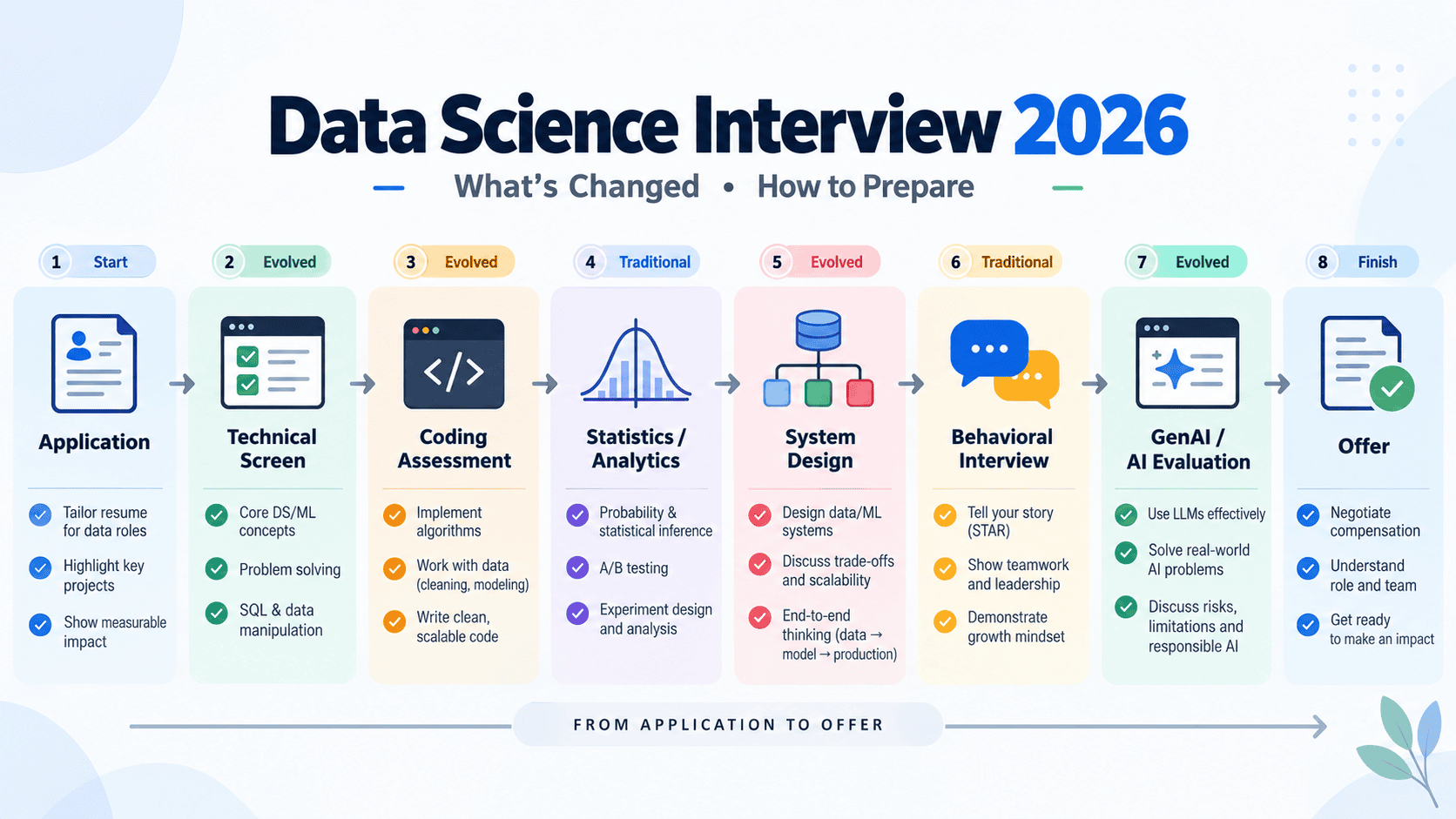
The data science interview has changed more in the past two years than in the previous five. If you prepped for interviews in 2023 or 2024 and you’re back on the market now, the format you practiced for might not match what you’ll actually face.
Some shifts are structural. Take-home assignments look different. AI tools are explicitly part of many live coding rounds. Machine learning system design questions, once reserved for senior loops, now show up at the mid-level. Other shifts are topical: generative AI (GenAI) and large language model (LLM) evaluation questions have become their own interview category, and behavioral rounds dig into how you handle AI-generated output, not just ambiguous data. And some shifts reflect a tighter market. Processes run longer, more rounds are common, and the bar for “good” in system design or business case rounds has gone up.
That said, a lot hasn’t changed. SQL fluency still matters, and in some ways it’s tested more rigorously, not less. Statistical reasoning and A/B testing are still core requirements. And the ability to explain analytical findings to a non-technical audience? That’s still one of the most commonly cited differences between candidates who get offers and those who don’t.
This guide covers both sides: what’s genuinely changed, and what you still need to prepare.
The Modern Data Science Interview Loop
A typical data science interview at a mid-size to large tech company in 2026 runs four to six rounds over two to four weeks. The exact combination varies by company type and role, but most loops include some version of these:
Recruiter screen (30–45 minutes)
Background, motivation, compensation expectations, and timeline. Nothing here has changed dramatically, but the bar for narrative clarity has gone up. Interviewers flag candidates who can’t deliver a crisp 90-second summary of their career progression and what specifically drew them to this role. Vague answers like “I want to work on interesting problems” don’t land well.
Technical coding round (45–90 minutes)
SQL and Python, usually in a live shared environment. This is where the AI tool question is most visible. More on that below.
Statistics and machine learning fundamentals round (60–90 minutes)
Conceptual depth, model selection judgment, and evaluation metric reasoning. Statistical inference, A/B testing design, and the ability to reason about model failure modes come up consistently.
Machine learning system design round (45–75 minutes)
End-to-end production machine learning system design. This round has grown in scope and now appears in more mid-level loops than it did two years ago.
Business case or product sense round (45–75 minutes)
Translating a business problem into a data problem, defining what to measure, and explaining the output to a non-technical stakeholder.
Behavioral round (30–60 minutes)
STAR-format questions on collaboration, ambiguity, stakeholder conflict, and (more and more) situations where AI or model outputs behaved unexpectedly.
For GenAI-specific roles, an additional round has emerged: a dedicated evaluation round that tests how candidates design and implement LLM evaluation frameworks.
What Has Changed: The Six Biggest Shifts
1. AI Tools Are Now Part of the Interview, but the Rules Vary
This is the most visible structural change in 2026. The blanket “no tools allowed” policy that governed technical interviews for over a decade has splintered into three distinct formats. Candidates who don’t know which one they’re walking into will struggle.
Proctored no-tools rounds. Live algorithm and SQL coding rounds at most large companies still prohibit AI assistance. The logic is simple: if the interviewer wants to evaluate your independent reasoning, AI-generated output gets in the way. These rounds now test something slightly different from before. There’s less emphasis on syntax recall and more on reasoning about when to use a window function versus a self-join, and why.
AI-allowed assisted rounds. A growing number of companies (roughly 25% of U.S. employers as of mid-2026, and climbing) explicitly permit AI tools in at least one interview round. Here, the evaluation flips entirely. The evaluation flips: interviewers assume you can get working code and watch how you check it, fix it, and explain it. Candidates who accept AI-generated code without checking for edge cases, wrong assumptions, or logic errors fail these rounds just as easily as they’d fail a no-tools round through poor logic.
Open-ended take-homes with expected AI use. Take-home assessments have evolved, too. Companies now commonly ask candidates to submit their work and then answer a follow-up question: “How did you use AI in completing this?” Some require a live walkthrough where you explain and modify your submission on the spot. That format is essentially impossible to bluff. If you get a take-home in 2026, assume you’ll need to defend every decision in a follow-up conversation.
The practical takeaway: before any technical round, send one clear message to your recruiter: “Will I be allowed to use AI tools during the live coding round, and if so, which ones?” This prevents surprises and shows you understand that the format matters.
2. Coding Questions Have Become “AI-Resistant”
Alongside AI-allowed rounds, the coding questions themselves have shifted. Since AI tools can generate syntactically correct SQL and Python quickly, pure implementation questions have given way to formats that test judgment over generation.
The most common new format is debugging AI-generated code. Instead of opening a blank editor and writing a query, you get code that was written by an AI, and your job is to find what’s wrong, explain why, and fix it. StrataScratch, one of the go-to interview prep platforms for data science, has added a dedicated “Debug AI Code” mode to reflect this. The interviewer is watching whether you can catch mistakes, understand why they’re mistakes, and explain your reasoning. Whether you can produce the solution from scratch is secondary.
A second format asks you to explain code you’ve been given: “Here’s a query. Walk me through what it does and why it was written this way.” This tests comprehension and communication depth, not implementation speed.
Window functions, common table expressions (CTEs), and query optimization are still just as important as before. The difference is that interviewers now expect you to show understanding of the underlying logic, not just demonstrate that you can type the syntax.
3. Machine Learning System Design Has Moved Downstream
Machine learning system design rounds used to show up mainly in senior and staff-level interview loops. In 2026, they appear regularly at the mid-level too, driven by the expectation that data scientists own the full model lifecycle rather than hand things off to a separate engineering team.
The round tests your ability to design an end-to-end machine learning system from a vague product goal. A typical prompt: “Design a recommendation system for an e-commerce platform handling 50,000 requests per second.” A strong response works through six stages: clarifying the business objective, framing it as a machine learning problem, defining data requirements and pipelines, selecting and justifying a modeling approach, designing the deployment and inference architecture, and describing how you’d monitor and maintain the system over time.
What’s different in 2026 is the content of these questions. Two new categories have become standard:
LLM evaluation system design. “Design an evaluation framework for an LLM-powered customer support assistant” is now the 2026 equivalent of “design a data warehouse.” It’s a near-universal senior prompt that candidates are expected to have thought through. This requires familiarity with automated evaluation methods (LLM-as-judge), human evaluation pipelines, golden test sets, and regression testing before model updates ship.
AI-adjacent architecture questions. Candidates are expected to reason about vector databases, embedding pipelines, retrieval-augmented generation (RAG) architectures, and retrieval system design as part of standard system design, not as niche specializations. Interviewers check whether you can think through hallucination risk, embedding freshness, evaluation latency, and cost alongside traditional infrastructure considerations.
The rubric has expanded, too. In 2026 loops, cost reasoning and operational thinking are explicitly graded, not assumed. A candidate who designs an elegant system but can’t speak to the cost of running it at scale is leaving points on the table.
4. Generative AI and Large Language Model Questions Have Emerged as a Distinct Interview Category
Analysis of over 500 GenAI and LLM interview questions from Dataford found that 30% are rated hard. That’s second only to statistics in difficulty across the entire data interview landscape. The category spans applied LLM work including retrieval, vector search, evaluation, and model serving, on top of classical natural language processing foundations.
These questions now come up regularly at the mid and senior level across roles with any AI component. Common question types include:
- How would you evaluate an LLM system in production? How do you know a prompt change didn’t make things worse?
- Walk through how you’d design a RAG system for a domain-specific knowledge base. How would you handle document freshness?
- How would you reduce hallucinations in an LLM-powered application without fine-tuning the model?
- A model that was working in staging is behaving differently in production. Walk me through how you’d diagnose it.
The candidates who do best on these questions, according to interviewers, volunteer two things before being asked: how they’d measure the system, and what it would cost to run. Those are the dimensions that separate people who’ve shipped production AI systems from those who’ve only built them in notebooks.
5. Take-Homes Have Evolved, Not Disappeared
Reports of the take-home’s death are premature. What’s changed is the format and the follow-up. AI tools made traditional take-homes noisy. If anyone can generate a polished analysis in two hours with Claude or Copilot, the signal from a clean submission drops a lot.
Companies adapted in two ways. Some moved away from take-homes toward live coding or paired sessions where the thinking process is visible. Others kept the take-home but added a mandatory live defense session: you submit your work, then join a 30-minute call where you explain your choices, handle a new requirement the interviewer adds on the spot, and show that you actually built what you submitted.
If you get a take-home in 2026, the right approach is to use AI tools where they help, document your process (some companies ask for this explicitly), and practice explaining every decision as if you’ll be asked to defend it live. Because you probably will be.
6. Behavioral Rounds Now Probe AI and Model Judgment
Behavioral questions have expanded beyond the traditional collaboration, conflict, and ambiguity categories. A new cluster of questions digs into how you handle AI-generated output and model failures in practice:
- “Tell me about a time a model or AI tool produced output that turned out to be wrong. How did you catch it and what did you do?”
- “Describe a situation where you had to communicate to a non-technical stakeholder that a model’s results shouldn’t be trusted.”
- “Walk me through a decision where you chose not to use an AI tool for a particular task. Why?”
These questions aren’t about theoretical awareness of AI limitations. They’re probing for specific experiences that show operational judgment: the ability to evaluate AI-generated work critically, communicate its limits, and make decisions that account for model uncertainty.
According to the National Association of Colleges and Employers Job Outlook 2026 report, 87% of employers rely on behavioral interviews for skills-based hiring. At AI-first companies, behavioral rounds are now treated as a critical filter, not a formality.
What Hasn’t Changed: The Foundations Still Matter
With all the new content to prepare for, the foundations are still non-negotiable.
SQL fluency is still tested, and more rigorously in some ways. Window functions, CTEs, query optimization, and the ability to work with messy schemas are expected at the mid-level and above. The new wrinkle is that some companies now test whether you can work across cloud SQL variants (BigQuery, Snowflake, Redshift) rather than generic SQL alone.
Statistical reasoning and A/B testing are still core. Statistical inference, hypothesis testing, experimental design, and the ability to reason about sample sizes, power, and confounding are just as important as they were three years ago. A candidate who can’t explain the difference between Type I and Type II errors, or who can’t design an experiment with appropriate controls, won’t get past the statistics round. It doesn’t matter how fluent they are with LLMs.
Business case and product sense rounds still reward the same skills. Those skills are taking a vague business question, translating it into a measurable data problem, defining the right metric, and explaining the result to someone without a technical background. That’s still the most consistently cited differentiator between candidates who get offers and those who don’t. This hasn’t changed.
Communication and narrating your thinking matter more than ever. When AI tools can generate code and analysis, the interview increasingly tests whether you understand what you’re doing and can explain it. Candidates who write good code in silence and present it without commentary are at a disadvantage compared to those who think out loud, ask clarifying questions, and explain trade-offs as they go.
How to Prepare: A Round-by-Round Plan
For coding rounds: Practice SQL and Python in the format you’ll actually face. If the company uses HackerRank or CoderPad, practice in that environment. Add debugging exercises to your routine. Platforms like StrataScratch now offer AI-generated code debugging practice built specifically for this shift. The week before your interview, confirm with your recruiter whether AI tools are allowed and practice both with and without them.
For the statistics and machine learning fundamentals round: Focus on A/B testing design (sample size calculation, power, multiple comparison correction), probability and statistical inference, and reasoning about model evaluation metrics and their trade-offs. Be ready to explain not just what a metric measures but when it’s the wrong metric to go after.
For machine learning system design: Practice the six-stage framework: clarify the business objective, frame the machine learning problem, define data requirements, select a modeling approach, design deployment and inference, and describe monitoring. Add at least two LLM evaluation and RAG design problems to your prep. Resources like Grokking the System Design Interview and Interview Kickstart’s machine learning system design guide cover the structure. Layer in your own thinking about cost and operational trade-offs.
For business case and product sense rounds: Practice framing a business problem as a data problem before jumping to solutions. Interviewers consistently flag candidates who propose a model before they’ve defined what success looks like. Practice explaining your reasoning out loud, as if you’re talking to a product manager rather than a data scientist.
For behavioral rounds: Prepare six STAR-format stories that cover collaboration, navigating ambiguity, influencing without authority, communicating technical limitations to stakeholders, and (specifically for 2026) a situation where you had to evaluate, correct, or override AI-generated output. Quantify outcomes wherever possible.
For GenAI evaluation rounds (if applicable): Build familiarity with LLM evaluation frameworks: automated evaluation approaches like LLM-as-judge, golden test sets and regression benchmarks, RAG evaluation metrics (the RAG triad of faithfulness, answer relevance, and context relevance), and the principles behind human evaluation pipelines. The Dataford GenAI & LLM Interview Report provides a structured question bank built from actual company interview guides.
Recommended Preparation Resources
- StrataScratch: SQL and Python interview practice with a Debug AI Code mode that reflects the new interview format. Free and paid tiers available.
- Interview Kickstart: Machine learning system design curriculum built for FAANG and comparable loops. Strong coverage of the end-to-end system design framework.
- Dataford: Data science and GenAI interview question bank built from actual company interview reports, with difficulty ratings and role-specific filtering.
- IGotAnOffer: Strong coverage of the full data science interview loop with company-specific guides and behavioral round preparation.
- Exponent: Product sense and machine learning system design mock interview practice with experienced interviewers.
- LeetCode SQL: Still the most widely used platform for SQL interview prep. Focus on medium and hard problems, window functions, and multi-table scenarios.
Final Thoughts
The data science interview in 2026 is harder in some dimensions and different in others. The hardest part to prepare for is a change in mindset rather than any one question type. The interview is no longer primarily testing what you can produce. It’s testing whether you understand what you’re doing, whether you can evaluate and improve what AI tools produce, and whether you can explain all of it to someone who didn’t go through the same analytical process you did.
Candidates who struggle in 2026 interviews tend to fall into two patterns. The first: over-relying on AI tools and then not being able to explain or defend the output when asked. The second: ignoring AI literacy entirely and treating the interview as if it were still 2022. Neither approach is competitive.
The candidates who succeed bring technical depth, practice their thinking-out-loud habits, and show up with clear, specific examples of work they’ve shipped. That includes at least one experience where they had to evaluate, correct, or push back on AI-generated output. That combination maps directly to what hiring managers describe as the difference between offers and no-offers in the current market.
Vinod Chugani is an AI and data science educator who bridges the gap between emerging AI technologies and practical application for working professionals. His focus areas include agentic AI, machine learning applications, and automation workflows. Through his work as a technical mentor and instructor, Vinod has supported data professionals through skill development and career transitions. He brings analytical expertise from quantitative finance to his hands-on teaching approach. His content emphasizes actionable strategies and frameworks that professionals can apply immediately.
