

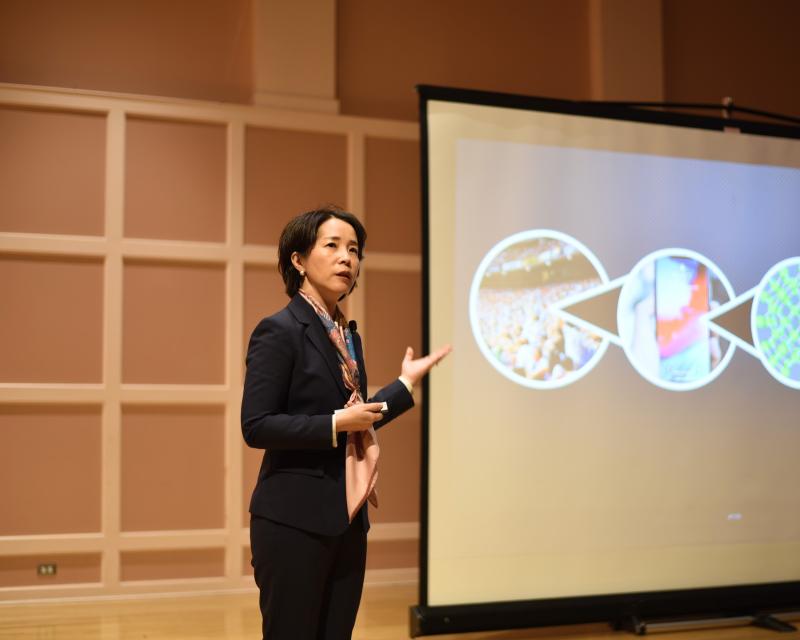
While AI is often associated with generative tools that produce text and images, Eun-Ah Kim is focused on a different use of AI. In her research, she used machine learning to analyze scientific data and predict how materials might behave.
“If you ask a good question that can be centered around data, then these tools can make a big difference,” said Kim, who gave the 35th annual Kay Malmstrom Lecture in Physics on Oct. 27.
Kim is the Hans A. Bethe Professor of physics at Cornell University. Her lecture, “Can Artificial Intelligence Discover New States of Matter?” explored how AI can help scientists discover new states of matter. Hamline University’s Department of Physics hosted the lecture.
During her lecture, Kim discussed the importance of representation in machine learning, explaining how scientists must determine which information is most relevant before an AI system can analyze data and make predictions.
“The only form of information computers understand is a stream of numbers,” Kim said.
She explained the concept using an image of an elephant statue. While the statue may be an accurate physical depiction of an elephant, it would not provide useful information if someone wanted to determine the elephant’s body temperature.
Kim described how her research team used machine learning to analyze large amounts of data to study how a material responded at different temperatures. The technology grouped measurements that changed in similar patterns, helping researchers identify evidence of a long-sought state of matter known as a Bragg glass.
Kim also discussed how her team used AI to discover a new nickelate superconductor. She described how her research team searched a database of crystal structures that had not previously been tested for superconductivity, the ability to carry electricity without resistance under certain conditions. The model identified a promising candidate with a 75% predicted probability of being superconducting. Researchers later synthesized and tested the material, confirming its superconducting properties.
While AI played an important role in these discoveries, Kim emphasized the importance of asking good questions. She ended the lecture by revisiting its central question, “Can AI discover new states of matter?” Her answer was yes, but she stressed it isn’t whether AI can discover new states of matter, but whether it can help people discover them.
“Leveraging AI algorithmic tools for the discovery and advancement taught us we hold the questions,” Kim said.
The Kay Malmstrom Lecture in Physics, part of the Emma K. and Carl R.N. Malmstrom Chair in Physics, is an annual symposium featuring leading scientists discussing contemporary issues and research in physics. Established in 1991, the Kay Malmstrom Lecture in Physics, was made possible through a gift from Carl R. N. Malmstrom ’36. The lecture series gives students the opportunity to learn from experts in the field.
