

Affiliate links on Android Authority may earn us a commission. Learn more.
Samsung’s Android XR smart glasses are doomed to fail
Are smart glasses over? Samsung and Google better hope not, but neither are doing anything to change it.
By
•
•
•
Andy Boxall / Android Authority
Add Android Authority on Google:
Preferred SourceGoogle Discover
The strategy behind Samsung and Google’s Android XR smart glasses launch is concerning. Not only are we still waiting for the first pairs to arrive, but they’re going to come while the entire industry flaps around in an attempt to convince us it’s taking privacy seriously, and that really, there’s nothing to worry about at all.
Except there is, and the negative stigma now attached to smart glasses in general is so ingrained, it’s unlikely to go away soon. What are Samsung and Google doing to show us that they’re treating this as their top priority? Staying very quiet, which is a brave thing to do when what’s presumably a very expensive product to develop is about to launch.
Are you excited for Samsung’s smart glasses running on Android XR?
Privacy is our top priority, honest!
Just because the general public feels uncomfortable about smart glasses, tech brands are still keen to get them on our faces, and are coming up with ingenious ways to protect our privacy. Unfortunately, the methods range from the annoying to the outlandish, and only draw attention to the fact no one likes the idea of a camera on the face of someone we’re talking to.
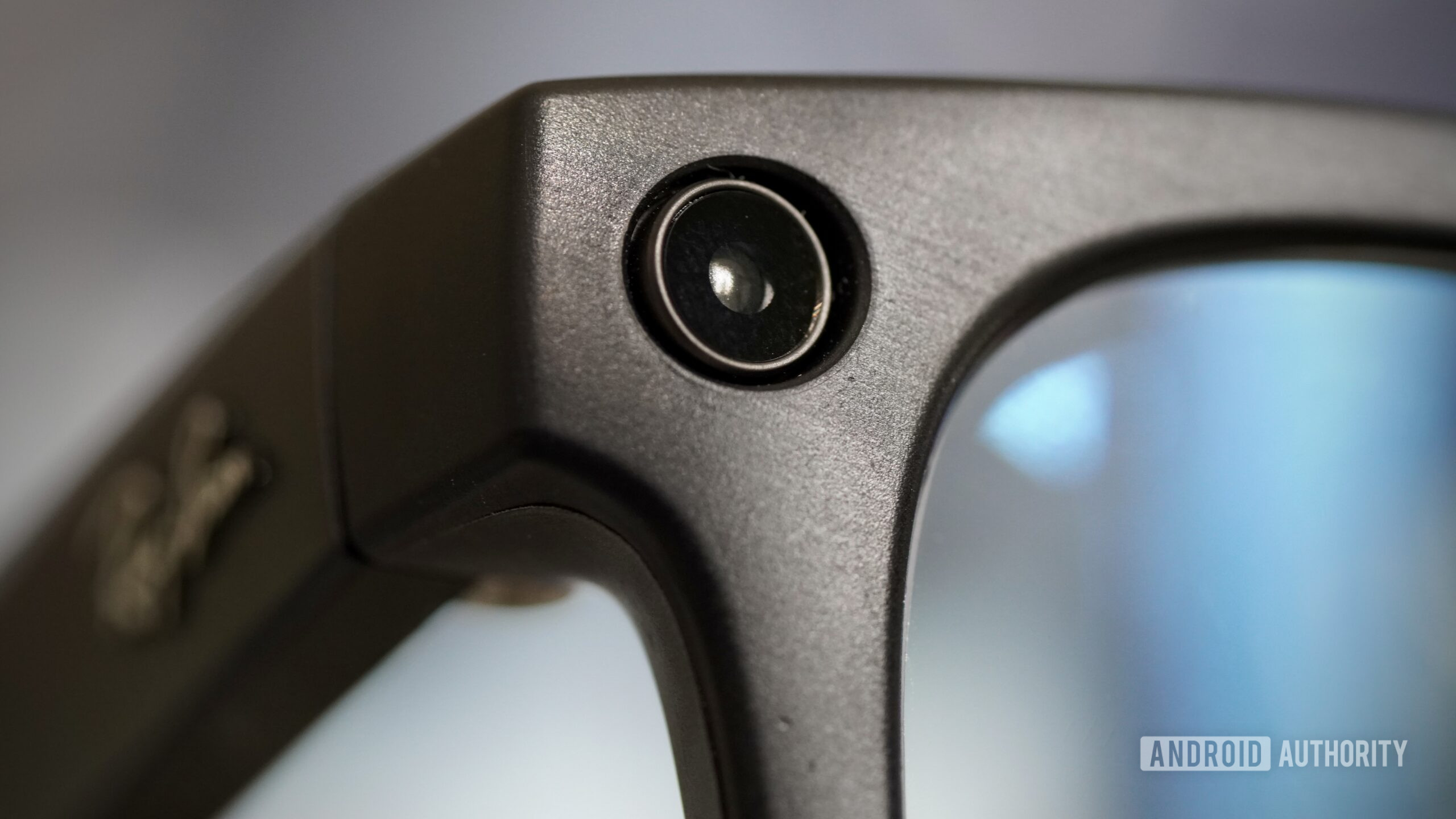
Raven Resonance, makers of the Raven Prism smart glasses, tackled the problem of the 13-megapixel camera set in the temple in two different ways. The first is the now-standard indicator light that shows when it’s recording, and the second is a physical cover that magnetically attaches to the lens. This has to be removed before the camera operates, obviously.
Undoubtedly effective, but it’s hardly a design and ergonomic win, and it’s still privacy lip service at best. It’s not as dystopian as HTC’s effort to make you feel more in control around people wearing its HTC Vive Eagle smart glasses. There’s the usual indicator light, along with an option to allow people around you to say ‘stop filming’ if they don’t want to star in your pervert films. That’s right, we’re on the cusp of a future where we feel compelled to say ‘stop filming’ before we say ‘hello’ or ‘nice to meet you.’
Look through the literature on both the Raven Prism and HTC Vive Eagle and you’ll find the usual disclaimers about how the wearer is responsible for following laws and obtaining consent, but for those who are planning to abuse the camera feature anyway, this is unlikely to change their mind. Samsung’s approach to privacy so far echoes this.
Legislation isn’t the answer
Many concentrate on the camera as the main concern, but it’s also microphones and always-listening features used to activate and interact with AI that cause issues. Yes, our phones, smart speakers, and even televisions use the same technology, but there’s something more concerning about devices worn on our faces that can see and hear us.
Are the brands responsible for how their products are used? No, in the same way car makers are not responsible when you get caught speeding. However, Samsung and Google in particular hold considerable power and massive influence, as does Meta, yet they’re all so consumed with giving us the opportunity to use AI all the time — make no mistake, this is the reason modern smart glasses exist — they’re sitting back and letting others take control of the thorny issue about privacy. It’s why we’re seeing features like physical camera covers and voice commands.
What’s happening outside isn’t any better. The government in Victoria, Australia will ban smart glasses in some schools from 2027, a move considered by many others around the world. A council in Melbourne, Australia has banned camera-equipped smart glasses from gyms, pools, playgrounds, and child care locations. Retailers in Belgium and the Netherlands have decided to stop selling smart glasses. In the US and the UK, smart glasses are banned from courts, and the European Union has labeled camera-equipped smart glasses as a risk to public privacy.
Anecdotally, I’ve spoken to a few people on a professional level over the past weeks who have shied away from smart glasses coverage unless concerns and warnings about privacy are clearly stated from the start. Because public perception is so negative, failing to address it from the outset would be seen as out of touch. When I have worn Ray-Ban Meta recently, I haven’t experienced anything negative, but the questions I have got usually start with ‘oh, do they have a camera? I don’t like that.’ It’s notable because there’s no excitement or intrigue around what is still an emerging tech innovation, only caution and concern.
Brands procrastinate over smart glasses
Andy Boxall / Android Authority
This is the storm Samsung and Google intend to launch the first major Android XR smart glasses in. Not at the height of anticipation, but when trepidation is rife. Currently, buying smart glasses isn’t the ticket to a fun lifestyle; it’s the opportunity to be labeled a pervert, creep, or worse, an influencer. Tempting stuff.
The trouble is, Samsung’s first smart glasses were supposed to launch last year, before the problems really started. Google already knows all this too. It has already seen how this story plays out with Google Glass. But the need to try to recoup the huge investment in AI is so strong that it probably doesn’t care if Glass 2.0 fails.
What’s frustrating is all the time Samsung and Google have procrastinated over the initial launch hasn’t been spent trying to change negative public perception of the product that’s already out there. Instead, the most Samsung has done is say the industry needs to do something about privacy concerns, and then continue to do absolutely nothing, outside of the same things as everyone else. Wear detection, indicator lights, and the usual privacy measures when images and voice are used to train AI.
Both Samsung and Google have decided to use ‘intelligent eyewear’ to describe smart glasses and to emphasize audio or display capabilities over the camera, even though the camera is present. Again, this doesn’t actually solve the problem; it’s just a marketing Band-Aid. Google’s huge influence likely means it’s working with governments though, including on legislation like the now vetoed Senate Bill 1130, and the European Data Protection Board.
A missed opportunity
The fact is, to get the most from AI, a camera is required for visual search and other features, so it’s going to be a fixture. Audio smart glasses have been and gone once already, and their return is another non-action in the quest to stop people upsetting company executives about cameras and privacy.
Samsung and Google have had plenty of time to do some real grassroots campaigning. To educate people about responsible use, work with local authorities, show the benefits of a camera, then work with those affected by abuse of the technology and highlight their experiences. Doing this in public could make a difference, certainly more so than doing nothing.
Changing people’s minds is possible, but leaving it to governments to legislate isn’t the answer, as this will only further demonize the tech and put people off. Waiting until the product launches is a luxury I don’t think Samsung has, when damage has already been done. It ends up making companies look disinterested and oblivious.
When Samsung and Google’s smart glasses do launch later this year, the story isn’t going to be the product — it’s going to be how society views them, and it won’t be a positive one. Unfortunately, the time to change that has run out, and they only have themselves to blame.
Features
Android XRGoogleSamsungSmart Glasses
