

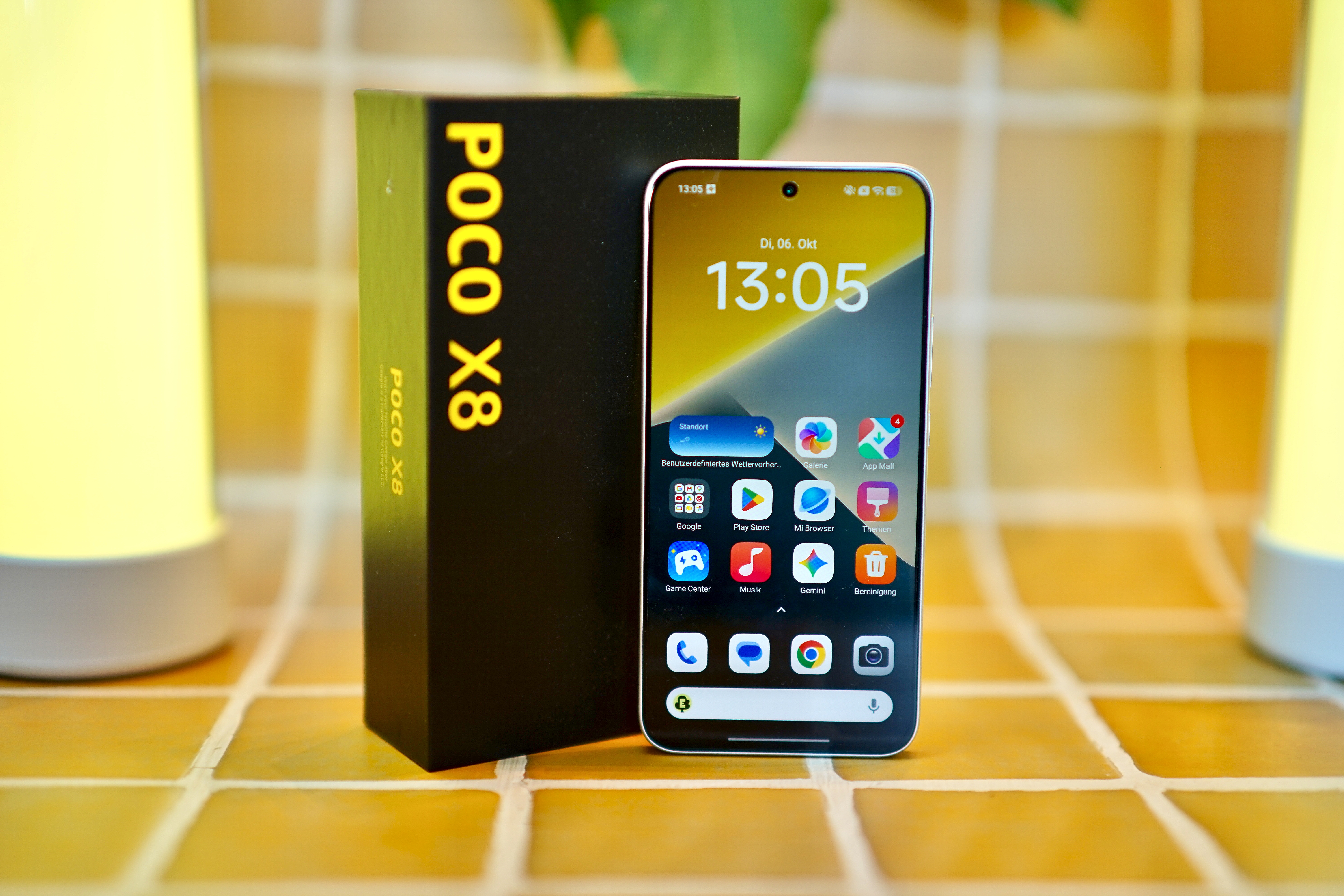
The Poco X8 leaves a rather mixed impression in our review: Thanks to its high durability, including IP69K certification, numerous certifications from TÜV and SGS, and fantastic battery life, the 2026 model clearly positions itself as a stylish outdoor companion. Together with its very bright AMOLED display, the Xiaomi phone has some strong selling points – but compromises have to be accepted when it comes to performance.
Xiaomi also had to cut costs on the main camera: Image quality is poor, especially in low-light conditions.
Long-term updates, on the other hand, are still not a given across the midrange segment. Xiaomi impresses here and also provides a good range of cellular frequency bands for international use.
Test device courtesy of Xiaomi Deutschland
Download your licensed rating image as PNG / SVG
The extensive use of plastic in the casing is a matter of taste, and the limited performance and slow internet could also be a problem compared to the competition.
One more note: The Xiaomi Poco X8 is very similar to the Redmi Note 17 Pro 5G, but offers different storage configurations with more RAM. It also lacks the wide-angle camera and eSIM support. On the other hand, our review unit is significantly cheaper than the Redmi phone.
+bright 120 Hz AMOLED display
+very long battery life
+67-watt fast charging
+rugged with IP69K protection
+six years of security updates
+affordable price
-poor performance
-poor camera quality in low light
-no ultra-wide-angle camera
-slow Wi-Fi and USB
-no eSIM support or microSD slot
-ads in the operating system
-PWM flickering
The Xiaomi Poco X8 is already available for just under US$ 340.
- $349.99XIAOMI Poco X8 PRO 5G Ai (Compatible with Tmobile Mint Tello & Global) (256GB + 8GB) 6.59″ 50MP Gamers Phone NFC Dual sim Unlocked Model 2511FPC34G Liberado (Black)
- $517.99XIAOMI Poco X8 PRO MAX 5G Ai (Compatible with Tmobile Mint Tello & Global) (512GB + 12GB) 6.83″ 50MP Gamers Phone NFC Dual sim Unlocked Model 2602BPC18G Liberado (Black)
- $439.50XIAOMI Poco X8 PRO 5G Ai (Compatible with Tmobile Mint Tello & Global) (512GB + 12GB) 6.59″ 50MP Gamers Phone NFC Dual sim Unlocked Model 2511FPC34G Liberado (Black)
Table of Contents
- Verdict on the Xiaomi Poco X8
- Specifications
- Case – Plenty of plastic on the sturdy Xiaomi phone
- Features – Poco phone with up to 12 GB RAM
- Software – Long-term updates for the affordable mid-range phone
- Communication and GNSS – Xiaomi smartphone without WiFi 7
- Phone features and call quality – Poco X8 without eSIM
- Cameras – The mid-range phone lacks a wide-angle camera
- Accessories and warranty – Poco without a power adapter in Europe
- Input devices and operation – Affordable Android phone with fingerprint sensor
- Display – Very bright OLED in a mid-range phone with DC dimming
- Performance – Is the Poco X8 an affordable flagship killer?
- Emissions – Poco X8 barely throttles under load
- Battery life – Affordable Android phone with a large battery
- Notebookcheck Overall Rating
- Possible alternatives compared
Processor
Qualcomm Snapdragon 6s Gen 4 8c/8t, 4 x 2.4 GHz ARM Cortex-A78, 4 x 1.9 GHz ARM Cortex-A55, Cortex-A78/A55
Graphics adapter
Qualcomm Adreno 710
Memory
8 GB
Display
6.83 inch 19.4:9, 2772 x 1280 pixel 447 PPI, AMOLED, glossy: yes, 120 Hz
Storage
256 GB UFS 3.1 Flash, 256 GB , 213 GB free
Connections
1 USB 2.0, 1 Infrared, 1 Fingerprint Reader, NFC, Brightness Sensor, Sensors: compass, light, proximity, gyroscope
Networking
802.11 a/b/g/n/ac (a/b/g/n = Wi-Fi 4/ac = Wi-Fi 5/), Bluetooth 5.1, 2G (850/900/1800/1900), 3G (B1/B2/B4/B5/B8), 4G (B1/B2/B3/B4/B5/B7/B8/B18/B19/B20/B26/B28/B38/B40/B41/B42/B48/B66/B71), 5G (n1/n2/n3/n5/n7/n8/n20/n26/n28/n38/n40/n41/n48/n66/n71/n77/n78) , Dual SIM, LTE, 5G, GPS
Size
height x width x depth (in mm): 8.6 x 163.5 x 78.3 ( = 0.34 x 6.44 x 3.08 in)
Battery
8340 mAh Lithium-Ion, 67 Watt charging, 22.5 Watt wired reverse charging
Charging
fast charging / Quickcharge
Operating System
Android 16
Camera
Primary Camera: 50 MPix f/1.8, phase shift AF, OIS, Dual LED flash, Videos @1080p/30fps (camera 1); 2.0MP, depth sensor (camera 2)
Secondary Camera: 16 MPix f/2.4, Videos @1080p/30fps
Additional features
Speakers: stereo speakers (hybrid), USB-C cable, SIM tool, bumper, 12 Months Warranty, IP68/IP69K certified, , fanless, waterproof
Weight
223 g ( = 7.87 oz / 0.49 pounds)
Price
320 Euro
Note: The manufacturer may use components from different suppliers including display panels, drives or memory sticks with similar specifications.
see all specifications
[+] Add to comparison» Compare devices
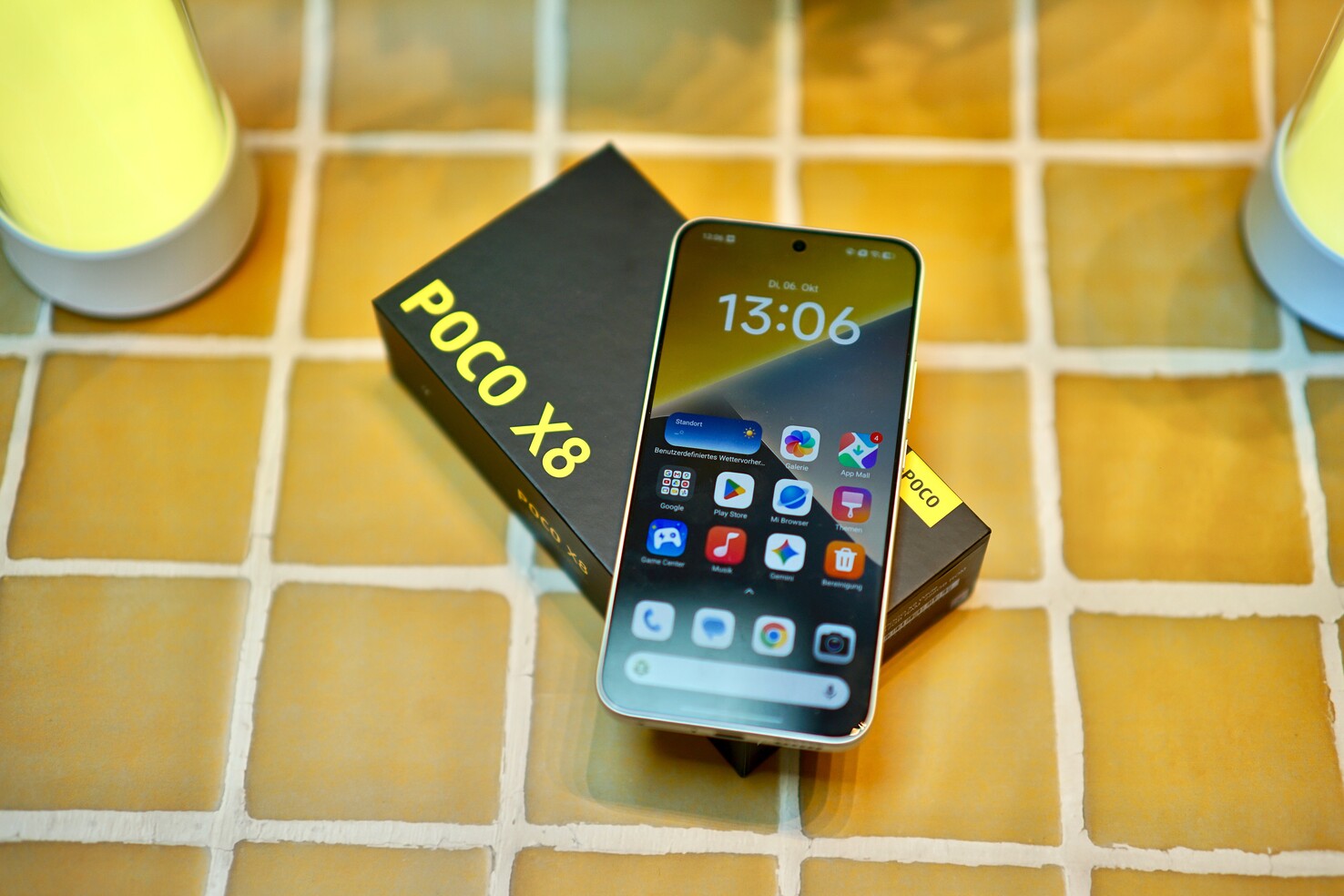
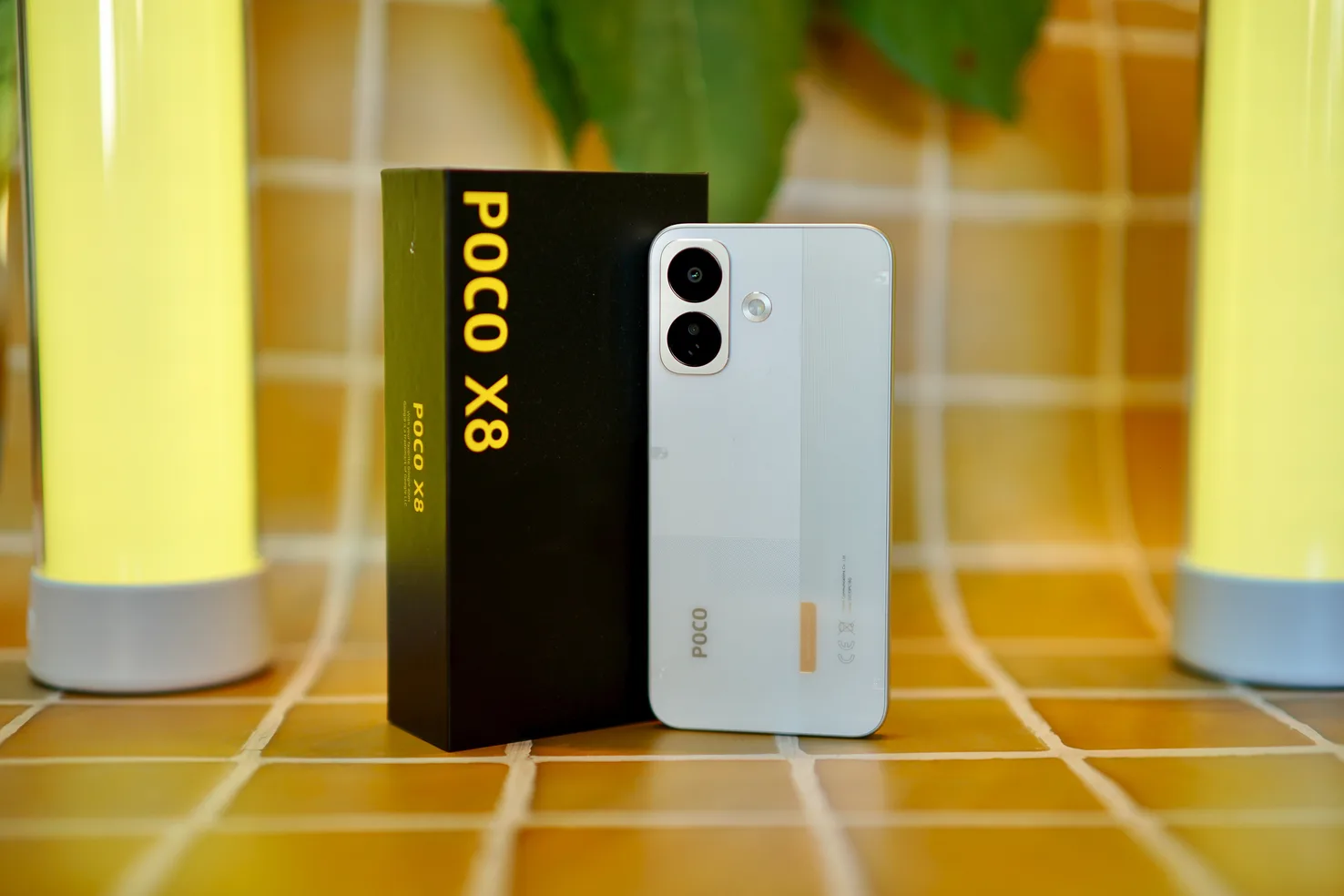
The Poco phone has a fairly classic design with rounded corners. The white back of our review unit features various textures beneath a transparent plastic layer with visible screws. The other color variants in dark gray and orange take a slightly more subtle approach to this industrial look.
The Poco X8 is rated IP68 and IP69K. TÜV SÜD certifies water resistance at depths of up to two meters for 72 hours, and there is also an SGS certification that is said to cover drops onto granite from heights of up to three meters.
According to the manufacturer, the battery was also subjected to extreme conditions in the lab – from minus 40 to plus 75 degrees Celsius.






Nothing Phone (4b) Xiaomi Poco X8 Xiaomi Redmi Note 17 Pro 5G Motorola Moto G77 Xiaomi Poco X7 DIN A6❌
The phone is available with either 8 GB or 12 GB of RAM, always paired with 256 GB of UFS 3.1 storage. There is no microSD card reader.
The rest of the features are what you would expect in this price range: an electronic compass, NFC, an IR blaster and USB OTG are on board.
Neither a fast USB 3 port with wired video output nor WiFi 7 is available. The screen can be mirrored wirelessly
Android 16 is preinstalled on the device. At the time of testing, the security patches are from August 2026 and thus still reasonably up to date.
An update should be expected approximately every three months, according to the Xiaomi Security Center, until 2032, meaning six years from launch. Five new Android versions, up to Android 21, are also promised.
Unfortunately, ads keep appearing in the operating system.
Xiaomi does not provide reliable figures on its environmental footprint. The manufacturer merely points to its ESG measures – plastic-free packaging, lower-CO₂ rail and sea transport, and a self-repair program.
Xiaomi does not provide fast WiFi with 6 GHz support, but only WiFi 5 with a basic antenna setup. This only allows speeds of around 350 MBit/s. Some similarly priced competitors are significantly faster here.
5G is supported, as are many LTE frequencies, so the phone is also well suited for use when traveling. Reception is good in our test, but not always entirely stable in challenging conditions.
| iperf3 transmit Wi-Fi6/7 RT-BE96U | 335 (min: 305) MBit/s ∼21% |
| iperf3 receive Wi-Fi6/7 RT-BE96U | 353 (min: 314) MBit/s ∼20% |
| iperf3 transmit AXE11000 | 398 (min: 193) MBit/s ∼61% |
| iperf3 receive AXE11000 | 377 (min: 187) MBit/s ∼55% |
| iperf3 transmit Wi-Fi6/7 RT-BE96U | 509 (min: 471) MBit/s ∼32% |
| iperf3 receive Wi-Fi6/7 RT-BE96U | 435 (min: 391) MBit/s ∼25% |
| iperf3 transmit AXE11000 | 279 (min: 169) MBit/s ∼43% |
| iperf3 receive AXE11000 | 342 (min: 251) MBit/s ∼50% |
| iperf3 transmit Wi-Fi6/7 RT-BE96U | 362 (min: 347) MBit/s ∼22% |
| iperf3 receive Wi-Fi6/7 RT-BE96U | 340 (min: 319) MBit/s ∼19% |
| iperf3 transmit AXE11000 | 337 (min: 10.5) MBit/s ∼51% |
| iperf3 receive AXE11000 | 330 (min: 20.1) MBit/s ∼48% |
| iperf3 transmit Wi-Fi6/7 RT-BE96U | 343 (min: 304) MBit/s ∼21% |
| iperf3 receive Wi-Fi6/7 RT-BE96U | 350 (min: 328) MBit/s ∼20% |
| iperf3 transmit AXE11000 | 655 (min: 52.5) MBit/s ∼100% |
| iperf3 receive AXE11000 | 689 (min: 52.2) MBit/s ∼100% |
| iperf3 transmit Wi-Fi6/7 RT-BE96U | 1615 (min: 316) MBit/s ∼100% |
| iperf3 receive Wi-Fi6/7 RT-BE96U | 1763 (min: 328) MBit/s ∼100% |
Xiaomi Poco X8; iperf3 transmit Wi-Fi6/7 RT-BE96U; iperf 3.21, 5 GHz: Ø335 (305-351) MBit/s
Xiaomi Poco X8; iperf3 receive Wi-Fi6/7 RT-BE96U; iperf 3.21, 5 GHz: Ø353 (314-380) MBit/s
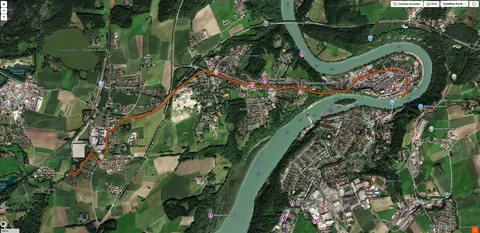
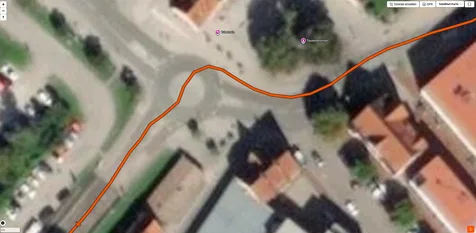
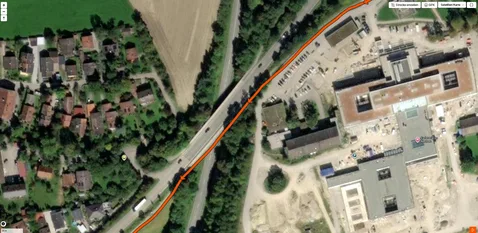
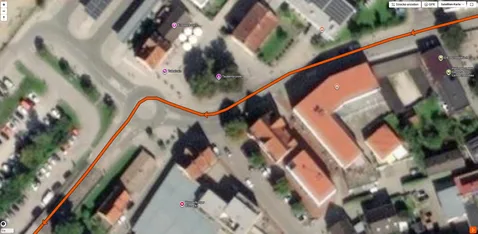
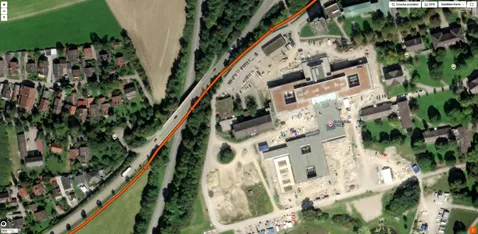
For satellite positioning, the Poco X8 uses single-band GNSS and quickly locates us outdoors with an accuracy of around three meters.
In a real-world test against a Garmin Venu 2, the Xiaomi phone is reasonably accurate, but consistently places us slightly off the route traveled. However, this remains within acceptable limits.
The mid-range smartphone is therefore suitable for navigation.

The Poco X8 supports dual SIM with two nanoSIM cards; eSIM is not supported.
VoLTE, VoNR and VoWiFi are also on board.
Call quality is good, and the earpiece volume is always loud enough to hear clearly.

Xiaomi cuts corners on the cameras: While the predecessor still had a wide-angle and a macro camera, there is now only a 50-megapixel main camera on the back and a small depth sensor, which cannot take photos itself.
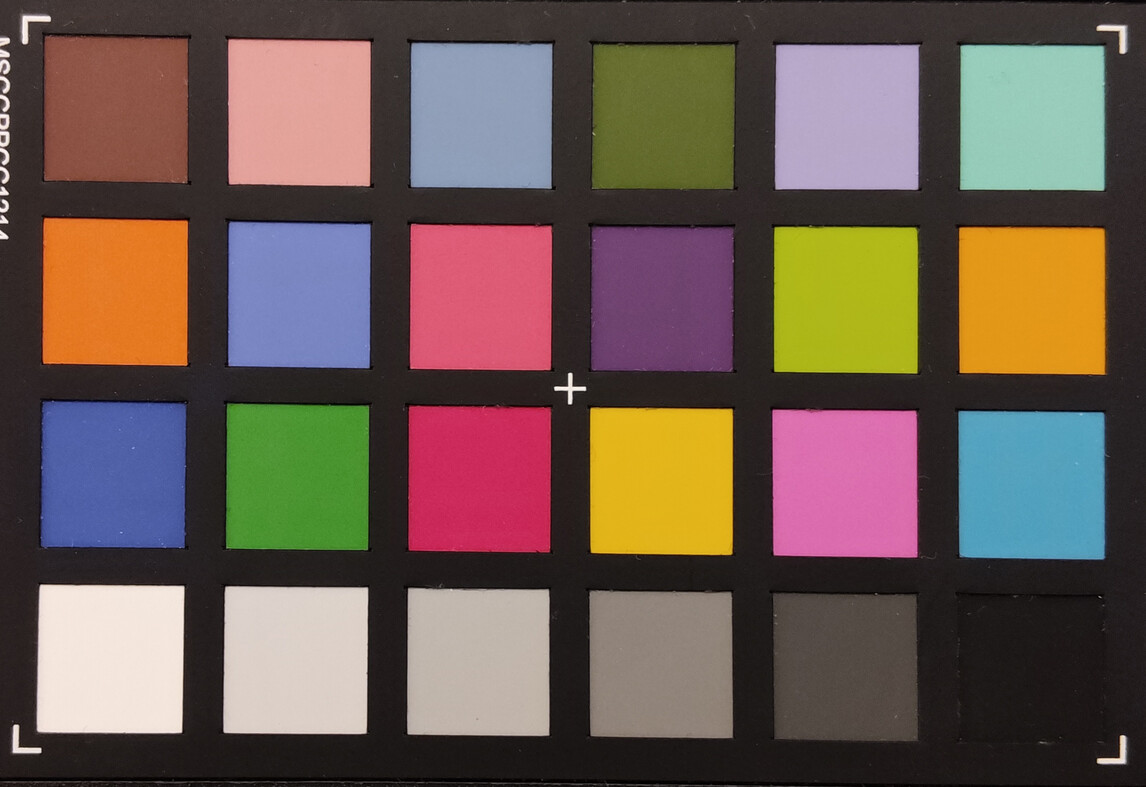
The Poco X8 can take decent pictures in good light, but sharpness is often not quite optimal and bright areas quickly become overexposed. In low light, the limited dynamic range is clearly evident in bright and dark areas. Taking photos is almost impossible without an additional light source.
The front camera, meanwhile, takes decent selfies, but edges against a bright background have a somewhat artificial glow.
Choose a scene and navigate within the first image. One click changes the position on touchscreens. One click on the zoomed-in image opens the original in a new window. The first image shows the scaled photograph of the test device.
PflanzeUmgebungLow Lightclick to load images
Xiaomi Poco X8
Apple iPhone 18 Pro
Oppo Find X9 Pro
Canon EOS 600D
7.8 ∆E
9.5 ∆E
13.4 ∆E
7.8 ∆E
14.2 ∆E
7.3 ∆E
4.1 ∆E
16.3 ∆E
6.6 ∆E
4.6 ∆E
6.7 ∆E
3.7 ∆E
11.9 ∆E
4.4 ∆E
10.2 ∆E
5.9 ∆E
9.4 ∆E
11.2 ∆E
6.9 ∆E
6.2 ∆E
8.5 ∆E
7.9 ∆E
6.7 ∆E
9.2 ∆E
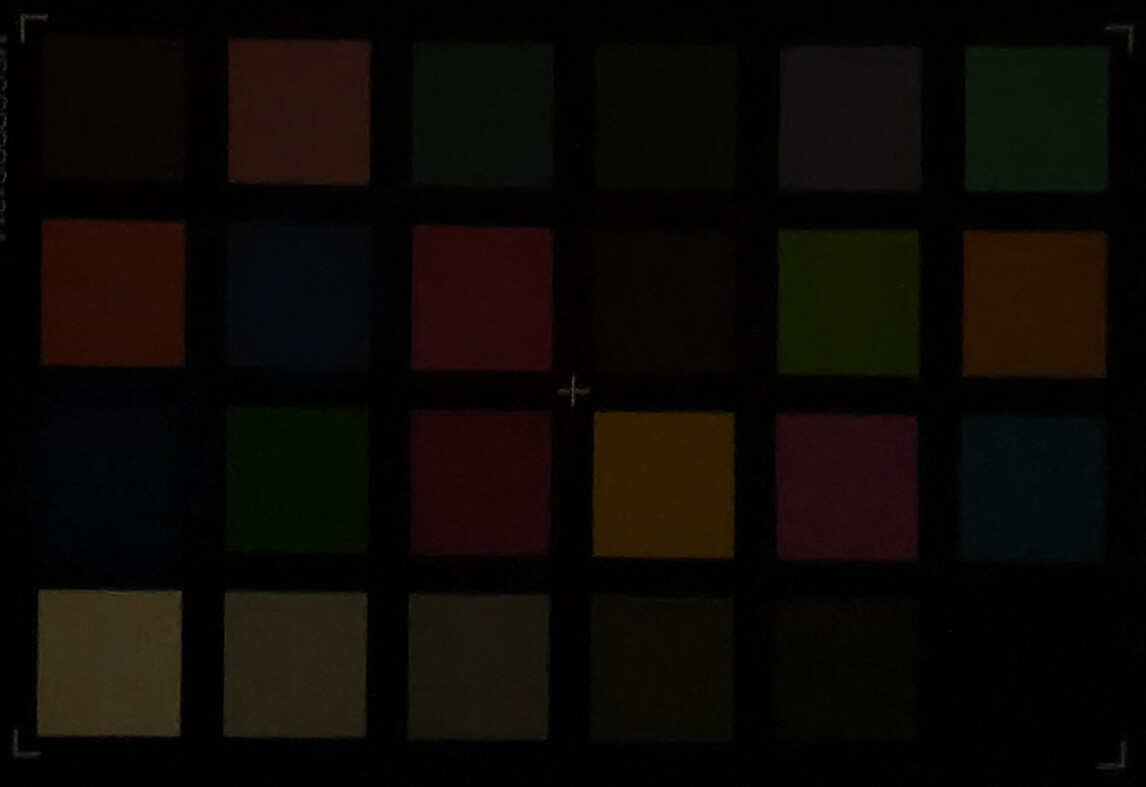
28.1 ∆E
48.8 ∆E
39.3 ∆E
33.3 ∆E
43.5 ∆E
58.1 ∆E
48.4 ∆E
33.2 ∆E
36.4 ∆E
28.4 ∆E
60 ∆E
58.8 ∆E
29.4 ∆E
44.7 ∆E
32.1 ∆E
69.5 ∆E
38 ∆E
40 ∆E
69.7 ∆E
66.3 ∆E
49.8 ∆E
35.9 ∆E
23.9 ∆E
13.9 ∆E
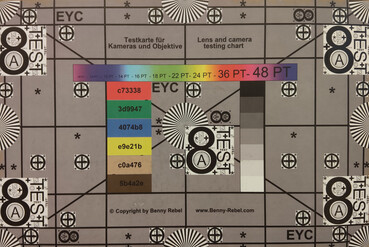
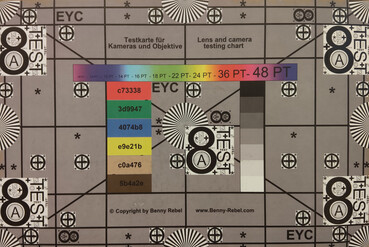


A USB-C cable, a SIM tool and a protective case can be found in the box in Europe. In other regions, a compatible charger is also included.
Unfortunately, Xiaomi phones in Europe only come with a 12-month warranty.
A 240 Hz touch sampling rate gives the Poco phone a fast response time to inputs. In games, the sampling rate can be increased even further.
The fingerprint sensor is hidden behind the screen and positioned quite low down, but after the initial setup, it unlocks the phone fairly reliably and can be used to control access to other apps.
Facial recognition is also available. It also works reliably in our tests, even in low light. However, as it relies solely on 2D recognition

The display gives the Poco X8 one of the strongest selling points of the entire package: The OLED panel runs at up to 120 Hz and reaches around 1,000 cd/m2 in the realistic APL measurement – a tangible advantage for outdoor use in sunlight.
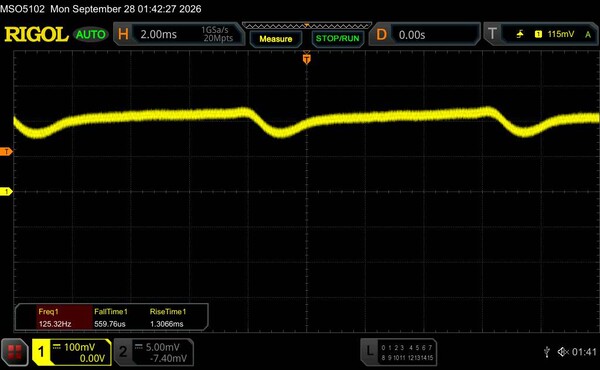
The Xiaomi smartphone also leads the way in eye comfort. In addition to conventional PWM flickering at around 125 Hz, it uses the high-frequency PWM dimming at up to 3,840 Hz advertised by Xiaomi. Anyone sensitive to flickering should nevertheless be aware of the low-frequency 120 Hz component – at this frequency, burning eyes or headaches during prolonged use cannot be ruled out.
For comparison: Slightly more than half of all the devices we have tested dim without any PWM at all; where PWM is used, the average frequency is significantly higher.
|
Distribution of brightness
tested with X-Rite i1Pro 3
Maximum: 1116 cd/m² (Nits) Average: 1027.7 cd/m² Minimum: 1.04 cd/m²
Brightness Distribution: 90 %
Center on Battery: 1019 cd/m²
Contrast: ∞:1 (Black: 0 cd/m²)
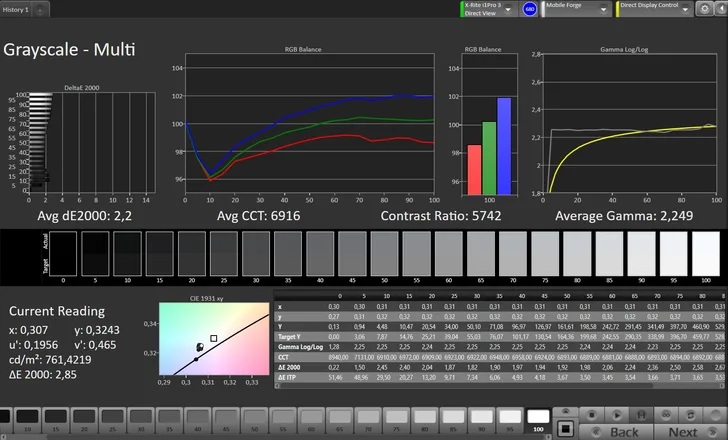
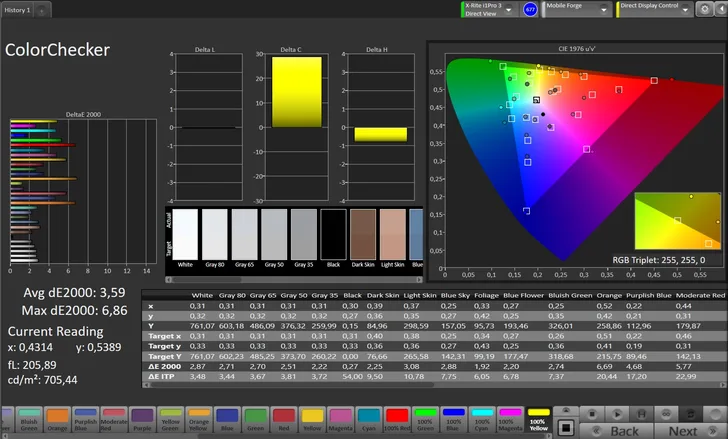
ΔE ColorChecker Calman: 3.59 | ∀{0.5-29.43 Ø4.69}
ΔE Greyscale Calman: 2.2 | ∀{0.09-98 Ø4.94}
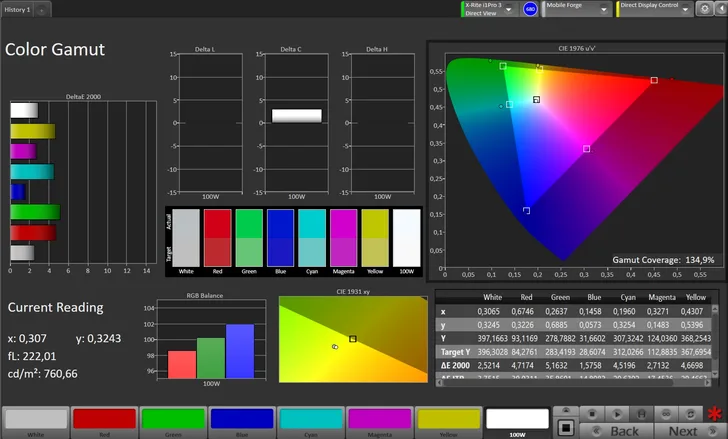
134.9% sRGB (Calman 2D)
Gamma: 2.249
CCT: 6916 K
| Xiaomi Poco X8 AMOLED, 2772×1280, 6.8″ |
Xiaomi Poco X7 AMOLED, 2712×1220, 6.7″ |
Nothing Phone (4b) Super AMOLED, 2344×1080, 6.8″ |
Motorola Moto G77 AMOLED, 2772×1272, 6.8″ |
Xiaomi Redmi Note 17 Pro 5G OLED, 2772×1280, 6.8″ |
|
|---|---|---|---|---|---|
| APL18 Peak Brightness (cd/m²) | 4009 | 1156 -71% | 1160 -71% | 3521 -12% | 4034 1% |
| HDR Peak Brightness (cd/m²) | 4421 | 2563 -42% | 1030 -77% | 3704 -16% | 4440 0% |
| Response Time Grey 50% / Grey 80% * (ms) | 0.8 ?(0.4, 0.4) | 1.44 ?(0.7075, 0.7315)-80% | 0.95 ?(0.46, 0.491)-19% | 1.6 ?(0.8, 0.8)-100% | 1.6 ?(0.782, 0.8195)-100% |
| Response Time Black / White * (ms) | 0.8 ?(0.4, 0.4) | 1.6 ?(0.877, 0.7265)-100% | 1.28 ?(0.6045, 0.678)-60% | 1.1 ?(0.5, 0.6)-38% | 1.3 ?(0.667, 0.632)-63% |
| PWM Frequency (Hz) | 125.3 | 120 | 480 | 103 | 120 |
| PWM Amplitude * (%) | 16 | 14.08 12% | 17.34 -8% | 10 37% | 13.42 16% |
| Brightness middle (cd/m²) | 1019 | 1156 13% | 1148 13% | 1558 53% | 1053 3% |
| Brightness (cd/m²) | 1028 | 1150 12% | 1526 48% | 1063 3% | |
| Brightness Distribution (%) | 90 | 98 9% | 96 7% | 98 9% | |
| Black Level * (cd/m²) | |||||
| Colorchecker dE 2000 * | 3.59 | 1.1 69% | 1.9 47% | 0.79 78% | 2.9 19% |
| Colorchecker dE 2000 max. * | 6.86 | 3.1 55% | 4.7 31% | 2.97 57% | 4.9 29% |
| Greyscale dE 2000 * | 2.2 | 1.6 27% | 3.6 -64% | 1.3 41% | 3 -36% |
| Gamma | 2.249 98% | 2.22 99% | 2.24 98% | 2.24 98% | 2.24 98% |
| CCT | 6916 94% | 6304 103% | 6856 95% | 6489 100% | 6747 96% |
Screen Flickering / PWM (Pulse-Width Modulation)
ℹ
To dim the screen, some notebooks will simply cycle the backlight on and off in rapid succession – a method called Pulse Width Modulation (PWM) . This cycling frequency should ideally be undetectable to the human eye. If said frequency is too low, users with sensitive eyes may experience strain or headaches or even notice the flickering altogether.
| Screen flickering / PWM detected | 125.3 Hz Amplitude: 16 % |
 |
|
The display backlight flickers at 125.3 Hz (worst case, e.g., utilizing PWM) . The frequency of 125.3 Hz is very low, so the flickering may cause eyestrain and headaches after extended use. In comparison: 52 % of all tested devices do not use PWM to dim the display. If PWM was detected, an average of 7579 (minimum: 5 – maximum: 343500) Hz was measured. |
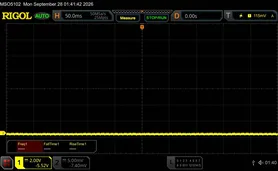
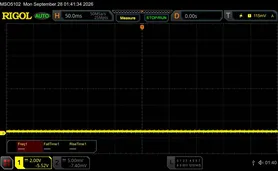
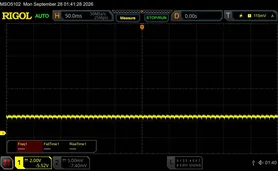
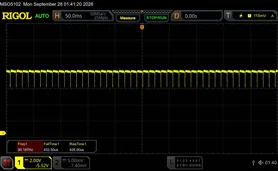
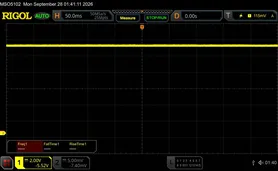
Measurement series with a fixed zoom level and different brightness settings (Although the amplitude curve at minimum brightness looks flat, this is due to the scaling. The info box shows an enlarged version of the amplitude at minimum brightness.)
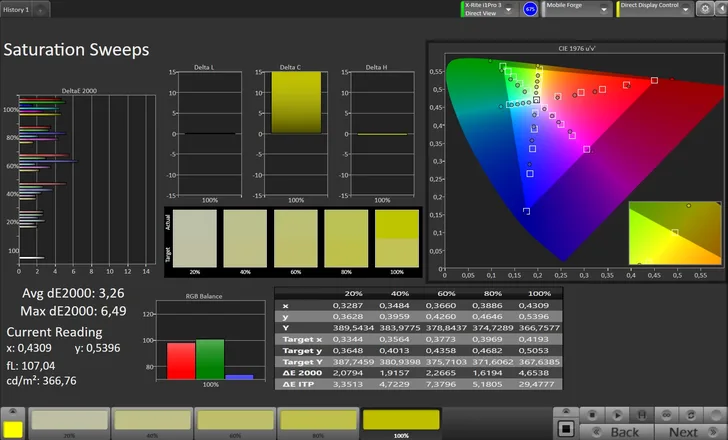
Slight color variations are something you have to live with in everyday use, even though the settings allow for some adjustments. However, these barely noticeable differences will probably mainly bother professionals.
Display Response Times
ℹ
Display response times show how fast the screen is able to change from one color to the next. Slow response times can lead to afterimages and can cause moving objects to appear blurry (ghosting). Gamers of fast-paced 3D titles should pay special attention to fast response times.
| ↔ Response Time Black to White | ||
|---|---|---|
| 0.8 ms … rise ↗ and fall ↘ combined | ↗ 0.4 ms rise | 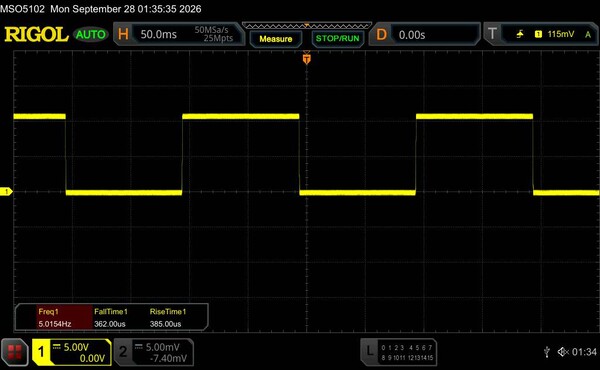 |
| ↘ 0.4 ms fall | ||
| The screen shows very fast response rates in our tests and should be very well suited for fast-paced gaming. In comparison, all tested devices range from 0.1 (minimum) to 240 (maximum) ms. » 3 % of all devices are better. This means that the measured response time is better than the average of all tested devices (19.6 ms). |
||
| ↔ Response Time 50% Grey to 80% Grey | ||
| 0.8 ms … rise ↗ and fall ↘ combined | ↗ 0.4 ms rise | 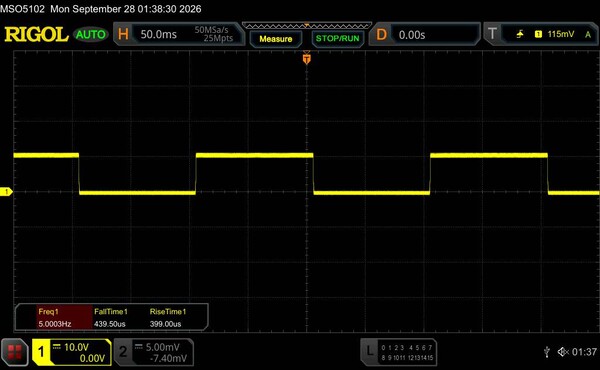 |
| ↘ 0.4 ms fall | ||
| The screen shows very fast response rates in our tests and should be very well suited for fast-paced gaming. In comparison, all tested devices range from 0.13 (minimum) to 636 (maximum) ms. » 3 % of all devices are better. This means that the measured response time is better than the average of all tested devices (30.7 ms). |
We cannot detect any performance improvement over its predecessor despite the new SoC; if anything, the opposite is true: The Qualcomm Snapdragon 6s Gen 4 is underpowered, but can still keep up reasonably well with many similarly priced phones.
Day-to-day use of the Poco X8 is not entirely stutter-free, and the phone quickly seems overwhelmed, especially with somewhat more demanding tasks or multitasking.
Geekbench 7.0 | Geekbench 6.7 | PCMark for Android | Antutu v11 | CrossMark | BaseMark OS II | UL Procyon AI Inference for Android | AImark | Geekbench AI | AI Benchmark
| Average of class Smartphone (514 – 4055, n=41, last 2 years) |
1568 Points +78% |
| Nothing Phone (4b) Qualcomm Snapdragon 6 Gen 4, Adreno 810, 8192 |
983 Points +11% |
| Xiaomi Poco X8 Qualcomm Snapdragon 6s Gen 4, Adreno 710, 8192 |
883 Points |
| Average Qualcomm Snapdragon 6s Gen 4 (881 – 883, n=2) |
882 Points 0% |
| Xiaomi Redmi Note 17 Pro 5G Qualcomm Snapdragon 6s Gen 4, Adreno 710, 6144 |
881 Points 0% |
| Average of class Smartphone (1368 – 11622, n=41, last 2 years) |
5435 Points +103% |
| Nothing Phone (4b) Qualcomm Snapdragon 6 Gen 4, Adreno 810, 8192 |
3163 Points +18% |
| Xiaomi Poco X8 Qualcomm Snapdragon 6s Gen 4, Adreno 710, 8192 |
2680 Points |
| Average Qualcomm Snapdragon 6s Gen 4 (2622 – 2680, n=2) |
2651 Points -1% |
| Xiaomi Redmi Note 17 Pro 5G Qualcomm Snapdragon 6s Gen 4, Adreno 710, 6144 |
2622 Points -2% |
| Average of class Smartphone (196 – 4733, n=186, last 2 years) |
1861 Points +93% |
| Nothing Phone (4b) Qualcomm Snapdragon 6 Gen 4, Adreno 810, 8192 |
1088 Points +13% |
| Xiaomi Poco X7 MediaTek Dimensity 7300, Mali-G615 MP2, 12288 |
1030 Points +7% |
| Xiaomi Redmi Note 17 Pro 5G Qualcomm Snapdragon 6s Gen 4, Adreno 710, 6144 |
1012 Points +5% |
| Average Qualcomm Snapdragon 6s Gen 4 (964 – 1014, n=3) |
997 Points +3% |
| Xiaomi Poco X8 Qualcomm Snapdragon 6s Gen 4, Adreno 710, 8192 |
964 Points |
| Motorola Moto G77 Mediatek Dimensity 6400, Mali-G57 MP2, 8192 |
802 Points -17% |
| Average of class Smartphone (830 – 12854, n=186, last 2 years) |
5651 Points +106% |
| Nothing Phone (4b) Qualcomm Snapdragon 6 Gen 4, Adreno 810, 8192 |
3169 Points +15% |
| Xiaomi Poco X7 MediaTek Dimensity 7300, Mali-G615 MP2, 12288 |
2908 Points +6% |
| Xiaomi Redmi Note 17 Pro 5G Qualcomm Snapdragon 6s Gen 4, Adreno 710, 6144 |
2898 Points +5% |
| Average Qualcomm Snapdragon 6s Gen 4 (2748 – 2930, n=3) |
2859 Points +4% |
| Xiaomi Poco X8 Qualcomm Snapdragon 6s Gen 4, Adreno 710, 8192 |
2748 Points |
| Motorola Moto G77 Mediatek Dimensity 6400, Mali-G57 MP2, 8192 |
2022 Points -26% |
| Average of class Smartphone (4507 – 28557, n=129, last 2 years) |
14893 Points +25% |
| Xiaomi Poco X7 MediaTek Dimensity 7300, Mali-G615 MP2, 12288 |
13406 Points +12% |
| Average Qualcomm Snapdragon 6s Gen 4 (11939 – 14722, n=3) |
12885 Points +8% |
| Xiaomi Redmi Note 17 Pro 5G Qualcomm Snapdragon 6s Gen 4, Adreno 710, 6144 |
11993 Points 0% |
| Xiaomi Poco X8 Qualcomm Snapdragon 6s Gen 4, Adreno 710, 8192 |
11939 Points |
| Average of class Smartphone (519159 – 4450644, n=46, last 2 years) |
2413796 Points +194% |
| Nothing Phone (4b) Qualcomm Snapdragon 6 Gen 4, Adreno 810, 8192 |
948782 Points +15% |
| Xiaomi Redmi Note 17 Pro 5G Qualcomm Snapdragon 6s Gen 4, Adreno 710, 6144 |
848400 Points +3% |
| Average Qualcomm Snapdragon 6s Gen 4 (822196 – 848400, n=3) |
831206 Points +1% |
| Xiaomi Poco X8 Qualcomm Snapdragon 6s Gen 4, Adreno 710, 8192 |
822196 Points |
| Average of class Smartphone (376 – 2856, n=105, last 2 years) |
1230 Points +41% |
| Xiaomi Poco X8 Qualcomm Snapdragon 6s Gen 4, Adreno 710, 8192 |
873 Points |
| Xiaomi Poco X7 MediaTek Dimensity 7300, Mali-G615 MP2, 12288 |
759 Points -13% |
| Average Qualcomm Snapdragon 6s Gen 4 (610 – 873, n=2) |
742 Points -15% |
| Motorola Moto G77 Mediatek Dimensity 6400, Mali-G57 MP2, 8192 |
502 Points -42% |
| Nothing Phone (4b) Qualcomm Snapdragon 6 Gen 4, Adreno 810, 8192 |
Points -100% |
| Xiaomi Redmi Note 17 Pro 5G Qualcomm Snapdragon 6s Gen 4, Adreno 710, 6144 |
Points -100% |
| Average of class Smartphone (1885 – 16690, n=111, last 2 years) |
7917 Points +62% |
| Xiaomi Poco X8 Qualcomm Snapdragon 6s Gen 4, Adreno 710, 8192 |
4891 Points |
| Average Qualcomm Snapdragon 6s Gen 4 (4611 – 4891, n=3) |
4738 Points -3% |
| Xiaomi Poco X7 MediaTek Dimensity 7300, Mali-G615 MP2, 12288 |
4725 Points -3% |
| Xiaomi Redmi Note 17 Pro 5G Qualcomm Snapdragon 6s Gen 4, Adreno 710, 6144 |
4611 Points -6% |
| Average of class Smartphone (4117 – 21153, n=111, last 2 years) |
11496 Points +28% |
| Xiaomi Redmi Note 17 Pro 5G Qualcomm Snapdragon 6s Gen 4, Adreno 710, 6144 |
9076 Points +1% |
| Xiaomi Poco X8 Qualcomm Snapdragon 6s Gen 4, Adreno 710, 8192 |
9004 Points |
| Average Qualcomm Snapdragon 6s Gen 4 (8570 – 9076, n=3) |
8883 Points -1% |
| Xiaomi Poco X7 MediaTek Dimensity 7300, Mali-G615 MP2, 12288 |
8774 Points -3% |
| Average of class Smartphone (2760 – 24052, n=111, last 2 years) |
9351 Points +43% |
| Xiaomi Poco X8 Qualcomm Snapdragon 6s Gen 4, Adreno 710, 8192 |
6540 Points |
| Average Qualcomm Snapdragon 6s Gen 4 (5133 – 6540, n=3) |
5827 Points -11% |
| Xiaomi Redmi Note 17 Pro 5G Qualcomm Snapdragon 6s Gen 4, Adreno 710, 6144 |
5133 Points -22% |
| Xiaomi Poco X7 MediaTek Dimensity 7300, Mali-G615 MP2, 12288 |
4732 Points -28% |
| Average of class Smartphone (1046 – 61797, n=111, last 2 years) |
24556 Points +256% |
| Xiaomi Poco X7 MediaTek Dimensity 7300, Mali-G615 MP2, 12288 |
8570 Points +24% |
| Xiaomi Poco X8 Qualcomm Snapdragon 6s Gen 4, Adreno 710, 8192 |
6902 Points |
| Average Qualcomm Snapdragon 6s Gen 4 (6753 – 6913, n=3) |
6856 Points -1% |
| Xiaomi Redmi Note 17 Pro 5G Qualcomm Snapdragon 6s Gen 4, Adreno 710, 6144 |
6753 Points -2% |
| Average of class Smartphone (1062 – 2587, n=111, last 2 years) |
1734 Points +23% |
| Xiaomi Poco X8 Qualcomm Snapdragon 6s Gen 4, Adreno 710, 8192 |
1408 Points |
| Xiaomi Poco X7 MediaTek Dimensity 7300, Mali-G615 MP2, 12288 |
1401 Points 0% |
| Average Qualcomm Snapdragon 6s Gen 4 (1343 – 1431, n=3) |
1394 Points -1% |
| Xiaomi Redmi Note 17 Pro 5G Qualcomm Snapdragon 6s Gen 4, Adreno 710, 6144 |
1343 Points -5% |
| Average of class Smartphone (2895 – 66164, n=97, last 2 years) |
18833 Points +141% |
| Xiaomi Poco X7 MediaTek Dimensity 7300, Mali-G615 MP2, 12288 |
8359 Points +7% |
| Average Qualcomm Snapdragon 6s Gen 4 (7819 – 8777, n=3) |
8176 Points +5% |
| Xiaomi Redmi Note 17 Pro 5G Qualcomm Snapdragon 6s Gen 4, Adreno 710, 6144 |
7933 Points +1% |
| Xiaomi Poco X8 Qualcomm Snapdragon 6s Gen 4, Adreno 710, 8192 |
7819 Points |
| Average of class Smartphone (293 – 307528, n=65, last 2 years) |
14242 Points +2499% |
| Xiaomi Redmi Note 17 Pro 5G Qualcomm Snapdragon 6s Gen 4, Adreno 710, 6144 |
567 Points +3% |
| Average Qualcomm Snapdragon 6s Gen 4 (548 – 567, n=3) |
558 Points +2% |
| Xiaomi Poco X8 Qualcomm Snapdragon 6s Gen 4, Adreno 710, 8192 |
548 Points |
| Average of class Smartphone (80 – 6997, n=135, last 2 years) |
539 Points +291% |
| Motorola Moto G77 Mediatek Dimensity 6400, Mali-G57 MP2, 8192 |
230 Points +67% |
| Nothing Phone (4b) Qualcomm Snapdragon 6 Gen 4, Adreno 810, 8192 |
217 Points +57% |
| Xiaomi Poco X8 Qualcomm Snapdragon 6s Gen 4, Adreno 710, 8192 |
138 Points |
| Xiaomi Redmi Note 17 Pro 5G Qualcomm Snapdragon 6s Gen 4, Adreno 710, 6144 |
134 Points -3% |
| Average Qualcomm Snapdragon 6s Gen 4 (123 – 138, n=3) |
131.7 Points -5% |
| Average of class Smartphone (80 – 55067, n=135, last 2 years) |
1757 Points +1173% |
| Motorola Moto G77 Mediatek Dimensity 6400, Mali-G57 MP2, 8192 |
330 Points +139% |
| Nothing Phone (4b) Qualcomm Snapdragon 6 Gen 4, Adreno 810, 8192 |
218 Points +58% |
| Xiaomi Redmi Note 17 Pro 5G Qualcomm Snapdragon 6s Gen 4, Adreno 710, 6144 |
148 Points +7% |
| Xiaomi Poco X8 Qualcomm Snapdragon 6s Gen 4, Adreno 710, 8192 |
138 Points |
| Average Qualcomm Snapdragon 6s Gen 4 (122 – 148, n=3) |
136 Points -1% |
| Average of class Smartphone (124 – 71367, n=135, last 2 years) |
2664 Points +580% |
| Nothing Phone (4b) Qualcomm Snapdragon 6 Gen 4, Adreno 810, 8192 |
500 Points +28% |
| Xiaomi Poco X8 Qualcomm Snapdragon 6s Gen 4, Adreno 710, 8192 |
392 Points |
| Xiaomi Redmi Note 17 Pro 5G Qualcomm Snapdragon 6s Gen 4, Adreno 710, 6144 |
390 Points -1% |
| Average Qualcomm Snapdragon 6s Gen 4 (346 – 392, n=3) |
376 Points -4% |
| Motorola Moto G77 Mediatek Dimensity 6400, Mali-G57 MP2, 8192 |
203 Points -48% |
| Average of class Smartphone (46.4 – 3334, n=16, last 2 years) |
393 Points |
| Xiaomi Poco X7 MediaTek Dimensity 7300, Mali-G615 MP2, 12288 |
88.8 Points |
| Average of class Smartphone (55.6 – 22780, n=77, last 2 years) |
6143 Points +1826% |
| Average Qualcomm Snapdragon 6s Gen 4 (311 – 337, n=3) |
322 Points +1% |
| Xiaomi Poco X8 Qualcomm Snapdragon 6s Gen 4, Adreno 710, 8192 |
319 Points |
| Xiaomi Redmi Note 17 Pro 5G Qualcomm Snapdragon 6s Gen 4, Adreno 710, 6144 |
311 Points -3% |
| Xiaomi Poco X7 MediaTek Dimensity 7300, Mali-G615 MP2, 12288 |
234 Points -27% |
The Poco X8 doesn’t stand out in the graphics benchmarks either. Most games should be playable on the phone, but more demanding titles aren’t exactly a thrill to play.
3DMark: Wild Life Extreme Unlimited | Wild Life Extreme | Wild Life Unlimited Score | Steel Nomad Light Unlimited Score | Steel Nomad Light Score
GFXBench (DX / GLBenchmark) 2.7: T-Rex Onscreen | 1920×1080 T-Rex Offscreen
GFXBench 3.0: on screen Manhattan Onscreen OGL | 1920×1080 1080p Manhattan Offscreen
GFXBench 3.1: on screen Manhattan ES 3.1 Onscreen | 1920×1080 Manhattan ES 3.1 Offscreen
GFXBench: on screen Car Chase Onscreen | 1920×1080 Car Chase Offscreen | on screen Aztec Ruins High Tier Onscreen | 2560×1440 Aztec Ruins High Tier Offscreen | on screen Aztec Ruins Normal Tier Onscreen | 1920×1080 Aztec Ruins Normal Tier Offscreen | 3840×2160 4K Aztec Ruins High Tier Offscreen
| Nothing Phone (4b) Adreno 810, SD 6 Gen 4, 128 GB UFS 2.2 Flash |
957 Points +26% |
| Xiaomi Poco X7 Mali-G615 MP2, Dimensity 7300, 512 GB UFS 2.2 Flash |
842 Points +11% |
| Xiaomi Poco X8 Adreno 710, SD 6s Gen 4, 256 GB UFS 3.1 Flash |
759 Points |
| Xiaomi Redmi Note 17 Pro 5G Adreno 710, SD 6s Gen 4, 256 GB UFS 3.1 Flash |
741 Points -2% |
| Motorola Moto G77 Mali-G57 MP2, Dimensity 6400, 256 GB UFS 2.1 Flash |
382 Points -50% |
| Nothing Phone (4b) Adreno 810, SD 6 Gen 4, 128 GB UFS 2.2 Flash |
960 Points +25% |
| Xiaomi Poco X7 Mali-G615 MP2, Dimensity 7300, 512 GB UFS 2.2 Flash |
846 Points +11% |
| Xiaomi Poco X8 Adreno 710, SD 6s Gen 4, 256 GB UFS 3.1 Flash |
765 Points |
| Xiaomi Redmi Note 17 Pro 5G Adreno 710, SD 6s Gen 4, 256 GB UFS 3.1 Flash |
744 Points -3% |
| Motorola Moto G77 Mali-G57 MP2, Dimensity 6400, 256 GB UFS 2.1 Flash |
386 Points -50% |
| Nothing Phone (4b) Adreno 810, SD 6 Gen 4, 128 GB UFS 2.2 Flash |
3770 Points +28% |
| Xiaomi Poco X7 Mali-G615 MP2, Dimensity 7300, 512 GB UFS 2.2 Flash |
3129 Points +6% |
| Xiaomi Redmi Note 17 Pro 5G Adreno 710, SD 6s Gen 4, 256 GB UFS 3.1 Flash |
2977 Points +1% |
| Xiaomi Poco X8 Adreno 710, SD 6s Gen 4, 256 GB UFS 3.1 Flash |
2941 Points |
| Motorola Moto G77 Mali-G57 MP2, Dimensity 6400, 256 GB UFS 2.1 Flash |
1377 Points -53% |
| Nothing Phone (4b) Adreno 810, SD 6 Gen 4, 128 GB UFS 2.2 Flash |
352 Points +30% |
| Xiaomi Poco X7 Mali-G615 MP2, Dimensity 7300, 512 GB UFS 2.2 Flash |
346 Points +28% |
| Xiaomi Poco X8 Adreno 710, SD 6s Gen 4, 256 GB UFS 3.1 Flash |
271 Points |
| Nothing Phone (4b) Adreno 810, SD 6 Gen 4, 128 GB UFS 2.2 Flash |
353 Points +30% |
| Xiaomi Poco X7 Mali-G615 MP2, Dimensity 7300, 512 GB UFS 2.2 Flash |
344 Points +27% |
| Xiaomi Poco X8 Adreno 710, SD 6s Gen 4, 256 GB UFS 3.1 Flash |
271 Points |
| Xiaomi Poco X7 Mali-G615 MP2, Dimensity 7300, 512 GB UFS 2.2 Flash |
86 fps +6% |
| Xiaomi Redmi Note 17 Pro 5G Adreno 710, SD 6s Gen 4, 256 GB UFS 3.1 Flash |
84 fps +4% |
| Xiaomi Poco X8 Adreno 710, SD 6s Gen 4, 256 GB UFS 3.1 Flash |
81 fps |
| Xiaomi Redmi Note 17 Pro 5G Adreno 710, SD 6s Gen 4, 256 GB UFS 3.1 Flash |
117 fps +4% |
| Xiaomi Poco X7 Mali-G615 MP2, Dimensity 7300, 512 GB UFS 2.2 Flash |
115 fps +2% |
| Xiaomi Poco X8 Adreno 710, SD 6s Gen 4, 256 GB UFS 3.1 Flash |
113 fps |
| Xiaomi Poco X7 Mali-G615 MP2, Dimensity 7300, 512 GB UFS 2.2 Flash |
60 fps +30% |
| Xiaomi Redmi Note 17 Pro 5G Adreno 710, SD 6s Gen 4, 256 GB UFS 3.1 Flash |
48 fps +4% |
| Xiaomi Poco X8 Adreno 710, SD 6s Gen 4, 256 GB UFS 3.1 Flash |
46 fps |
| Xiaomi Poco X7 Mali-G615 MP2, Dimensity 7300, 512 GB UFS 2.2 Flash |
81 fps +21% |
| Xiaomi Redmi Note 17 Pro 5G Adreno 710, SD 6s Gen 4, 256 GB UFS 3.1 Flash |
68 fps +1% |
| Xiaomi Poco X8 Adreno 710, SD 6s Gen 4, 256 GB UFS 3.1 Flash |
67 fps |
| Xiaomi Poco X7 Mali-G615 MP2, Dimensity 7300, 512 GB UFS 2.2 Flash |
39 fps +22% |
| Xiaomi Redmi Note 17 Pro 5G Adreno 710, SD 6s Gen 4, 256 GB UFS 3.1 Flash |
34 fps +6% |
| Xiaomi Poco X8 Adreno 710, SD 6s Gen 4, 256 GB UFS 3.1 Flash |
32 fps |
| Xiaomi Poco X7 Mali-G615 MP2, Dimensity 7300, 512 GB UFS 2.2 Flash |
56 fps +14% |
| Xiaomi Redmi Note 17 Pro 5G Adreno 710, SD 6s Gen 4, 256 GB UFS 3.1 Flash |
51 fps +4% |
| Xiaomi Poco X8 Adreno 710, SD 6s Gen 4, 256 GB UFS 3.1 Flash |
49 fps |
| Xiaomi Poco X7 Mali-G615 MP2, Dimensity 7300, 512 GB UFS 2.2 Flash |
23 fps +44% |
| Xiaomi Redmi Note 17 Pro 5G Adreno 710, SD 6s Gen 4, 256 GB UFS 3.1 Flash |
17 fps +6% |
| Xiaomi Poco X8 Adreno 710, SD 6s Gen 4, 256 GB UFS 3.1 Flash |
16 fps |
| Xiaomi Poco X7 Mali-G615 MP2, Dimensity 7300, 512 GB UFS 2.2 Flash |
33 fps +22% |
| Xiaomi Poco X8 Adreno 710, SD 6s Gen 4, 256 GB UFS 3.1 Flash |
27 fps |
| Xiaomi Redmi Note 17 Pro 5G Adreno 710, SD 6s Gen 4, 256 GB UFS 3.1 Flash |
24 fps -11% |
| Nothing Phone (4b) Adreno 810, SD 6 Gen 4, 128 GB UFS 2.2 Flash |
26 fps +100% |
| Xiaomi Poco X7 Mali-G615 MP2, Dimensity 7300, 512 GB UFS 2.2 Flash |
17 fps +31% |
| Xiaomi Redmi Note 17 Pro 5G Adreno 710, SD 6s Gen 4, 256 GB UFS 3.1 Flash |
14 fps +8% |
| Xiaomi Poco X8 Adreno 710, SD 6s Gen 4, 256 GB UFS 3.1 Flash |
13 fps |
| Motorola Moto G77 Mali-G57 MP2, Dimensity 6400, 256 GB UFS 2.1 Flash |
8.6 fps -34% |
| Nothing Phone (4b) Adreno 810, SD 6 Gen 4, 128 GB UFS 2.2 Flash |
18 fps +50% |
| Xiaomi Poco X7 Mali-G615 MP2, Dimensity 7300, 512 GB UFS 2.2 Flash |
15 fps +25% |
| Xiaomi Redmi Note 17 Pro 5G Adreno 710, SD 6s Gen 4, 256 GB UFS 3.1 Flash |
13 fps +8% |
| Xiaomi Poco X8 Adreno 710, SD 6s Gen 4, 256 GB UFS 3.1 Flash |
12 fps |
| Motorola Moto G77 Mali-G57 MP2, Dimensity 6400, 256 GB UFS 2.1 Flash |
5.9 fps -51% |
| Nothing Phone (4b) Adreno 810, SD 6 Gen 4, 128 GB UFS 2.2 Flash |
43 fps +105% |
| Xiaomi Poco X7 Mali-G615 MP2, Dimensity 7300, 512 GB UFS 2.2 Flash |
28 fps +33% |
| Xiaomi Redmi Note 17 Pro 5G Adreno 710, SD 6s Gen 4, 256 GB UFS 3.1 Flash |
23 fps +10% |
| Xiaomi Poco X8 Adreno 710, SD 6s Gen 4, 256 GB UFS 3.1 Flash |
21 fps |
| Motorola Moto G77 Mali-G57 MP2, Dimensity 6400, 256 GB UFS 2.1 Flash |
12 fps -43% |
| Nothing Phone (4b) Adreno 810, SD 6 Gen 4, 128 GB UFS 2.2 Flash |
47 fps +42% |
| Xiaomi Poco X7 Mali-G615 MP2, Dimensity 7300, 512 GB UFS 2.2 Flash |
40 fps +21% |
| Xiaomi Redmi Note 17 Pro 5G Adreno 710, SD 6s Gen 4, 256 GB UFS 3.1 Flash |
38 fps +15% |
| Xiaomi Poco X8 Adreno 710, SD 6s Gen 4, 256 GB UFS 3.1 Flash |
33 fps |
| Motorola Moto G77 Mali-G57 MP2, Dimensity 6400, 256 GB UFS 2.1 Flash |
15 fps -55% |
| Nothing Phone (4b) Adreno 810, SD 6 Gen 4, 128 GB UFS 2.2 Flash |
7.8 fps +44% |
| Xiaomi Poco X7 Mali-G615 MP2, Dimensity 7300, 512 GB UFS 2.2 Flash |
6.5 fps +20% |
| Xiaomi Redmi Note 17 Pro 5G Adreno 710, SD 6s Gen 4, 256 GB UFS 3.1 Flash |
5.7 fps +6% |
| Xiaomi Poco X8 Adreno 710, SD 6s Gen 4, 256 GB UFS 3.1 Flash |
5.4 fps |
| Motorola Moto G77 Mali-G57 MP2, Dimensity 6400, 256 GB UFS 2.1 Flash |
2.5 fps -54% |
Jetstream 2 | Speedometer 2.0 | Speedometer 3 | WebXPRT 4 | Octane V2 | Mozilla Kraken 1.1
| Xiaomi Poco X8(Chrome 155) | 156.129 Points |
| Average of class Smartphone(63.9 – 423, n=114, last 2 years) | 154.1 Points -1% |
| Nothing Phone (4b)(Chrome 153) | 147.238 Points -6% |
| Average Qualcomm Snapdragon 6s Gen 4(118.3 – 156.1, n=3) | 131.3 Points -16% |
| Xiaomi Redmi Note 17 Pro 5G(Chrome 151) | 119.362 Points -24% |
| Motorola Moto G77(Chrome 145) | 98.2 Points -37% |
| Xiaomi Poco X7(Chrome 132.0.6834.163) | 87.225 Points -44% |
| Average of class Smartphone(2 – 480, n=105, last 2 years) | 204 Points +41% |
| Nothing Phone (4b)(Chrome 153) | 170.221 Points +17% |
| Xiaomi Poco X8(Chrome 155) | 145.019 Points |
| Average Qualcomm Snapdragon 6s Gen 4(126.5 – 145, n=3) | 134.3 Points -7% |
| Xiaomi Redmi Note 17 Pro 5G(Chrome 151) | 126.463 Points -13% |
| Average of class Smartphone(49.3 – 733, n=71, last 2 years) | 223 runs/min +136% |
| Xiaomi Redmi Note 17 Pro 5G(Chrome 151) | 136 runs/min +44% |
| Average Qualcomm Snapdragon 6s Gen 4(94.6 – 136, n=3) | 114.5 runs/min +21% |
| Xiaomi Poco X7(Chrome 132.0.6834.163) | 107 runs/min +13% |
| Xiaomi Poco X8(Chrome 155) | 94.6 runs/min |
| Average of class Smartphone(3.06 – 56.5, n=80, last 2 years) | 14.5 runs/min +107% |
| Xiaomi Redmi Note 17 Pro 5G(Chrome 151) | 9.56 runs/min +37% |
| Average Qualcomm Snapdragon 6s Gen 4(7 – 9.56, n=3) | 7.89 runs/min +13% |
| Xiaomi Poco X8(Chrome 155) | 7 runs/min |
| Xiaomi Poco X7(Chrome 132.0.6834.163) | 6.88 runs/min -2% |
| Average of class Smartphone(56 – 278, n=88, last 2 years) | 132.5 Points +19% |
| Xiaomi Redmi Note 17 Pro 5G(Chrome 151) | 122 Points +10% |
| Average Qualcomm Snapdragon 6s Gen 4(111 – 122, n=3) | 116.3 Points +5% |
| Xiaomi Poco X8(Chrome 155) | 111 Points |
| Xiaomi Poco X7(Chrome 132.0.6834.163) | 100 Points -10% |
| Average of class Smartphone(6015 – 160221, n=132, last 2 years) | 50840 Points +29% |
| Xiaomi Poco X8(Chrome 155) | 39336 Points |
| Xiaomi Redmi Note 17 Pro 5G(Chrome 151) | 39091 Points -1% |
| Average Qualcomm Snapdragon 6s Gen 4(34926 – 39336, n=3) | 37784 Points -4% |
| Xiaomi Poco X7(Chrome 132.0.6834.163) | 31245 Points -21% |
| Xiaomi Poco X7 | 1312.2 ms * -35% |
| Average Qualcomm Snapdragon 6s Gen 4(973 – 1093, n=3) | 1025 ms * -5% |
| Xiaomi Redmi Note 17 Pro 5G(Chrome 151) | 1008.1 ms * -4% |
| Xiaomi Poco X8(Chrome 155) | 973.1 ms * |
| Average of class Smartphone(216 – 2718, n=119, last 2 years) | 859 ms * +12% |
| Xiaomi Poco X8 | Xiaomi Poco X7 | Nothing Phone (4b) | Motorola Moto G77 | Xiaomi Redmi Note 17 Pro 5G | Average 256 GB UFS 3.1 Flash | Average of class Smartphone | |
|---|---|---|---|---|---|---|---|
| Sequential Read 256KB (MB/s) | 2052.5 | 947.4 -54% | 952.54 -54% | 522.1 -75% | 2098.67 2% | 1777 ?(950 – 3497, n=128)-13% | 2263 ?(270 – 4370, n=177, last 2 years)10% |
| Sequential Write 256KB (MB/s) | 1986.1 | 915.23 -54% | 860.56 -57% | 494.6 -75% | 1981.23 0% | 1253 ?(166.8 – 2674, n=128)-37% | 1966 ?(152.2 – 4113, n=177, last 2 years)-1% |
| Random Read 4KB (MB/s) | 264.1 | 100.16 -62% | 253.22 -4% | 217.2 -18% | 266.38 1% | 289 ?(173.5 – 543, n=128)9% | 316 ?(47.6 – 614, n=177, last 2 years)20% |
| Random Write 4KB (MB/s) | 263.1 | 226.88 -14% | 293.92 12% | 206.2 -22% | 251.83 -4% | 319 ?(62.6 – 548, n=129)21% | 362 ?(13.1 – 1071, n=177, last 2 years)38% |
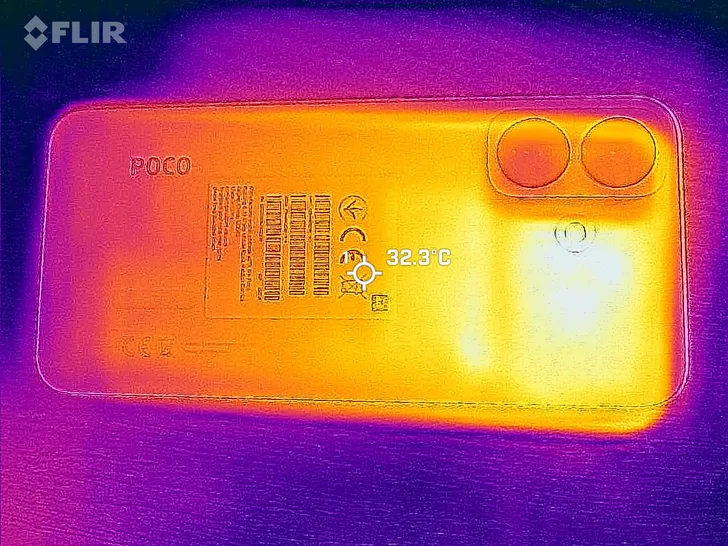
The surface temperatures under sustained load are noticeable but not critical – we measured a peak of just under 42 °C.
On a positive note: The Poco X8 throttles its performance only slightly in the 3DMark stress tests, so the maximum available power can be sustained even over long periods.
|
|||||||||
| Maximum: 41.9 °C = 107 F Average: 39.9 °C = 104 F |
|
|||||||||
| Maximum: 41.2 °C = 106 F Average: 38.8 °C = 102 F |
Power Supply (max.) 42.1 °C = 108 F | Room Temperature 20.8 °C = 69 F | Fluke t3000FC (calibrated), Voltcraft IR-260
(-) The average temperature for the upper side under maximal load is 39.9 °C / 104 F, compared to the average of 33 °C / 91 F for the devices in the class Smartphone.
(±) The maximum temperature on the upper side is 41.9 °C / 107 F, compared to the average of 35.4 °C / 96 F, ranging from 21.9 to 247 °C for the class Smartphone.
(±) The bottom heats up to a maximum of 41.2 °C / 106 F, compared to the average of 34.1 °C / 93 F
(+) In idle usage, the average temperature for the upper side is 24.4 °C / 76 F, compared to the device average of 33 °C / 91 F.
| Nothing Phone (4b) Adreno 810, SD 6 Gen 4, 128 GB UFS 2.2 Flash |
99.8 % 0% |
| Motorola Moto G77 Mali-G57 MP2, Dimensity 6400, 256 GB UFS 2.1 Flash |
99.5 % 0% |
| Xiaomi Poco X8 Adreno 710, SD 6s Gen 4, 256 GB UFS 3.1 Flash |
99.5 % |
| Xiaomi Poco X7 Mali-G615 MP2, Dimensity 7300, 512 GB UFS 2.2 Flash |
99.4 % 0% |
| Xiaomi Redmi Note 17 Pro 5G Adreno 710, SD 6s Gen 4, 256 GB UFS 3.1 Flash |
99.4 % 0% |
| Xiaomi Poco X7 Mali-G615 MP2, Dimensity 7300, 512 GB UFS 2.2 Flash |
99.6 % 0% |
| Xiaomi Poco X8 Adreno 710, SD 6s Gen 4, 256 GB UFS 3.1 Flash |
99.6 % |
| Motorola Moto G77 Mali-G57 MP2, Dimensity 6400, 256 GB UFS 2.1 Flash |
98.7 % -1% |
| Xiaomi Redmi Note 17 Pro 5G Adreno 710, SD 6s Gen 4, 256 GB UFS 3.1 Flash |
92 % -8% |
| Xiaomi Poco X8 Adreno 710, SD 6s Gen 4, 256 GB UFS 3.1 Flash |
99.4 % |
| Nothing Phone (4b) Adreno 810, SD 6 Gen 4, 128 GB UFS 2.2 Flash |
98.7 % -1% |
| Xiaomi Poco X7 Mali-G615 MP2, Dimensity 7300, 512 GB UFS 2.2 Flash |
98.6 % -1% |
Xiaomi Poco X8 Adreno 710, SD 6s Gen 4, 256 GB UFS 3.1 Flash; Wild Life Extreme Stress Test; 1.1.14.3: Ø4.64 (4.63-4.64) %
Xiaomi Poco X7 Mali-G615 MP2, Dimensity 7300, 512 GB UFS 2.2 Flash; Wild Life Extreme Stress Test; 1.1.4.1: Ø5.06 (5.05-5.07) %
Motorola Moto G77 Mali-G57 MP2, Dimensity 6400, 256 GB UFS 2.1 Flash; Wild Life Extreme Stress Test; 1.1.14.3: Ø2.3 (2.28-2.31) %
Xiaomi Redmi Note 17 Pro 5G Adreno 710, SD 6s Gen 4, 256 GB UFS 3.1 Flash; Wild Life Extreme Stress Test; 1.1.14.3: Ø4.6 (4.26-4.64) %
Xiaomi Poco X8 Adreno 710, SD 6s Gen 4, 256 GB UFS 3.1 Flash; Wild Life Stress Test Stability; 0.0.0.0: Ø17.6 (17.6-17.7) %
Xiaomi Poco X7 Mali-G615 MP2, Dimensity 7300, 512 GB UFS 2.2 Flash; Wild Life Stress Test Stability; 0.0.0.0: Ø18.7 (18.7-18.8) %
Nothing Phone (4b) Adreno 810, SD 6 Gen 4, 128 GB UFS 2.2 Flash; Wild Life Stress Test Stability: Ø22.3 (22.2-22.3) %
Motorola Moto G77 Mali-G57 MP2, Dimensity 6400, 256 GB UFS 2.1 Flash; Wild Life Stress Test Stability; 0.0.0.0: Ø8.28 (8.26-8.3) %
Xiaomi Redmi Note 17 Pro 5G Adreno 710, SD 6s Gen 4, 256 GB UFS 3.1 Flash; Wild Life Stress Test Stability; 0.0.0.0: Ø17.5 (17.4-17.5) %
Xiaomi Poco X8 Adreno 710, SD 6s Gen 4, 256 GB UFS 3.1 Flash; Steel Nomad Light Stress Test Stability; 1.0.6.2: Ø2.06 (2.05-2.07) %
Xiaomi Poco X7 Mali-G615 MP2, Dimensity 7300, 512 GB UFS 2.2 Flash; Steel Nomad Light Stress Test Stability; 1.1.1.3: Ø2.56 (2.54-2.57) %
Nothing Phone (4b) Adreno 810, SD 6 Gen 4, 128 GB UFS 2.2 Flash; Steel Nomad Light Stress Test Stability; 1.0.6.2: Ø2.6 (2.58-2.62) %
There is a small speaker on the bottom, which combines with the earpiece to form the Poco X8’s stereo sound system. Music doesn’t really come alive, though, as the sound is too treble-heavy and lacks presence.
External speakers or headphones, which can be connectedly, the Poco X8 only has the older Bluetooth 5.1, so many features from more recent updates are missing, such as Bluetooth LE Audio for hearing aids or Channel Sounding for locating devices
On the other hand, Xiaomi offers a wide selection of Bluetooth codecs, so there is a good chance you can connect your audio device to the phone with good sound quality.
Frequency diagram (checkboxes can be checked and unchecked to compare devices)
Xiaomi Poco X8 audio analysis
(+) | speakers can play relatively loud (85.6 dB)
Bass 100 – 315 Hz
(-) | nearly no bass – on average 32.4% lower than median
(±) | linearity of bass is average (12.8% delta to prev. frequency)
Mids 400 – 2000 Hz
(±) | higher mids – on average 7.4% higher than median
(±) | linearity of mids is average (7.5% delta to prev. frequency)
Highs 2 – 16 kHz
(±) | higher highs – on average 5.9% higher than median
(±) | linearity of highs is average (7.4% delta to prev. frequency)
Overall 100 – 16.000 Hz
(±) | linearity of overall sound is average (27.5% difference to median)
Compared to same class
»72% of all tested devices in this class were better, 5% similar, 23% worse
»The best had a delta of 11%, average was 34%, worst was 136%
Compared to all devices tested
»84% of all tested devices were better, 3% similar, 13% worse
»The best had a delta of 4%, average was 23%, worst was 136%
Motorola Moto G77 audio analysis
The Poco X8 is not particularly energy-efficient, except under very heavy load.
The phone can be charged at up to 67 watts and proved fully compatible with the chargers in our test lab.
| Off / Standby |   0.1 / 0.2 Watt |
| Idle |  1.2 / 1.8 / 2.3 Watt |
| Load | 4.8 / 8.1 Watt |
| Key: min: , med: , max: Metrahit Energy |
| Xiaomi Poco X8 8340 mAh |
Xiaomi Poco X7 5110 mAh |
Nothing Phone (4b) 5200 mAh |
Xiaomi Redmi Note 17 Pro 5G 8340 mAh |
Average Qualcomm Snapdragon 6s Gen 4 |
Average of class Smartphone |
|
|---|---|---|---|---|---|---|
| Idle Minimum * (Watt) | 1.2 | 1.09 9% | 1.01 16% | 1.27 -6% | 1.235 ?(1.2 – 1.27, n=2)-3% | 0.903 ?(0.39 – 1.7, n=136, last 2 years)25% |
| Idle Average * (Watt) | 1.8 | 1.28 29% | 2 -11% | 1.98 -10% | 1.89 ?(1.8 – 1.98, n=2)-5% | 1.479 ?(0.7 – 4.36, n=136, last 2 years)18% |
| Idle Maximum * (Watt) | 2.3 | 1.31 43% | 2.09 9% | 2.3 -0% | 2.3 ?(2.3 – 2.3, n=2)-0% | 1.677 ?(0.75 – 4.46, n=136, last 2 years)27% |
| Load Average * (Watt) | 4.8 | 3.25 32% | 4.62 4% | 4.71 ?(4.62 – 4.8, n=2)2% | 6.66 ?(2.9 – 14.9, n=88, last 2 years)-39% | |
| Load Maximum * (Watt) | 8.1 | 8.62 -6% | 8.73 -8% | 8.42 ?(8.1 – 8.73, n=2)-4% | 10.6 ?(4.75 – 22, n=88, last 2 years)-31% |
Xiaomi Poco X8; Geekbench 5.5 Power Consumption 150cd: Ø4.04 (1.273-8.02) Watt
Xiaomi Poco X8; Idle 150cd/m2: Ø1.857 (1.633-4) Watt
Xiaomi Poco X8; Idle 150cd/m2: Ø1.857 (1.633-4) Watt
Xiaomi Poco X8; 2560×1440 3DMark Steel Nomad Light Unlimited: Ø3.56 (3.24-5.27) Watt
One of the Poco X8’s greatest strengths is its battery life: In the Wi-Fi battery test, the phone achieves an impressive runtime of almost 30 hours – a figure that sets the benchmark in this price range. Some similarly priced phones last only 60% as long.
| WiFi Websurfing | 29h 29min |
| Xiaomi Poco X8 8340 mAh |
Xiaomi Poco X7 5110 mAh |
Nothing Phone (4b) 5200 mAh |
Motorola Moto G77 5200 mAh |
Xiaomi Redmi Note 17 Pro 5G 8340 mAh |
|
|---|---|---|---|---|---|
| WiFi v1.3 (h) | 29.5 | 17.5 -41% | 22 -25% | 20 -32% | 29.2 -1% |
| Reader / Idle (h) | 50 | ||||
| Load (h) | 5.2 |
It’s impressive what Xiaomi offers with the Poco X8 in terms of screen and battery life at a bargain price.
On the other hand, the cutbacks in performance and camera quality are also noticeable.
Xiaomi Poco X8
– 10/16/2026 v8
Florian Schmitt
Chassis
87%
Keyboard
67 / 75 → 89%
Pointing Device
91%
Connectivity
42 / 69 → 61%
Weight
88 / 50-100 → 75%
Battery
96%
Display
89%
Games Performance
12 / 55 → 22%
Application Performance
61 / 85 → 72%
AI Performance
10%
Temperature
89%
Noise
100%
Audio
74 / 90 → 82%
Camera
60%
Average
64%
76%
Smartphone – Weighted Average
CO2 Emissions
No Data
Materials
25%
Packaging
90%
Power Use
95.2%
Repairability
30%
Software Updates
91.7%
Total Sustainability Score: 55.3%
| Image | Model / Review | Price | Weight | Drive | Display |
|---|---|---|---|---|---|
| 1. 75.8%  |
Xiaomi Poco X8 Qualcomm Snapdragon 6s Gen 4 ⎘ Qualcomm Adreno 710 ⎘ 8 GB Memory, 256 GB UFS 3.1 |
List Price: 320€ | 223 g | 256 GB UFS 3.1 Flash | 6.83″ 2772×1280 447 PPI AMOLED |
| 2. 77.7%  |
Xiaomi Poco X7 MediaTek Dimensity 7300 ⎘ ARM Mali-G615 MP2 ⎘ 12 GB Memory, 512 GB UFS 2.2 |
185.5 g | 512 GB UFS 2.2 Flash | 6.67″ 2712×1220 446 PPI AMOLED |
|
| 3. 76.5%  |
Nothing Phone (4b) Qualcomm Snapdragon 6 Gen 4 ⎘ Qualcomm Adreno 810 ⎘ 8 GB Memory, 128 GB UFS 2.2 |
List Price: 329€ | 210 g | 128 GB UFS 2.2 Flash | 6.77″ 2344×1080 381 PPI Super AMOLED |
| 4. 76.7%  |
Motorola Moto G77 Mediatek Dimensity 6400 ⎘ ARM Mali-G57 MP2 ⎘ 8 GB Memory, 256 GB UFS 2.1 |
List Price: 300€ | 182 g | 256 GB UFS 2.1 Flash | 6.78″ 2772×1272 450 PPI AMOLED |
| 5. 76.7%  |
Xiaomi Redmi Note 17 Pro 5G Qualcomm Snapdragon 6s Gen 4 ⎘ Qualcomm Adreno 710 ⎘ 6 GB Memory, 256 GB UFS 3.1 |
List Price: 480€ | 223 g | 256 GB UFS 3.1 Flash | 6.83″ 2772×1280 447 PPI OLED |
Transparency
The selection of devices to be reviewed is made by our editorial team. The test sample was provided to the author as a loan by the manufacturer or retailer for the purpose of this review. The lender had no influence on this review, nor did the manufacturer receive a copy of this review before publication. There was no obligation to publish this review. As an independent media company, Notebookcheck is not subjected to the authority of manufacturers, retailers or publishers.
This is how Notebookcheck is testing
Every year, Notebookcheck independently reviews hundreds of laptops and smartphones using standardized procedures to ensure that all results are comparable. We have continuously developed our test methods for around 20 years and set industry standards in the process. In our test labs, high-quality measuring equipment is utilized by experienced technicians and editors. These tests involve a multi-stage validation process. Our complex rating system is based on hundreds of well-founded measurements and benchmarks, which maintains objectivity. Further information on our test methods can be found here.
> Expert reviews and news on laptops, smartphones and tech innovations > Reviews > Xiaomi Poco X8 smartphone review – Probably the best phone deal of 2026 for battery life and display
Florian Schmitt, 2026-10-17 (Update: 2026-10-17)
