

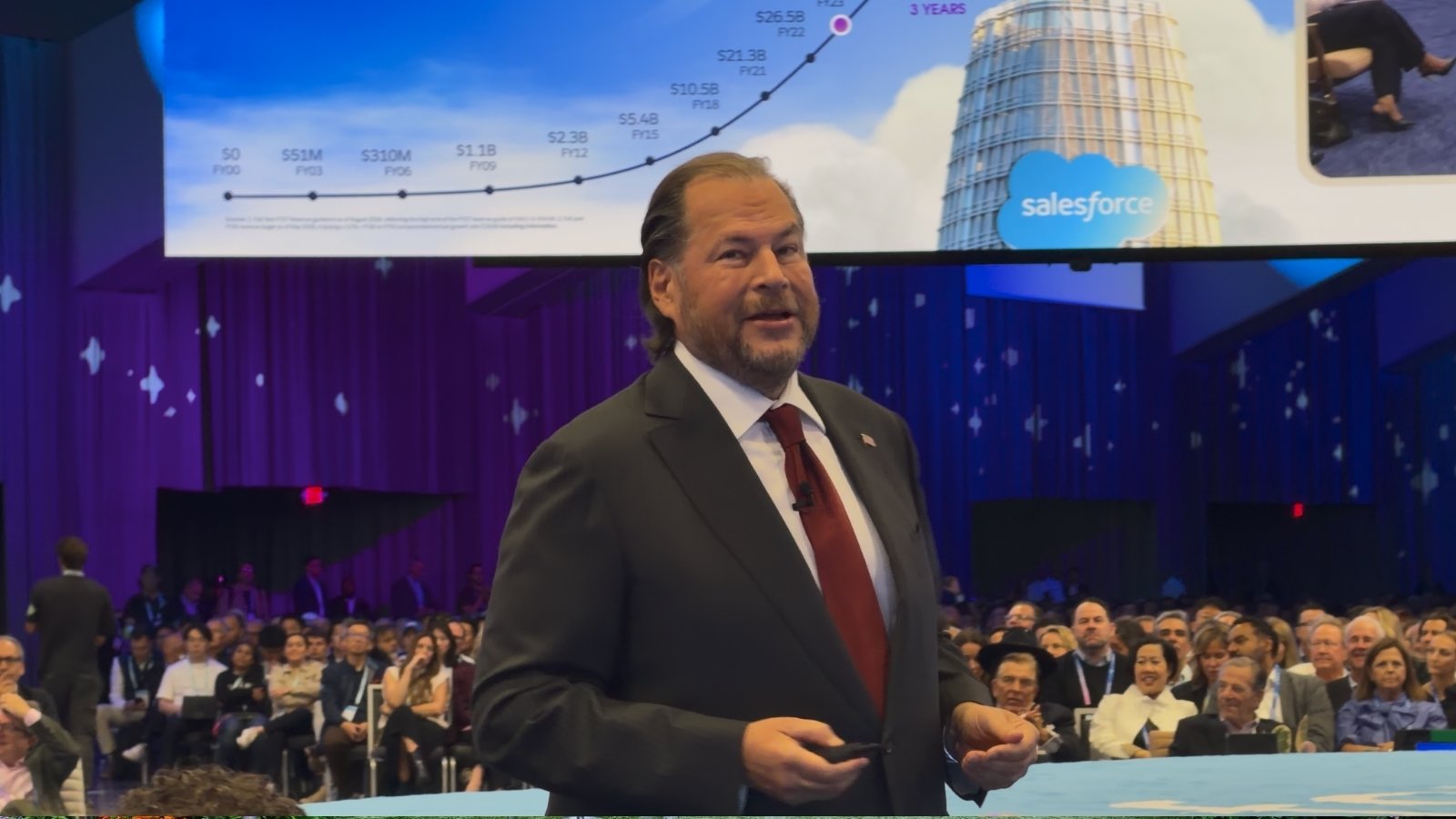
Dreamforce 2026: Salesforce Takes CRM Out of Salesforce
SAN FRANCISCO — Salesforce has arrived at Dreamforce 2026 with an argument that would once have sounded unusual for a CRM company: the future of CRM may involve spending less time inside the CRM itself.
The company wants customer data, business rules and approved actions to be available in the tools where employees increasingly work, including Slack and Claude.
For CX teams, this is more than an interface update. Salesforce is trying to make CRM the governed layer beneath customer operations—whether work is happening in a service application, a Slack channel, an AI assistant or another connected system.
“You may never log in to Salesforce again.”
— Parker Harris, Salesforce co-founder, on the Slackforce vision
That idea was central to Salesforce Chair and CEO Marc Benioff’s opening keynote, where the company presented AIforce as an “interface revolution.” The argument is that the value of CRM is not its screens, but the customer data, permissions, workflows and business rules behind them.
“AIforce is here to Unlock trapped value from anywhere”
— Marc Benioff, CEO, Salesforce
There is an obvious appeal for service organizations. Customer work is often split across CRM records, knowledge bases, order systems, contact-center tools, dashboards and internal chat. Bringing relevant context into the same place where a team is discussing a case could reduce some of that switching.
But it also makes the questions harder. When an employee or AI agent acts from Slack, Claude or another interface, what customer information was used? Which policy applied? What was the agent allowed to do? And can the organization trace and correct the decision if something goes wrong?
At the keynote, Benioff repeatedly contrasted the probabilistic nature of AI models with the deterministic controls required for enterprise work. Salesforce’s position is that AI can help reason through a problem, but customer data, permissions and approved business processes must still determine what happens next.
CRM as an AI Layer
Salesforce is using the term AIforce for a group of agentic experiences designed to bring Salesforce context and actions into AI interfaces, rather than asking users to work solely through conventional CRM pages.
The early components include ClaudeForce, Slackforce and Agentforce Coworker.
ClaudeForce is Salesforce’s integration for Claude Enterprise. Salesforce says it connects Claude to Salesforce data, skills and security controls, allowing employees to ask questions about accounts, deals or customer history and take authorized actions without working through the standard Salesforce interface. The company says it enters open beta at Dreamforce.
Salesforce demonstrated the proposition during the keynote with a digital version of Parker Harris, showing Sales Cloud running in Claude. Patrick Stokes, Salesforce President of Applications and Marketing, said the setup could be completed in six to eight minutes.
Anthropic CEO Dario Amodei joined Benioff on stage and said he was surprised that the technology was moving at such a pace in the business world. He also argued there was still “so much diffusion left to do”—a useful reminder that broad enterprise adoption remains at an early stage.
Slackforce takes the same proposition into Slack. Salesforce has already moved CRM capabilities into the collaboration platform and enabled Slackbot to read from, write to and take action across Salesforce through Model Context Protocol connections. Its latest addition, Slackforce Surfaces, turns a prompt into an interactive interface built around available business data.
A Live View of Service Operations
The most immediate CX example for Slackforce Surfaces is operational. Salesforce suggests a service leader could create a live view of Agentforce Service queues in Slack, highlighting SLA breaches, case severity and customer tier.
Salesforce says Surfaces can use Slack, Salesforce and connected enterprise data to create dashboards, reports and other interactive views. Teams can pin them to a channel, explore them together and ask follow-up questions. Salesforce says the capability is available now for Slackbot-enabled customers on eligible plans, with live-data capability beginning to roll out in October.
“A Surface isn’t an export or a screenshot of what your systems looked like the moment you asked — it’s connected to the
A live operational view could help teams identify and act on a deteriorating queue before a scheduled report catches up. But service leaders will need to know where the data came from, whether it is current and complete, and how customer-data permissions apply when information from several systems is brought into Slack.
Prebuilt Agents for CX Work
Salesforce is pairing this interface strategy with a broader Agentforce portfolio of preconfigured, role-specific agents.
For CX, the key additions are Casey, a customer-service help agent, and Fin, a cross-channel customer agent. Salesforce says Casey supports voice, SMS, WhatsApp and web chat, with prebuilt support for FAQs, returns, account management and human escalation. It is generally available now.
Benioff used the keynote to welcome Fin into Agentforce. Salesforce says Fin is generally available and positioned for complex customer-experience workflows across channels. The company says Fin resolves 79% of the Anthropic conversations it handles autonomously, while Engine’s help agent fully resolves 50% of chat inquiries.
The figures are useful deployment claims, but they are not a complete customer-outcome scorecard. CX teams should look beyond automation rates to repeat contact, abandonment, complaints, customer effort and the quality of escalation.
Koa Targets the Gap Between an Answer and an Action
Salesforce also used Dreamforce to introduce Koa, its first CRM reasoning model, built on NVIDIA Nemotron.
In simple terms, Koa is intended to help Agentforce work through the steps behind a multistage CRM task, such as routing a service case, updating an opportunity or scheduling a follow-up, rather than merely generating a plausible response.
For customer service, that is an important distinction. A useful AI agent needs to interpret the customer’s situation, retrieve relevant context, follow approved rules and use the right tools to complete the next step—or recognize when it needs to hand the work to a person.
Salesforce says Koa matches or exceeds leading models on CRM-specific actions with three times fewer errors in its own benchmark. That is a vendor claim, and the methodology and real-world performance will need closer scrutiny as the product moves beyond pilot deployments.
NVIDIA CEO Jensen Huang told the Dreamforce audience that AI had become “extremely useful,” arguing that every enterprise would become an agentic enterprise. The keynote’s more practical question was how those agents can operate safely when they are connected to real customer data and business processes.
The Context and Control Question
Salesforce’s proposed answer to that challenge is its Trusted Enterprise AI Harness. The architecture brings together context, agency, action, governance, security and models, alongside a new AI Control Plane intended to help businesses manage agents across Salesforce and third-party environments.
For CX, the relevant question is whether an agent can use the right mix of order status, entitlement, policy, interaction history and workflow rules to take an approved action—or bring in a person when it cannot.
“AI reasoning can be open-ended, but enterprise execution often cannot.”
Salesforce also emphasized zero-data-retention protections during the keynote, arguing that customer data should not be retained by models or used to train them. That claim will matter to enterprises assessing where their data travels when Salesforce services connect with external model providers.
Salesforce says many underlying Harness technologies are available today. Its unified experience and additional capabilities are expected to begin rolling out in early fiscal 2028, with pricing and packaging still to be announced.
The next few days will show whether Salesforce can demonstrate these elements working together in real customer journeys—not just as connected product announcements.
This live story will be updated with customer interviews and on-site reporting from Dreamforce.
