


Nathan Wilmers, Maxim Massenkoff, Peter McCrory
Summary
How are businesses across the economy adopting AI? What bottlenecks and challenges have they faced? How can employers reorganize human expertise around increasingly capable models? To understand businesses’ experiences better, we conducted 66 interviews with 58 of Anthropic’s enterprise customers. We found:
- Sources of AI value. Companies are deploying AI across a dizzying range of knowledge work tasks. In particular, they are increasingly using coding agents to bring software capabilities to nontechnical roles. Interviewees report that most uses of AI add value by increasing their output, rather than by cutting costs. They attribute this both to AI accelerating existing work and to its role in introducing novel product and service improvements.
- Impact on employment. Across our interviews, we saw very few examples of domestic layoffs that were driven by AI automation. Although some companies reported hiring more due to AI, most companies reported hiring less due to AI. Many also reported reducing their use of contractors, particularly offshore ones. These reported cuts could be an early warning of job disruption in the international business services industry.
- Bottlenecks. Companies reported a range of bottlenecks, including experts resisting AI deployment and tasks that are not accelerated by AI. As coding speeds up, for example, other tasks—like code review, sales, and strategic decision-making—increasingly need to keep pace.
- Limits to top-down and bottom-up approaches. Many companies approach AI by identifying a workflow to automate and rolling out a top-down solution. This approach can lead to job insecurity, fears of workplace surveillance, and resistance from the experts needed to set up an effective and durable workflow. Companies that distribute AI tools and wait for bottom-up adoption see some valuable AI use but face bottlenecks from unequal adoption and single-task AI implementations.
- Reorganizing for AI. Interviewees described the highest-value uses as involving meaningful reorganization. Some companies are broadening their employees’ roles to ensure individuals can take ownership over whole workflows, and are redeploying employees to the “bottleneck” tasks that AI models cannot do. Some also seek to empower employees by building out infrastructure to support nondeveloper coding and by providing broad-based internal access to business data. These companies are reorganizing to take advantage of ongoing model capability improvements rather than settling on a fixed approach that assumes AI tools will remain as powerful as they are today.
Introduction
The use of LLMs has exploded across the economy. How are human organizations reshaping around these strange new collaborators? Consider an employee at a midsize law firm that we spoke to. For years, the firm’s mailroom had followed the same protocol: a scanner sent PDFs of incoming correspondence to an inbox; a mail clerk opened each PDF, skimmed it, clicked “Save As,” renamed it, and placed it in the firm’s file system. The process took five minutes per letter. One day, a senior developer visited the mailroom to watch the mail being processed. In a month, he built an AI system that eventually became two API calls, which name the document based on its first page and then assign it a place in the firm’s document system. The mail clerks “were blown away.”
An employee at another law firm we interviewed hoped AI would create “a second brain” for the firm. (“For higher-level stuff, it just opens up possibilities.”) But the firm struggled to get everyone to use AI effectively. Demand letters to potential defendants were filled with excessive em dashes and occasional errors. Attorneys building apps kept “running into the wall based on hallucinated menus or buttons that don’t exist.” Others worried about confidentiality and data security, or they just didn’t “have time to get onto this AI train.” A few power users inundated the firm with AI prose, “casually sending Claude-prompted seven-page instructions to the IT team.”
A third law firm we spoke to adopted AI early and achieved strong uptake. One of the firm’s early projects was an AI timekeeping system that saved attorneys work tracking billable hours. IT staff saw parts of their job automated, but they then focused on building secure infrastructure to host apps and manage context that served the rest of the firm. As AI tools spread, the firm realized that associates were no longer needed to write first drafts of certain legal documents. But without writing, “how does an associate know if that’s a good draft or a bad draft?” So it introduced a new workflow where junior lawyers were “required to really take that first [AI-written] draft and work with a senior attorney,” pairing off and marking up and editing the draft together.
These three firms applied the same technology in the same industry but in different ways. The first firm automated a workflow, creating efficiency gains but risking job displacement for the mail clerks. For the second, bottlenecks to adoption and effective implementation prevented job displacement but also blunted productivity gains that would benefit the firm. The third reorganized work without eliminating any jobs, because effective use of the technology required redeploying employees toward new tasks. The firm redesigned roles to maintain human expertise as a complement to increasingly capable AI models.
In this article, we explore the connections between AI-driven value and work reorganization through 66 face-to-face interviews conducted across 58 companies in the US, all of which are in the midst of adopting AI. We interviewed executives, managers, and individual contributors. We talked to employees at AI-native startups and 100-year-old businesses. We interviewed people at manufacturers and tech companies. We spoke with structural engineers, dentists, and accountants; employees at hedge funds, law firms, and private equity firms; a property manager, a trucking company, and a publisher. They’re all Anthropic customers, but many also use other AI tools. They were selected for this study because of their range across industry, size, and AI usage, though they are not a random or systematically representative sample.
As in other qualitative research, we present stories and a framework to organize them, with the expectation that follow-up quantitative research can test these ideas further. The interviews were done anonymously, both for the interviewees and their companies. Any names in the report are pseudonyms.
How are businesses adapting to AI?
In our interviews, we gained insight into how AI has become embedded in businesses across the economy. Some of the AI agents we heard about are sending faxes back and forth, as doctors’ offices refer and intake patients. Other agents are giving advice to technicians when an X-ray machine breaks, and still others are then marking up the X-rays to help patients better understand them. Agents are reading property deeds from the 1800s and working out delivery routes for gaming machines. Recently, an AI agent analyzed a company’s organizational chart and suggested departments where the company could add headcount: “Three heads here, we need to add two there, zero here.”
Mostly, agents are writing code. Interviewees described 100 pieces of software that they wrote with AI in enough detail that we could categorize them. Eighty percent of this software automated previously manual work, like spreadsheet-based financial updates or taking meeting notes. Another 20% replaced existing software, often previously purchased from outside vendors. Agents are building apps for private parking enforcement, 401(k) audits, and trademark checks for new product names. They are making dashboards to track portfolio companies, equipment repairs, and debt collectors’ phone calls.
How have human organizations harnessed these new assistants? We use our interviews to explore several aspects of these deployments. We begin by estimating how much value interviewees ascribe to AI deployments and relate that to a measure of how much organizational change they required to implement. Figure 1 plots nearly 300 AI applications that interviewees discussed in detail. We define an application as a specific AI use case in a specific company. We coded discussions of each application according to the value interviewees attributed to it and the extent to which the organization had to make significant organizational changes to accommodate it. These value assessments are primarily qualitative descriptions on the part of interviewees, not typically based on A/B tests or other quantitative assessments.1
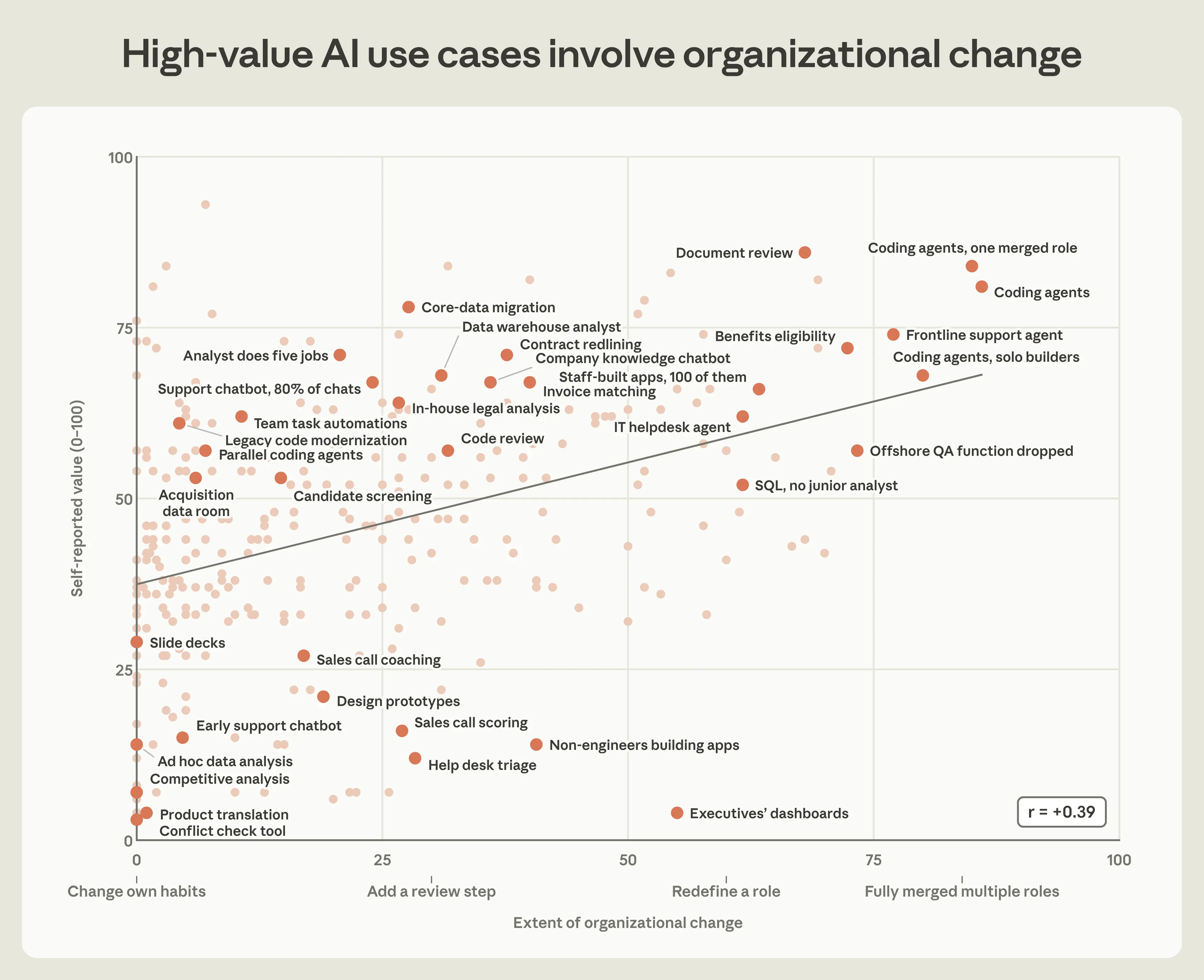
Figure 1 shows that many light-touch AI applications can fit into an existing organizational structure, like ad hoc data analysis or slide deck design. However, many of the simplest applications were rated as relatively low value by the employees who described them. Higher-value deployments tend to require changes to processes, like AI review of every code commit, or roles, like a marketing manager who edits skill.mds containing branding guidelines instead of designing individual documents.
Several interviewees described AI adoption as essentially a challenge of organizational change: flattening organizations, shifting reporting lines, or dropping functions. At one firm, for example, executives decided that junior analysts were no longer necessary because executives could complete their own SQL queries. As one accountant put it, “It’s a combination of process re-engineering and systematic discipline.”
There are several reasons why the most valuable applications led to significant organizational change. In some cases, the AI applications required a structural change in order to be successful, such as when a policy had to be clarified so that AI agents could rigorously apply it in an assessment workflow. In other cases, initial success spurred excitement about making larger organizational changes to further harness AI. In others, the success of using AI forced downstream changes. One commercial real estate company saw its staff start sending out client-facing documents themselves. But this meant they had violated company rules that asked employees to route external materials through the marketing department. As an IT director explained, “That’s good because, hey, we got another client. That’s bad because our standard operating procedures are starting to fall apart.” These stories echo academic research that shows that organizational change is necessary to derive value from transformative technologies.
Next, we studied what, exactly, value means in the context of AI adoption. Figure 2 shows that interviewees described most AI applications as adding value by increasing a firm’s output rather than cutting costs. Around half of the applications that increased output were due to AI accelerating or expanding existing work. The other half were the result of AI improving the quality of products and services or creating new products altogether. For instance, a medical group improved service quality by using AI to give patients an up-front estimate of after-insurance costs. A commercial real estate manager mocked up vacant units for potential tenants with their own branding (“Here’s what your sandwich place would look like in this space”). A dental company introduced an after-hours AI answering service, so patients’ midnight calls no longer went to voicemail.
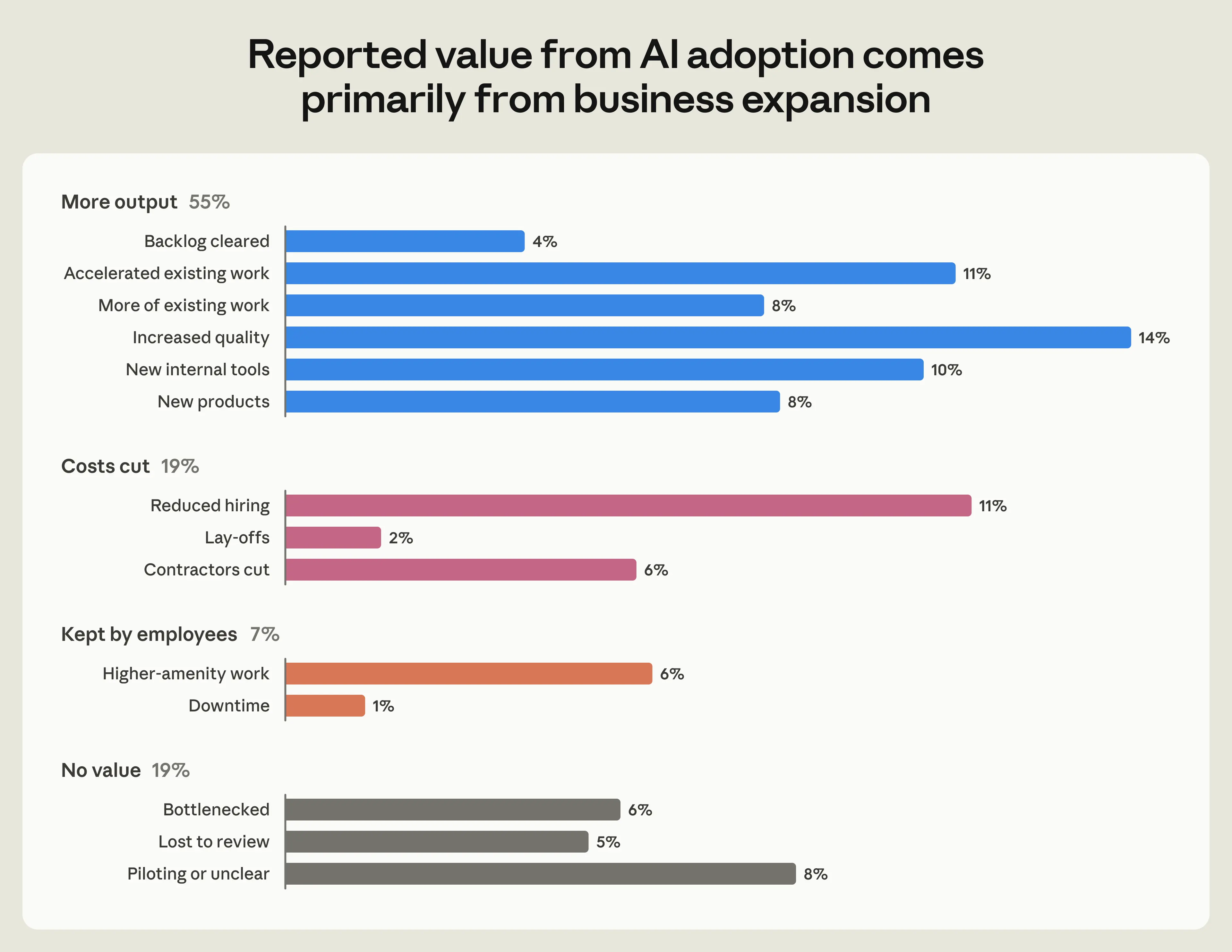
In one-tenth of the use cases laid out in Figure 2, value was captured directly by employees, who were either doing more enjoyable work or were doing less work altogether. One manager described how bringing AI into his construction company meant that “work can be a joy again instead of a difficult, painful thing.” Senior engineers at an engineering consultancy described being thrilled to be free of tedious standards reconciliation work.
This sentiment was particularly common in cases where AI sped up peripheral tasks that were distracting to experts, like making pitch decks for product developers or preparing CRM reports for sales representatives. An employee at one construction materials company said they appreciated a whole series of small, personal automations that were “changing my life because now I do so much less work.” An executive at a food industry company remarked on “the number of people who just have thanked me because they could take a vacation.” (This is consistent with a Danish survey that found that around 10% of employees who save time with AI chatbots say they take more breaks or have more leisure time.) But some managers were less enthused. One frustrated executive described his employees as hiding their AI-enabled successes, saying, “They don’t want you to know, because they want to use those 10 hours a week to go walk their dog.” A private equity manager suspected that, among workers at companies in his portfolio, “some of them are working basically half days.”
Our interviews show substantial variation in the degree and kind of value companies derive from AI. The highest-value applications involve wide-reaching organizational change. These patterns warrant attention to the specifics of AI deployments across these companies. In the following section, we assess three common adoption strategies that we observed in our interviews: top-down automation, bottom-up experimentation, and a broader reorganization around AI.
Top-down automation
Mark racked his brain: had he messed anything up recently? As a paralegal at his law firm, he was rarely called into a partner’s office and even more rarely ended up in an office with two of the firm’s equity partners. They wanted to “talk about his AI use,” a topic that filled him with dread. He had already realized that models’ continued improvement would mean “the beginning of the end for my work.” He worried, “Why would anyone want to employ someone like me?”
Mark’s fears were understandable—and far from unique. This past year, AI has loomed especially large in performance assessments across industries. Some of the most sobering moments in our interviews were when managers described making difficult decisions to terminate employees who wouldn’t adopt AI. One engineering leader described experiencing a “morale hit” after the company terminated a developer who, they said, “just kind of shut down instead of trying to embrace it.” As one person at a financial services firm said of their company’s AI push, “You either get on board or don’t. And this might not be the place for you [if you don’t].” An engineering executive described grappling with the massive performance differences he saw emerging between AI users and AI resisters. Ultimately, he said, “we had a couple people who started off extremely anti-AI, and they moved a little along the spectrum, but not enough, and so we ended up letting them go.” But even heavy AI users were not immune to fears of losing their jobs or falling behind: one operations manager said she woke at 3 a.m., fearing for her career, and asked Claude, “How do I make sure I set myself apart so that AI can’t do everything that I do?”
These cases were rare. Overall, people at five companies described pushing out employees who would not adopt AI, and only two had seen AI automation fully eliminate a position and lead to someone losing their job. (By contrast, 10 companies reported hiring more due to AI, primarily into AI implementation roles and to bolster IT support, and others had grown rapidly for a variety of business reasons.) But layoffs weren’t the only adverse employment effect. People at two-thirds of the companies we spoke to reported reduced hiring due to AI: as one person put it, “We may not be firing, but we’re not hiring.” A third of these hiring declines were due to companies actively shrinking functions through attrition without backfilling the roles. But most were the result of companies forgoing hiring that, in the absence of AI, they would have needed to scale their businesses—a finding consistent with past work suggesting that AI-native startups employ fewer workers. As an engineering leader at a health management company put it, “We’ve added a lot of capacity by buying tokens instead of hiring people.”
Beyond terminations and reduced hiring, nine companies described cutting contracted software developers, customer service representatives, legal counsel, and a range of back-office functions, many of which they had already offshored. These outsourced jobs, which are based on modular tasks (self-contained pieces of work that can be handed off separately), sometimes without high expectations for quality, have been particularly vulnerable to replacement. An executive at a company that worked with an offshore design firm said, “We’ve since fired them because now we can get better quality things faster and cheaper” with AI. A finance company downsized well over 100 offshore data and developer contractors. An operations leader at a software company explained that with AI-driven contract reviews, their “legal bill has just completely disappeared.”
These reductions were often the result of top-down workflow automation. For example, one financial technology company adopted AI customer service agents and cut its offshore customer service contracts. Instead of managing human customer service representatives and fielding escalated calls themselves, customer service managers now review transcripts of conversations with the AI agents and edit the agents’ prompts, knowledge graphs, and general operating procedures. One company built an agent as part of a document review workflow. The agent reads submissions against the company’s approval policies and passes a structured analysis to human reviewers. Deploying the agent led the company to cut the number of reviewers it expected to hire for the coming year by more than 90%.
These agentic automations—in which AI agents are given instructions and then operate largely autonomously—are more advanced than the chatbots that still define many employees’ experiences with AI. AI-native startups take these automated workflows to the extreme, both in the products they offer and in how they organize their own work. One Chief Operating Officer walked us through his one-stop agentic portal for operations, noting that 90% of his operations budget was spent on AI tokens and 10% on headcount. He said of his approach, “Look, don’t hire anybody on the back office. I’m going to automate it.”
One AI startup founder told us bluntly that their company’s pitch was to replace the back-office workers their customers currently employed: “You’re trying to fire your [data] labelers, I guess.” A founder of a marketing startup described how their “marketing factory” had flipped from humans doing 80% of the work and AI doing 20% to the opposite. Another startup founder estimated that their company spent as much on internal AI use as on labor, and that it would need three times as many employees without AI. Overall, the six startups that gave us an estimate said they would need, on average, four times as many employees without AI.
Another top-down deployment involves using AI to monitor employees more closely. Under the Anthropic Usage Policy, employee monitoring and its scope must be disclosed to employees, and the monitoring must be limited to employers’ systems for security, safety, logistics, or compliance purposes. The policy further defines employment decisions, like evaluating an employee’s performance, as high-risk, and requires a human in the loop and disclosure to employees. The workplace monitoring we heard about appeared to be compliant with these restrictions, and did not always involve Claude.
One engineering executive explained, “You want to make your work legible to your manager. But nowadays I think you want to make your work legible to the agents your manager uses.” This executive, and others we spoke to, were ambivalent about the implications of these capabilities, seeing both the benefits of more accurate performance feedback and the risks of workplace surveillance—a “panopticon effect,” as one executive put it. An operations supervisor said he started each day by reviewing an AI report on the throughput and error rate of each member of his 12-person document extraction team: “If somehow there was a lag, then I can question back to them, ‘Okay, what happened this hour?’” Another operations director set up an AI-based assessment process for the firm’s customer service representatives. An agent codes their transcripts according to dozens of performance dimensions, then routes the results to a dashboard monitored by the customer service representatives’ managers.
Top-down deployments like these shift power from employees to executives and owners. But they can also be brittle, because they can quickly become out of date or obsolete. For example, the dozens of performance dimensions that customer service representatives were rated on are scored by a two-year-old model and are not taken seriously by managers. Similarly, a law firm built a series of automations for document management but ended up with a number of low-quality “zombie” apps that were hardly used. One engineering leader described a chatbot their company had built for customer service workers—an early experiment built on an open-source chat interface—as “super basic; just chat and answer.” They said the system was difficult to update and maintain, and that “we haven’t spent any more time or money on it.”
These systems are largely built by outside vendors rather than developed directly by internal users, and are marketed as targeted solutions for a specific industry and function. In interview after interview, companies described how improvements in model capabilities rendered these products outdated. As one employee said of one such system, “It’ll be obsolete in three months.” One executive despaired of the up-front investments needed to build top-down workflows as models rapidly improved: “It’s almost like we’re trying to throw darts at a spinning dart board.”
Similar problems emerge in even the most ambitious automation attempts, those targeting knowledge work that requires deep expertise. Standing up effective workflows in these areas typically requires experts to design the agents’ prompts and evaluate their outputs. But this means experts are effectively being asked to build and maintain the very systems that could replace them. One software engineer, who we’ll call Ellen, described her first encounter with automated coding: “I don’t think that my job is secure… software engineers are going to be obsolete.” Another employee put it even more bluntly: “If I’m open to this, I’m essentially building my own coffin.”
Managers also end up facing understandable resistancefrom employees. Recall the company that used AI to automate an approval workflow. It intended to double the output of expert reviewers and reduce hiring by more than 90%. The human reviewers balked. As one executive put it, “Just because [a reviewer] can now do double the amount of cases, how do you incentivize them to do double the amount of cases?” The company considered offering gift cards to get reviewers to comply. At the time of our interview, the executive noted that while some reviewers were down to two minutes of review per submission, “there’s some that are hanging out in the 10-plus minutes.”
Likewise, recall the senior developer who’d automated one law firm’s mailroom. Fresh off that success, he told us, his COO put him on a more ambitious project: using AI to check for conflicts of interest among the firm’s prospective clients. Under the existing process, conflict staff would run a search, print out any hits, and pass “the buck right onto the attorney.” In under a week, he built a workflow that let attorneys request a check from an AI agent in plain language, which then routed the request through conflict-checking software. But the new workflow left it to the conflict staff to work through each potential conflict—and would often surface the types of complex and difficult conflicts that had previously been passed to the attorneys. Faced with this new work, the staff pushed back, the agent was shelved, and the firm returned to its old process.
Top-down AI deployment is already changing hiring and contracting patterns by automating whole workflows. It is also prompting resistance from experts and raising fears of workplace surveillance. That resistance can result in abandoned or fragile automations.
Bottom-up experimentation
For many companies, the problems of layoffs or the AI panopticon haven’t really arrived. Recall Mark, the paralegal who worried for his job after being called in to meet his bosses. The meeting was not the one he expected. Mark explained to us that at the meeting, the partners noted that his demand letters were better than others’ and asked him how he’d prompted AI so effectively. Mark said he’d felt hesitant about sharing his workflows. He remembered telling them, “That’s my secret sauce. I have my own workflow, my own process, and respectfully—please, do not take this the wrong way—I do not want to share with anyone.”
This pattern, of a few individual contributors thriving with AI, came up in many of our interviews, particularly for companies doing bottom-up deployments. Nontechnical knowledge workers with substantial expertise in a given domain often derived the highest value from such deployments. This is in line with prior research on Claude Code usage, which found that nontechnical experts had the highest task success rates. One accountant described “vibe-coding” an app that audits whether the 401(k) payments employers process actually end up in the investment fund they are intended for. This audit process requires matching payment records across dozens of different systems and providers and previously took accountants 80 hours. “I was able to show that to our team. They were like, ‘Wow, this is super cool,’” the accountant said. “They looked at me and they were like, ‘You built this?’ And I was like, ‘Sort of. I told Claude what I needed to do.’”
In these cases, coding tools clearly empower domain experts. A former airport operations manager told us about building a vehicle tracking app, saying, “I was wielding AI like Excalibur.” Quality assurance supervisors at a chemical plant built an app to monitor filtration rates despite having no coding experience: “They know they’re using Python because [Claude] told them.”
However, even the most dramatic success stories were often limited to changes that could be made from the bottom up. An employee at a manufacturing company explained, “We’re getting just these pockets of really cool stuff that could be great for our organization, but not necessarily a way to enable everyone to use that.” Swapping out a single software tool or building a new personal productivity app can be done by ambitious individual contributors. One investment manager at a real estate firm developed a deal tracker that replaced a third-party product that cost $10,000 per year. Another created a legacy Windows XP app that would have cost $250,000 to replace.
While many of these homegrown software replacements seem like notable upgrades at first, they still require review and ongoing maintenance—which means they can result in relatively small savings overall. How customized (and, therefore, how complex) does a deal tracker really need to be? An operations director at a large law firm considered building out dashboards to monitor their recruitment pipeline, but realized:
That’s small beans. There are plenty of SaaS
out there that can help you make dashboards. What is it—$30 a month, $50 a month, $100 a month, even? So, we can save that money by vibe coding. But the maintenance cost obviously goes up as well, and we have to get our talent manager to start maintaining a vibe-coded dashboard.
[Sound by JBL & Built-in Battery] Yaber T2 Outdoor Projector with WiFi 6 and Bluetooth, Native 1080P Smart Movie Portable Projector for Inside and Outside, Compatible with TV Dongle (Not included)
Uncategorized $259.992 Pack Gutter Mount Bracket Compatible with Eufy Solocam S340/E30, No Drill Installation, Stainless Steel Gutter Mount for Security Camera, Security Camera Holder
Uncategorized $19.992 Pack Gutter Mount Bracket for Eufy Security SoloCam S340/E30/E42 and 4G LTE Cam S33, Stainless Steel Gutter Mount for Solar Security Camera, No-Drill Installation
Uncategorized $19.992 Pack USB C Charger Block 200W 6 Port GaN Super Fast Type C Charger | Foldable PD Charging Station for All iPhone 17 16 /android phone Samsung Galaxy S25/S24/MacBook/ iPad
Uncategorized $34.99- Sale!
2026 3 in 1 Wireless Charging Station for Apple MagSafe Charger, 15W Fast Magnetic Mag-Safe Charger Stand for iPhone 17 16 15 14 13 12 17e Apple Watch AirPods Series, Gifts for Men
Mobile Accessories Original price was: $29.99.$21.55Current price is: $21.55.240W USB C to USB C Cable,PD 3.2 Retractable USB C Cable with Magnetic Slot for Travel,Car,5 Preset Length,Fast Charging for iPhone 17/16/15,iPad,MacBook,Galaxy S25/24,Grey,3.3ft,2pack
Uncategorized $19.88- Sale!
24V 90W AC/DC Adapter Charger for Jackery Explorer E500 E300 550 500 300 290 240 160 Portable Power Station Anker 521 535 Bluetii AC60 AC180 Solar Generator Power Supply Cord Charging Cable
Uncategorized Original price was: $19.99.$17.99Current price is: $17.99.2TB SANDISK Extreme PRO Portable SSD with USB4, Up to 3800 MB/s Read and 3700MB/s Write, USB-C, USB 3.2, Backwards Compatible, IP65 Water and Dust Resistance – SDSSDE82-2T00-G25
Computer Accessories $12.99- Sale!
3 in 1 MagSafe Wireless Charger Stand for iPhone Apple Watch AirPods | Adjustable Blue Ambient Light,15W Magnetic Charging Station for iPhone 17 16 15 14 13 12 Series Wireless Charging Station
Mobile Accessories Original price was: $27.99.$19.99Current price is: $19.99.3-in-1 Charging Station for Apple Device, Qi2 25W Certified Magnetic Wireless Foldable Fast Charger Stand Compatible with MagSafe for iPhone 17e/17/16/15/14/13/12/Air Series, Apple Watch & AirPods
Mobile Accessories $49.59- Sale!
5-in-1 Magnetic Wireless Charging Stand for Apple MagSafe Charger | Travel Charger Nightstand Charging Station with Night Light for iPhone 17/16/15/14/13/12, Watch, AirPods (Adapter Included)
Mobile Accessories Original price was: $31.99.$25.99Current price is: $25.99.AI Smart Glasses with Camera 8MP, 4K Video, HD Camera Glasses for Men Women, Bluetooth Smart Sunglasses for Outdoor Sport, UV Protection, Stabilization, Voice Assistant, Long Battery Life, Waterproof
AI Devices $109.99- Sale!
AI Smart Glasses with Camera and Audio, 4K HD Video Recording Glasses, 8MP Camera Glasses for Men Women, AI Voice, Real-Time Translation, Photochromic Lenses, IP65 Waterproof for Travel & Meetings
AI Devices Original price was: $79.48.$75.48Current price is: $75.48.- Sale!
Ai Smart Glasses with Camera and Bluetooth – 8MP HD Video Recording, Real-Time Translation, with Color-Changing Lenses for Travel, Sports, Outdoor Use
AI Devices Original price was: $69.91.$66.11Current price is: $66.11.- Sale!
AI Smart Glasses with Camera, 4K HD Video & Photo Capture, Real-Time Translation, Recording Glasses with AI Assistant, Open-Ear Audio, Object Recognition, Bluetooth, for Travel (Transparent Lens)
AI Devices Original price was: $99.99.$69.99Current price is: $69.99.- Sale!
AI Smart Glasses with Camera, 8MP HD Bluetooth Camera Glasses for Women Men | 1080P Video Recording Sunglasses, Real Time Translation, Voice Assistant, Open Earbuds, Travel, Work, Vlog
AI Devices Original price was: $99.99.$59.98Current price is: $59.98.- Sale!
AI Smart Glasses with Camera, 8MP HD Video, Real-Time Translation | Photo Capture,Object Recognition,80min Video Time,Open-Ear Music, Bluetooth Calls, AI Assistant
AI Devices Original price was: $59.99.$49.99Current price is: $49.99.AI Smart Glasses with Camera,8MP Camera Glasses,1080P Anti-Shake Video Recording Glasses, Real Time Translation,AI Voice Assistant,Object Recognition,Bluetooth Sunglasses for Men Women (Photochromic)
AI Devices $79.99AI Smart Glasses, Bluetooth Glasses with 164 Translation, Anti-Blue Light Glasses for Men Women, 7 Day Ultra-Long Standby, UV Protection, Waterproof, Wireless Music & Calls, Voice Control
AI Devices $69.99- Sale!
AI Voice Recorder, Free Lifetime Transcribe & Summarize, AI Note Taking Device with Case, Audio Recorder for Meetings & Calls, Lectures, Support 120 Languages (Silver)
AI Devices Original price was: $99.00.$89.00Current price is: $89.00.AI Voice Recorder,NoteCard Voice Recorder,No Subscription,App Control | Real Time Transcribe & Summarize, Multi-Language, Deep AI Analysis for Meetings/Class/Lectures (Deep Gray)
AI Devices $69.99- Sale!
Amazon Basics 24W Dual Port USB-A Wall Charger, Fast Portable (12W, 2.4A per port), Multiple Device Compatible for Phones (iPhone 16/15/14/13/12/11/X, Samsung, and more), non-PPS, White
Uncategorized Original price was: $14.99.$13.21Current price is: $13.21.Amazon Basics 24W Two-Port USB-A Wall Charger for Multiple Devices, Space-Saving Design, 12W 2.4A per Port, for iPhone 16/15/14/13/12/11/X, Samsung, and More, Black
Uncategorized $13.01- Sale!
Anker 3-in-1 Cube MagSafe Compatible 15W Foldable Charging Station | Wireless Charger, Compact Desktop Stand for iPhone 17 / 16 Series, Apple Watch, and AirPods (Adapter Included, Non-Battery)
Mobile Accessories Original price was: $129.99.$89.99Current price is: $89.99.Anker 310 USB C to Lightning Cable, MFi-Certified Cord(2-Pack, 6 ft, Black) | For iPhone 14 Series and More (Charger Not Included)
Mobile Accessories $21.99Anker Charger, 65W 3-Port Fast Compact Foldable USB C Charger Block for MacBook Pro/Air, iPad Pro, Galaxy S20, Dell XPS 13, Note 20/10+, iPhone 17 Series, Steam Deck, and More | Type C Charger Fast Charging for MacBook Pro/Air, iPad Pro, Galaxy S20, Dell XPS 13, Note 20/10+, iPhone 17 Series, and More
Mobile Accessories $29.99Anker USB A to Lightning Cable, MFi-Certified (1-Pack, 3.3 ft, Blue) | Double-Braided Nylon Cord, for iPhone 14 / 13 / 12 / 11 Pro / 11 / XS Max / XR / 8 / 7 / 6s Plus, and More
Uncategorized $16.99Anti-Theft Video Doorbell Mount for Eufy Doorbell E340/Wyze Duo Cam Doorbell, No-Drill Adjustable Mounting Bracket for Eufy E340, Apartment Door Camera Mount for Wyze Doorbell for Home Rentals Room
Uncategorized $16.99- Sale!
Anti-Theft Video Doorbell Mount for Eufy E340 Camera, Fully Metal Mounting Bracket, Anti-Blocks Motion Sensor, No Drilling Adjustable Accessories Mount for Houses/Apartments/Rentals-1 Pack
Uncategorized Original price was: $17.99.$14.89Current price is: $14.89.- Sale!
Apple AirPods (3rd Generation) (Renewed)
Mobile Accessories Original price was: $89.97.$82.00Current price is: $82.00.- Sale!
Apple AirPods 2 with Charging Case – White (Renewed)
Mobile Accessories Original price was: $83.50.$70.19Current price is: $70.19.- Sale!
Apple AirPods Pro (2nd generation) with MagSafe Charging Case (USB-C) (Renewed)
Mobile Accessories Original price was: $158.99.$137.00Current price is: $137.00.- Sale!
Arlo Pro Security Camera 2K HDR – Wireless Outdoor Camera, Rechargeable Removeable Battery, Event Captions, Emergency Response, 1-Month Trial of Secure Plan, 1 Cam, White
Uncategorized Original price was: $99.95.$79.99Current price is: $79.99.Armor Smart Safety Glasses, TR90 Frame, Light Adaptive Lenses, Open Ear Speakers & Microphone – ANSI Z87.1
AI Devices $149.00- Sale!
Baseus Inspire XC1 Open Ear Clip-On Earbuds, Sound by Bose, Dolby Audio, Adaptive Tunning Sound, Hybrid 2-Way Driver, Zero-Sense Air Cushion, 4-Mic Adaptive Clear Calls, IP66 Waterproof, 40H Playtime
Mobile Accessories Original price was: $129.99.$109.99Current price is: $109.99.- Sale!
Baseus USB C Cable, 100W PD 5A QC 4.0 Fast Charging USB C to USB C Cable, Zinc Alloy Nylon Braided Type C Data Cable for Samsung S21 S20+ S10 Note 10 iPad Pro MacBook Pro Google Pixel and More (2M)
Uncategorized Original price was: $11.99.$11.39Current price is: $11.39.- Sale!
Beats Flex Wireless Earbuds – Apple W1 Headphone Chip, Magnetic Earphones, Class 1 Bluetooth, 12 Hours of Listening Time, Built-in Microphone – Smoke Gray
Mobile Accessories Original price was: $69.95.$42.65Current price is: $42.65.- Sale!
Beats Studio Buds – True Wireless Noise Cancelling Earbuds – Compatible with Apple & Android, Built-in Microphone, IPX4 Rating, Sweat Resistant Earphones, Class 1 Bluetooth Headphones – White
Mobile Accessories Original price was: $149.95.$109.12Current price is: $109.12.BoxWave Adapter Compatible with Rabbit R1 – MagnetoSnap PD Angle Adapter, Magnetic Charging Connector Device Saver – Metallic Silver
AI Devices $16.95BoxWave Adapter Compatible with Rabbit R1 – Micro SD Card miniReader, USB Type-C OTG Reader USB3.0 Adapter Keychain – Metallic Silver
AI Devices $15.95BoxWave Adapter Compatible with Rabbit R1 – USB-A to C PortChanger (5-Pack), Type-C OTG Convert Charging Data Adapter – Metallic Silver
AI Devices $14.95BoxWave Cable Compatible with Rabbit R1 – AllCharge 3-in-1 Cable – Jet Black
AI Devices $24.95BoxWave Cable Compatible with Rabbit R1 – PowerDisplay PD Cable (6ft) – USB-C to USB-C (100W), LED Wattage Info Extra Long Braided Nylon – Jet Black
AI Devices $22.95BoxWave Cable Compatible with Rabbit R1 – USB Expansion Adapter, Add USB Connected Hardware to Your Phone
AI Devices $8.95BoxWave Cable Compatible with Rabbit R1 – USB-C to A PortChanger (2-Pack), USB Type-C OTG USB Portable Keychain – Slate Black
AI Devices $12.95BoxWave Screen Protector Compatible with Rabbit R1 – ClearTouch Anti-Glare Privacy (2-Pack), Privacy Screen Protector Flexible Film Anti-Glare
AI Devices $22.95BoxWave Screen Protector Compatible with Rabbit R1 – ClearTouch Anti-Glare ToughShield 9H (2-Pack), Anti-Glare 9H Tough Flexible Film Screen Protector
AI Devices $18.95BoxWave Screen Protector Compatible with Rabbit R1 – ClearTouch Crystal (2-Pack), HD Film Skin – Shields from Scratches
AI Devices $12.95BoxWave Screen Protector Compatible With Rabbit R1 – ClearTouch Crystal Anti-UV EyeCare (2-Pack), Filters out Harmful Blue Light Reduce Fatigue
AI Devices $18.95BoxWave Screen Protector Compatible with Rabbit R1 – ClearTouch ImpactShield (2-Pack), Impenetrable Screen Protector Flexible Film
AI Devices $20.95BoxWave Smart Gadget Compatible with Rabbit R1 – AllReader SD Card Reader, microSD Card Reader SD Compact USB – Jet Black
AI Devices $18.95BoxWave Stylus Pen Compatible with Rabbit R1 – AccuPoint Active Stylus, Electronic Stylus with Ultra Fine Tip – Metallic Silver
AI Devices $30.95BoxWave Stylus Pen Compatible with Rabbit R1 – DualTip Capacitive Stylus, Fiber Tip Disc Tip Capacitive Stylus Pen – Metallic Silver
AI Devices $16.95BoxWave Stylus Pen Compatible with Rabbit R1 – EverTouch Meritus Capacitive Styra, Capacitive Stylus with Rollerball Pen – Jet Black
AI Devices $19.95BoxWave Stylus Pen Compatible with Rabbit R1 – FineTouch Capacitive Stylus, Super Precise Stylus Pen – Jet Black
AI Devices $14.95BoxWave Stylus Pen Compatible with Rabbit R1 – FineTouch Capacitive Stylus, Super Precise Stylus Pen – Lunar Blue
AI Devices $14.95BoxWave Stylus Pouch Compatible with Rabbit R1 – Stylus PortaPouch, Pen Stylii Holder Carrier Portable Self-Adhesive – Jet Black
AI Devices $7.95CASEMATIX Carry Case Compatible with Humane Ai Pin Wearable Computer Artificial Intelligence Device and Battery Booster – Includes Travel Case Only with Carabiner
AI Devices $12.99- Sale!
co2CREA Hard Case for Anker 25,000mAh Laptop 25K 165W Power Bank, Black | Compatible with Zolo A1695, Mesh Accessory Pocket, Comfortable Wrist Strap, Cable Organization
Mobile Accessories Original price was: $19.99.$18.99Current price is: $18.99.- Sale!
Comulytic Note Pro AI Voice Recorder, AI Meeting Recorder and Note Taker | Digital Voice Recorder, App Control Digital Video Recorder, Support 113 Languages & Ultra-Slim for Meetings, Calls, Lectures
AI Devices Original price was: $159.99.$119.99Current price is: $119.99.- Sale!
Comulytic Note Pro AI Voice Recorder, AI Taking Device and Meeting Recorder | Unlimited Transcribe & Summarize, AI Voice Recorder with Noise Reduction, Supports 113 Languages, Ultra-Slim Case Included
AI Devices Original price was: $128.98.$116.08Current price is: $116.08.- Sale!
Corsair K100 AIR Wireless RGB Mechanical Gaming Keyboard – Ultra-Thin, Sub-1ms Slipstream, Low-Latency Bluetooth, Cherry MX Ultra Low Profile Keyswitches – NA Layout, QWERTY – Black
Computer Accessories Original price was: $329.99.$192.38Current price is: $192.38.Corsair K60 RGB TKL RGB Tenkeyless Optical-Mechanical Wired Gaming Keyboard – OPX Switches – Polycarbonate Keycaps – iCUE Compatible – QWERTY NA Layout – Black
Computer Accessories $74.99- Sale!
Corsair Vanguard 96 Wired Mechanical Gaming Keyboard – 96% Layout, MLX Quantum Switches, 8000Hz Polling, LCD Display, Virtual Stream Deck, G-Keys, SOCD Flashtap, QWERTY US – Dual Tone (Renewed)
Computer Accessories Original price was: $95.50.$89.99Current price is: $89.99.- Sale!
Corsair Vanguard PRO 96 Wired Gaming Keyboard, QWERTY US (Renewed) | 96% Layout, Hall Effect Magnetic Mechanical, MGX Hyperdrive Switches, 8000Hz Polling, Rapid Trigger, Virtual Stream Deck
Computer Accessories Original price was: $179.99.$118.60Current price is: $118.60.- Sale!
Crucial BX500 240GB 3D NAND SATA 2.5-Inch Internal SSD, up to 540MB/s – CT240BX500SSD1, Solid State Drive | Computer boot and storage upgrade with 540MB/s read speed, 240GB capacity and 2.5-inch SATA interface
Computer Accessories Original price was: $76.94.$68.00Current price is: $68.00.Crucial P310 1TB M.2 2230 SSD, PCIe Gen4 NVMe, Up to 7,100MB/s, Internal Solid State Drive, Ideal for Steam Deck, ASUS ROG Ally, MSI Claw, Mini PCs & Ultrabooks – CT1000P310SSD2 | High speed gaming storage with 7100 MB/s read speed and 1TB capacity
Computer Accessories $229.99- Sale!
Crucial P310 1TB SSD, PCIe Gen4 NVMe M.2 2280, Up to 7,100MB/s, for Laptop, Desktop (PC), & Handheld Gaming Consoles, Includes Acronis Data Recovery Software, Solid State Drive – CT1000P310SSD801
Computer Accessories Original price was: $339.99.$179.99Current price is: $179.99.Crucial P310 4TB SSD, PCIe Gen4 NVMe M.2 2280, Up to 7,100MB/s, for Laptop, Desktop (PC), & Handheld Gaming Consoles, Includes Acronis Data Recovery Software, Solid State Drive – CT4000P310SSD801
Computer Accessories $539.50Crucial P510 PCIe Gen5 NVMe 2TB SSD, Up to 10,000MB/s, TLC NAND, Laptop & Desktop (PC) Compatible, for Gamers & Creatives, Solid State Drive – CT2000P510SSD8-01
Computer Accessories $369.00Crucial T500 PCIe Gen4 NVMe 2TB SSD, Up to 7,400MB/s, TLC NAND, Laptop & Desktop (PC) Compatible, for Creatives and Gamers, Solid State Drive, Includes 1Mo Adobe CC – CT2000T500SSD8 | PCIe Gen4 NVMe M.2 SSD with 4TB capacity and cloning software for gaming, content creation and multitasking
Computer Accessories $369.90Crucial X10 1TB Portable SSD, Up to 2,100MB/s, USB 3.2 USB-C, External Solid State Drive, Compatible with Windows, Mac & Android, Durable Storage for Games, Photos & Files, Blue – CT1000X10SSD9-02
Computer Accessories $211.99Crucial X10 8TB Portable SSD, Up to 2,100MB/s, USB 3.2 USB-C, External Solid State Drive, Compatible with Windows, Mac & Android, Durable Storage for Games, Photos & Files, Blue – CT8000X10SSD9-02
Computer Accessories $845.99Crucial X9 1TB Portable SSD, Up to 1050MB/s, USB 3.2 USB-C, External Solid State Drive, Compatible with Windows, Mac, & Android, Reliable Storage for Games, Files, & Backups, Black – CT1000X9SSD902
Computer Accessories $199.99Didalo 2 Pack Gutter Mount Compatible with eufyCam 2C/2C Pro, 2/2 Pro, 3C/S300, 3/S330,SoloCam S220/C210, 360°Rotation Security Bracket with 1/4 Screw Thread(Camera Not Included)
Uncategorized $13.99Digital Voice Recorder
AI Devices $49.88DJI Mini 4K, Drone With 4K UHD Camera, Under 249 g | 3-Axis Gimbal, 10km Video Transmission, Auto Return, Wind Resistance, 31-Min Flight Time, Intelligent Flight
Uncategorized $299.00- Sale!
Drone with Camera for Adults, 2K HD FPV Drones with Upgrade Altitude Hold, One-Key Take Off/Landing, Speed Adjustment, Headless Mode, 2 Batteries, Toys Gifts for Teen Boys Girls, Beginner
Uncategorized Original price was: $66.99.$39.98Current price is: $39.98.Ethernet Coax Wall Plate – Cat6 F Type Wall Plate, 1 Port Cat6 Keystone and 1 Port F Type Connector Coax Keystone – White
Uncategorized $7.99- Sale!
Eufy Doorbell Camera Mount, Anti-Theft Doorbell Kit for Eufy E340 Doorbell | No-Drill Eufy Doorbell Mount, Hidden Screws & Lock Baffle Design, No Obstruction to Dual-Light System, for Rental House
Uncategorized Original price was: $17.99.$13.99Current price is: $13.99.EXW Wireless Charging Station for Magsafe Charger,Charging Station for Multiple Devices,Wireless Charger for iPhone 17 Air 16 15 14 13 12,Apple Watch,AirPods with LED(Black)
Mobile Accessories $29.99FNIRSI HS-02A 100W Portable Corded Soldering Iron Kit, 3S Fast Heating | 212-842℉, Pre-set 3 Groups Temps, Auto Sleep, 6 F245 Soldering Tips, Smart Digital Soldering Pen Tool for Electronics Repair
Uncategorized $89.99for Apple Mag-Safe Charger 2 Pack, Magnetic Wireless Charger, Silver | Made for iPhone 17/17 Pro/17 Pro Max/Air/16 15 14 13 12 Pro Max Plus mini, Charging Pad for Airpods Pro 3 2,Strong Magnet
Mobile Accessories $13.99GIGASTONE 128GB Micro SD Card 2-Pack, A1 V30 4K Video Recording, Compatible with Security Camera, Dash cam, Drone, 95MB/s MicroSDXC Memory Card UHS-I Class 10, with 2 SD Adapter
Uncategorized $64.98- Sale!
Ground Stake Mount for eufy Solocam S340/E30/S330,Reolink Argus PT 3MP/4MP/5MP,AOSU SE/Lite/Max,ANSQUE(GU01/SA01),SEHMUA,TP-Link Tapo Outdoor Pan/Tilt Wi-Fi,Cinnado B6 Security Cameras (Black)
Uncategorized Original price was: $38.99.$35.09Current price is: $35.09.- Sale!
Gutter Mount Bracket Compatible with Eufy Security SoloCam S340/SoloCam E30/E42,Solar Security Camera(1pack-White)
Uncategorized Original price was: $16.99.$15.29Current price is: $15.29.Hard Case for DJI Mini 4K Drone: Waterproof Travel Box for DJI Mini 2/SE | for DJI Mini 4k/Mini 2 /2 SE Fly Combo, With Custom Foam, Large for Drone, Battery, Charger, Cable Accessories (Case Only)
Uncategorized $29.99Hard EVA Carrying Case for Rabbit R1, Compact Design with Strap, Mesh Bag,Hard EVA Material, Anti-Shock, Crush Resistant, Compact Grey
AI Devices $7.99Hard Storage Case Fits for Anker PowerConf S330 USB Speakerphone/for EMEET Conference Speakerphone M0 Plus, Conference Microphone for Home Office, Case Only
Uncategorized $14.99- Sale!
Humane AI Pin Revolution: Shaping the Future of Healthcare
AI Devices Original price was: $17.99.$9.99Current price is: $9.99.Hybrid Active Noise Cancelling Wireless Ear Buds 80 Hrs Playtime Hi-Res Stereo Quality Bluetooth Earbuds with Transparency Mode Headphones Bluetooth Earhooks ANC Earphones for Work Sports Travel
Mobile Accessories $99.99- Sale!
HyperX Cloud Alpha – Gaming Headset, Dual Chamber Drivers, Legendary Comfort, Aluminum Frame, Detachable Microphone, Works on PC, PS4, PS5, Xbox One, Xbox Series X|S, Nintendo Switch and Mobile – Red | Dual Chamber Drivers, Legendary Comfort, Aluminum Frame, Detachable Microphone, Works on PC, PS4
Computer Accessories Original price was: $99.99.$64.50Current price is: $64.50.INIU Mini USB C Charger, 30W GaN Fast Charging ETL Certified Wall Adapter Block with Smart Phone Protection, Dual Port with 5ft Type C Cable for iPhone 17 iPad Samsung Google Switch etc [1-Pack Black]
Uncategorized $10.99IPG For Rabbit R1 AI Device Screen Protector (2 Units) Hydrogel Invisible Screen Guard – HD Quality/Self-Healing/Bubble -Free for ActiveBuds for R1
AI Devices $15.95- Sale!
JSAUX Charger for iPhone 17 Magsafe Wireless Charging, Compatible with iPhone 17 Air Pro Max/16/15/14/13/12 Series, Magnetic Mag Safe Charging Pad, Aluminum Alloy, USB & USB C Dual Ports – Blue
Mobile Accessories Original price was: $15.99.$11.37Current price is: $11.37.- Sale!
Kasa Matter Smart Dimmer Switch: Voice Control w/Siri, Alexa & Google Assistant | UL Certified | Timer & Schedule | Easy Guided Install | Neutral Wire Required | Single Pole | 2.4GHz Wi-Fi | KS225
Uncategorized Original price was: $24.99.$18.99Current price is: $18.99.- Sale!
Kasa Matter Smart Outdoor Plug, Dual Outlet, EP40M, No Hub Required | IP64 Weather Resistance, Works with Apple HomeKit, Amazon Alexa, Google Home, SmartThings, ETL Certified, 2.4GHz Wi-Fi Only
Uncategorized Original price was: $26.99.$21.99Current price is: $21.99.Kasa Smart Kasa Apple HomeKit Smart Light Switch KS200P3, Single Pole, Neutral Wire Required, 2.4GHz Wi-Fi Light Switch Works with Siri, Alexa & Google Home,UL Certified, No Hub Required,White, 3-Pack
Uncategorized $25.26- Sale!
Kasa Smart LED Light Strip, 16.4ft WiFi LED Strip Works with Alexa, Google Home, SmartThings, High Brightness with 16 Million Colors, RGB, Grouping, Adjustable Length, Up to 25,000 Hours (KL400L5)
Uncategorized Original price was: $24.99.$18.00Current price is: $18.00.Kasa Smart LED Light Strip, RGB, 32.8ft(2 Rolls of 16.4ft.) Wi-Fi LED Strip Works w/ Alexa & Google Assistant,High Brightness, Trimmable, Up to 25,000 Hours,2Yr Warranty (KL400L10),Multicolor
Uncategorized $35.99- Sale!
Kasa Smart Light Bulbs, Full Color Changing Dimmable Smart WiFi Bulbs Compatible with Alexa and Google Home, A19, 60 W 800 Lumens,2.4Ghz only, No Hub Required, 2-Pack (KL125P2), Multicolor
Uncategorized Original price was: $19.99.$14.99Current price is: $14.99.- Sale!
Kasa Smart Plug Mini 15A, Apple HomeKit Supported, Smart Outlet Works with Siri, Alexa & Google Home, UL Certified, App Control, Scheduling, Timer, 2.4G WiFi Only, 2 Count (Pack of 1) (EP25P2), White
Uncategorized Original price was: $24.99.$17.99Current price is: $17.99.Kasa Smart Plug Ultra Mini 15A, Smart Home Wi-Fi Outlet Works with Alexa, Google Home, No Hub Required, UL Certified, 2.4G WiFi Only, 2 Count (Pack of 1)(EP10P2) , White
Uncategorized $12.99khanka Case for Anker 20000mAh 87W Portable Charger Power Bank,Black | EVA Hard Shell, Hand Strap Portability,Hard Travel Bag Fits for Anker 20K 87W Battery Charger(A1383),Case Only
Mobile Accessories $18.99khanka Case for Anker Prime 26250mAh 300W Max Power Bank with Base Black | Fits for Anker Prime Power Bank and Charging Base,Accessory Storage Pocket, Travel-Ready Portable Storage,Case Only
Mobile Accessories $31.99khanka for Anker Prime Power Bank, 26,250Mah 300W Case,Black | Hard Travel Bag for Anker Prime Power Bank 26K A110A Portable Charger,Travel-Ready Portable Storage, Protective Case Only
Mobile Accessories $20.99khanka Hard Travel Case for Anker Nano Power Bank 10,000mAh 45W,Green | Protective Storage Bag for Anker Nano 10K 45W Portable Charger,Travel-Ready Portable Storage,Case Only
Mobile Accessories $16.99- Sale!
Kingston NV3 1TB M.2 2280 NVMe SSD | PCIe 4.0 Gen 4×4 | Up to 6000 MB/s | SNV3S/1000G | Gen 4×4 NVMe SSD with 6,000MB/s read speeds and 4TB capacity for laptops, consoles and PCs
Computer Accessories Original price was: $215.99.$162.00Current price is: $162.00.KU XIU Qi2.2 25W Magnetic Wireless Charger, Foldable 3 in 1 Travel Charging Station for iPhone 17/16/15/14/13/12, 5W for Apple Watch & AirPods, Aluminum Alloy Design, 45W GaN Adapter Included, Orange
Mobile Accessories $78.99Lebakort Hard Carry Case Compatible with Logitech MX Keys Mini Minimalist Illuminated Keyboard (Graphite Case)
Computer Accessories $22.99- Sale!
Logitech G Astro A50 Multi-Platform Wireless Gaming Headset – Black | For PS5, Xbox, PC, Switch – PLAYSYNC Audio Switcher,
Computer Accessories Original price was: $299.99.$259.99Current price is: $259.99.Logitech MX Anywhere 3S (for Business) Compact Wireless Mouse
Computer Accessories $129.90- Sale!
Logitech MX Creative Console 9 Customizable Keys – Graphite | Control Dial, for graphic design, Zoom and Spotify, includes 3-Month Adobe Cloud Membership, Stream Deck Accessories
Computer Accessories Original price was: $199.99.$184.50Current price is: $184.50.- Sale!
Logitech MX Creative Console 9 Customizable Keys – Pale Grey | Stream Deck accessories, graphic design, Adobe, Zoom, Spotify, 3-month Adobe Creative Cloud membership
Computer Accessories Original price was: $199.99.$185.99Current price is: $185.99.Logitech MX Keys Mini Minimalist Wireless Illuminated Keyboard – Graphite | Minimalist, compact, Bluetooth, USB-C, metal build, compatible with Apple macOS, iOS, Windows, Linux, Android
Computer Accessories $98.95Logitech MX Keys S Mac Wireless Keyboard Fluid Precise – Space Grey | Fluid, precise laptop-like typing, programmable keys, USB-C rechargeable, for MacBook Pro, MacBook Air, iMac, iPad
Computer Accessories $22.99- Sale!
Logitech MX Mechanical Wireless Illuminated Performance Keyboard Clicky | Illuminated performance, backlit keys, Bluetooth, USB-C, macOS, Windows, Linux, iOS, Android
Computer Accessories Original price was: $179.99.$159.00Current price is: $159.00.- Sale!
Magnetic Mount Compatible with eufy Security Solocam S340/E30/E42/4G LTE Cam S330/ E330 (Professional) Camera (White)
Uncategorized Original price was: $19.99.$17.99Current price is: $17.99.- Sale!
Magnetic Wireless Charger [Apple MFi Certified], 3.3FT 15W Fast Apple Mag-Safe Charger Pad with USB C Fast Charging Block Compatible with iPhone 17/Air/Pro/Pro Max/16/15/14/13/Plus/Pro/Pro Max,AirPods
Mobile Accessories Original price was: $27.99.$20.99Current price is: $20.99.Magnetic Wireless Charger Fast Apple Mag-Safe Charger for iPhone 16 Pro Max/16 Pro/iPhone 15Pro Max/15 Plus/14/13/12/AirPods 3/2/Pro/Pro 2 Magnet Charging Pad Mag Safe Chargerwith Dual Charging Ports
Mobile Accessories- Sale!
MagSafe Charger 2 Pack: Magnetic Wireless Charge iPhone 17-12 & AirPods | Strong Magnet Charging Pad, with Dual USB C to A Converters, Ultra-Thin & Portable, Ideal for Home Office & Travel, White
Mobile Accessories Original price was: $19.99.$15.99Current price is: $15.99.Meenova OEM Right Earbuds Replacement for Pods Pro (2nd Generation) A3047, A3048, A3049, Genuine Single Right Ear Side Only, Compatible with Original Air Pro 2 A2968 Charging Case
Mobile Accessories $98.92Memory Titanium Alloy Ear Hooks for AirPods Pro 3, AirPods Pro 2, AirPods Pro & AirPods 3, Anti-Slip Sport Accessories [Added Anti-Lost Lanyard] Comfortable Secure Fit, White
Mobile Accessories $24.95Mr.Shield 3-Pack Tempered Glass Screen Protector for Rabbit R1 | Japan Glass with 9H Hardness
AI Devices $9.95OEM Single Left Earbuds Replacement for Pod Pro (2nd Generation), A2698, A2699, A2931. Genuine Left Ear Side Only, Compatible Original Air Pro 2 A2700 Charging Case (Left-A2698 A2699 A2931)
Mobile Accessories $88.00OhO sunshine Bluetooth Audio Sunglasses, Lightweight Open Ear Sport Glasses, 10H Playtime, UV400 ANSI Z87.1, Water Resistant with Voice Control
AI Devices $39.00ORICO 65W GaN Travel Power Strip, 7 in 1 Charging Station(3AC, 4 USB Ports) | Flat Plug and 4ft Extension Cord, Fast Charger for MacBook, iPad, iPhone 17/16/15 – TK65
Uncategorized $35.99Original A2083 Right Earbud Replacement for Air Pro 1st Gen, Compatible with OEM Pod Pro Charging Case A2190, A2084, Single Right Ear Side Only, Used Pods Pro 1 R
Mobile Accessories $66.86- Sale!
OSO AI Earbuds with ChatGPT & Claude Integration, Smart Wireless Bluetooth Ear Bud Recorder Meeting Assistant, Transcribe + Summarize in 102+ Languages for Work Call Home, Charging Pod w/Display
AI Devices Original price was: $159.99.$136.79Current price is: $136.79.- Sale!
Potensic Atom 2 Fly More Combo with RC PTD 1, Drones with Camera for Adults 4K Video, 8K Photo, 10KM Transmission, 96 Mins Flight, 3-Axis Gimbal, AI Track, Vertical Shooting, AI Night Shot, Under 249g
Uncategorized Original price was: $519.99.$493.99Current price is: $493.99.Power Bank Case for Anker Laptop Power Bank 25,000mAh 165W (A1695), Crystal Clear TPU 1.5mm Slim Full-Body Protective Cover, HD Clear Screen Protection(Case Only)
Mobile Accessories $16.69Power Bank Case for Anker Prime 26250/25000/20100/737+ Base, Black | Mesh Pocket for 150W Charging Base, Splash-proof, Velcro Divider for USB-C Cables; Business Travel, Commute, Outdoor,Box Only
Mobile Accessories $26.99Protective Silicone Skin/Case for eufy Security S330 eufyCam 3, Waterproof, Soft, Lightweight, Durable Silicone Seelve Cover for Eufy Cam 3 Camera
Uncategorized $12.99R1 Concepts Brake Kit Fits 2008-2010 Audi A3; 2010-2013 Volkswagen Golf | 2005-2010 Volkswagen Jetta; 2006-2009 Volkswagen Rabbit| Ceramic Pads, Blank eLINE Rotors| Hardware
AI Devices $79.83R1 Concepts Brake Kit Fits 2008-2010 Audi A3; 2010-2013 Volkswagen Golf | 2005-2010 Volkswagen Jetta; 2006-2009 Volkswagen Rabbit| Semi Met Pads, Blank eLINE Rotors| Hardware
AI Devices $78.11R1 Concepts Front Brake Kit Fits 2010-2013 Audi A3 | 2005-2014 Volkswagen Jetta; 2006-2009 Volkswagen Rabbit| Euro Ceramic Pads, Blank Carbon Rotors| Hardware| 11.3″ Front
AI Devices $156.03Rabbit r1 AI Voice-Activated Gadget & Voice Recorder – No Subscription Fees | Vibe Coding and Speak to Control Hermes Agent, Claude Code, and OpenClaw, Unlimited Transcriptions and Meeting Summaries
AI Devices $199.00- Sale!
Rapoo MT760 PRO Wireless Mouse, NearLink + Bluetooth 5.0 Multi-Device, 12K DPI, 2K Polling, Ergo for Work & Gaming, 11 Programmable Buttons, On-Board Memory, Quiet Clicks, USB-C, 120 Days Battery Life
Computer Accessories Original price was: $50.34.$47.82Current price is: $47.82.- Sale!
Ray-Ban RB0840s Mega Wayfarer Square Sunglasses
AI Devices Original price was: $229.00.$160.30Current price is: $160.30.Ray-Ban RB4264 Chromance Square Sunglasses | Ray-Ban Sunglasses for Men – Crystal Polarized Designer Sunglasses with Adjustable Nose Pads
AI Devices $249.00- Sale!
Razer BlackWidow V4 X Mechanical Gaming Keyboard, Zenless Zone Zero Edition | Green Switches Tactile & Clicky, 6 Macro Keys, Chroma RGB, Doubleshot ABS Keycaps, Sound Dampening & Stabilizers
Computer Accessories Original price was: $189.99.$169.99Current price is: $169.99.- Sale!
Razer Huntsman Mini 60% Gaming Keyboard, Linear Optical Switches, Black | Aluminum Top Frame, Chroma RGB Lighting, PBT Keycaps, Onboard Memory, Snap Tap
Computer Accessories Original price was: $129.99.$79.99Current price is: $79.99.- Sale!
Razer Huntsman V2 Gaming Keyboard, Analog Optical Switches, Black | Adjustable Actuation, Rapid Trigger Mode, Dedicated Media Keys & Dial, Chroma RGB Lighting, Magnetic Plush Wrist Rest
Computer Accessories Original price was: $249.99.$128.00Current price is: $128.00.- Sale!
Razer Ornata V3 TKL Gaming Keyboard, Low-Profile Keys, Cinnamoroll Edition | Mecha-Membrane Switches, UV-Coated Keycaps, Backlit Media Keys, 8-Zone RGB Lighting, Magnetic Wrist Wrest
Computer Accessories Original price was: $119.99.$69.32Current price is: $69.32.Remote Control Outlet Plug, 80-275V/15A/1500W Wireless Light Switch | 300 ft, Buckle Design & Removable, No Wiring Needed, Programmable, for Household Appliances, Christmas Tree, Lamps, Fans
Uncategorized $21.99Remote Replacement for Anker D0442X Nebula Capsule 3 Laser and Nebula P1i | Compatible With Nebula X1 4K Projector D2351, D2342 Cosmos 4K SE Projector, Full Function Replacement, No Programming
Uncategorized $20.99Replacement Remote Control for Anker Nebula Capsule Smart Mini Projector D4111
Uncategorized $14.98Samsung Galaxy Buds 3 FE (2025) True Wireless Bluetooth Earbuds, Gray | Active Noise Cancellation, Powerful Sound, Clear Calls, Long Lasting Battery, Hands Free AI [US Version, 2 Year Warranty]
Mobile Accessories $144.99Samsung Galaxy Buds 3 Pro AI True Wireless Bluetooth Earbuds, Noise Cancelling, Sound Optimization, Real-Time Interpreter, Redesigned Comfort Fit Latin American Version (Silver)
Mobile Accessories $139.90- Sale!
Samsung Galaxy Buds 3 Pro AI True Wireless Bluetooth Earbuds, Noise Cancelling, Sound Optimization, Redesigned Comfort Fit, Silver [US Version, Amazon Exclusive, 2Yr Warranty]
Mobile Accessories Original price was: $225.54.$195.00Current price is: $195.00.- Sale!
Samsung Galaxy Buds 3-FE (2025) True Wireless Bluetooth Earbuds, Active Noise Cancellation, Clear Calls, Long Lasting Battery, Hands Free AI, Latin American Stock SM-R420NZKALTA – (Black)
Mobile Accessories Original price was: $78.99.$75.40Current price is: $75.40.Samsung Galaxy Buds 4 (2026) AI True Wireless Bluetooth Earbuds, White | Noise Cancelling, Hi-Res Audio, 1-Way Speaker, New Fit, IP54, Live Translation [US Version, 2 Yr Warranty]
Mobile Accessories $179.99Samsung Galaxy Buds 4 Ai SM-R540N Wireless Bluetooth 6.1 360 Audio with Head Tracking Noise Cancelling Real-Time Interpreter Comfort Fit Version Latino Americana (White SM-R540NZWALTA)
Mobile Accessories $133.99- Sale!
Samsung Galaxy Buds Core SM-R410 (2025) | Latin American Stock | Bluetooth 5.4 | Active Noise Cancelation | up to 35h Continuous Music Playblack – (Black)
Mobile Accessories Original price was: $48.90.$44.99Current price is: $44.99.- Sale!
Samsung Galaxy Buds Core SM-R410 (2025) | Latin American Stock | Bluetooth 5.4 | Active Noise Cancelation | up to 35h Continuous Music Playblack – (White)
Mobile Accessories Original price was: $49.99.$46.85Current price is: $46.85.SAMSUNG Galaxy Buds2 True Wireless Earbuds, Active Noise Cancelling, Ambient Sound, Bluetooth, Lightweight Comfort Fit, Graphite, International Version
Mobile Accessories $199.99Samsung Galaxy Buds3 (2024, ANC) Water Resistant, AI Real-Time Language Interpreter, True Wireless Bluetooth 5.4 Earbuds, Hi-Fi Sound, Noise Cancelling, Touch Control, International Model (Silver)
Mobile Accessories $89.99- Sale!
Samsung SSD 990 EVO Plus 1TB, PCIe Gen 4×4 | 5×2 M.2 2280, Up to 7,150 MB/s | NVMe Internal Solid State Drive, Upgrade Storage for PC/Laptops, HMB Technology & Intelligent Turbowrite 2.0 (MZ-V9S1T0B/AM)
Computer Accessories Original price was: $289.99.$237.67Current price is: $237.67.- Sale!
Samsung SSD 990 PRO 2TB, PCIe 4.0 M.2 2280, Up to 7,450 MB/s | NVMe Internal Solid State Hard Drive for High End Computing, Gaming, and Heavy Duty Workstations, (MZ-V9P2T0B/AM)
Computer Accessories Original price was: $639.99.$389.99Current price is: $389.99.- Sale!
Samsung SSD 990 PRO 4TB, PCIe 4.0 M.2 2280, Up to 7,450 MB/s | NVMe Internal Solid State Hard Drive for High End Computing, Gaming, and Heavy Duty Workstations (MZ-V9P4T0B/AM)
Computer Accessories Original price was: $1,099.99.$849.99Current price is: $849.99.- Sale!
Samsung T7 Portable SSD 1TB Titan Gray, USB 3.2 Gen 2, Up to 1,050MB/s | Reliable External Solid State Drive Storage for Gaming, Students, Professionals (MU-PC1T0T/AM)
Computer Accessories Original price was: $274.99.$219.98Current price is: $219.98.- Sale!
Samsung T9 Portable SSD 1TB, USB 3.2 Gen 2×2 External SSD, Up to 2,000 MB/s | External Solid State Drive for Gaming, Students and Professionals, MU-PG1T0B/AM, Black
Computer Accessories Original price was: $287.99.$234.70Current price is: $234.70.SanDisk 1TB Extreme Go SSD
Computer Accessories $168.88SANDISK 1TB Portable SSD – Up to 800MB/s, USB-C, USB 3.2 Gen 2, Updated Firmware – External Solid State Drive – SDSSDE30-1T00-G26
Computer Accessories $164.99SANDISK 2TB Extreme Portable SSD (Old Model) – Up to 1050MB/s, USB-C, USB 3.2 Gen 2, IP65 Water and Dust Resistance, Updated Firmware – External Solid State Drive – SDSSDE61-2T00-G25 | 1050MB/s NVMe SSD with IP55 rating and 256-bit AES encryption for photography, travel and video capture
Computer Accessories $308.99SANDISK 4TB Extreme Portable SSD (New Model) – up to 2000MB/s Transfer speeds – USB Type-C connectivity, Reliable Durability – Black – SDSSDE70-4T00-G25
Computer Accessories $899.99Security Cameras USB C Charger for EufyCam USB A to Type C Cord 5FT Compatible for Oura Ring/Eufy Security C10/C31/C35/C37/E10/E20/E21/42/E340/S3/S4/S220/S330/S340/S350/E20/E30 Power Cable Accessories
Uncategorized $12.99- Sale!
Silicone Case for Anker Laptop Power Bank (2,5000mAh, 165W) | Shockproof Drop Resistant, Travel Protective Cover with Stable Base & Handle, Compatible with Anker A1695, Black, Case Only
Mobile Accessories Original price was: $16.99.$16.14Current price is: $16.14.SimpliSafe 8 Piece Wireless Home Security System – Optional 24/7 Professional Monitoring – No Contract – Compatible with Alexa and Google Assistant , White
Uncategorized $239.99Solar Panel for Eufy Outdoor Camera, 5W Solar Panel Charger Compatible with Eufycam, Continuous Power Supply, 9.8ft Charging Cable, IP65 Waterproof, Adjustable Wall Mount, 2 Pack
Uncategorized $29.99- Sale!
SteelSeries Arctis Nova Pro Wireless Multi-System Gaming Headset – Neodymium Magnetic Drivers – Active Noise Cancellation – Infinity Power System – Gen 2 Mic – PS5, PS4, PC, Switch, Mobile – White
Computer Accessories Original price was: $379.99.$299.95Current price is: $299.95.SteelSeries Arctis Prime – Competitive Gaming Headset – High Fidelity Audio Drivers – Multiplatform Compatibility,Black
Computer Accessories $46.99Tapo 2K+ Indoor/Outdoor Wired Security Camera, Baby Monitoring, C120 | 2024 PCMag Editors’ Choice, Person/Pet/Vehicle Detection, Color Night Vision, Subscription-Free Local Storage or Cloud
Uncategorized $39.99- Sale!
Tapo Matter Smart 3-Way Dimmer Switch Kit, S515D KIT | Energy Monitoring, Neutral Wire Required, Works with Alexa/Siri/Google Home/SmartThings, UL Certified, 2.4GHz Wi-Fi
Uncategorized Original price was: $44.99.$35.99Current price is: $35.99.Tapo Smart Hub with Built-in Chime, H200, 2.4GHz Wi-Fi Required | Connect up to 64 Smart + 4 Camera Devices, Sub-1G Low-Power Wireless Protocol, 512GB Local Storage
Uncategorized $39.99Tapo Smart Plug, Wi-Fi in-Wall Outlet, Matter Compatible, Energy Monitoring, 15A/1800W Max, Works with Alexa, Apple Home, Google Home, SmartThings, Voice/Remote Control, ETL Certified – Tapo P210M
Uncategorized $25.99toocki USB-C to C Cable 100W Fast Charging with LED Display, 6.6ft, Blue | 5A power output, 480Mbps data transfer, nylon braided, for MacBook Pro/Air, iPhone 15/16/17 Series, iPad Pro, Galaxy S25
Uncategorized $9.99TP-Link Smart Plug, white (Tapo P100(4-pack))
Uncategorized $39.98- Sale!
TP-Link Tapo Matter Supported Smart Plug Mini, Compact Design, 15A/1800W Max, Super Easy Setup, Works with Apple Home, Alexa & Google Home, UL Certified, 2.4G Wi-Fi Only, White, Tapo P125M(3-Pack)
Uncategorized Original price was: $24.99.$19.99Current price is: $19.99.- Sale!
TP-Link Tapo Smart Light Switch, Single Pole, Neutral Wire Required, 2.4GHz Wi-Fi Light Switch Compatible with Alexa and Google Home, UL Certified, No Hub Required, White, Tapo S500(4-Pack)
Uncategorized Original price was: $49.99.$35.99Current price is: $35.99.- Sale!
TP-Link Tapo Smart Plug Mini 15A, Smart Home Wi-Fi Plug, Super Easy Setup, Compatible with Alexa & Google Home, No Hub Required, UL Certified, 2.4G WiFi Only, White, Tapo P105(4-Pack)
Uncategorized Original price was: $34.99.$28.19Current price is: $28.19.- Sale!
Travel Case for Anker Prime Power Bank 26250mAh 300W Portable Charger | Protective Storage Box, Portable Carrying Box, Shockproof, Anti-crush, Mesh Pocket, Compact & Lightweight
Mobile Accessories Original price was: $22.99.$20.99Current price is: $20.99.- Sale!
UEQ 3 in 1 Wireless Charging Station for Apple Devices,Foldable Fast Travel Magnetic Wireless Charger,Compatible with MagSafe Charger for iPhone 17 Air 16 15 14 13 12,Apple Watch&AirPods Pro
Mobile Accessories Original price was: $39.99.$29.99Current price is: $29.99.- Sale!
UEQ Foldable 3 in 1 Wireless Charging Station for Apple Magsafe Charger Stand,Fast Magnetic Wireless Charger Station for iPhone 17 Air 16 15 14 13 12 Series,Airpods Pro,Apple Watch Ultra (Pure Black)
Mobile Accessories Original price was: $39.99.$32.99Current price is: $32.99.- Sale!
UGREEN USB C 240W Cable with Digital Display, PD 100W Fast Charging, 6.6FT | Compatible with MacBook Pro/Air, iPad Pro, XPS, Gaming Laptops, iPhone 17/16/15, Galaxy S26/S25, Pixel & More. Nylon Braided.
Uncategorized Original price was: $26.99.$12.19Current price is: $12.19.- Sale!
Universal-TV-Remote-Control Compatible with Samsung/LG/Vizio/TCL/Hisense/Sony/Philips/Onn/Sharp/Element/Westinghouse/Sanyo/Emerson TV and More Brand Smart TVs
Uncategorized Original price was: $11.99.$9.47Current price is: $9.47.Uogw 25FT Power Cable Compatible with eufy SoloCam S220/S340/C210/E30,eufy Indoor Cam S350/C210/C220,eufyCam 3/S330/S3 Pro/3C/S300,Waterproof USB Type-C Extension Cable Charging Cord for Camera-2Pack
Uncategorized $17.99USB Charging Station (1000W),12-Port USB C Charger Block with Dual 100W PD USB-C Fast Charging Station Hub for MacBook Pro/Air/All iPad Phone 17/16 15/14/13/Pro Max/Samsung Galaxy Note (Black)
Uncategorized $49.99WD 1TB Elements SE – Portable SSD, USB 3.0, Compatible with PC, Mac – WDBAYN0010BBK-WESN
Computer Accessories $169.99WD 2TB My Passport, Portable External Hard Drive, Black, backup software with defense against ransomware, and password protection, USB 3.1/USB 3.0 compatible – WDBYVG0020BBK-WESN
Computer Accessories $144.00WD_Black 2TB SN7100X NVMe SSD – Built for ROG Xbox Ally (X) & PC, Read Speeds Up to 7,250MB/s, Internal Solid State Drive, Officially Licensed for ROG Xbox Ally (X) Gaming – WDBELH0020BBK-WRSN
Computer Accessories $349.99WD_BLACK 8TB D10 Game Drive – Portable External Hard Drive HDD Compatible with Playstation, Xbox, PC, & Mac – WDBA3P0080HBK-NESN
Computer Accessories $399.99WD_Black SN7100 2TB NVMe SSD – Gen4 PCIe, M.2 2280, Up to 7,250 MB/s Read Speed, Up to 6,900 MB/s Write Speed, Next Gen TLC 3D NAND, for Laptops, Handheld Gaming Devices – WDS200T4X0E
Computer Accessories $289.99WD_Black SN8100 2TB NVMe SSD – PCIe 5.0×4, M.2 2280, Up to 14,900MB/s Read Speed, up to 11,000MB/s Write Speed, Best for AI Applications, Gaming, and Video Editing – WDS200T1X0M
Computer Accessories $399.99WD_Black SN8100 4TB NVMe SSD – PCIe 5.0×4, M.2 2280, Up to 14,900MB/s Read Speed, up to 11,000MB/s Write Speed, Best for AI Applications, Gaming, and Video Editing – WDS400T1X0M
Computer Accessories $699.99WD_Black SN8100 4TB NVMe SSD with Heatsink – PCIe 5.0×4, M.2 2280, Up to 14,900MB/s Read Speed, up to 11,000MB/s Write Speed, Best for AI Applications, Gaming, and Video Editing – WDS400T1XHM
Computer Accessories $665.73WD_Black SN850X 4TB NVMe SSD with Heatsink – M.2 2280, Up to 7,300 MB/s Read speeds, Up to 6,300 MB/s Write speeds, Gaming Expansion, High Performance Internal Solid State Drive – WDS400T2XHE
Computer Accessories $699.00- Sale!
Western Digital 1TB P40 Game Drive SSD – Up to 2,000MB/s, RGB Lighting, Portable External Solid State Drive , Compatible with Playstation, Xbox, PC, & Mac – WDBAWY0010BBK-WESN
Computer Accessories Original price was: $209.99.$199.99Current price is: $199.99.Western Digital 1TB WD Blue SA510 SATA Internal Solid State Drive SSD – SATA III 6 Gb/s, 2.5″/7mm, Up to 560 MB/s – WDS100T3B0A
Computer Accessories $179.00Western Digital 1TB WD Green SN3000 NVMe Internal SSD – Solid State Drive – Gen4 PCIe, M.2 2280, Up to 5,000 MB/s – WDS100T4G0E
Computer Accessories $154.99Western Digital 2TB SN850 NVMe SSD for PS5 Consoles Solid State Drive with Heatsink – Gen4 PCIe, M.2 2280, Up to 7,000 MB/s – WDBBKW0020BBK-WRSN
Computer Accessories $499.99Wireless Ear Buds Airpod Pro (2nd Generation), Bluetooth Headphones with Charging Case Included, Over 42 Hours of Battery Life, Effortless Setup for iOS/Android
Mobile Accessories $39.98WiTi Gutter Mount Stainless Steel Bracket for Eufy Security SoloCam S340, Solar Security Camera Holder Anti-Rust Screws, No Drill Installation Compatible with IP PTZ Dome Cameras Outdoor
Uncategorized $14.49WiTi Metal Corner Mount for eufy soloCam s340, to Achieve a Wider View Range 270° on Both Sides of Exterior Wall Corner, Bracket for PTZ Camera Spray Coated Antirust for Outdoor and Indoor
Uncategorized $12.99XT60i Solar Panel Extension Cable 16AWG 5m (16.4ft), Solar Charging Cable for Ecoflow Delta 3 Plus Delta 2 3 Max River 2 Max, Anker SOLIX C300/C1000/C2000, DJI Power 1000, AFERIY AF-P010 Solar Plug
Uncategorized $25.49YWXTW Silicone Case for Anker Laptop Power Bank (25,000mAh/165W) – Shockproof Drop-Resistant, Built-in Cable Storage | Non-Slip Grip, Hidden Dust Plug Protective Cover for Anker Power Bank 165w
Mobile Accessories $17.99YWXTW Silicone Case for Anker Power Bank (20,000mAh/87W) – Shockproof Drop-Resistant, Travel Protective Cover with Lanyard | LCD Display Visible | Impact Protection for Anker Power Bank A1383 (Grey)
Mobile Accessories $9.99- Sale!
ZIUTY Wireless Earbuds, ANC ENC Noise Cancelling Ear Buds with Touch Screen | 40H Stereo Deep Bass, Bluetooth Headphones with Transparency Mode, IPX7 Waterproof, Clear Calls, 5 EQ for iOS Andoid,Obsidian
Mobile Accessories Original price was: $159.99.$16.99Current price is: $16.99.





















































Likewise, an engineer at a government services firm considered using AI to customize their software but decided that even if it helped them win a few contracts, “we don’t think it’s super sustainable from the maintenance and support side still. It just requires a lot of staffing.”
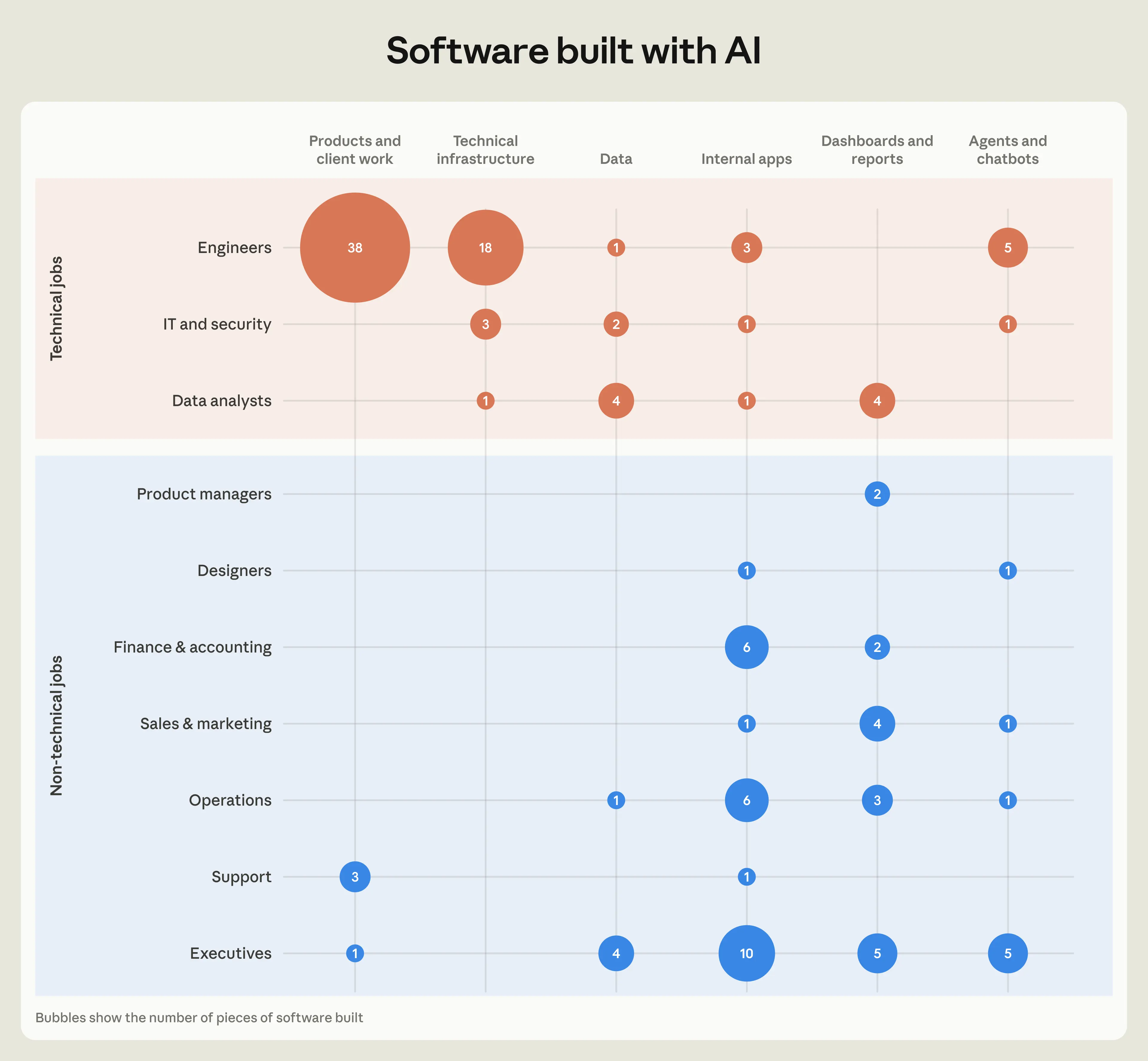
Figure 3 summarizes the 140 pieces of software that interviewees described as being built with AI, broken down by the software’s purpose and the role of the person who worked with AI to build it. It shows that product features and technical infrastructure remain solidly within the purview of technical employees, while nontechnical employees focus on internal apps and dashboards. This implies that the bulk of software built by nondevelopers still requires support or infrastructure from technical employees.
Beyond maintenance, these one-off, bottom-up coding projects can create substantially more work elsewhere in the organization, either in the last mile of production or through uneven acceleration across different tasks. The 401(k) audit app prototype mentioned above had to be implemented by a third-party vendor and was still not in active use months later. An engineer at an equipment manufacturer realized that AI could translate the text on their product surfaces into 10 different languages, but “we don’t have anybody that can answer the phone in those languages… So we ended up turning that [feature] off. We didn’t even ship it.” As coding accelerates relative to other functions, it hits bottlenecks: “Without the proper scaffolding in place, that bottleneck is immediate.”
These uneven changes in productivity can also run into organizational politics. As one manager put it, “In our world, it’s like Billy in Sales doesn’t trust Sally in Marketing.” Exacerbating these conflicts is the fact that the uneven adoption of AI can impose costs on nonadopters. Power users lob “Claude grenades” and shoot “Claude cannons” at the rest of the organization, while AI skeptics respond, “Guys, I’m not reading your AI email.” In one case, an AI agent put together a set of profit and loss projections that a Chief Investment Officer realized were based on outdated assumptions. As one frustrated executive put it, “A mediocre engineer with an AI is a menace to society.”
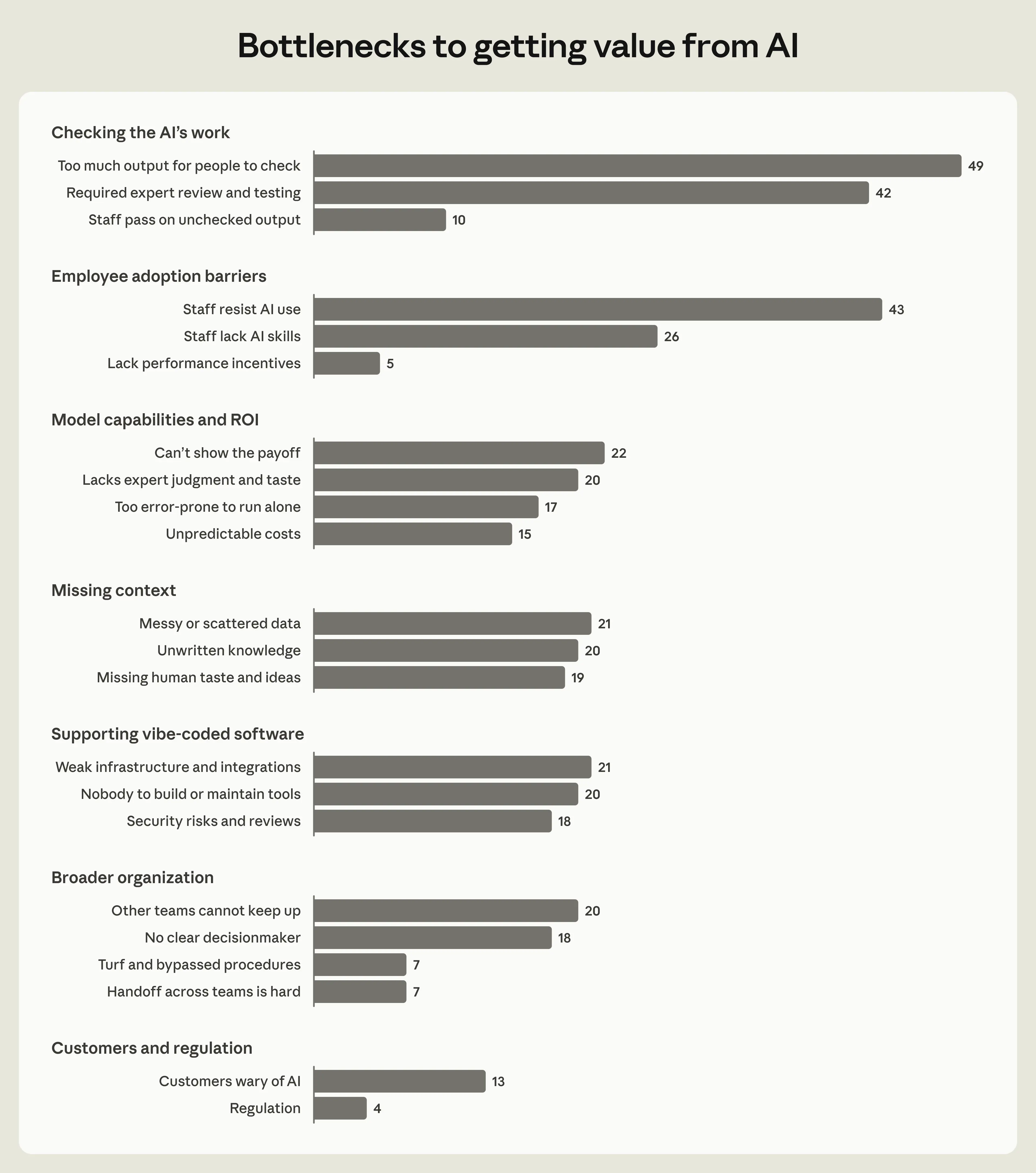
Figure 4 summarizes the bottlenecks to deriving value from AI discussed across the interviews. Many involve the uneven acceleration of tasks. The difficulty of reviewing AI outputs came up again and again, as their volume swamped scarce human attention. In one incident, an agent added an errant “S” to an API endpoint and broke a carefully planned feature release. In other cases, when coding accelerated, other functions could not keep up. Uneven employee adoption was also common, as the enthusiasm of power users failed to rub off on their peers. Companies also often noted that they lacked the necessary context and infrastructure to support AI-generated software. By contrast, customer skepticism and regulation were rarely cited as bottlenecks. The bulk of bottlenecks appear to emerge from the process of adopting AI within the organization itself.
These examples evoke Paul David’s mill buildings retrofitted with electric engines—a classic account of why productivity growth may lag technological implementation. Individual contributors can only revamp processes and decisions within their own small corners of an organization, while the broader division of labor remains in place. As one hotel services operations director put it, “The individual doesn’t have the authority to change the work. They can only apply it in their own area.” The head of AI at an investment firm voiced similar frustration with the bottom-up projects he had seen: “How can we upskill and tear down our workflows and rebuild like we were starting the company again now?… Not ‘Claude, write the email,’ but, ‘Why are you even getting the email?’”
One manager described the challenge of using AI agents to automate production planning. Setting output targets required input from a half-dozen functions spanning procurement, logistics, manufacturing, sales, and planning: “They’ve done a poor job at defining who has accountability and authority to make decisions.” The manager noted that only executive pressure could force change: “Getting them to imagine doing their job differently… can’t come from them. It has to come top-down.”
Reorganizing around AI
What is the alternative? Can AI deployment avoid both brittle automation of low-value tasks and the bottleneck of hobbyist projects the organization can’t absorb? Mark, the paralegal, ultimately agreed to share his approach with the partners and the rest of his firm. He had effectively automated the most relaxed part of his job—firing off AI-written demand letters. But he gained a new responsibility: supporting his firm’s AI transition and enablement.
Some companies are experimenting with complementary organizational changes in response to AI rather than just automating existing workflows or handing out AI tools. Here, we look at three ways companies have pursued these organizational changes: broadening roles to reduce coordination costs, redeploying employees toward “bottleneck” tasks, and building common infrastructure to support nontechnical builders.
Broadening roles
When firms broaden employees’ roles, individuals become responsible for an entire workflow rather than one narrow type of expertise. Engineers, for example, might start working across product, design, and even customer engagement. One healthcare startup asked all of its engineers—not just its business people—to speak regularly to medical professionals who used their product. Having a single employee or small team own an entire product or customer relationship limits the organizational friction and potential vetoes that can otherwise block AI acceleration. As one engineering leader put it, “Two people plus Claude is the most amazing thing… if two people agree on something, just ship it.”
As production—not just of code but also of legal research, data analysis, financial modeling, and other aspects of knowledge work—speeds up, agreeing on what to build across the organization can become slow and costly. But the more a single individual or a small team controls an entire workflow, the less these coordination costs appear. One executive described rethinking their lead sourcing, account executive, and customer success roles, merging them into a single role that handles the whole customer life cycle. AI tools made keeping up with the details of each step in the deal process easier, and made the “context loss” associated with handing a task off to a colleague more costly. One startup founder described exclusively employing individual contributors and giving each of them ownership over a distinct part of the product and business. At another company, a manager explained that “we essentially collapse designer, product manager, engineer, and QA, and even infrastructure, into a singular role.” Another engineering leader aimed at “more full-body contact of engineers with customers.” Figure 5 shows examples of roles broadening from specific functions to whole workflows.
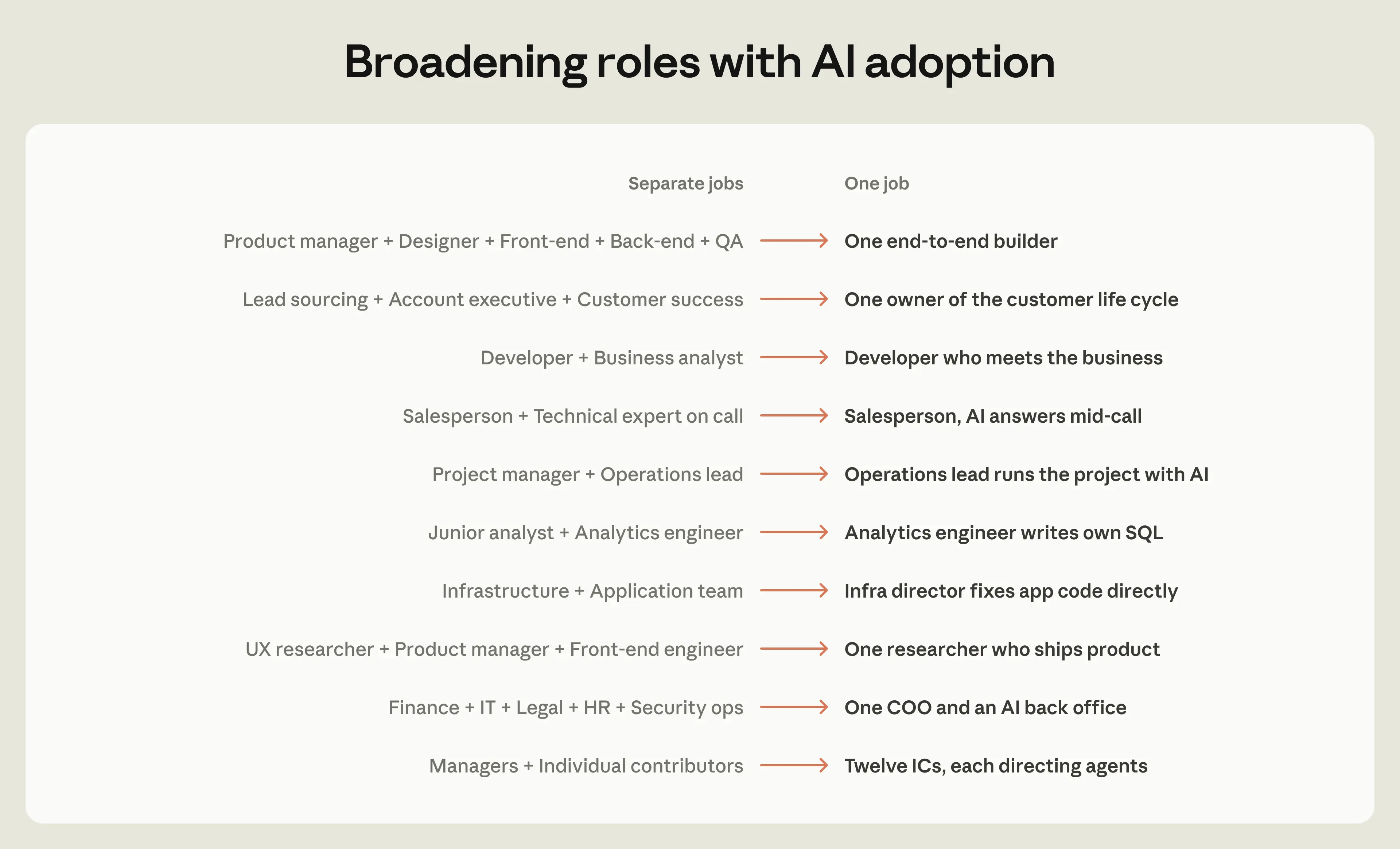
Another benefit of role broadening is that even as some parts of a job are automated, experts have less reason to fear job loss. At current model capabilities, agentic workflows still typically need active expert engagement and input to develop. They also require ongoing maintenance as models improve and workflows change. For example, one engineer automated a system to respond to production-alert tickets, which had previously been a substantial part of his job. For two months after deploying the system, the engineer read transcripts of every conversation with the AI agent and tweaked the prompts, repaired broken integrations, supplied missing vendor documentation, and approved agents’ authorization requests. Six months in, with the system working well, he still sampled transcripts every two weeks to update and maintain the system. He also kept building on it. The alert agent became a company-wide Slack agent (“the company basically runs on it now”), and then an agent that keeps skills and context up to date on everyone’s laptop.
Some companies have also found creative ways to transfer employees to new roles and build their expertise. A financial services firm, for example, shifted its internship program away from its immediate business needs toward helping interns develop domain expertise, such that now the “sole purpose is to build expertise and domain knowledge for that person.”
Redeploying employees toward bottleneck tasks
Some companies respond to AI-enabled acceleration by shifting employees toward the tasks that are still bottlenecks. If employees can chase down bottlenecks, they can better complement the capabilities of AI models. Recall Ellen, the software engineer who was initially afraid she would lose her job to coding agents. She eventually accepted that “the entire job has switched right from writing code to making decisions.” At a consulting company, consultants helped automate the process of reconciling best practices and standards documents that conflicted with one another. The consultants then shifted to more “person-to-person consulting work instead of sifting through documents.” Likewise, an engineering director suggested that their team spend more time “talking to your PM
As another example, project managers at a construction company contributed to an agentic workflow for checking in across construction sites. Previously, project managers would call crew members at different sites every morning, put notes together, and write up a daily report for customers. Now, an AI agent pings crew members, who “talk to the robot” instead. The agent synthesizes the responses, reviews previous reports, drafts a new one, and sends it to the customer. Project managers said they got their mornings back to talk to customers about more pressing needs: “an excellent customer experience—that’s number one.” Similarly, one CTO shifted his product managers’ focus to aspects of the role that require more taste, or the ability to identify product-market fit. As the CTO put it, “Claude is a terrible product manager… So it’s a lot of taste deciding what features are important.”
For engineers, code review became a critical bottleneck, so many of them have worked on solving it. One engineer explained, “You find a bottleneck. Find out how to tackle that. Have someone own that. …Code’s no longer the problem. Let’s put time in user experience testing. Let’s put time in requirements gathering.” Some companies worked on automating code review, while others expanded the share of time engineers spent reviewing code. One company abandoned formal code review altogether but had developers work side by side with Claude to assess code.
The pressure to flexibly shift toward bottlenecks is especially strong with AI, because the models improve too fast for any fixed organizational plan to keep pace. As one HR manager put it, “You wait three months, and something new you didn’t think AI could do is now possible. And you’re like, ‘Well, okay, let me revise my whole plan.’” A CTO said, “If the world could just pause for a minute and let us get some harnesses in place, that would be great.” AI adoption benefits from scaffolding that makes role changes easier as the bottlenecks keep moving.
Figure 6 shows what these role changes look like across a variety of jobs. As software development becomes the purview of a whole gamut of nontechnical functions, engineers broaden their scope across design, product management, and even core business functions. At the same time, new tasks emerge: certified public accountants grade an AI finance agent’s outputs; marketing executives edit branding skill prompts; IT decides which nondeveloper apps to put into production; a client experience manager builds synthetic customers to pitch ideas to. Production planners, accustomed to poring over spreadsheets, become data labelers, providing qualitative context for AI agents to better understand the numbers: “You should be a journalist… you should not think about competing with AI.”
Representatives at the largest firms we interviewed said they were systematically inventorying employees’ skills and tracking shifts in their labor needs to formalize these changes. At one HR support firm, an agentic workflow automated the work of a team that had assessed clients’ employees for benefits eligibility. The team pivoted to client-facing work, answering calls and providing high-touch customer support, which the company had not previously had the resources to do. At a construction company, a contract administrator helped automate their own data-gathering work and was redeployed to integrate AI across the company and maintain agentic workflows. Redeployments like these can keep automation from leading to layoffs.
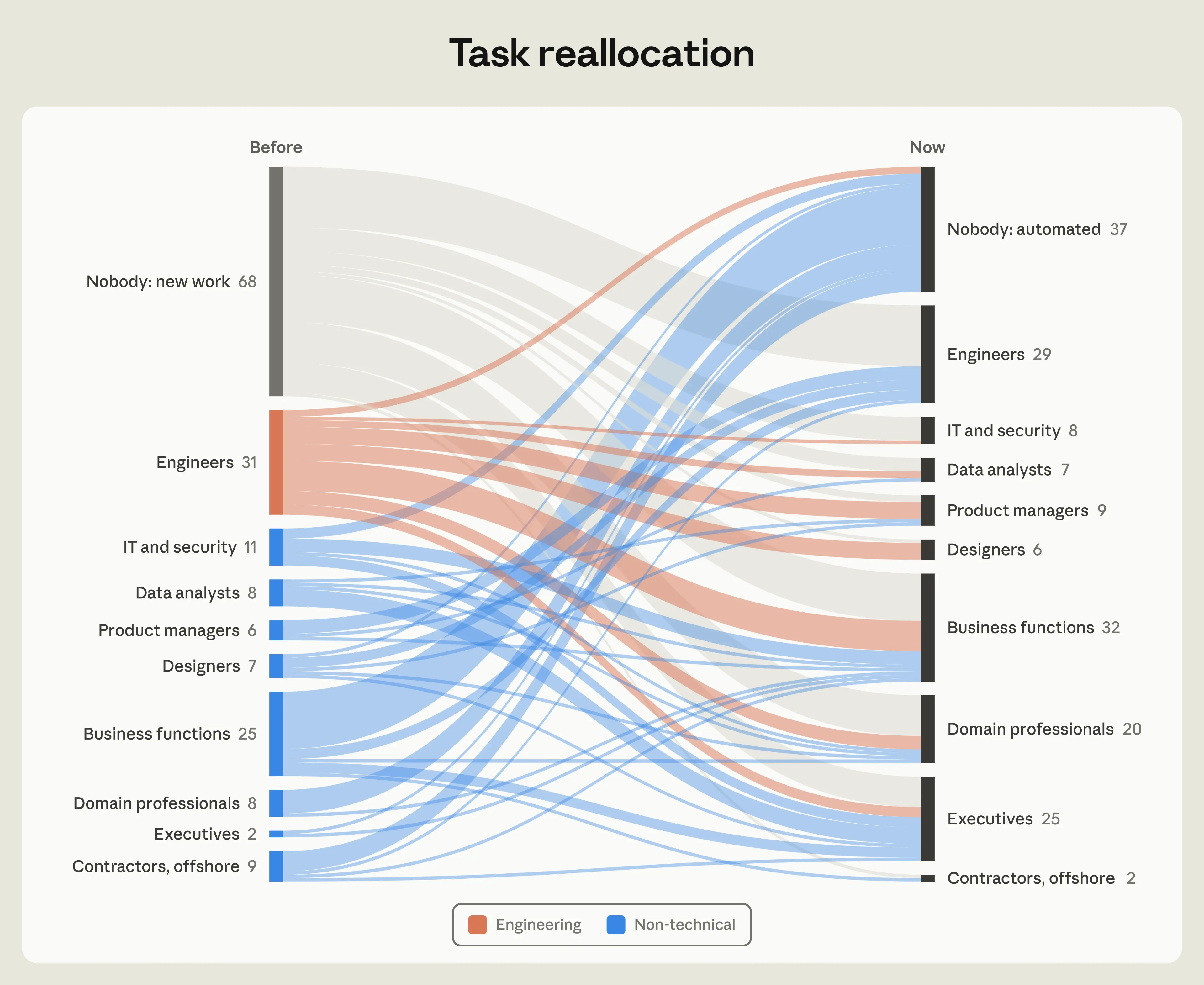
Building common infrastructure
Several companies have set up common infrastructure that allows nontechnical people to build apps that do not expose security vulnerabilities or require substantial maintenance by engineers. “Every single employee now is a developer… creating additional attack surface every day,” a data security executive told us. The head of engineering at a real estate company said they “went from having a team of five developers to a team of [dozens of] developers that all want to release software.”
Perhaps the most important shared infrastructure is company data, which provides context both for increasingly autonomous agents and for employees across functions. With AI, an executive can query business data “at the moment of need” rather than waiting for a regular report from data analysts. A trucking company built an agent-accessible “data warehouse,” and managers across the company began creating their own analyses based on that data: “they’re absolutely addicted to it,” a person at the company said. Instead of a business intelligence or data science team mediating every request for analysis—“it would have ended up on the queue, sometimes a year or two”—a broad range of knowledge workers started running SQL queries themselves. At another company, a sales team leapt into data analysis, linking sales and finance data: “Anybody can do it. And so now everybody does it.” Without AI, one employee said, “they probably would have never seen [the data], or they would have never tried to do anything with it.” And the trust and safety team at an online marketplace used their new data analytics tools to identify fraud patterns. As one team member explained, “we can [now] go parse through all of our logs.” These examples all depended on companies first pulling in and consolidating their data so that AI had the context it needed. This is consistent with prior research on enterprise use, which found that more complex tasks tend to require more context from users (measured in input tokens).
Making data available to the whole organization can shift power downward. As one executive put it, “You have to trust the democratization of data.” At one company, the reporting team initially protested: “Hey, we have to stop Claude from accessing data. People are reporting on things that we normally report on.” But the AI advocates won out, and the work of the reporting and business intelligence teams changed. Rather than creating reports and building dashboards, the teams were able to offer advice and insight derived from more rapid and sophisticated analysis.
For AI-native startups, a structured pool of data is critical. Teams transcribe and graph customer calls and pull meeting transcripts into Slack and other public surfaces: “We just, like, transcribe everything.” An AI lead at an investment firm described urging employees to move out of direct messages and “work out loud.”
The same data and AI tooling can give executives more oversight of employees and give employees more leverage in the organization. Prior research has found that information technologies tend to push decision-making down to employees, while communication technologies tend to centralize it. Our interviews suggest that how organizations set up AI tools, such as who can access data, can tilt a given technology toward empowering employees.
Conclusion
The dozens of people we interviewed told us that AI has substantially automated a range of work at their companies, particularly in software engineering, customer service, and back-office roles. But we also heard about a variety of bottlenecks that prevented productivity gains on particular tasks from translating into overall benefits for businesses. As one executive put it, “The closer you are to the money, the harder it is for models to excel in that job.” If prototyping is fast but deployment is not, or production is fast but marketing is slow, then AI tools deliver far less than model evaluations and capabilities would imply.
The people working alongside AI face even deeper problems. In top-down deployments, automation and surveillance threaten to undermine employees. In bottom-up deployments, inconsistent velocity across the organization leads to inequality in performance between employees or teams.
Companies that reorganized around AI addressed the challenges associated with both top-down and bottom-up approaches. Developers broadened their remit across the full software stack, then shifted toward product, design, and quality assurance. Nontechnical employees found themselves needed for a whole range of novel tasks. The underlying approach was to shift people’s jobs toward the tasks that AI can’t yet accomplish. Broadening jobs also gave the people closest to the work the authority to redesign their workflows. And shared data and infrastructure helped knowledge workers collaborate with AI, extending the benefits of coding agents beyond engineers.
Our interviews suggest a path that could benefit both employees and employers. Given current model capabilities, experts are still critical to building and reviewing AI workflows. Interpersonal and strategic tasks are currently the central bottlenecks where humans are needed, but the details of these roles will continue to change as models improve. Employers that develop systems to redeploy employees in new roles and broaden their scope may be best placed to take advantage of these intelligence gains without displacing employees.
How can employers deliver on this potential? Our interviews suggest that some companies are already sharing the gains of AI deployments with their employees, using productivity gains to improve job quality and lighten tedious work. Sharing the gains in this way may also motivate employees to contribute their expertise to redesigning workflows for AI tools. Companies that commit to internal worker reallocation must plan ahead for where those workers could go. And they can give employees, including nontechnical ones, broad access to the data and infrastructure they need to make the most of new AI tools. Finally, model developers like Anthropic must support these practices by offering training and help to business customers. We hope the findings in this report will inform those efforts.
None of this is a guarantee against AI-induced job loss, and it will not replace a strong policy response in the event of substantial technological disruption. But the wide variation in how employers are deploying the same technology suggests they have some say in how AI changes work.
Appendix and references
For technical details on the study, see the Appendix in our report PDF. The PDF also contains a full list of the sources used in this research.
