

Healthcare companies can spend months building an AI health app, reviewing its HIPAA requirements, and testing its features. Yet after launch, doctors may continue updating patient records by hand, switching between hospital systems, or using tools they already know.
HIPAA sets rules for keeping patient information private and secure, so clinical adoption depends on how well an app fits into a doctor’s daily work. An American Medical Association survey found that 84% of physicians considered EHR integration important for advancing AI adoption, highlighting how much clinical use depends on fitting into existing systems.
For healthcare companies, low adoption can affect the returns on development and compliance spending. Rollouts may slow down, doctors may lose confidence in the app, and leaders may struggle to show what the investment has achieved.
HIPAA compliance helps protect patient information. Doctors also need tools that fit their daily routines, work with existing hospital systems, and help them care for patients.

Five Reasons HIPAA-Compliant AI Health Apps Struggle With Clinical Adoption
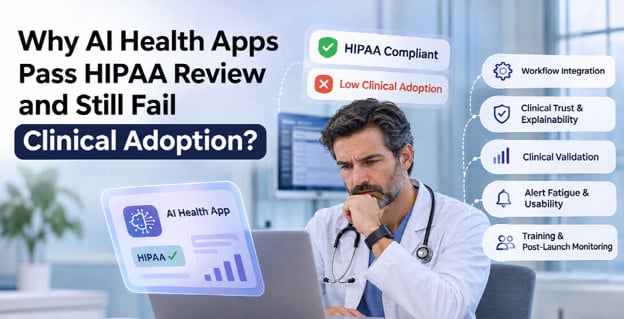
Passing a HIPAA review does not mean clinicians will use an AI health app. They still need to fit it into their daily work, understand its recommendations, and trust the results. Five issues can get in the way.
The tool that summarizes medical records saves little time if doctors must open another dashboard to read the summary and copy it into the patient’s file. Instead of making their work easier, the app adds another task.
Clinicians need to know why an AI tool has flagged a patient or suggested an action. A risk score alone does not explain which test results, symptoms, or medical records led to that result.
A model that performs well in technical tests may not work as expected with real patients. Their results can vary across age groups, health conditions, and clinical settings. Testing must establish whether the tool supports clinical decisions and performs safely in the setting where it will be used.
Frequent notifications can make it harder for clinicians to spot alerts that need attention. Poorly timed alerts and confusing screens add to the problem, interrupting patient consultations and other tasks. The app should make important information easy to find without creating more distractions.
Clinicians need to understand how to use an AI tool, what its recommendations mean, and when to rely on their own judgment. Without proper training, staff may avoid features they do not understand. If clinicians have no way to report incorrect recommendations or workflow issues, the development team may not know what needs fixing.
5 Reliable Healthcare App Development Companies Supporting AI-Powered Clinical Applications in the USA
Addressing clinical adoption calls for development partners who understand how healthcare professionals interact with technology, how clinical systems exchange information, and how applications perform in real-world care environments. The following companies offer capabilities relevant to these projects.
GeekyAnts is an AI-Powered Digital Product Engineering & Consulting Company. Its work spans healthcare applications, mobile and web development, AI integration, backend systems, and product engineering. These capabilities can support applications that connect patient-facing features with clinical data and existing systems. Teams planning a clinical product should discuss how the development partner will handle data exchange, usability testing, and clinician feedback.
Clutch Rating: 4.9/5 (120 reviews)
Address: GeekyAnts Inc., 315 Montgomery Street, 9th and 10th floors, San Francisco, CA 94104, USA
Phone: +1 845-534-6825, Email: info@geekyants.com, Website: geekyants.com
Vokal combines mobile app development, UX/UI design, and digital strategy. Its Clutch profile identifies health and wellness as a focus area for its mobile work. Their services may suit patient-facing products that need clear navigation and a consistent user experience. Healthcare teams should confirm the company’s experience with clinical workflows, healthcare data, and integrations before selecting it for a clinical application.
Clutch Rating: 4.8/5 (5 reviews)
Address: 315 N Racine Ave, Chicago, IL 60607, USA
Phone: +1-877-584-5122
Dom & Tom builds iOS and Android applications and offers UX/UI design, AI product development, and app modernization. Its mobile portfolio includes an application for Port Medical Management and work for the Alzheimer’s Association. This experience is relevant to healthcare products where mobile workflows and accessible interfaces matter. Buyers should examine how the team handles clinical integrations and gathers feedback from healthcare users.
Clutch Rating: 4.8/5 (25 reviews)
Address: 85 Broad Street, New York, NY 10004, USA
Phone: +1 773-377-5585
ZUZEX develops iOS applications, mobile software, and custom web solutions. Its Clutch profile lists health and wellness among its mobile app development focus areas. This makes its services relevant to patient-facing applications and digital health products. Healthcare teams should ask how they approach clinical data handling, system integrations, and testing with the people expected to use the application.
Clutch Rating: 4.7/5 (8 reviews)
Address: 3558 Round Barn Blvd, Santa Rosa, CA 95403, USA
Phone: +1 (662) 622-1126
KRUTSCH works across mobile app development, AI development, and UX/UI design. Its healthcare work includes clinical research systems, connected devices, and enterprise platforms. This background is relevant to applications that need to fit established workflows and present information clearly to users. Buyers should ask for examples of how the team has tested clinical applications with their intended users.
Clutch Rating: 4.7/5 (20 reviews)
Address: 3800 American Blvd W, Suite 1500, Bloomington, MN 55431, USA
Phone: +1 612-605-7549
Passing HIPAA review is an important step, but it doesn’t tell healthcare leaders whether clinicians will use an application during patient care. Clinical adoption depends on how well an application fits into everyday practice. Clinicians need to be involved from product discovery through testing and deployment. Their feedback can reveal workflow gaps, usability issues, and concerns that technical testing alone may miss.
Clinical validation, clear explanations, onboarding, and post-launch monitoring also help teams identify problems before they affect routine use.
Artificial Intelligence Disclosure & Legal Disclaimer
AI Content Policy.
To provide our readers with timely and comprehensive coverage, South Florida Reporter uses artificial intelligence (AI) to assist in producing certain articles and visual content.
Articles: AI may be used to assist in research, structural drafting, or data analysis. All AI-assisted text is reviewed and edited by our team to ensure accuracy and adherence to our editorial standards.
Images: Any imagery generated or significantly altered by AI is clearly marked with a disclaimer or watermark to distinguish it from traditional photography or editorial illustrations.
The information contained in South Florida Reporter is for general information purposes only.
South Florida Reporter assumes no responsibility for errors or omissions in the contents of the Service. In no event shall South Florida Reporter be liable for any special, direct, indirect, consequential, or incidental damages or any damages whatsoever, whether in an action of contract, negligence or other tort, arising out of or in connection with the use of the Service or the contents of the Service.
The Company reserves the right to make additions, deletions, or modifications to the contents of the Service at any time without prior notice. The Company does not warrant that the Service is free of viruses or other harmful components.
