


Guest Post: When Will Quantum Computing Become Useful for Insurance?

Firgun Venturesis a VC firm investing in Series A/B quantum scale-ups globally.
Insurance is, at its core, the business of putting a price on uncertainty, and computationally intensive simulations underpin much of how insurers assess risk. US insurer Allstate can run around 100,000 simulated scenarios to assess outcomes across its homeowners’ portfolio, yet the worst 1%, representing the extreme losses that influence capital requirements, leaves only about 1,000 simulated outcomes from which to estimate rare events across different hazards and geographies. Problems like this are drawing insurers’ attention to quantum computing, where the usual question is when error-corrected machines will run full actuarial risk models.
Insurance contains several distinct computational problems, each mapping onto different quantum algorithms and hardware, with varying levels of reliability. (1) Hybrid quantum machine learning (QML), (2) quantum randomness processing, and (3) quantum-assisted optimisation can already be tested on today’s devices. Within these nearer-term use cases, commercial products, named enterprise customers, and insurance-specific experiments exist. The most demanding uses, including (4) detailed quantum generative risk distributions and (5)quantum amplitude estimation for actuarial simulation, face far steeper hurdles. Quantum commercialisation within insurance is therefore likely to arrive in overlapping waves, and innovative insurers who adopt quantum early instead of waiting for the final wave stand to gain expertise, proprietary data, and commercially beneficial partnerships.

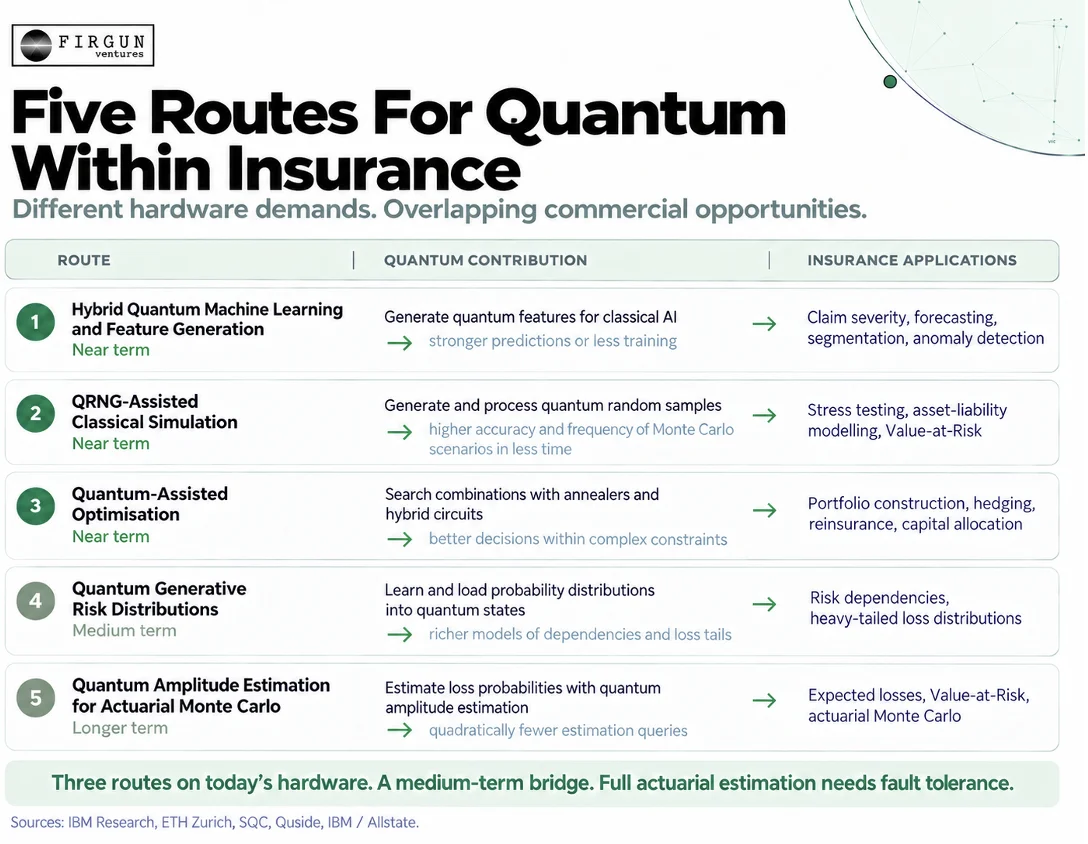
Figure 1. Five quantum hardware use cases and insurance applications, grouped by the maturity of the hardware each requires. Time horizons are indicative, and the potential benefits reflect early results or theoretical advantages rather than proven insurance outcomes. Firgun Ventures analysis.
The first commercial opportunities do not require the same quantum computers as the most ambitious actuarial applications. Of the five routes summarised in Figure 1, hybrid QML, quantum randomness processing, and quantum-assisted optimisation run on today’s processors; in the medium term, quantum generative risk distributions form the bridge, and quantum amplitude estimation awaits fault-tolerant machines (computers that continuously correct their own errors).
The three near-term routes each strengthen an established workflow rather than replacing it. Hybrid quantum machine learning generates additional features from existing data to support predictive models, while quantum randomness hardware accelerates and improves the accuracy of Monte Carlo simulation (estimating outcomes by running many randomised scenarios) for stress testing and Value-at-Risk (the loss a portfolio should not exceed at a given confidence level over a set period). Quantum-assisted optimisation already runs on today’s annealers and hybrid circuits, evidenced in pilots by D-Wave and CaixaBank, making it one of the routes on which insurers hold the most direct evidence.
Further out, quantum generative models aim to capture the dependencies and heavy tails of loss distributions, and early work by IBM Research and ETH Zurich has shown such models loading learned probability distributions into a quantum computer, addressing the data-loading bottleneck that more advanced processes such as amplitude estimation require. Amplitude estimation changes the simulation algorithm itself, and IBM Research’s 2019 paper “Quantum Risk Analysis” demonstrated that it can estimate Value-at-Risk with near quadratically fewer samples. In principle, a calculation needing a million classical scenarios might need around a thousand quantum queries. However, the method requires loading full risk distributions into quantum states and running deep, error-corrected circuits, placing it on the longest path of the five routes.
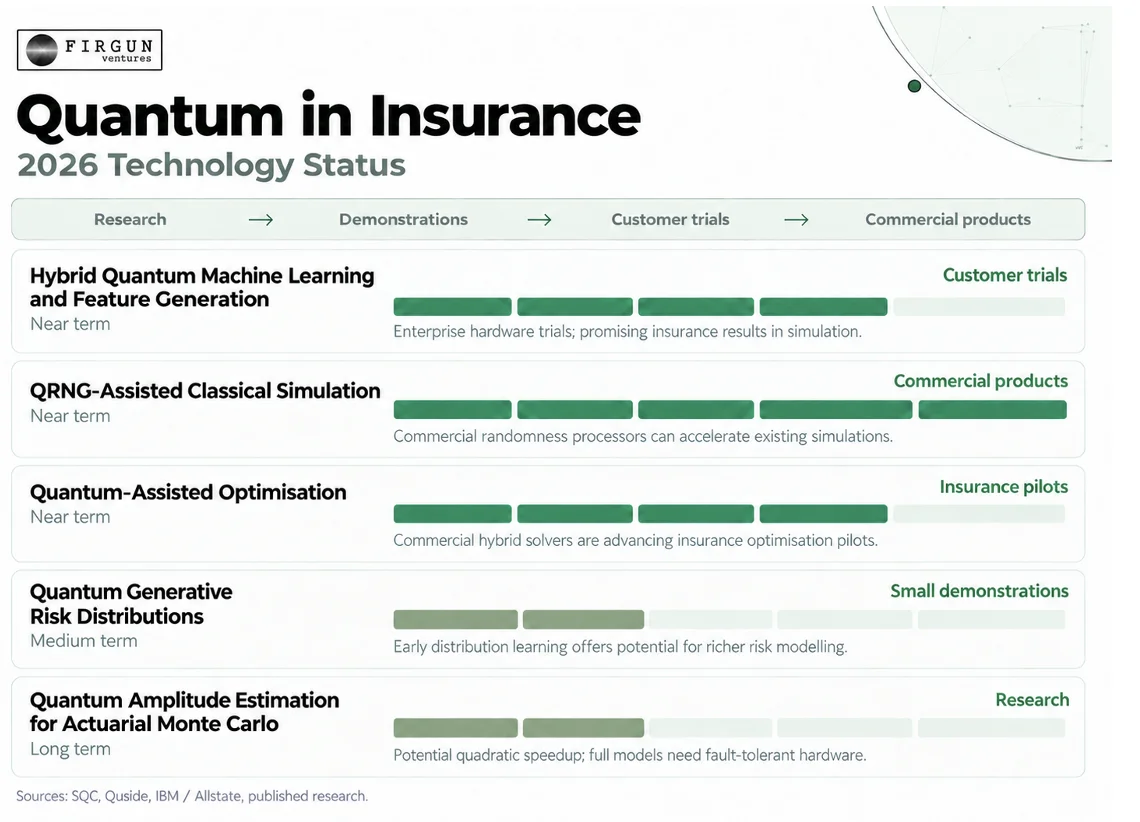
Figure 2. The five routes side by side, using 2026 as the evidence baseline and distinguishing purchasable products, named customer experiments, insurance-specific proofs of concept, and research demonstrations. Firgun Ventures analysis.
Quantum reservoir computing, which combines quantum computing with neural networks and represents a leading form of hybrid QML and feature generation, illustrates why a small quantum system can already add value to a large classical workflow, well before fault tolerance. Within quantum reservoir computing, the natural dynamics of the quantum system perform most of the complex transformation, so training concentrates on a simple classical model at the output rather than on deep quantum circuits. A 2026 study using Qatar Insurance Company’s motor claims applied the approach with only three to five simulated qubits and reported lower prediction errors than leading classical machine learning models (XGBoost and CatBoost). The results support the notion that small specialist quantum systems working alongside existing classical models in a hybrid approach are where quantum value in insurance is expected to emerge in the near term.
Early Commercial Evidence Is Building, But Unevenly
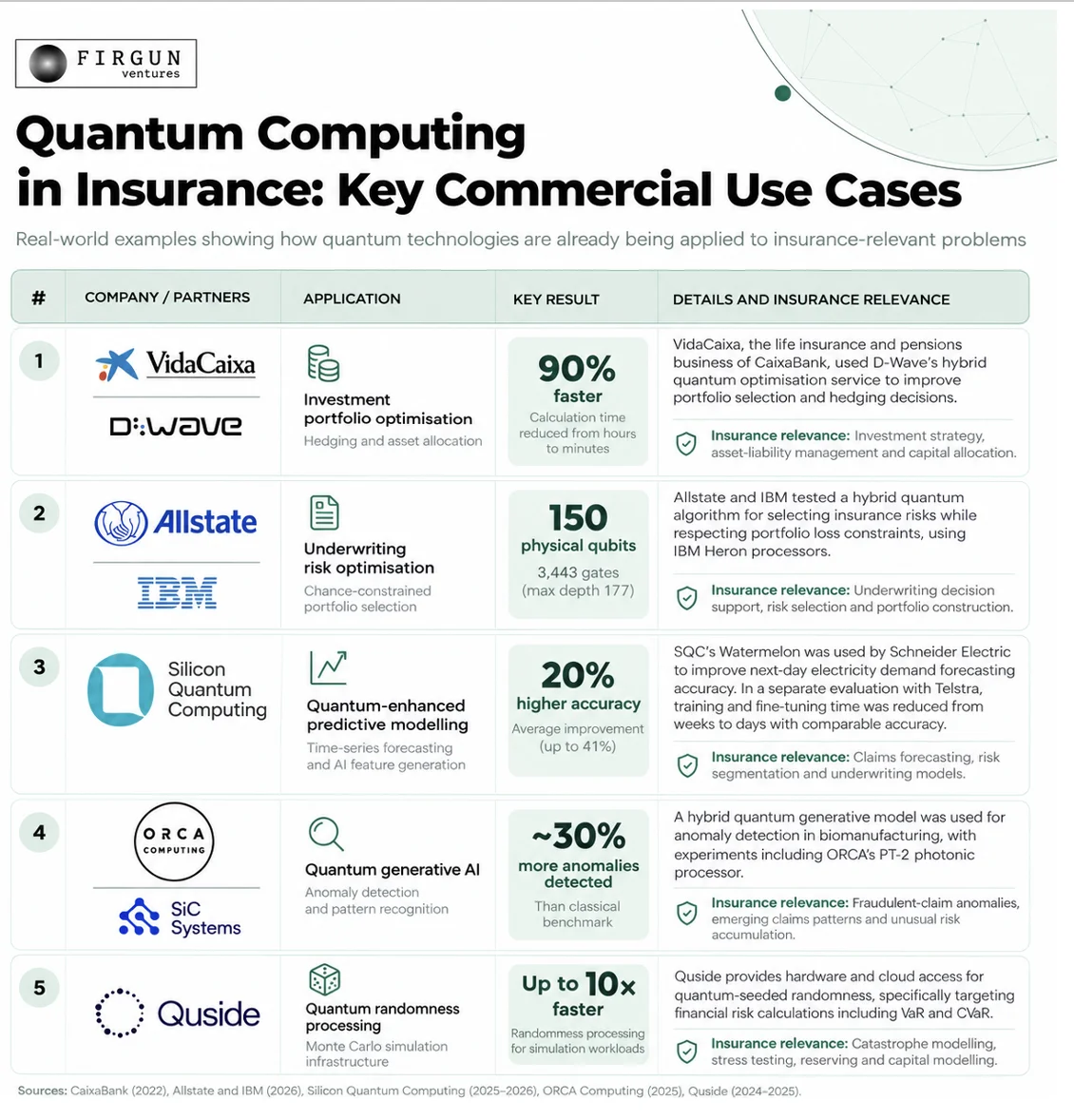
Commercial evidence across optimisation, machine learning, and simulation infrastructure already shows narrow quantum components adding value inside existing classical workflows. In 2022, VidaCaixa, CaixaBank’s life and pensions arm, used D-Wave’s hybrid solvers to cut portfolio hedging calculations from hours to minutes, a reported reduction of up to 90%. In May 2026, Allstate and IBM brought optimisation into underwriting, running circuits on up to 150 qubits of an IBM Heron processor to select simulated homeowners’ policies within catastrophe loss limits, keeping pace with the strongest classical heuristic and edging ahead on tightly constrained problems.
Quantum-enhanced machine learning supplies further evidence from outside insurance, where named enterprise customers are testing physical hardware on prediction tasks that resemble actuarial work. Firgun Ventures’ portfolio company Silicon Quantum Computingleveraged theirWatermelon system to improve Schneider Electric’s next-day energy forecasts by an average of 20% against a classical benchmark in October 2026, having earlier matched the accuracy of telecommunications company Telstra’s deep learning model with days rather than weeks of model training and tuning. Another related example includes London-based ORCA Computing’s photonic processor strengthening an anomaly detection model developed in collaboration with Novo Nordisk and the Technical University of Denmark. Within QRNG classical-assisted simulation, QRNG startup Quside sells a Randomness Processing Unit built to accelerate financial Monte Carlo workloads. Forecasting and anomaly detection are commonplace tasks in pricing and claims, hence, these results give insurers a ready template for structuring their own trials.
Why Full Actuarial Modelling Remains the Longest Climb
A full underwriting or capital model must represent many uncertain risk factors, their dependencies, and the financial consequences of each scenario, all in the form a quantum computer can process. Full catastrophe modelling is expected to require fault-tolerant machines, and resource estimates from finance demonstrate the challenge. In derivative pricing, a narrower calculation, Goldman Sachs and IBM estimated in 2021 that benchmark contracts would need around 8,000 logical qubits (error-corrected qubits built from many physical ones). A fuller implementation in Microsoft’s Q# language put one subroutine alone at 19,200 in 2022, before a 2024 method based on quantum signal processing reduced the total to 4,700 (75% reduction). Full actuarial models involve additional risks and dependencies, yet these figures show algorithms moving the target as quickly as hardware.
Hardware roadmaps supply the other half of the comparison, and they diverge considerably between vendors. IBM targets 200 logical qubits running 100 million gates in 2029 and 2,000 from 2033, while IonQ targets 8,000 in 2029 and 80,000 by 2030. Therefore, machines of that scale could, on paper, appear within the decade. Despite this, meeting these targets would not on its own make an actuarial algorithm viable, since circuit depth, gate speeds, logical error rates, and data-loading costs must also align.
Starting the Investment Clock Before Fault Tolerance
For insurers, the case for acting now rests on readiness rather than imminent advantage. Skills, datasets, supplier relationships, and model governance take years to build, while narrowly defined problems can already be tested through cloud services and specialist vendors. The upside is substantial, from more accurate pricing in competitive lines, where marginal gains in predictive accuracy can translate into meaningful profit, to faster hedging calculations and portfolios built around a clearer view of correlated catastrophe risk. Insurers that build capability early will also be positioned to capture each subsequent wave as it matures, while early trials show which route addresses an insurer’s real bottleneck. The strongest opportunities will emerge where quantum systems outperform properly optimised classical methods on economically significant workloads, with the comparative evidence insurers build now against their own best baselines separating those opportunities from well-marketed pilots.
Cover image by Vlad Deep on Unsplash

Keep track of everything going on in the Quantum Technology Market. In one place.
- Donald Harmitt, Firgun Ventures, guest post, insurance, Kris Naudts, quantum utility, Zeynep Koruturk
Resonance
The Quantum Insider is the leading online resource dedicated exclusively to Quantum Computing. You can contact us at [email protected].

Delta Gold Launches Dedicated Quantum Sensing Program
Students Use Quantum Computing to Address Electric Grid Challenges at Tennessee Hackathon
SEALSQ Signs LOI to Acquire QuintessenceLabs
BMO Reports Quantum Utility in Machine Learning Application Using IBM Quantum Computers
- Matt Swayne
- November 19, 2026
Guest Post — The 2026 Finance Quantum Index: Recognizing the Leaders Advancing Quantum in Finance
- Steve Suarez
- November 18, 2026
Guest Post — Commercial Diplomacy: Building The Quantum Ecosystem
- Matt Swayne
- November 6, 2026
