

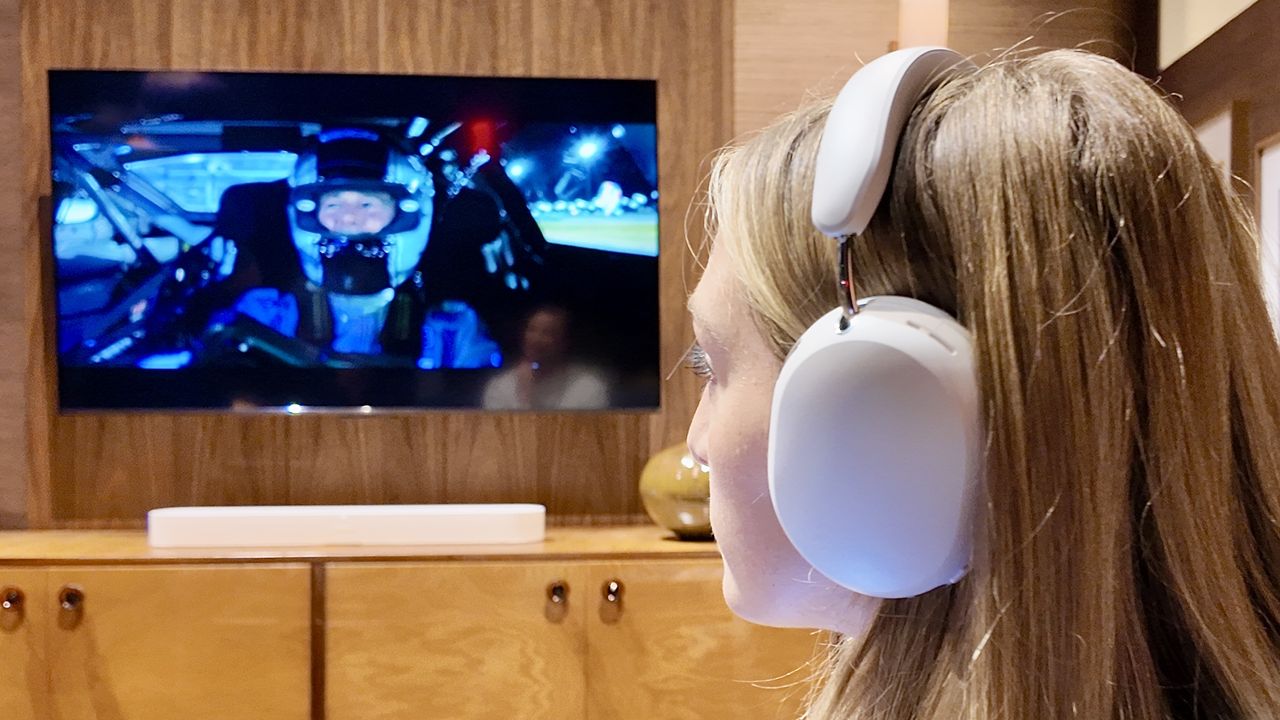
As a Formula 1 engine ripped through the center channel of the new Sonos Beam Ultra, I decided I simply was not audibly immersed enough. I picked up two Sonos Play speakers from a side shelf and set them down on a long table behind the couch.
Without touching a phone or digging through a settings menu, the Sonos system registered a subtle, satisfying “boop.” The accelerometers inside the portables recognized they’d been placed down, fired off an imperceptible ultrasonic chirp to locate the soundbar and instantly reconfigured themselves into active rear surround channels.
But remembering I was in a public setting and should probably respect everyone else’s ears, I double-tapped the physical action button on the earcup of the new Ace Ultra headphones. The roar of the race track instantly lifted off the soundbar and dropped straight into my ears.
No Bluetooth pairing screen, no app lag — just an instantaneous network handoff.
After two years of software headaches, this seamless handoff felt like the turning point Sonos has so desperately needed.
Earning back trust with Sonos 27
It’s no secret that Sonos software has faced intense scrutiny from its most passionate users, primarily
But rather than dancing around the past, Sonos is framing its new operating system, Sonos 27, as a direct answer to that feedback. In fact, surveying the room, I learned that members of the Sonos Reddit community were actively participating in demos right alongside the media.
“We’ve been listening to customers all along, but especially in the last two years… we’ve learned a ton about what customers actually want,” explained Andrew Sutherland, Sonos Senior Director of Product Management during an interview with me following the event.
“Internally, the way we’re thinking about testing and releasing things has really been bolstered,” said Sutherland. “A really good example is the app redesign with tabs in the last three months, which has actually been behind a test that users can opt into and try out.”
Beyond core stability and opt-in testing, Sonos 27 introduces open platform AI control, letting users connect outside assistants like ChatGPT alongside Sonos’ own voice engine or custom agents
“It always comes back to choice and being an open platform for control,” Sutherland said. “We don’t really have skin in the game to say one intelligence should be used over the other.”
Ecosystem-first hardware design
While competitors like Sony and Bose dominate commuter noise cancellation, Sonos is carving out a hybrid category with the $449 Ace Ultra: high-end cans designed to act as an instant extension of your living room system.
“These headphones are definitely the best headphones you can use at home, no doubt. But they’re also the best headphones you can use away from the home,” Brandon Holley, Sonos Interim Hardware Lead, clarified to me when I asked about Ace Ultra’s competition.
“We worked incredibly hard to make them light, but also extremely comfortable. So when you walk in the front door, it’s an amazing experience that you don’t need to leave at the front door.”
“When you walk in the front door, it’s an amazing experience that you don’t need to leave at the front door.”
Brandon Holley, Sonos Interim Hardware Lead
Under the hood, bringing Wi-Fi system-linking directly into a wearable
“You have to get into the radio. That means making sure you have space for the antennas, the radio, and moving electronics so the thermal design works,” Holley said.
Acoustically, the Ace Ultra upgrades its predecessor’s hardware for a custom-engineered 40mm driver optimized for sheer dynamic range.
Ace Ultra: $449
Noise-canceling headphones with rich, detailed audio, up to 35 hours of battery with ANC on, and a direct connection to your Sonos system.View Deal
“When you’re creating sound, you’re trying to transfer mechanical energy into movement of air. Power-to-weight ratio—if you want to think about it in terms of automobiles—that is king,” Holley emphasized. “You want as much power as you can with as light of a diaphragm as you can make.”
Meanwhile, on the Beam Ultra front, Holley revealed that fitting nine custom drivers (including two dedicated up-firing speakers) into the mid-size Beam Ultra meant engineering every component completely from scratch to solve cabinet displacement constraints.
The unseen magic of Sonos Fabric
The thread binding this new hardware generation together is Sonos Fabric, the underlying software capability that lets devices sense each other in physical space. Whether it’s enabling portable speakers to act as instant, dynamic rear surrounds or letting headphones pull sound straight off a soundbar, Sonos’s goal is to eliminate manual configuration entirely.
“Fabric is the set of technologies that allows us to be able to do that,” said Sutherland. “You shouldn’t have to go into an app to set those things up or change them. It should just feel natural in your home. You almost don’t want anyone to actually talk about Fabric, you just want it to happen.”
When the roar of an F1 engine can jump from a soundbar, route through two self-configuring rear surrounds, and land straight in your headphones with a single tap (all without looking at a phone screen) I’m able to recognize what Sonos is actually fighting for at this moment in the company’s 20-plus-year history.
For loyalists who felt burned by Sonos’ recent software missteps, Sonos 27 and this new hardware push send a clear message: Sonos is dedicated to making its ecosystem feel effortless again.
When the sound follows you from the soundbar to your headset without a single glance at your phone, you don’t care how complex the underlying tech is. You’re just glad it finally gets out of your way.
- Sonos is ready to steal back the soundbar crown with the new Beam Ultra
- I just set up the ultimate Sonos surround system
- Change these Sonos soundbar settings immediately
