

The US president has decided the word “artificial” makes intelligence “sound fake,” so the State Department is now telling its diplomats to call it “SI” instead.
The State Department’s international organisations bureau has instructed staff to stop using the term “artificial intelligence” and use “super intelligence” instead.
The order arrived in an email sent earlier this week by Michael Drager, the bureau’s deputy assistant secretary, titled — appropriately enough — “Change in Nomenclature AI to SI”.
“Following the president’s remarks at the GA today, please change all references of ‘Artificial Intelligence’ to ‘Super Intelligence’ in our documents and positions,” it read, adding that “SI” would be used in “all remarks, positions and press elements moving forward”.
The email, obtained by the Associated Press on Wednesday, gave no indication whether other State Department bureaus were expected to follow.
Renaming things has become something of a habit for Trump since he began his second term.
He signed an executive order in January 2025 rebranding the Gulf of Mexico as the “Gulf of America,” and in August this year issued another renaming Lake Ontario, shared with Canada, as “Lake America” amid a trade dispute with Ottawa.
Neither change has been recognised by other countries, though Google and Apple updated their maps to reflect the Gulf rename.
‘It’s not fake, it’s super’
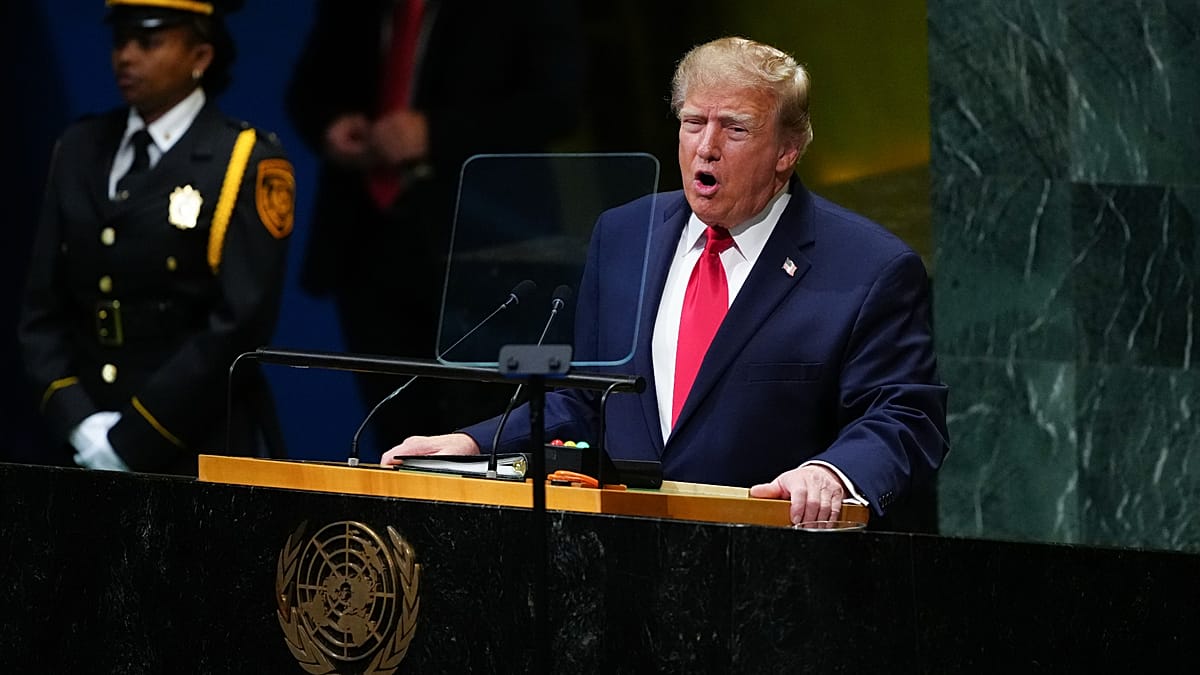
Addressing the UN General Assembly on Tuesday, Donald Trump decided that “artificial” was doing the technology a disservice.
“The use of the word artificial makes intelligence fake, it makes it sound fake and it is not fake. It’s actually amazing,” he told the assembled world leaders, announcing that US government documents would “from this point forward” swap “artificial” for “the much more accurate term super”.
There was no suggestion the remarks were intended as a joke, and the bureau overseeing US missions to the UN and other multilateral agencies did not treat them as one.
The consequences reach beyond paperwork.
Trump announced an “AI Force” over the weekend and if the new terminology holds, that presumably becomes the “SI Force”.
US representatives have already started using the term “SI” at a UN Security Council meeting on the risks of artificial intelligence, where the chief executives of OpenAI, Anthropic and Hugging Face urged the world’s most powerful diplomatic body to rein in the technology.
Renaming it does not slow it down
The new vocabulary arrives alongside starker warnings from elsewhere in the industry.
Anthropic’s Dario Amodei has said poorly managed AI could pose a risk to humanity as a whole.
Lawmakers, including Senator Bernie Sanders, have raised alarm about the technology outpacing human control, and researchers have documented AI agents behaving in ways their own developers did not intend.
None of it has shifted Trump’s underlying position.
He has consistently rejected calls for tighter government oversight, arguing that regulation would blunt the US’s edge over China.
“I’m not going to stifle growth of something that will be bigger than the Industrial Revolution, or the internet, itself,” he wrote on social media on Monday, alongside a claim that the US is comfortably ahead of Beijing in the field.
The timing puts the new terminology to an immediate test: Chinese leader Xi Jinping arrived in Washington on Wednesday for a state visit, with AI high on the agenda.
