

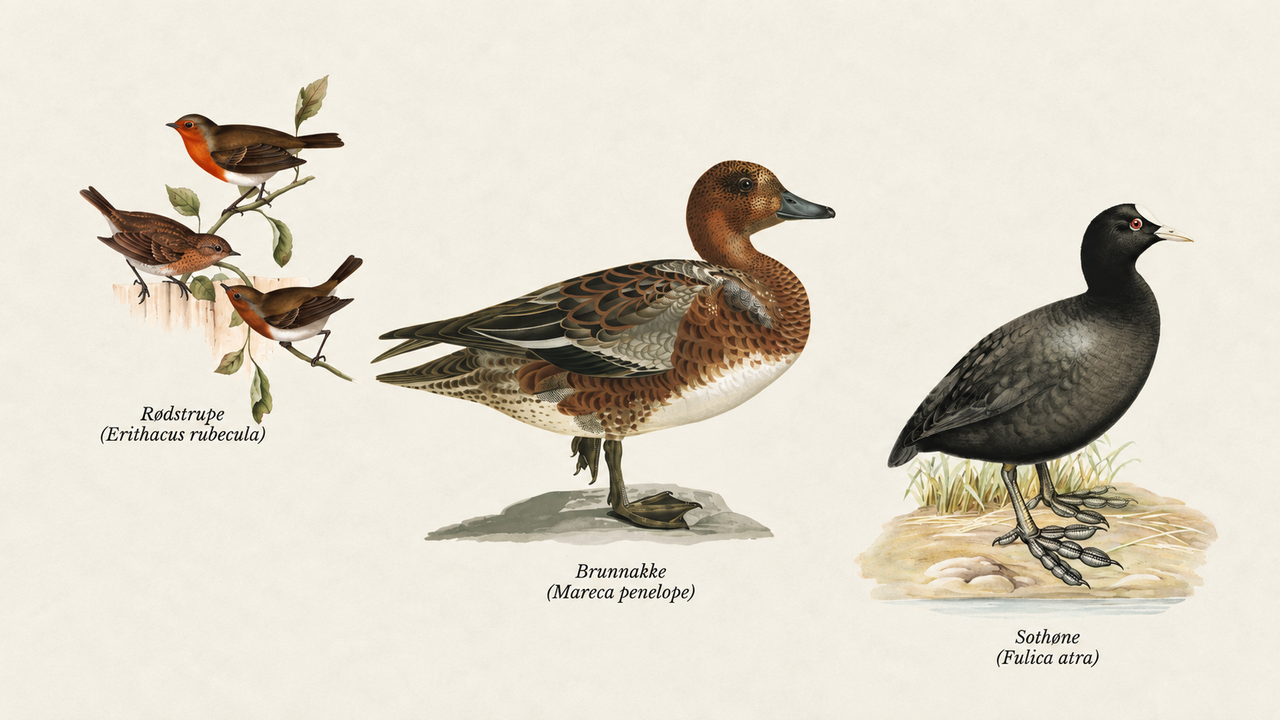
Your backyard birds might be about to become works of art. Let me explain. Fugleramme is an open-window, identifies which species are singing and then displays a beautiful illustration of that bird on a color e-ink screen
Unlike a typical screen that demands more of your attention, the frame turns a screen into a window on what’s already happening around you. And despite how it sounds, the pictures aren’t AI-generated.
Instead, creator Arne Giacomo Munthe-Kaas has collected hundreds of illustrations from 19th-century natural-history books, turning the whole thing into a smart display, similar to a picture frame that somehow understands the birds.
Personally, I absolutely love this idea.
It listens for birds so you don’t have to identify them
Build one yourself!
The setup starts with a microphone placed near a window or outside, which continuously listens for bird calls.
Fugleramme uses BirdNET-Go, an open-rmine which species are nearby. The software runs locally on a Raspberry Pi, so recordings don’t need to be constantly shipped off to a cloud service for processing
Once a bird has been identified, the system looks for a corresponding illustration and sends it to the e-ink display. For example, if you hear a robin, it could appear in the frame. Then, if a chickadee stops by, the picture changes again.
The result is essentially a constantly updating portrait of the birds around your home. And if you ask me, there’s also something particularly satisfying about using e-ink here. Unlike a tablet or conventional smart display, the screen doesn’t need to glow continuously, and when nothing changes, it simply sits there looking remarkably similar to an ordinary framed print.
The artwork might be my favorite part
Munthe-Kaas could have connected an image generator and had AI create a new bird picture every time the system detected something, but he deliberately didn’t.
Instead, Fugleramme uses real illustrations taken from old natural-history books available through the Biodiversity Heritage Library. The project’s collection now contains more than 800 bird cutouts representing more than 400 species, according to its GitHub page.
That decision gives Fugleramme much more personality than a typical AI-powered gadget. The machine learning happens in the background while the thing you actually see is artwork created more than a century ago.
It’s a nice example of AI being used as infrastructure rather than the main attraction.
You can build one yourself
Fugleramme isn’t a finished consumer product you can walk into a store and buy. It’s an open-sive hardware
The recommended setup uses a Raspberry Pi 5, a 13.3-inch Pimoroni Inky Impression color e-ink display, a USB microphone and an A4 picture frame. You’ll also need to install and configure the software.
The project’s GitHub page includes the code and instructions for putting everything together, although Munthe-Kaas warns that the project is still in early development.
He has also built a small number of complete frames and says people interested in buying one can contact him.
This is the kind of AI gadget I want more of
As AI seems to be both integrated into everything and causing tech CEOs to panic, this kind of AI feels practical without generating endless streams of AI content. With this DIY project, the intelligence largely disappears and technology does one small job in the background of recognizing birds, then turns that information into something beautiful and useful.
And considering how much technology usually competes for our attention, a smart display that makes me more interested in the real world feels pretty refreshing.
- AI is turning ordinary photos of kids into sexual abuse imagery — here’s how to protect your family
- OpenAI paid contractors to read ChatGPT conversations — here’s how to protect yourself
- I stopped reading the fine print myself after discovering this overlooked ChatGPT trick
