

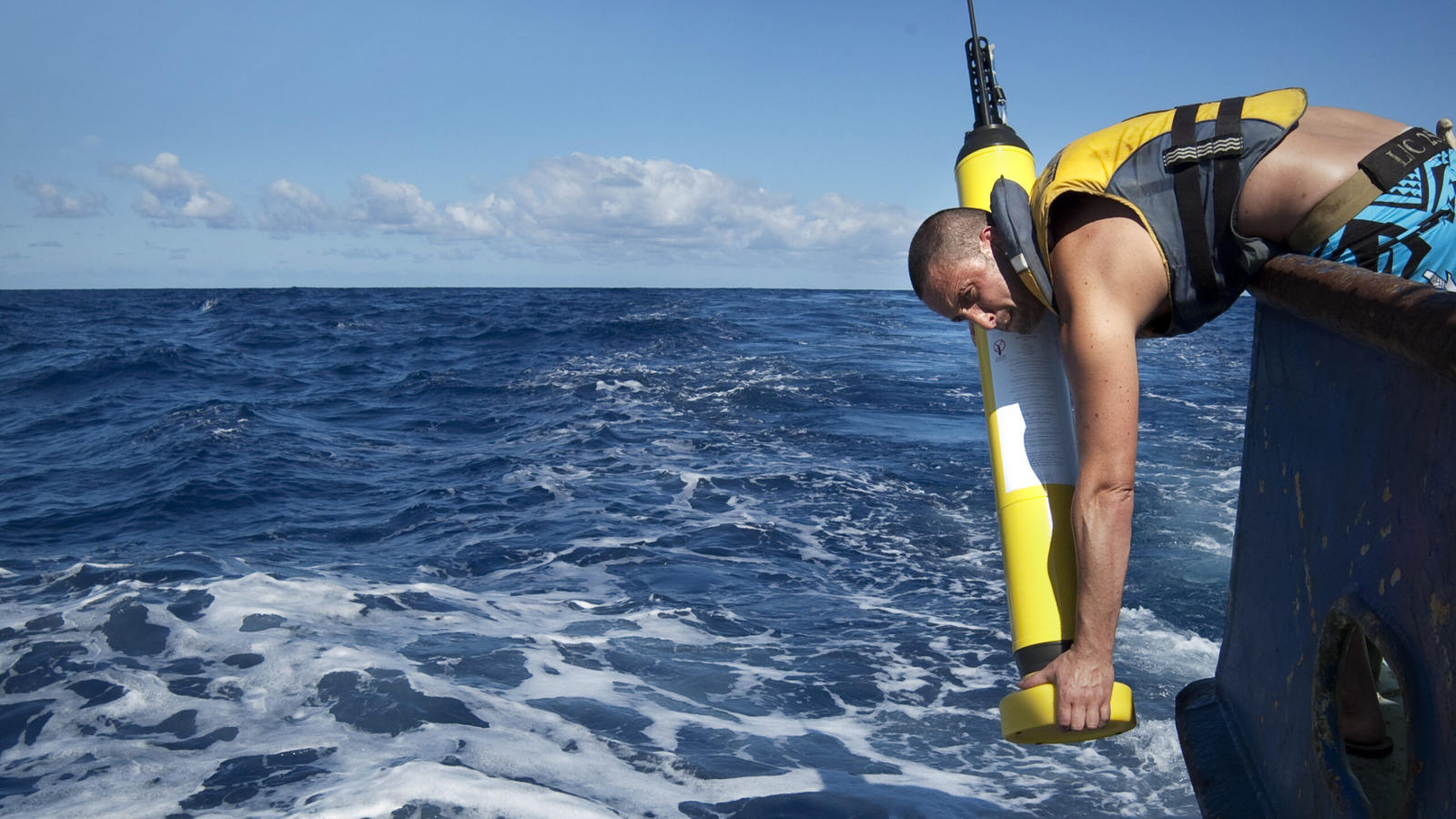
New ocean-sensing drones are being built to withstand the deepest depths of the ocean.
More than 70 percent of our planet is covered by the ocean, but the vast majority of it remains unexplored — an increasingly urgent blind spot as climate change raises water temperatures and. Autonomous underwater drone floats could soon close that gap, with a growing fleet set to cover more than 98 percent of ocean volume by 2028.
Exploring new depths
Today, the vast majority of ocean data is generated by members of the Argo Program — an international collaboration launched in 1999 that deploys 4,000 data-collection floats worldwide. The majority of Argo drones (like the one pictured above) descend between 2,000 and 4,000 meters into the ocean, but 10 percent of ocean warming occurs below these depths, marking a major gap in data collection.
This year, Ifremer — the French state ocean agency — reported its two Deep-6000 prototypes had completed five dives of 6,000 meters (nearly 20,000 feet) between January 11 and February 2 of this year, collecting crucial data on the abyssal zone. These successful missions make France the third country in the world, following China and the United States, to develop Argo floats capable of reaching these depths.
Ifremer said that by 2028, 30 more deep-sea floats will join the existing Argo-led international fleet of 4,000 devices, allowing researchers to explore more than 98 percent of the ocean.
The US currently operates more than 100 deep-sea floats and China operates more than thirty.
How do the dives work?
More than 90 percent of the ocean is considered deep ocean, reaching 200 meters (656 feet) deep or more — and of the entire ocean, only five percent has been explored. The lack of research on the deepest ocean areas — or abyssal zones — is largely due to technical constraints. At these depths, the ocean puts an enormous amount of pressure on machinery — approximately one atmosphere for every 10 meters of depth.That means at 6,000 meters, the pressure is approximately 600 times greater than that at sea level.
“The main challenge was to design a system that could withstand the pressures of the deep sea, be self-sufficient in terms of energy to remain operational for seven years, and keep costs under control,” Xavier André, head of profiler technology development at Ifremer, said in a press release.
To accommodate for the massive amounts of pressure, Ifremer constructed the hulls of its Deep-6000 prototypes with composite materials other than pure titanium. At 88 pounds, the devices weigh approximately twice as much as a typical Argo float, allowing it to better withstand the intense pressure.
The float missions for these Argo devices run on ten-day cycles: the float is dropped from a boat, descending to a “drift” depth where it stays for nine days, then further descending to a “profile” depth for approximately three hours. The float then ascends back to the surface, where it sends data it has collected to a satellite. This process is repeated until its battery dies — usually around 150 cycles over three to five years.
What information do the drones collect?
The floats collect information on water salinity, temperature, oxygen and pressure to help scientists at weather and climate centers better understand how the ocean is behaving as climate change warms the waters. Argo data can be used to improve forecasts of major climate phenomena like monsoons, ocean warming, sea level rise and ocean circulation. The 4,000 floats that exist globally produce more than 100,000 temperature and salinity profiles per year, and all Argo data is free online to access and use.
Virginie Thierry, a physical oceanographer at Ifremer, said in a press release that the new Deep-6000 floats will allow the French organization to track ocean warming all the way through abyssal depths.
“We will also be able to obtain information on deep ocean circulation,” she said, “which contributes to the storage of climate signals such as heat and carbon in the deep ocean, and refine ocean prediction models. Argo is an example of truly remarkable international cooperation, with more than 60 countries contributing to it.”
