

■ apps
■ developers
■ vibecoding
Sorry, new developers, it’s vibecodetown
If you’re like me, you receive three to five emails each day extolling the virtues of a new iPhone, iPad, or Mac app. If you’re like Jason, you get dozens of these emails. If you’re lucky, you’re like neither of us—in that one respect.
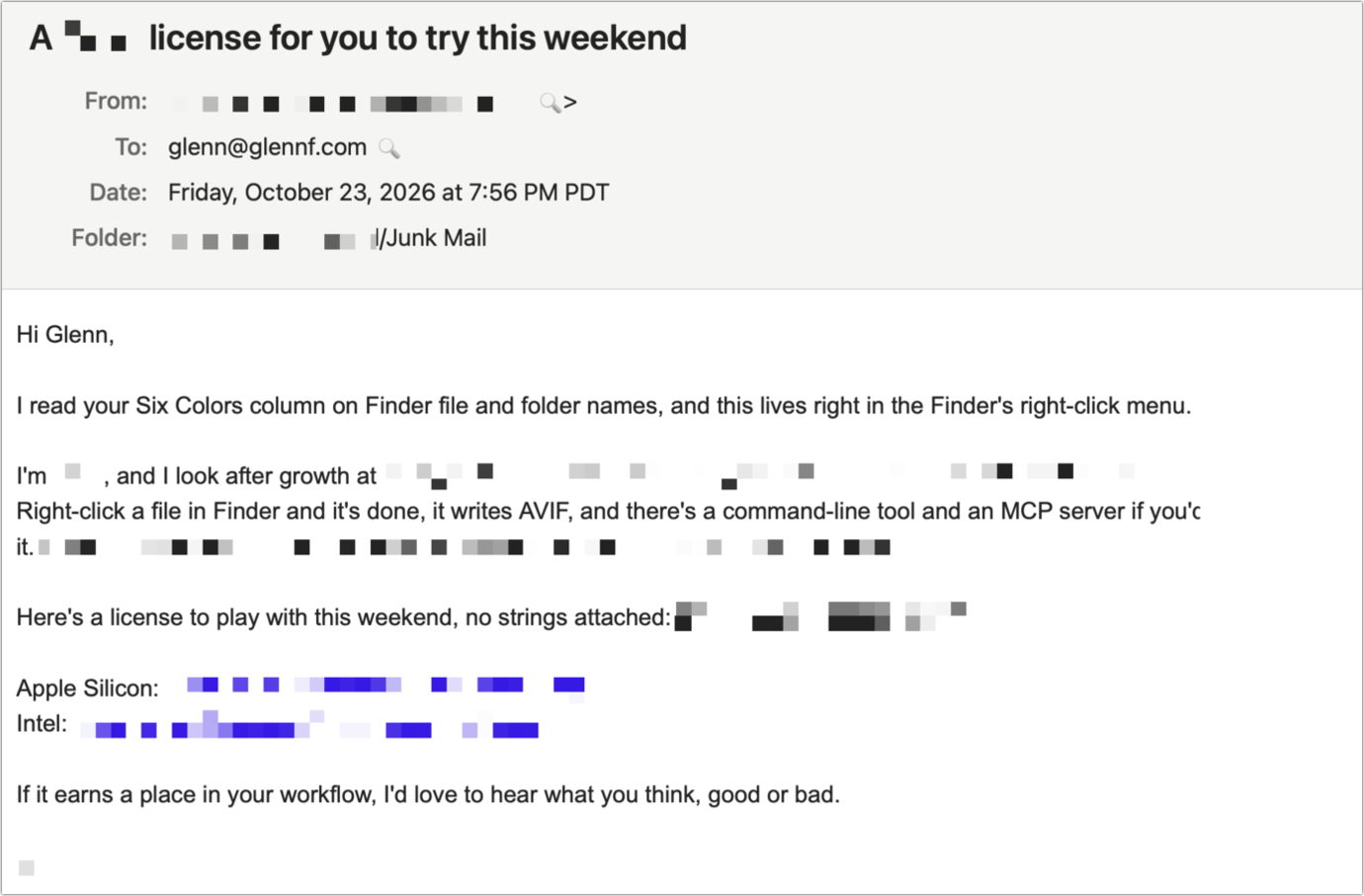
They’re often written in a friendly manner. They start with a reference or two to something I’ve written, then describe how the developer had an itch to scratch that solved a problem mentioned in my column. (Or not—the emails aren’t always on target.) So they wrote TextEdit Genius (a fake name), which dramatically expands the capabilities of TextEdit. Or a Notes exporter. Or an app that lets you frame photos. Or whatever.
Don’t get me wrong. As a long-time tech writer, I love emails from developers.1 However, these particular messages are obviously, or not so obviously, written by chatbots. Perhaps the prompt is, “Try not to sound like an LLM,” and then the developers further edit so they have at least a smidgeon of a voice. The apps they promote are almost certainly vibe coded, a term I loathe that describes using AI to write software or help write it. But not all of those apps are vibe coded—and that’s the problem.
If you’re a serious developer, whether writing all the code by hand or using agentic assistance, with the intent to support and mature your app for years to come, how do you get the word out? How can you become a BBEdit, PCalc, or A Better Finder Attributes? In our current environment, how do you create an app that pierces through the fog?
I sense a vibe change
Man, do I hate the term vibe coding. It’s used for everything from “Gemini, write me a Markdown editing app” to the process Lex Friedman uses. That’s a vast chasm. Read Lex’s entire essay, but the briefer version is: you can tell a coding agent to do something, but refining it, debugging it, and producing something worthwhile needs a foundation of previous experience with app development (or at the very least, thinking deeply about apps and user interactions) even if you’re writing almost zero code.
As someone who has programmed since I was 10, lo, those many decades ago, I don’t want to be an angry gatekeeper saying that you must have a coder’s mindset to make apps using LLMs. In fact, I believe exactly the opposite: LLMs democratize code-writing in a way that’s entirely different from their use for generative creative purposes of writing, drawing, and photo-realistic image-making.
Before I get too many angry responses:2
- Coding is a creative profession, but it works within incredible constraints. The creative part happens more in how our brains simulate compilers and interpreters to produce syntactically correct statements that add up to working software. LLMs can, provably, write code that works. They don’t need to invent the outcome, because it’s testable. (Chatbots can lie and write code that pretends to do things rather than actually do them, of course, making testing critical.)
-
Writing, drawing, and other arts, crafts, and livelihoods have a nearly infinite range of possible expression, limited by the human mind—and often hands or other body parts—to shape the outcome. Constraints are few, set only by the medium and our capabilities, honed over years or lifetimes. LLMs can simulate this, but the simulation works within a space well understood by humans, as we read and see pictures constantly. There’s little value to this sort of generation, except for limited forms of automation, and it’s often readily apparent in the uncanny valley of ick it produces.
My complaint about receiving so many emails about ostensibly vibe-coded apps (or emails that sound AI-written, which leads me to discount the quality of the apps described) isn’t that people are having the excitement of creating something they were previously incapable of. Despite my long coding background, I could never conquer Objective-C or Swift (any version). Programming is not my day job, and I’m not suited to writing code all day. I know because I have spent days to months over 33 years writing scripts for various websites, some of which ran entire parts of my business or other people’s.

I had the joy of producing Mister Plimsoll some months ago after a Six Colors reader asked about software that would monitor a drive filling up. I couldn’t find a tool that fit the purpose so, with Claude’s help, I wrote one. I wish vibe-coding an app were as easy as saying “do this task” and walking away. But I invested dozens of hours into Mister Plimsoll, debugging and refining it, and adding features based on user feedback. I now understand Swift much better than I ever did, even though I mostly reviewed code and made few changes. As my first Mac app, I made it free because it has a super-niche utility purpose, and I wanted to give back to the Mac ecosystem I’ve gotten so much out of. (I think tips so far amount to under $80.)
I didn’t send out emails about Mister Plimsoll, partly because it’s free, but also because I wanted natural discovery to lead people to it when they searched something like “notify me when my Mac drive is getting full app.” So far, Google hasn’t obliged.
The death of small devs?
If the backbone of Mac sales at one point was productivity and graphic-design apps, like the Microsoft and Adobe suites, the meaty flesh of the platform was and remains third-party developers, many of them companies with a single primary developer or a small team. Some apps developed in the ’90s and early 2000s continue to advance as active products decades later.
In that context, I don’t worry about vibe coding as such. Based on discussions in public and private, a significant percentage of app developers use agentic AI, whether to build testing suites or stress test their software, write small pieces of code, run their build process for the App Store, or endless other tasks. Vibe coding isn’t radioactive to programmers, and will likely only become even further integrated into workflows.
Rather, my concern is whether vibe coding creates a flood of apps that overwhelms the ecosystem’s ability to absorb new, good ones. By some measures, it already has. Some vibe-coded apps are or will be great, but the sheer volume of mediocre, unsafe, or buggy ones is the issue.

From my comics history background, I would use the analogy of Charles Schulz, the creator of Peanuts. Schulz penciled and inked every line of every strip for 50 years, and every letter, too. But when it came to applying tints, which had to be cut from an adhesive sheet of tiny dots and carefully laid onto the art, Schulz had an assistant do it. Ditto for the Sunday colors we remember from Peanuts; he set guidelines and had an assistant mark up a copy of the black-ink drawings that were sent to the syndicate to execute through the color production process. While he approved the colors, he let her pick them.3
To continue that analogy, hundreds of thousands of people draw cartoons. Some are read by a few people; others by millions daily. Of those hundreds of thousands, most seek a larger audience and work like heck to find it. Generative artwork is still far too poor to make a good comic strip or panel, and I don’t know that it will ever truly get there, because it can mimic and repeat patterns, but not invent. A world where millions of LLM-generated cartoons flooded Reddit, Instagram, websites, and social media every day would cause many people to lose hope and give up.
I’d like fewer emails trying to convince me a quickly made app is worth looking at, and fewer AI-generated emails, since I almost always delete those after reading very little. But I fear there is no turning back, and developers who want to make a living, or part of one, from apps will struggle to break out of the sloppy pack.
- Some of my best friends are developers. Really! ↩
- This space is too small to address fully my ethical qualms about LLMs, which I wrestle with even as I use them in constrained ways. I don’t think the coding space is absolved of environmental costs or piracy allegations. However, it’s a different piece of the pie from generative writing and art as well as using chatbots for answers and research. ↩
- I have a couple of chapters in my book, How Comics Are Made, that include an interview with Schulz’s last assistant, Erin Samuels, who has ironically been working on digitized Peanuts since 2000 to remove dots and replace them with solid tints, and to add colors to the Sunday line art! ↩
[Glenn Fleishman is a printing and comics historian, Jeopardy champion, and serial Kickstarterer. His current books in preparation, which you can pre-order, are Flong Time, No See, and That One Matt Bors Comic. Other books include Six Centuries of Type & Printing and How Comics Are Made.]
If you appreciate articles like this one, support us by becoming a Six Colors subscriber. Subscribers get access to an exclusive podcast, members-only stories, and a special community.
