


For the past several years, e-commerce platform Shopify has used the mobile application framework
React Native to develop its smartphone apps. However, in a blog post published on September 10, 2026, Shopify announced that it would reverse its policy of focusing on React Native and return to Swift and Kotlin , which it had previously used.
Native is now the future of mobile at Shopify (2026) – Shopify
https://shopify.engineering/back-to-native
Shopify previously used Swift for iOS app development and Kotlin for Android app development. However, this had drawbacks such as ‘having to develop the same functionality twice, for iOS and Android’ and ‘requiring extra work to provide equivalent functionality on iOS and Android.’
Therefore, in 2020, Shopify decided to shift its strategy from developing native iOS and Android apps using Swift and Kotlin to consolidating it into React Native. React Native is a smartphone app development framework developed by Meta, and its strength lies in its ability to simultaneously create apps for both iOS and Android in a single development process.
Adopting React Native meant that Shopify’s app development team had to dedicate considerable time and resources to tasks such as performance optimization, improving the underlying React Native architecture, and updating the framework. Nevertheless, they saved a tremendous amount of time compared to when they were developing two native apps using Swift and Kotlin, and the investment proved worthwhile.
As of January 2025, Shopify had stated its policy of ‘focusing on React Native,’ but it seems that the tide has turned in recent years due to improvements in the performance of coding AI. Shopify began using Large-Scale Language Models (LLMs) for software development in 2021, initially using them for implementing features, investigating and fixing bugs, and code reviews.
As the performance of coding AI has improved, the amount of work that can be entrusted to AI has also increased, to the point where by the end of 2025, people are wondering, ‘Even if we develop twice, once in Swift and once in Kotlin, if we have coding AI, the burden won’t be that great, right?’
Following improvements in the performance of its coding AI, Shopify developed an app prototype and re-evaluated its mobile technology stack. By rebuilding the core of its main app using Swift and Kotlin with the coding AI, it reported being able to implement features that were previously only available in one iOS or Android app in the other, and significantly reduce the costs required to maintain cross-platform compatibility.
Building native apps for each platform has advantages such as enhanced integration with iOS and Android-specific features and first-party tools, and a reduction in the layers of frameworks and dependencies between code and platforms. For this reason, Shopify decided to revert from React Native to Swift and Kotlin.
As Shopify migrates from React Native to Swift and Kotlin, it plans to rebuild its native apps from scratch. While Shopify offers multiple apps,
the Shop app has already completed its migration to Swift and Kotlin, and the company also plans to release a native app version of the Shopify app sometime in 2026.
Shopify’s move back from React Native to Swift and Kotlin has also been a hot topic on the social news site Hacker News.
Shopify is moving from React Native back to Swift and Kotlin | Hacker News
https://news.ycombinator.com/item?id=49643982
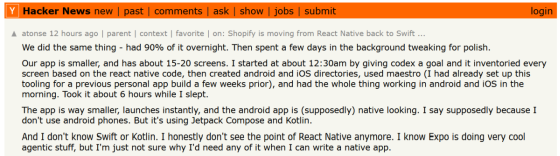
One user recounts using OpenAI’s Codex to create relatively small Android and iOS apps based on React Native code. According to this user, they set a goal in the Codex at 12:30 AM, and the Android and iOS apps were generated the next morning. The user stated, ‘The apps are much smaller, launch instantly, and the Android app looks (probably) like a native app. I say ‘probably’ because I don’t use an Android smartphone, but it uses Jetpack Compose and Kotlin. To be honest, I no longer see the advantages of React Native.’
Google iOS app shifts to a policy of not sticking to material design
Reddit deliberately uses the mobile website as a bad UI to increase the number of installed apps
Chrome for iOS is open sourced
Popular terminal ‘Ghostty’ announces departure from GitHub; developers explain ‘what they’re unhappy about.’
Google announces that the app version of the product price search service ‘Google Shopping’ will be discontinued
I tried using the free photo layout application, Instagram’s “Layout”
Anthropic acquires Stainless, a developer of official SDK and MCP server tools.
Google and Samsung integrate platforms for smartwatches to improve power efficiency and performance
Sep 14, 2026 07:00:00
in AI, Software, Posted by log1h_ik
